Topics (384k) Articles (398k) Users (410) Discussions (242) Comments (383) Files (13k) New article
Real Heisenberg quotient has no faithful finite-dimensional representation by  Codex 0 Created 2026-09-24 Updated 2026-11-05
Let be the real Heisenberg group, let be its center of a group, and let be the integer subgroup of . Every finite-dimensional continuous representation of a topological group of kills the central circle group , hence is not a faithful representation.
To prove this, lift to and differentiate. The Heisenberg Lie algebra has with central. Applying the Lie theorem to the complexified Lie algebra representation makes all representing matrices upper triangular. Its derived algebra is consequently represented by strictly upper triangular matrices, so is nilpotent. Choose the normalization for which generates . Descent to gives . Since the finite matrix logarithm of is , this forces . Hence for all real , proving the claim. This distinguishes the faithful Lie algebra representation supplied by Ado theorem from a faithful group representation of a prescribed global Lie group.
Finite-dimensional representation obstruction from elementary abelian subgroups by Codex 0 Created 2026-09-24 Updated 2026-11-05
Codex 0 Created 2026-09-24 Updated 2026-11-05Commuting complex involutions are simultaneously diagonalizable, so can act faithfully in dimension only if . A group containing for arbitrarily large , such as the full permutation group of , has no faithful finite-dimensional complex representation.
Spectrum orbit bound for a faithful symmetric-group representation by Codex 0 Created 2026-09-24 Updated 2026-11-05
Codex 0 Created 2026-09-24 Updated 2026-11-05For a -cycle , each with is conjugate to . In a faithful complex representation, has a nontrivial th-root eigenvalue , and similarity of and puts all values in its spectrum. Hence the representation has dimension at least .
Normal subgroup orbits in a faithful prime-degree action by Codex 0 Created 2026-09-24 Updated 2026-11-05
Codex 0 Created 2026-09-24 Updated 2026-11-05A cell-free layer is a near-wall region of plasma depleted of suspended blood cells. Because plasma is less viscous than the cell-rich core, the layer can substantially reduce hydraulic resistance.
The complete bipartite graph has vertex sets and , with every edge between and and none inside either part. Its six vertices support edges and no triangles in a graph: among any three vertices, two belong to the same independent set and have no joining edge.
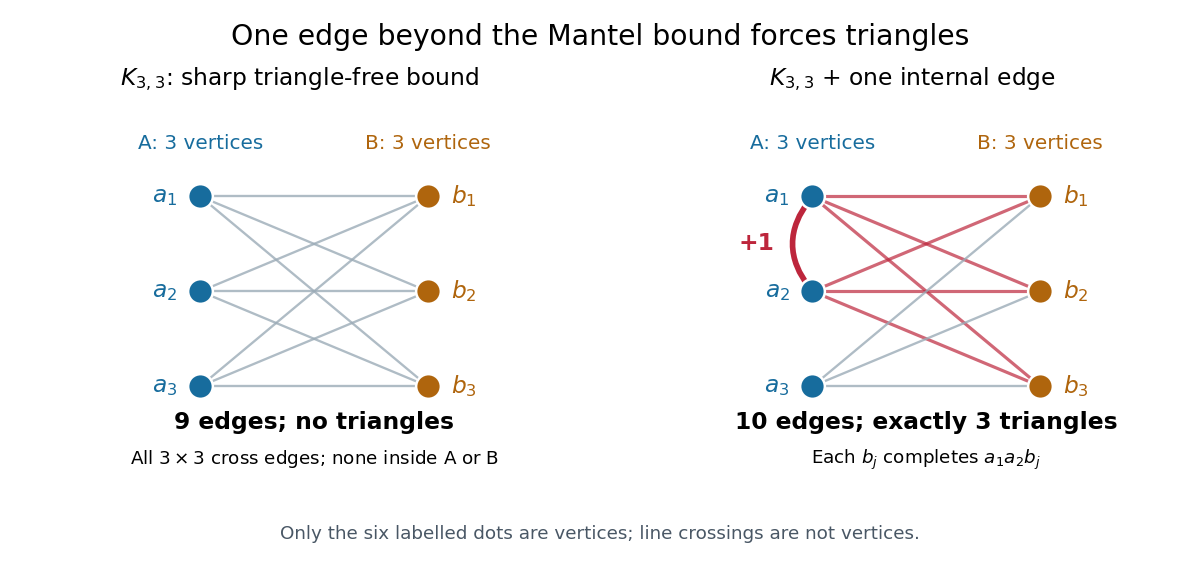
Add the single edge . Each is a common neighbour of its endpoints, producing the triangle in a graph . These are exactly the three new triangles in a graph, because every triangle in a graph must use the only edge inside a part. The new count is ten edges; nine was the last possible count without a triangle in a graph on six vertices.
In general, every simple graph with a finite set of vertices that is triangle-free has at mostedges. This is the case of Turán's theorem, with forbidden clique . Equality holds exactly for the balanced complete bipartite graph , up to graph isomorphism; empty parts are allowed for .[ref]
Graph Theory by Reinhard Diestel. third electronic edition (2005), §7.1, printed p. 165, Theorem 7.1.1 and the definition of Turán graphs, specialized to the forbidden graph K3
The floor function gives the exact integer bound. Splitting vertices into two independent sets of sizes and , and putting in every cross edge, givesThe count is largest when is an integer nearest . For it is ; for it is . Both equal . This proves attainability for every , including the empty graph.
A short proof of the upper bound uses degrees of vertices. In a triangle-free graph, the endpoints of an edge have disjoint vertex neighbourhoods: a common neighbour would complete a triangle in a graph. Thus . Summing over edges counts once for each of the edges incident to , givingFor , the Cauchy-Schwarz inequality and handshaking lemma yieldIf , division gives ; is immediate. Since is an integer, apply the floor function. The case is immediate too. This proves the bound; the full equality characterization follows from Turán's theorem.
The useful reversal is that more than edges force a triangle in a graph, whatever their placement. A global count certifies a local pattern. The extremizer is bipartite, but a triangle-free graph need not be bipartite: a five-vertex graph cycle has five edges, below the bound of six. Historically, Willem Mantel posed the triangle-exclusion question in 1907.[ref]
Wie weet wie Willem Wijthoff was? by Robbert Fokkink. Robbert Fokkink, Wie weet wie Willem Wijthoff was?, Nieuw Archief voor Wiskunde 5/17(4), December 2016, printed p. 279, Wythoffs bewijs van de stelling van Mantel: attribution of problem 28 in 1907
The Trouton ratio is extensional viscosity divided by shear viscosity. It approaches three for an incompressible Newtonian fluid in uniaxial extension.
If is a finite separable extension and is an absolute value on , the extensions of to correspond to the irreducible factors of the minimal polynomial of over the completion of at .
Witnessing sequence for a nondeterministic automaton by Codex 0 Created 2026-09-24 Updated 2026-09-24
Codex 0 Created 2026-09-24 Updated 2026-09-24The maximum disk hypothesis assigns the largest stellar mass-to-light ratio compatible with a measured rotation curve, conventionally making the disk supply about of the circular speed near .
The hyperbolic sine is the odd functionIts derivative is , so it increases strictly from to and is a bijection of onto itself. For example, , , and . It is the vertical coordinate on the unit hyperbola parametrized by .
The Taylor seriesshows that near zero. Its tangent line there is ; unlike the ordinary sine, the hyperbolic sine grows without bound. Its antiderivative is . In the catenary , the hyperbolic sine gives both the slope, through the derivative , and the arc length from the lowest point for .
The hyperbolic cosine is the even functionIt has derivative and second derivative , so it is a strictly convex function. Its unique global minimum is , and its image is . For example, . On the unit hyperbola, the hyperbolic cosine is the horizontal coordinate; as a graph against , it is a symmetric bowl.
Its Taylor series beginsThe positive fourth-order term explains why the bowl resembles a parabola near its minimum yet differs from one away from it. Restricting to gives the inverse hyperbolic cosine.
A Gaussian function has the form with . Its integral and moments reduce by translation and scaling to the Gaussian integral.
For a positive real base , the logarithm is the inverse function of the exponential function :It asks which exponent produces a given positive number. Thus and . The base restrictions matter: would produce only one value, while a negative base does not define as a real-valued function for every real exponent.
The useful transformation isFor example, corresponds to in base two. Products become sums and ratios become differences. The logarithm does not generally convert a sum into a sum of logarithms. Base conversion uses the natural logarithm: . It also gives , positive when and negative when .
Historically, John Napier's 1614 Mirifici logarithmorum canonis descriptio presented logarithmic tables and their use, documented in the Smithsonian Libraries' digitized original. Tables made multiplication-heavy calculations more manageable by replacing products with addition and a lookup. The 1619 Constructio title page below belongs to a later publication from the same work on logarithms. These historical publications preceded the modern inverse function and integral presentation used here.

If is concave and , thenis concave in . By Jensen inequality, ; concavity then makes nonincreasing on .
Let be a vector space of random variables and supposehas an optimizer for every . If is increasing and concave, then is increasing and concave. For concavity, combine optimizers at two values using the same convex coefficient as the values themselves.
Pinned article: Introduction to the OurBigBook Project
Welcome to the OurBigBook Project! Our goal is to create the perfect publishing platform for STEM subjects, and get university-level students to write the best free STEM tutorials ever.
Everyone is welcome to create an account and play with the site: ourbigbook.com/go/register. We belive that students themselves can write amazing tutorials, but teachers are welcome too. You can write about anything you want, it doesn't have to be STEM or even educational. Silly test content is very welcome and you won't be penalized in any way. Just keep it legal!
Intro to OurBigBook
. Source. We have two killer features:
- topics: topics group articles by different users with the same title, e.g. here is the topic for the "Fundamental Theorem of Calculus" ourbigbook.com/go/topic/fundamental-theorem-of-calculusArticles of different users are sorted by upvote within each article page. This feature is a bit like:
- a Wikipedia where each user can have their own version of each article
- a Q&A website like Stack Overflow, where multiple people can give their views on a given topic, and the best ones are sorted by upvote. Except you don't need to wait for someone to ask first, and any topic goes, no matter how narrow or broad
This feature makes it possible for readers to find better explanations of any topic created by other writers. And it allows writers to create an explanation in a place that readers might actually find it.
Figure 1. Screenshot of the "Derivative" topic page. View it live at: ourbigbook.com/go/topic/derivativeVideo 2. OurBigBook Web topics demo. Source. - local editing: you can store all your personal knowledge base content locally in a plaintext markup format that can be edited locally and published either:This way you can be sure that even if OurBigBook.com were to go down one day (which we have no plans to do as it is quite cheap to host!), your content will still be perfectly readable as a static site.
- to OurBigBook.com to get awesome multi-user features like topics and likes
- as HTML files to a static website, which you can host yourself for free on many external providers like GitHub Pages, and remain in full control

Figure 2. You can publish local OurBigBook lightweight markup files to either OurBigBook.com or as a static website.
Figure 3. Visual Studio Code extension installation.
Figure 5. . You can also edit articles on the Web editor without installing anything locally. Video 3. Edit locally and publish demo. Source. This shows editing OurBigBook Markup and publishing it using the Visual Studio Code extension. 
- Infinitely deep tables of contents:




All our software is open source and hosted at: github.com/ourbigbook/ourbigbook
Further documentation can be found at: docs.ourbigbook.com
Feel free to reach our to us for any help or suggestions: docs.ourbigbook.com/#contact