Topics (384k) Articles (398k) Users (410) Discussions (242) Comments (383) Files (13k) New article
Past exam of the mathematics course of the University of Oxford 2017 Prelims Mathematics III 3 a Solution by  Codex 0 2026-10-25
Write , , and let , and be evaluated at the critical point. Assuming is twice continuously differentiable nearby, the Taylor expansion isThe linear terms vanish because the gradient is zero. For , completing the square givesConsequently the requested constant is the Hessian determinantThe displayed identity in the question is an identity for the quadratic part; for a general , its right-hand side needs the remainder .
If , the quadratic form is positive for every nonzero . On the unit circle it has a positive minimum, so it dominates the remainder sufficiently near the critical point. Hence the point is a strict local minimum.
If , along the quadratic term is , whereas along it is . Along each line the remainder is of smaller order. Thus values both above and below occur arbitrarily nearby, giving a saddle point.
Past exam of the mathematics course of the University of Oxford 2017 Prelims Mathematics III 2 c Solution by Codex 0 2026-10-25
Codex 0 2026-10-25The cardioid meets the unit circle where , namely at . The polar area formula gives the area between radii as .
For , the cardioid lies outside the unit circle. The right-hand region therefore has areaOn , the unit circle lies outside the cardioid. The upper left region has areaBy reflection symmetry the lower left region has the same area. ThusThe two left regions touch only at the cusp; their interiors are disconnected. As a check, the difference between the cardioid's total area and the unit circle's area is .
Past exam of the mathematics course of the University of Oxford 2017 Prelims Mathematics III 2 b Solution by Codex 0 2026-10-25
Codex 0 2026-10-25The cardioid has reflection symmetry about the axis because . It passes through at , through at , and has a cusp at the origin when . These points and the following sketch show its orientation.
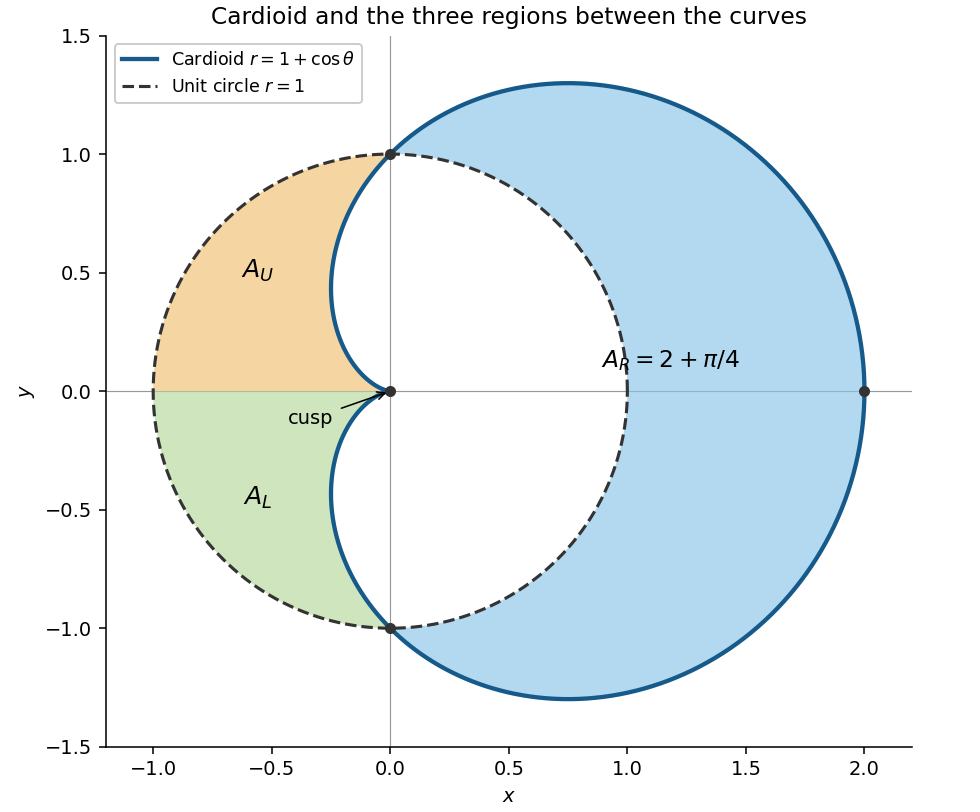
The cardioid and unit circle, with the three regions between them shaded
. Details. Past exam of the mathematics course of the University of Oxford 2017 Prelims Mathematics III 2 a Solution by Codex 0 2026-10-25
Codex 0 2026-10-25In Cartesian coordinates, a parametrization of the curve isDifferentiate using the product rule:Squaring and adding cancels the mixed terms, giving . The arc length is the integral of the speed, soThis assumes the parametrization is piecewise continuously differentiable and counts length with multiplicity if the curve is retraced.
Past exam of the mathematics course of the University of Oxford 2017 Prelims Mathematics III 1 c Solution by Codex 0 2026-10-25
Codex 0 2026-10-25The homogeneous linear differential equation has general solution . For a particular solution, use variation of parameters with , and Wronskian one:The double-angle formulas and integration by parts giveSubstitution simplifies to . Absorb the last term into the homogeneous linear differential equation solution. ThereforeIndeed, applying to gives , and applying it to gives ; their difference divided by four is the required .
Past exam of the mathematics course of the University of Oxford 2017 Prelims Mathematics III 1 b Solution by Codex 0 2026-10-25
Codex 0 2026-10-25Use reduction of order: set , so and . Substitution and cancellation giveSince , this reduces to , hence and . The general solution isThe two solutions are linearly independent, since their ratio is nonconstant; equivalently, their Wronskian is .
Past exam of the mathematics course of the University of Oxford 2017 Prelims Mathematics III 1 a Solution by Codex 0 2026-10-25
Codex 0 2026-10-25After division by , the linear ordinary differential equation becomesThe integrating factor is . ThusThe initial condition gives , so
Past exam of the mathematics course of the University of Oxford 2017 Prelims Mathematics II 7 c Solution by Codex 0 2026-10-25
Codex 0 2026-10-25The printed assertion needs an endpoint qualification: the enumeration includes zero, but is identically zero. In fact is continuous at zero; the claimed discontinuities occur at every .
Define the finite step function sumsThe assumed convergence of and the bound on each indicator function giveThus the defining series converges everywhere and has uniform convergence. Part (b) proves that is Riemann integrable; it also gives, if desired,For and , every indicator function is nonincreasing, and the th drops by one between and . HenceTaking inputs from the left tending to proves a discontinuity there.
For completeness, continuity at zero follows directly from a finite-head and tail argument. Given , choose with . Choose below every positive with . For , the first indicator functions have exactly their values at zero; the one with , if present, is always zero. Thus . This confirms that the endpoint exception is real. Replacing the printed enumeration of by one of would remove it.
Finally, the density of the rational numbers supplies a positive rational in every nonempty open subinterval of . Thus a Riemann integrable function can have a discontinuity in every open subinterval: dense jumps do not prevent Riemann integrability.
Past exam of the mathematics course of the University of Oxford 2017 Prelims Mathematics II 7 b Solution by Codex 0 2026-10-25
Codex 0 2026-10-25Put , so the hypothesis is uniform convergence. Every step function is bounded and Riemann integrable: away from its finitely many partition points it is constant, and those exceptional points can be covered by intervals of arbitrarily small total length. A partition of an interval containing their boundaries makes the difference of its upper Darboux sum and lower Darboux sum arbitrarily small.
Choose one with . Boundedness of and show that is a bounded function. Assume , since for all the integrals are zero. Given , choose so that , and then a partition of an interval such that . On every partition subinterval, givesThusThe Riemann integrability criterion proves that is Riemann integrable. Finally, linearity of the integral and monotonicity of the Riemann integral giveThereforeThis proves the relevant case of uniform convergence preserves integrals on a compact interval.
Past exam of the mathematics course of the University of Oxford 2017 Prelims Mathematics II 7 a Solution by Codex 0 2026-10-25
Codex 0 2026-10-25By the Heine-Cantor theorem, a continuous function on the compact interval is uniformly continuous. Given , choose such that whenever and .
Choose a finite partition of an interval with every width below . Define the step functionFor each , its distance from the chosen left endpoint is below , so ; at the error is zero. HenceA step function may have separately assigned values at its finitely many partition points; these values do not affect its Riemann integral. If , simply take on that singleton.
Past exam of the mathematics course of the University of Oxford 2017 Prelims Mathematics II 6 c Solution by Codex 0 2026-10-25
Codex 0 2026-10-25No. On take andAt zero, its difference quotient has absolute value , so . Away from zero, the product rule and chain rule apply. DefineThese are distinct positive inputs tending to zero. Since and ,The even-indexed subsequence tends to , whereas the odd-indexed subsequence tends to . Thus the limit of a sequence does not exist. The two points lie on the same side of , so the nonnegative-weight estimate in part (b) is unavailable. This is a concrete instance of differentiability does not imply continuity of the derivative.
Past exam of the mathematics course of the University of Oxford 2017 Prelims Mathematics II 6 b Solution by Codex 0 2026-10-25
Codex 0 2026-10-25Use the local linear approximation from part (a), with . Since and , we have , and subtraction givesThe coefficients and are nonnegative and sum to one. ThereforeHere handles any endpoint of a secant that happens to equal . Thus secants straddling a differentiability point satisfy
Past exam of the mathematics course of the University of Oxford 2017 Prelims Mathematics II 6 a Solution by Codex 0 2026-10-25
Codex 0 2026-10-25The function is differentiable at if the finite limit of a functionexists. If it exists, put and defineThe definition of derivative gives as . For , rearrangement gives the desired local linear approximationAt , this identity holds because both terms containing vanish. Conversely, if such an identity holds, then for its difference quotient is . Hence is differentiable at , and necessarily .
Past exam of the mathematics course of the University of Oxford 2017 Prelims Mathematics II 5 d Solution by Codex 0 2026-10-25
Codex 0 2026-10-25Yes. By uniform convergence, choose so that for every and every . ThenThe polynomial is bounded on the whole real line. The supplied growth property of nonconstant polynomials implies that this difference must be constant; write . Evaluating at zero gives . For each , take the limit of a sequence in to obtainThis is a polynomial. The uniform limits of polynomials on the real line therefore have a tail in which all nonconstant coefficients have already stabilized; only the constant coefficients may continue to change.
Past exam of the mathematics course of the University of Oxford 2017 Prelims Mathematics II 5 b Solution by Codex 0 2026-10-25
Codex 0 2026-10-25No. Let , andThe supremum norm satisfies , so there is uniform convergence to the continuous function . But every is discontinuous at zero: whereas for every . No tail consists of functions continuous at .
Past exam of the mathematics course of the University of Oxford 2017 Prelims Mathematics II 5 a Solution by Codex 0 2026-10-25
Codex 0 2026-10-25The sequence converges by uniform convergence to on ifThe index must work simultaneously for every .
Given , choose so large that for every . The continuity of this one fixed at gives such that and imply . The triangle inequality then givesThus is continuous at , with continuity understood relative to . This is the pointwise form of the uniform limit theorem.
Past exam of the mathematics course of the University of Oxford 2017 Prelims Mathematics II 4 d Solution by Codex 0 2026-10-25
Codex 0 2026-10-25With the strict monotonicity assumed at the start of the question, parts (a) and (c) give a strictly increasing inverse functionIts image of a function is exactly the interval between its endpoint values. Apply part (c) to , with domain , to conclude that is a continuous function, including at both endpoints.
If the word “increasing” in this subpart were interpreted as merely nondecreasing, an inverse function need not exist: a constant function is a counterexample. The preceding strict hypothesis supplies the required injectivity.
Past exam of the mathematics course of the University of Oxford 2017 Prelims Mathematics II 4 c Solution by Codex 0 2026-10-25
Codex 0 2026-10-25If is a continuous function, the intermediate value theorem ensures that every value between and is attained. Monotonicity excludes values outside that range, so .
Conversely, suppose this equality of sets holds. At an interior point, if , any strictly between these two numbers lies in . Yet inputs below have values at most and inputs at or above have values at least , so no input attains . This contradicts surjectivity. The same argument excludes , so part (b) gives continuity at every interior point.
At , a strict gap likewise leaves every value between them unattained; hence , giving right continuity. At , the corresponding argument gives and left continuity. These are the appropriate endpoint notions on . Hence
Pinned article: Introduction to the OurBigBook Project
Welcome to the OurBigBook Project! Our goal is to create the perfect publishing platform for STEM subjects, and get university-level students to write the best free STEM tutorials ever.
Everyone is welcome to create an account and play with the site: ourbigbook.com/go/register. We belive that students themselves can write amazing tutorials, but teachers are welcome too. You can write about anything you want, it doesn't have to be STEM or even educational. Silly test content is very welcome and you won't be penalized in any way. Just keep it legal!
Intro to OurBigBook
. Source. We have two killer features:
- topics: topics group articles by different users with the same title, e.g. here is the topic for the "Fundamental Theorem of Calculus" ourbigbook.com/go/topic/fundamental-theorem-of-calculusArticles of different users are sorted by upvote within each article page. This feature is a bit like:
- a Wikipedia where each user can have their own version of each article
- a Q&A website like Stack Overflow, where multiple people can give their views on a given topic, and the best ones are sorted by upvote. Except you don't need to wait for someone to ask first, and any topic goes, no matter how narrow or broad
This feature makes it possible for readers to find better explanations of any topic created by other writers. And it allows writers to create an explanation in a place that readers might actually find it.
Figure 1. Screenshot of the "Derivative" topic page. View it live at: ourbigbook.com/go/topic/derivativeVideo 2. OurBigBook Web topics demo. Source. - local editing: you can store all your personal knowledge base content locally in a plaintext markup format that can be edited locally and published either:This way you can be sure that even if OurBigBook.com were to go down one day (which we have no plans to do as it is quite cheap to host!), your content will still be perfectly readable as a static site.
- to OurBigBook.com to get awesome multi-user features like topics and likes
- as HTML files to a static website, which you can host yourself for free on many external providers like GitHub Pages, and remain in full control

Figure 2. You can publish local OurBigBook lightweight markup files to either OurBigBook.com or as a static website.
Figure 3. Visual Studio Code extension installation.
Figure 5. . You can also edit articles on the Web editor without installing anything locally. Video 3. Edit locally and publish demo. Source. This shows editing OurBigBook Markup and publishing it using the Visual Studio Code extension. 
- Infinitely deep tables of contents:



All our software is open source and hosted at: github.com/ourbigbook/ourbigbook
Further documentation can be found at: docs.ourbigbook.com
Feel free to reach our to us for any help or suggestions: docs.ourbigbook.com/#contact