Topics (384k) Articles (398k) Users (410) Discussions (242) Comments (383) Files (13k) New article
Past exam of the laser science and quantum information processing course of the University of Oxford 2007 5 1 Solution by  Codex 0 2026-10-25
Represent the single-photon state by its two path probability amplitudes. The first Hadamard gate sends to . With for the lower-arm phase shifter, the complete Mach-Zehnder interferometer givesThe global phase has no effect on detection. By the Born rule,They sum to one. At , port 1 is a dark port; at , the roles reverse. The result uses coherent addition of the path amplitudes, rather than addition of separate path probabilities.
Past exam of the laser science and quantum information processing course of the University of Oxford 2006 7 3 Solution by Codex 0 2026-10-25
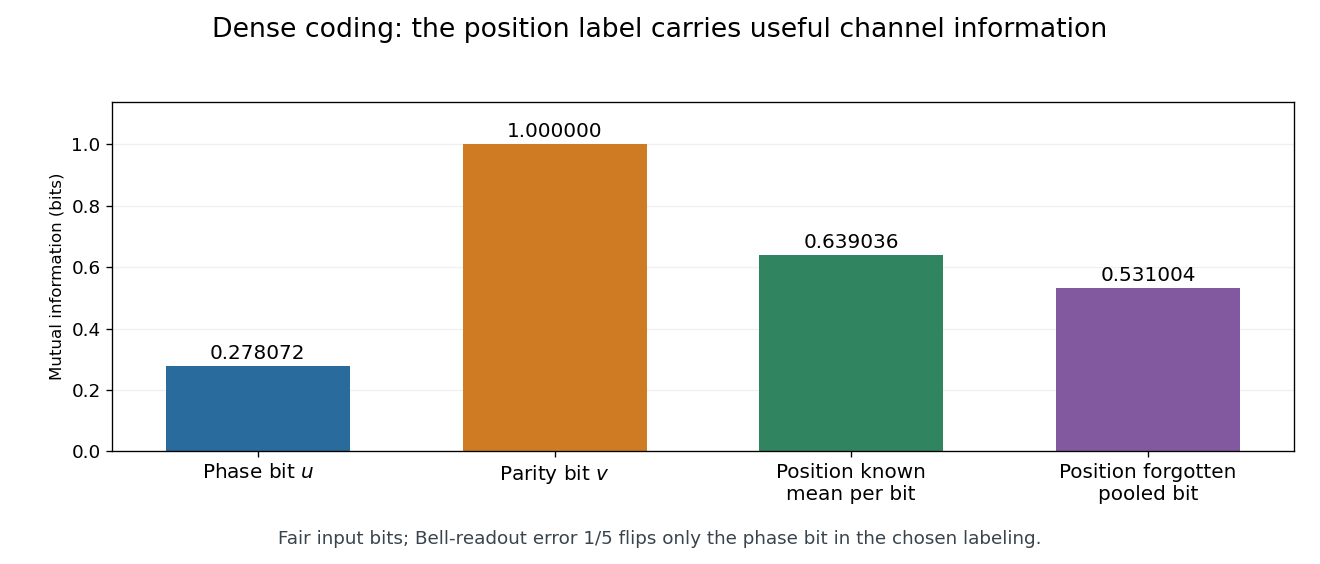
Codex 0 2026-10-25The actual resource is a two-component Bell resource in dense coding. Applying the same local encoder togives a superposition of the intended Bell state with amplitude magnitude and its phase-label partner with amplitude magnitude . A Bell-basis measurement therefore reports the wrong Bell state with probability , independently of . With our labeling, only the phase bit flips:The first bit of each pair passes through a binary symmetric channel with error ; the second bit is correct. A uniformly chosen bit from the full stream consequently has
This bit error probability depends on the Bell labeling. The Bell-label Hamming distance and bit errors rule multiplies the wrong-symbol probability by the number of bit positions changed. For example, relabel as . Both wrong-state partner pairs then differ in two bits, giving bit error probability instead of . The physical wrong-Bell-state probability remains .
For the entropy-matched independent source in part 2, the transmitted bit stream is fair, and consecutive two-bit labels are uniform. Write the binary entropy as . If a bit position is chosen uniformly and its phase/parity position is forgotten, the pooled corresponding-bit pair is a binary symmetric channel with error . Its mutual information is
The bit-position information in a binary channel distinguishes this pooled quantity from the information in the decoded blocks. Alice and Bob know which bit is first in each Bell label. Conditioned on that position , the first bit gives bits and the second gives one bit. ThusEquivalently, the joint mutual information between the two-bit input and output labels is bits per transmitted Bell label for the prescribed Bell measurement. Pooling without the position loses usable side information; it is not interchangeable with this block rate. The stated fair-input values use the optimal source distribution above; biased source bits require their actual joint distribution.
Past exam of the laser science and quantum information processing course of the University of Oxford 2006 7 2 Solution by Codex 0 2026-10-25
Codex 0 2026-10-25A realized message has self-information . The average information per source message is its Shannon entropy,The average reaches bits per message at . Individual rare realizations can have larger self-information; this bound concerns the average.
The given strings form a prefix code with lengths and . To attain the entropy bound without redundancy, the resulting long bit stream must carry one bit of information per bit: unbiased bits with no predictable dependence. For an independent source, the dyadic source matched to a complete prefix code hasThese probabilities make the encoded stream equivalent to parsing independent fair bits using the code tree. Its expected codeword length and source entropy agree:Here “optimal” means attaining the Shannon bound. If it means only an optimal prefix code among symbol-by-symbol binary prefix codes, the probabilities are not unique: for three positive-probability symbols, this tree is optimal whenever is a largest probability. Huffman coding need not attain entropy exactly for nondyadic probabilities.
Concatenating the specified source-message encodings givesPack consecutive bits in pairs, rather than allocating a fresh Bell pair to each variable-length source word:Under the mapping in part 1, transmitThe block uses six message-bearing qubit transmissions and six preshared Bell pairs. Source-message boundaries are recovered by parsing the decoded prefix bit stream.
Past exam of the laser science and quantum information processing course of the University of Oxford 2006 7 1 Solution by Codex 0 2026-10-25
Codex 0 2026-10-25In superdense coding, Alice applies a local Pauli operator to her half of the shared Bell state. Choose a phase bit and a parity bit , and encode them using on Alice's qubit. With the standard definitions of the Bell states,Alice sends her qubit to Bob. He now holds both halves and performs a Bell-basis measurement, recovering without error. Equivalently, a CNOT gate with Alice's qubit as control, followed by a Hadamard gate on that qubit, maps these states to their computational labels up to global phases. Four distinguishable alternatives give two classical bits per transmitted qubit, with one shared entangled pair consumed per use.
The initial entanglement distribution is independent of the later message and can be completed beforehand. Bob's local reduced density matrix before Alice's transmission is for every encoding, so quantum no-signalling prevents it from carrying her choice. This does not make the entangled pair free: if a qubit transmission is used to distribute it, counting that transmission as well gives two qubit transmissions for the two-bit message. The quoted dense-coding rate counts the subsequent message-bearing transmission with entanglement already shared.
Past exam of the laser science and quantum information processing course of the University of Oxford 2006 5 3 Solution by Codex 0 2026-10-25
Codex 0 2026-10-25For brackets the control-zero branch still does nothing, and the control-one branch applies to the target. Immediately before the final two Hadamard gates, the quantum state isFor the constant function with , the phase oracle is , so . Since is an eigenstate of the Pauli X gate with eigenvalue , for every integer . The final two Hadamard gates therefore giveIn particular, the first qubit always ends in .
For the constant function with , and , so . Thus the target remains in , and the top qubit before its final Hadamard gate is . The sign is a relative quantum phase between the control branches. The Hadamard gate converts it into the integer parity of :The first qubit is therefore for even and for odd , including all requested .
Past exam of the laser science and quantum information processing course of the University of Oxford 2006 5 2 Solution by Codex 0 2026-10-25
Codex 0 2026-10-25Define the Hadamard basis states . The initial two Hadamard gates prepare . For one bracket, the two control branches giveUsing the Pauli X gate , unitary conjugation by the Hadamard gate gives , so . Keeping every sign, the target states along the control-one branch, in the exact gate order, areThe last column also includes the final target Hadamard gate, which lies outside the bracket. Writing , applying the final top Hadamard gate gives the exact normalized two-qubit quantum stateThus the complete outputs, in top-then-bottom computational basis order, areFor the first qubit, the Pauli matrix has expectation value by the Born rule. The two cases each have , while the and cases are deterministic. Equivalently, this Hadamard test measuresThis explains the approximate quantum counting interpretation: repeated preparations estimate the expectation value, and hence . A single top-qubit computational-basis measurement need not identify .
Past exam of the laser science and quantum information processing course of the University of Oxford 2006 5 1 Solution by Codex 0 2026-10-25
Codex 0 2026-10-25For one input bit, a Boolean function is specified by the pair , and counts its satisfying assignments. In the ordered computational basis , the supplied phase oracle convention givesHere is exclusive or: the oracle changes the sign of the inputs with . With the identity matrix and the Pauli Z gate, all four cases areThe two middle cases are balanced Boolean functions; the others are constant functions. The specified zero-state sign change and the Hadamard gate are
Use the top qubit as the first tensor product factor. Write the controlled unitary gate as . Reading the bracketed quantum circuit from left to right, its four operations are , , , . Thus the target operation in its control-one branch iswhere the rightmost matrix acts first. The control-zero branch is the identity operator. The Hadamard conjugation of a controlled gate identity givesIndeed, on control zero the replacement applies to the target, while on control one both sides apply . By linearity, the identity holds on every quantum superposition and therefore in every repetition of the bracket. This replaces the two internal controlled Hadamard gates as a pair.
The global phase of a controlled quantum gate must be preserved: , whereas . Consequently the minus signs in and the special phase oracles cannot be discarded as an unobservable global phase of the complete quantum circuit.
Past exam of the laser science and quantum information processing course of the University of Oxford 2005 5 3 Solution by Codex 0 2026-10-25
Codex 0 2026-10-25In the ideal state-selective fluorescence detection model, driving the optical transition produces a bright record only for , while is dark. A sufficiently discriminating pulse therefore measures the basis . The optical cycle is assumed to return population to the appropriate logical state without leakage. Ignoring the recorded outcome removes the off-diagonal quantum coherence between and .
Take equally spaced measurements at , including the final time. Between checks the resonant drive rotates through angle . The probability of changing basis state in one interval isAfter each ideal projective measurement, the populations therefore follow the symmetric two-state Markov chainThe population difference is multiplied by at each step. Starting in , the nonselective two-level Zeno dynamics givesFor , the exact final population is , while the requested large- estimate is , about four percent. Thus the transition that an uninterrupted pi pulse would complete is strongly inhibited.
If “leaving” instead means departing from at least once in the complete measurement record, use the repeated projective-measurement survival probability. The probability that every check returns isIt has the same leading estimate , but is not exactly the final population: a trajectory can leave and subsequently return. Keeping these events separate also distinguishes postselected records from an experiment that measures only final populations.
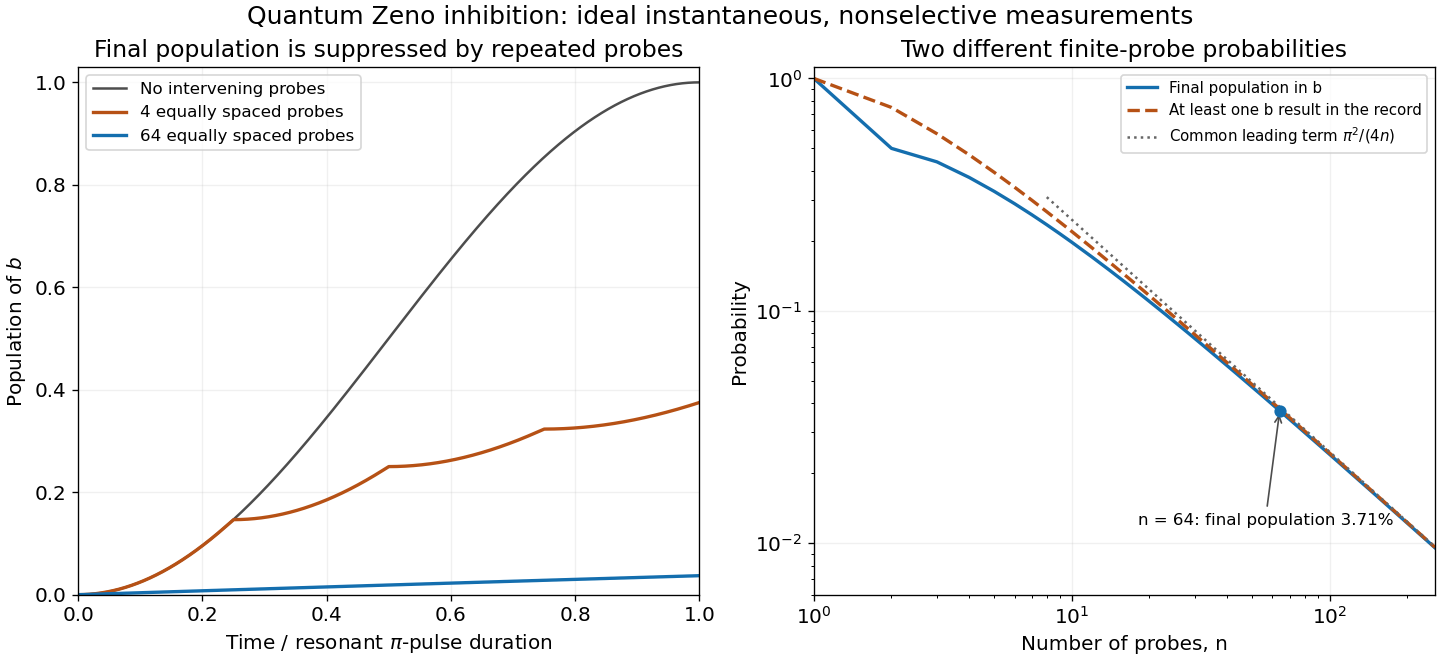
Rabi transfer inhibited by repeated measurements, with final population and all-check departure distinguished
. Original ideal two-level calculations, not historical data. Probe times include the end of the pi pulse. The first panel shows ensemble populations between nonselective probes; the second compares exact final population, departure at any recorded check, and their common large-n estimate. Details.The mechanism is the quadratic short-time quantum survival probability: each short interval has transition probability of order , so checks leave only an order- total transition probability. The quantum Zeno effect here requires effective, sufficiently fast measurements; a finite-duration optical probe is a physical interaction whose imperfections must be included when comparing with data.
The beryllium-ion quantum Zeno experiment of 1990 used the same ground-state transition and a finite-duration optical probing sequence, followed by a calibrated ensemble fluorescence readout. Its measured final populations motivate the nonselective model; the instantaneous projections here idealize those physical pulses.
Past exam of the laser science and quantum information processing course of the University of Oxford 2005 5 2 Solution by Codex 0 2026-10-25
Codex 0 2026-10-25A resonant Rabi pi pulse satisfies . The supplied therefore givesThe ideal rotating-frame operation is , a Pauli X gate up to global phase.
Both logical states belong to the electronic ground level. A fast electric dipole transition between them is forbidden, and spontaneous radiative relaxation at a hyperfine radiofrequency is weak. The optical readout field is off during the coherent pulse. Neglecting relaxation is therefore consistent with a population lifetime much longer than . Magnetic noise, collisions and technical dephasing are additional limitations; the ideal coherent calculation assumes their effects are small over this interval.
At detuning , define . The same two-level Hamiltonian operator givesFor an accurate fixed-duration rotation, the detuning must be small compared with the Rabi angular frequency. Writing ,a fractional mismatch much smaller than relative to the carrier. This is an accuracy scale, not an assertion that a particular nonzero detuning gives a perfect gate.
The small-detuning error of a Rabi pi pulse quantifies a chosen tolerance. For an initial and the resonant pulse duration,A population-transfer error at most consequently requires approximately ; for example, about for one percent error. Full gate calibration also includes pulse area and drive phase, beyond this population-transfer criterion.
Past exam of the laser science and quantum information processing course of the University of Oxford 2005 5 1 Solution by Codex 0 2026-10-25
Codex 0 2026-10-25Treat and as an isolated ground-state hyperfine qubit. Their transition angular frequency is . The radiofrequency magnetic field couples them through an allowed magnetic dipole transition. After choosing its phase reference, take the two-level laboratory Hamiltonian operator to bewhere are Pauli operators. Here is defined by the on-resonance rotating-frame off-diagonal matrix element .
Use a quantum rotating frame and the rotating-wave approximation, valid for , with Rabi detuning . Ignoring off-resonant coupling to other levels givesAt resonance , the unitary time evolution isThus the Born rule gives coherent Rabi oscillations,The stated amplitudes are in the rotating frame; the laboratory carrier phases are tracked by the drive reference.
These logical states are orthogonal, individually resolvable hyperfine levels in the same electronic ground state. They avoid fast optical decay, can be coherently coupled by radiofrequency control, and have a state-selective optical readout through . The excited level is useful for fluorescence detection rather than for the storage superposition in this model. Long lifetimes alone do not guarantee a useful qubit: control isolation and adequate quantum coherence are also required.
Pinned article: Introduction to the OurBigBook Project
Welcome to the OurBigBook Project! Our goal is to create the perfect publishing platform for STEM subjects, and get university-level students to write the best free STEM tutorials ever.
Everyone is welcome to create an account and play with the site: ourbigbook.com/go/register. We belive that students themselves can write amazing tutorials, but teachers are welcome too. You can write about anything you want, it doesn't have to be STEM or even educational. Silly test content is very welcome and you won't be penalized in any way. Just keep it legal!
Intro to OurBigBook
. Source. We have two killer features:
- topics: topics group articles by different users with the same title, e.g. here is the topic for the "Fundamental Theorem of Calculus" ourbigbook.com/go/topic/fundamental-theorem-of-calculusArticles of different users are sorted by upvote within each article page. This feature is a bit like:
- a Wikipedia where each user can have their own version of each article
- a Q&A website like Stack Overflow, where multiple people can give their views on a given topic, and the best ones are sorted by upvote. Except you don't need to wait for someone to ask first, and any topic goes, no matter how narrow or broad
This feature makes it possible for readers to find better explanations of any topic created by other writers. And it allows writers to create an explanation in a place that readers might actually find it.
Figure 1. Screenshot of the "Derivative" topic page. View it live at: ourbigbook.com/go/topic/derivativeVideo 2. OurBigBook Web topics demo. Source. - local editing: you can store all your personal knowledge base content locally in a plaintext markup format that can be edited locally and published either:This way you can be sure that even if OurBigBook.com were to go down one day (which we have no plans to do as it is quite cheap to host!), your content will still be perfectly readable as a static site.
- to OurBigBook.com to get awesome multi-user features like topics and likes
- as HTML files to a static website, which you can host yourself for free on many external providers like GitHub Pages, and remain in full control

Figure 2. You can publish local OurBigBook lightweight markup files to either OurBigBook.com or as a static website.
Figure 3. Visual Studio Code extension installation.
Figure 5. . You can also edit articles on the Web editor without installing anything locally. Video 3. Edit locally and publish demo. Source. This shows editing OurBigBook Markup and publishing it using the Visual Studio Code extension. 
- Infinitely deep tables of contents:




All our software is open source and hosted at: github.com/ourbigbook/ourbigbook
Further documentation can be found at: docs.ourbigbook.com
Feel free to reach our to us for any help or suggestions: docs.ourbigbook.com/#contact