Topics (384k) Articles (398k) Users (410) Discussions (242) Comments (383) Files (13k) New article
Past exam of the laser science and quantum information processing course of the University of Oxford 2010 8 2 Solution by  Codex 0 2026-10-25
Use the two-pair component of polarization-entangled down-conversion to account for identical bosons in the same collected modes. Write for a creation operator in mode with horizontal polarization, and similarly for the other modes. For the plus Bell state, the pair-creation operator is . The normalized four-photon state isThese are normalized Fock states. In particular, ; omitting this factor would misnormalize the four-photon input.
The first polarizing beam splitter sends to and to . Only the middle term can give exactly one trigger photon and leave another photon in . In the first term both photons reach and none reaches ; in the last there is no trigger. Thus the relevant, still unnormalized component is
For the selected paths of the half-wave plate and beam splitter, takeHere labels the output towards . An immaterial common reflection phase has been absorbed in the mode definitions. Keeping one photon at leavesAt the final polarizing beam splitter, the alternative yields one at each of , while yields one at each. The two opposite-polarization alternatives send both photons to the same detector and fail fourfold coincidence counting. The accepted component is thereforeAfter conditioning and normalization, the three detected output modes haveThe optical mode matching must erase any timing, frequency or other record that distinguishes the two alternatives. Otherwise the same polarization populations could describe an incoherent mixed quantum state, rather than this quantum superposition. The Bouwmeester three-photon GHZ experiment uses this principle. The photonic GHZ preparation by fourfold coincidence is a measurement in the coincidence basis: detecting all four photons projects and consumes them. A click at by itself does not herald a guaranteed freely available three-photon state.
Past exam of the laser science and quantum information processing course of the University of Oxford 2010 8 1 Solution by Codex 0 2026-10-25
Codex 0 2026-10-25The beta barium borate crystal supplies spontaneous parametric down-conversion: a weak ultraviolet pump can produce a pair of lower-frequency photons, with their frequencies and wavevectors selected by conservation of energy and phase matching. A suitably aligned and compensated source makes the two polarization alternatives coherent, giving the stated Bell state. The crystal alone does not guarantee that every collected pair has that state.
The two polarizing beam splitters route horizontal polarization and vertical polarization to different ports. Take from arm to the trigger and to arm . The ordinary beam splitter in arm is a lossless, polarization-independent 50:50 splitter, with the unused input in the vacuum state. It splits probability amplitudes, rather than measuring which output a photon takes. The half-wave plate changes the relative phase of its principal polarizations by ; orient it so that a photon in becomes in , up to a common phase. Finally, photodetectors absorb arriving photons and supply electrical clicks. They need not resolve photon number for the ideal four-photon, fourfold-coincidence calculation: a click at every detector already requires one photon at each.
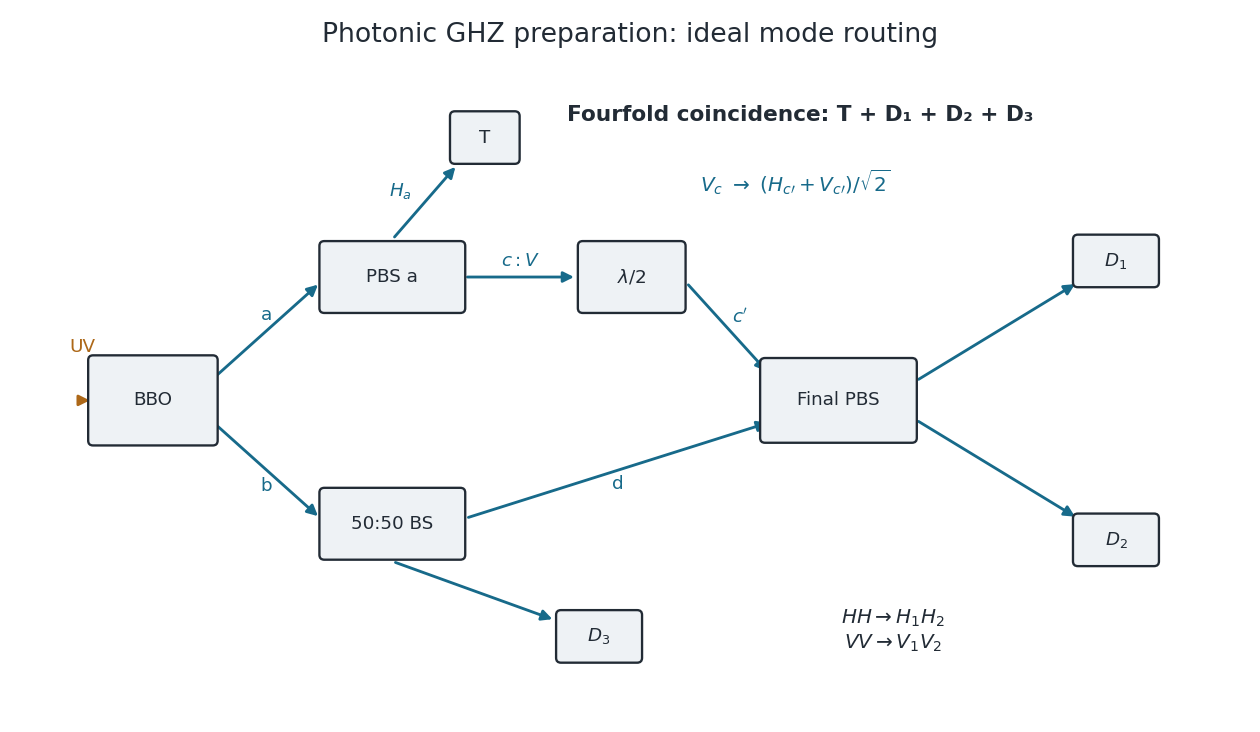
Original mode diagram for photonic GHZ preparation by fourfold coincidence
. The paths and polarization conventions used in the calculation. PBS denotes a polarizing beam splitter; BS is a polarization-independent 50:50 beam splitter. A trigger click alone does not guarantee the required one-photon occupation of all three other outputs. Details.Choose the relative wave phases so that the final polarizing beam splitter sends to , to , to and to . Such phase conventions must be used consistently: an uncompensated relative phase would give a phase-shifted GHZ state.
Past exam of the laser science and quantum information processing course of the University of Oxford 2010 6 3 Solution by Codex 0 2026-10-25
Codex 0 2026-10-25The required identity is CNOT control reversal in the Hadamard basis. To derive it using standard quantum circuit identities, let be the Controlled-Z gate, which multiplies by and fixes the other computational-basis states. Since ,The Controlled-Z gate is symmetric in its two wires. Combining this symmetry with givesThis is an exact operator identity, including its global phase, and applies to arbitrary inputs. One can also check it directly from the orthogonal projectors : conjugating by gives
For the three-wire quantum circuit, put . Conjugation distributes over products because : . Each CNOT gate in therefore reverses direction, while the Hadamard gates on untouched wires cancel. The Hadamard-conjugated linear oracle isThese are the simplified quantum circuits in the figure: for there are no gates; for there is ; for there is ; and for there are both. The ancilla qubit becomes their common control. On every computational-basis state, the entire simplified circuit acts asStarting the data qubits at , the prescribed computational basis preparation of the ancilla qubit must therefore be : it activates the required flips and gives . Starting it at instead gives for every , so no information is obtained.
More generally, an initial ancilla qubit state in this same fixed quantum circuit givesFor nonzero , the desired data output has probability , and exact identification for every requires . This condition refers to the displayed ancilla preparation for the Bernstein-Vazirani algorithm: the state entering the function oracle must be , up to global phase. Other quantum state preparation procedures that deliver this same state are equivalent; is the prescribed input before the first Hadamard gate.
For arbitrary , linearity of the linear Boolean function suppliesThis decomposition is for analysis: the Bernstein-Vazirani algorithm calls the unknown function oracle as one supplied operation. The common control starts at , so the simplified quantum circuit takes to . Equivalently, phase kickback gives a product statewhich the final Hadamard transform decodes to . Thus one quantum oracle call suffices for every , compared with classical calls. This counts function oracle uses; the surrounding Hadamard gates and final computational-basis measurement still act on and qubits, respectively.
Past exam of the laser science and quantum information processing course of the University of Oxford 2010 6 2 Solution by Codex 0 2026-10-25
Codex 0 2026-10-25Use the Hadamard basis states . The Hadamard gate satisfies , , and . After the first three Hadamard gates, the full quantum state isThe Pauli X gate obeys . Consequently the Boolean quantum oracle produces phase kickback:Factoring out the ancilla qubit, the four states immediately after the function oracle areThe final Hadamard gates send to and to . In particular, the printed quantum circuit includes a final Hadamard gate on the ancilla qubit too. Its full outputs, ordered as , areThus one oracle call identifies with certainty: a computational-basis measurement of the first two qubits returns . The ancilla qubit returns to and carries no additional information about . The Bernstein-Vazirani algorithm turns the pattern of relative quantum phases into a definite computational-basis state.
Past exam of the laser science and quantum information processing course of the University of Oxford 2010 6 1 Solution by Codex 0 2026-10-25
Codex 0 2026-10-25Write and , with the top wire carrying , the middle wire , and the bottom wire the ancilla bit . The binary inner product is , where is exclusive or. Let denote a CNOT gate controlled by wire and targeting . The four linear Boolean functions and their Boolean quantum oracles are:
| Reversible circuit for | : three unchanged wires |
|---|
The CNOT gates in the last row commute: their common target acquires the exclusive or of the two controls. Each input wire is preserved, and applying any of these reversible circuits twice restores .
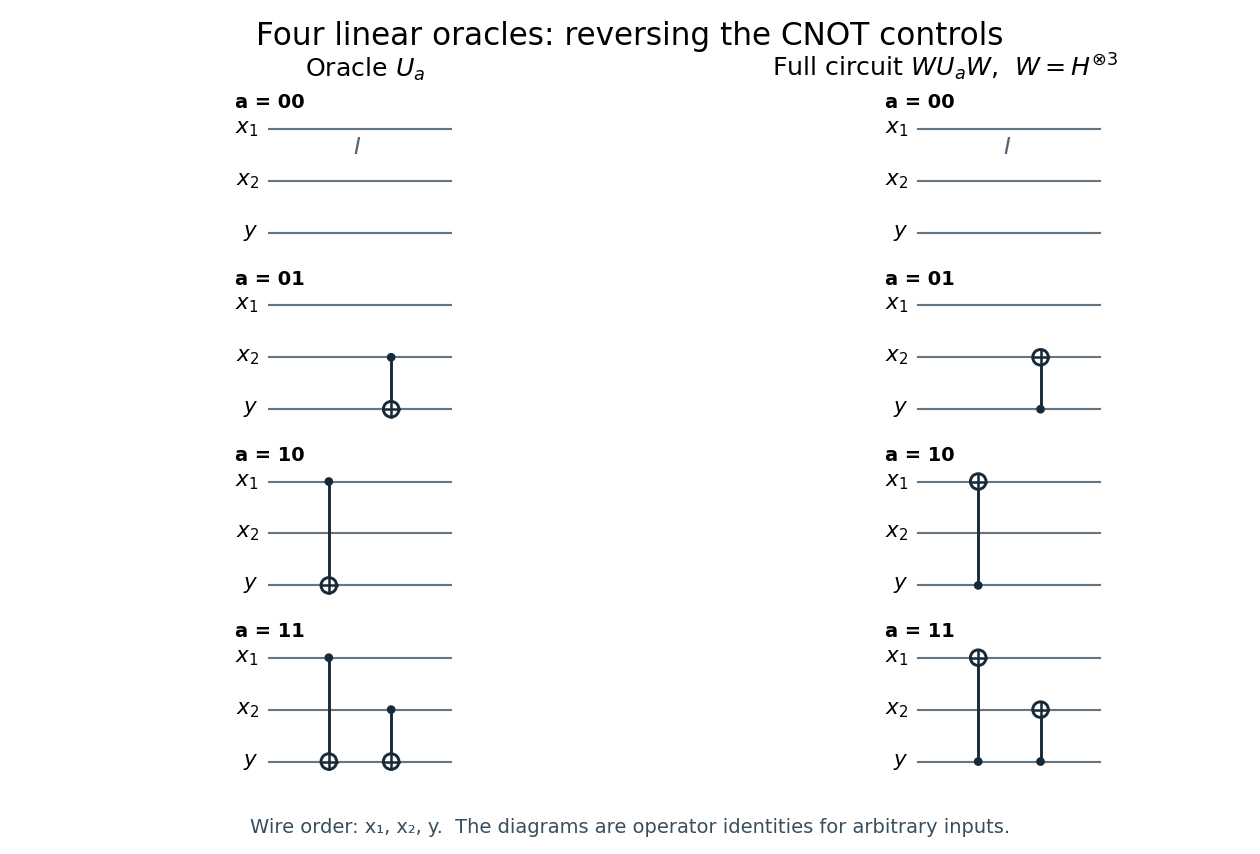
The four two-bit linear oracles and their exact simplifications after Hadamard gates on all three wires; a filled dot is a control and a circled plus is a target
. Details. For classical reversible computation, call the unknown function oracle on and . The resulting ancilla bits are respectively and :Use a fresh zero ancilla bit for each call, or preserve the first result in workspace before restoring the target to zero. Thus two classical calls determine the two-bit string.
For input bits, query the standard basis strings , since . This gives an upper bound of calls. It is also optimal for exact identification: every classical query reveals at most one new bit, since is unchanged and reveals just when is known. A depth- decision tree has at most answer histories, but must distinguish possible hidden strings. Hence , including adaptive strategies. The classical query complexity of linear Boolean function identification is therefore
Past exam of the laser science and quantum information processing course of the University of Oxford 2009 8 3 Solution by Codex 0 2026-10-25
Codex 0 2026-10-25Eve's computational-basis intercept-resend attack applies a projective measurement of to Bob's photon and discards her outcome from Alice and Bob's description. Their resulting density matrix isThis separable state keeps but removes . HenceUsing the same signed Bell-test statistic givesThe ideal value is halved, and the attack no longer violates the CHSH inequality.
The key data show why several settings matter. For , Eve's measurement leaves perfect anticorrelation, so this subset has zero bit errors after Bob flips his assignment. For , , so correct anticorrelation has probability : its quantum bit error rate is . If both key-setting pairs occur equally often, their combined raw-key error rate is . The Bell-test change detects this attack even though the vertical/horizontal key subset alone would not.
Past exam of the laser science and quantum information processing course of the University of Oxford 2009 8 2 Solution by Codex 0 2026-10-25
Codex 0 2026-10-25Use an Ekert protocol. Alice and Bob choose their analyzer settings independently and randomly for each received pair, record the outcomes, and confirm reception before announcing settings over an authenticated public classical channel. The authentication prevents an adversary from impersonating either party; it does not conceal the setting announcements. Announcing settings after reception also avoids the premature basis announcement in quantum key distribution attack.
The polarization correlations of the Psi-plus Bell state satisfyIndeed, , , and the cross terms vanish. In the specified setting order,
For key sifting, retain the setting pairs and . Their outcomes are perfectly anticorrelated. Alice assigns bit to outcome and bit to outcome ; Bob uses the opposite assignment. Their raw keys then agree. With uniform independent choices of the three settings, these pairs supply a raw-key fraction , before sacrificing a test sample. They must keep the remaining raw-key outcomes secret. The four pairs supply Bell-test data, and the other three setting pairs can be discarded.
Reveal the outcomes of those Bell-test rounds and estimateThe ideal entries give . The CHSH inequality gives for local hidden-variable theories: for predetermined outcomes , the signed combination is . One bracket is zero and the other is , so averaging cannot exceed two in magnitude. The Tsirelson bound limits quantum correlations to .
For the specified, trusted Pauli operators, the maximal CHSH witness for a fixed Bell state makes the ideal security statement precise. Its operator isIts largest eigenvalue has the unique eigenvector . Exact attainment therefore fixes the shared density matrix to this pure state. Since purity decouples a subsystem from its purification, Eve cannot hold information correlated with that pair. This rules out information-gaining eavesdropping in the ideal model, rather than proving that no observer exists. More generally, CHSH self-testing identifies the entangled qubit pair up to local changes of representation under its own assumptions.
A quantum measurement that reads Eve's chosen polarization generally disturbs correlations in an incompatible basis. The no-cloning theorem also prevents copying arbitrary unknown photon polarizations and retaining a perfect copy while forwarding an unchanged original. The Bell test checks several incompatible settings, so observing perfect correlation in only one key basis is insufficient.
Alice and Bob also reveal a randomly chosen sample of their raw keys to estimate the quantum bit error rate, then discard that sample. Information reconciliation corrects discrepancies, and privacy amplification removes residual information, including leakage from the public transcript. With finite data they need statistical bounds and a security analysis appropriate to their devices and noise. A measured violation alone does not assert zero information for Eve; the exact ideal argument above uses the maximal value.[ref]
Quantum cryptography based on Bell's theorem by Artur K. Ekert. Original 1991 proposal connecting Bell-correlation tests to quantum key distribution
Past exam of the laser science and quantum information processing course of the University of Oxford 2009 8 1 Solution by Codex 0 2026-10-25
Codex 0 2026-10-25Normalize the supplied Bell state as , with and . For a measurement of linear photon polarization, the two orthogonal analyzer states can be taken asAssigning outcomes gives the observablewhere are the Pauli operators. The angle of the Bloch vector is twice the physical analyzer angle. HenceEach has eigenvalues and square equal to the identity operator.
Past exam of the laser science and quantum information processing course of the University of Oxford 2008 8 3 Solution by Codex 0 2026-10-25
Codex 0 2026-10-25Use the ordered computational basis , with qubit 1 written first. The half-time gate requires a branch convention. Even stationary Hamiltonian evolution with does not uniquely specify : different accumulated eigenstate phases can agree at and differ at . In particular, both and below square to SWAP gate and leave unchanged. Adopt the conventional continuous isotropic exchange interaction branch, with a relative singlet phase increasing from to during the full pulse. This is the exchange square-root branch convention.
The symmetric and antisymmetric eigenstateshave SWAP gate eigenvalues . Let and be their antisymmetric and symmetric orthogonal projectors. The adopted exchange evolution isFor effective spin-one-half qubits, , an isotropic exchange interaction plus an energy offset that fixes the common phase. At half time choose on the symmetric sector and on the antisymmetric sector, the conventional principal square-root value of . Hence the square root of the SWAP gate isThus , , and , where and . The identities and verify , and the projector form proves unitarity. The endpoint truth table alone would allow other matrix square roots; the stated exchange branch supplies the additional physical assumption.
For the network, fix the Pauli Z gate, Hadamard gate and S gate conventionsThe letter distinguishes this local S gate from the two-qubit exchange gate . In particular ; replacing by changes the network. Subscripts specify the acted-on qubit: , and . Operators act rightmost first, so the printed quantum circuit is
First multiply the central two exchange pulses. Since , their off-diagonal terms cancel:This reduces the entire network to . Its action on all four computational basis states, retaining every relative quantum phase, isEquivalently,It flips the second qubit when the first is zero and contributes when the first is one. That conditional phase cannot be discarded as a global phase.
To obtain the standard CNOT gate controlled by qubit 1, append an gate to qubit 2 and to qubit 1. They commute, andFor control zero, undoes the original flip. For control one, it supplies the desired flip and cancels the phase because . This phase-corrected exchange network for a CNOT gate realizes the standard gate exactly with the declared conventions.
Finally, has equal Schmidt coefficients and is maximally entangled: a half exchange creates quantum entanglement although a full SWAP gate does not. More constructively, the network above produces a CNOT gate from two half exchanges and local gates. Since CNOT gates and arbitrary single-qubit unitary operators form a universal quantum gate set, the square root of the SWAP gate and arbitrary single-qubit gates are universal. The alternative inverse exchange branch remains entangling and universal, but its phases and local correction must be recomputed consistently.
Past exam of the laser science and quantum information processing course of the University of Oxford 2008 8 2 Solution by Codex 0 2026-10-25
Codex 0 2026-10-25Let and be normalized qubit states. By linearity, the SWAP gate givesThe output remains a product state. Single-qubit unitary operators also preserve product states, so an induction over any quantum circuit made from these operations shows that it cannot create quantum entanglement from a product state. Equivalently, moves every exchange through the local operations, leaving only local gates and a permutation of wires. This is the product-state obstruction to SWAP universality.
Consequently SWAP gates and arbitrary single-qubit gates do not form a universal quantum gate set. For example, they cannot map to the Bell state , whereas a Hadamard gate followed by a CNOT gate does so.
Past exam of the laser science and quantum information processing course of the University of Oxford 2008 8 1 Solution by Codex 0 2026-10-25
Codex 0 2026-10-25A good atomic qubit needs two reproducible, orthogonal internal states whose populations and relative quantum phase survive for many gate times. Both should be long lived, with weak spontaneous emission and little decoherence from fluctuating fields or atomic motion. Their transition must nevertheless permit fast, selective, coherent control with little leakage to other states. Reliable initialization and state-selective quantum measurement are also required; optical pumping and fluorescence readout can supply these functions.
For rubidium-87, use the two ground state hyperfine levels in the electronic configuration. The electronic angular momentum is , and addition of angular momentum to the given nuclear spin gives . A suitable Rubidium-87 clock qubit isThese are coupled electron-nucleus angular momentum eigenstates, rather than two bare nuclear-spin projections. Their hyperfine structure supplies a resolvable splitting . Both belong to the electronic ground state, avoiding a short optical excited-state lifetime. Since the weak-field Zeeman shift is proportional to , both have zero linear shift at : their rubidium-87 clock transition suppresses first-order magnetic-field dephasing near zero field. A quadratic Zeeman shift of a clock transition and differential optical shifts remain. A small stable bias field can define the quantization axis and help resolve unwanted transitions, at the cost of some residual magnetic sensitivity.[ref]
Drive the magnetic dipole transition with a resonant microwave field of suitable polarization, here , or use two phase-coherent optical fields for a far-detuned stimulated Raman transition with their frequency difference resonant with . The optical excited state is then only virtually populated, reducing spontaneous emission. In the rotating frame and rotating-wave approximation, define the drive phase by the effective HamiltonianHere are the Pauli matrices on the chosen qubit, and is the Rabi angular frequency. Pulse duration controls the rotation gate angle, while phase selects the axis in the equatorial plane of the Bloch sphere. A pulse exchanges the populations; a pulse makes an equal quantum superposition from either basis state. Controlled Rabi detuning, a differential energy shift, or compositions of these pulses give rotations. For example, realizes any one-qubit unitary operator up to a global phase. Thus the atomic encoding admits arbitrary single-qubit quantum gates.
Past exam of the laser science and quantum information processing course of the University of Oxford 2008 6 3 Solution by Codex 0 2026-10-25
Codex 0 2026-10-25Quantum error correction encodes a logical qubit redundantly, obtains an error syndrome without measuring its unknown logical amplitudes, and applies a recovery that reverses the specified errors. A decoherence-free subspace instead uses a symmetry of a specified noise model: each noise operator acts as a scalar on the entire encoded space, so no syndrome-dependent recovery is required. This is passive protection and can also be viewed as a special case of quantum error correction.
For the two-spin decoherence-free encoding, chooseSimultaneous Pauli Z gates givesoBoth logical components acquire the same global phase; their relative phase and amplitudes survive. The density matrix is exactly unchanged, so even an unknown random choice between applying and causes no logical dephasing.
More strongly, the encoding protects against arbitrary collective dephasing:because both basis states have total eigenvalue zero. At , , consistent with the previous overall phase. The protection relies on correlated noise: independent rotations generally change the logical relative phase, and this two-spin code does not protect a whole logical qubit against arbitrary collective rotations about all three axes or against arbitrary single-spin errors.
Past exam of the laser science and quantum information processing course of the University of Oxford 2008 6 2 Solution by Codex 0 2026-10-25
Codex 0 2026-10-25Set . Define the quantum rotating frame byThe isotropic Heisenberg model coupling commutes with the total spin angular momentum, so . The transformed Hamiltonian operator is thereforeHere removal of the common Zeeman energy is exact; the exchange is resonant and cannot be discarded using the weak coupling condition for two NMR spins.
Put , , and . Exponentiating the parallel-spin entries and the middle matrix gives the time-evolution operatorFor example, at this equals the SWAP gate times , which checks both the exchange angle and the overall phase.
The printed network reads from left to right as , a Pauli Z gate on the upper spin only, , and another upper-spin Pauli Z gate. LetIts total time-evolution operator, with the first operation on the right, is . For this Heisenberg exchange echo,The three paired Pauli operators , , commute pairwise: for example both products and equal . Thus commutes with , andThe spin echo cancels the exchange terms and retains the Ising coupling. Equivalently, over the total free-evolution time it produces the effective Hamiltonian operator exactly for ideal instantaneous gates. It is generally not the identity. A physical rotation about is ; using two such pulses instead of the ideal gates changes only by a physically irrelevant global phase of minus one.
The implementation requires frequency-selective spin control. Under the usual common-radio frequency NMR assumptions, equal resonance frequencies give no way to apply a pulse to the first spin while leaving the second untouched. For equally coupled spins in a spatially uniform control field, the transverse control Hamiltonian operator has the formBoth this control and the drift Hamiltonian operator commute with the SWAP gate . Every reachable time-evolution operator consequently commutes with . But : the individual pulse required by the diagram fails this symmetry test. This is the exchange symmetry obstruction to individual spin control. Applying simultaneous gates gives , which commutes with and instead yields ; it does not refocus the exchange. A common change of the RF phase reference also supplies only a collective rotation.
This obstruction assumes the usual common-RF control with no extra handle distinguishing the spins. Equal resonance frequencies do not universally forbid individual addressing: a spatially selective field, unequal control couplings, or another symmetry-breaking interaction could alter controllability. Such resources are absent from the specified equivalent-spin NMR model.
Past exam of the laser science and quantum information processing course of the University of Oxford 2008 6 1 Solution by Codex 0 2026-10-25
Codex 0 2026-10-25Use the ordered computational basis , with and . Write for the Pauli matrices, for the identity operator, , , and . As in the question, the Hamiltonian operators have angular frequency units, so the time-evolution operator is . The Heisenberg coupling matrix for two spins isConsequently the full Heisenberg model Hamiltonian operator and its proposed Ising coupling approximation are
For nondegenerate perturbation theory, choose as the unperturbed Hamiltonian operator andas the perturbation. Only and are coupled, and their unperturbed energy levels differ by . All first-order energy corrections vanish. The first-order eigenvectors and second-order energy corrections areThe states are exact eigenvectors throughout. Hence the weak coupling condition for two NMR spins isA large common Zeeman energy alone does not ensure this condition. Crossings involving the uncoupled parallel-spin states do not invalidate the argument: the relevant denominator is the separation of the two states connected by .
As an exact check, the middle matrix has eigenvaluesFor , labeling by the limiting computational basis states reproduces the shifts above. The quantum transition probability from to isThus unwanted exchange has a uniformly small amplitude when . If accumulated phases must also be approximated over a duration , neglecting the second-order shifts additionally requires , or those shifts must be retained in an improved effective Hamiltonian operator.
The same result is the secular approximation for scalar-coupled spins. In the interaction picture of the Zeeman energy terms,These terms average rapidly on the coupling timescale when , while survives.
For fixed nuclei and electronic environments, the individual NMR angular frequencies scale with the static magnetic field : schematically , where includes the gyromagnetic ratio and magnetic shielding. The NMR scalar coupling in angular frequency units is approximately independent of . Therefore a nonzero separation increases with magnetic field, improving the approximation. In particular, a fixed difference of chemical shifts gives a larger separation in hertz at higher magnetic field. If the two resonances remain exactly equal, increasing their common frequency does not suppress their exchange.
Past exam of the laser science and quantum information processing course of the University of Oxford 2008 5 4 Solution by Codex 0 2026-10-25
Codex 0 2026-10-25The Bloch vectors of and areThey share the same component and differ along . The equal-prior discrimination of qubit states therefore selects the axis: it maximizes the separation of their projected outcome probabilities. This also explains why the measurement in part 3 is uninformative.
For and , the Bloch vectors are and . Their difference points along . Hence Carl W. Helstrom's Helstrom measurement for the zero and plus states measuresGuess after and after . An explicit orthonormal basis for these projectors isThe positive measurement axis is tilted by from towards on the Bloch sphere; the corresponding state-vector rotation angle is .
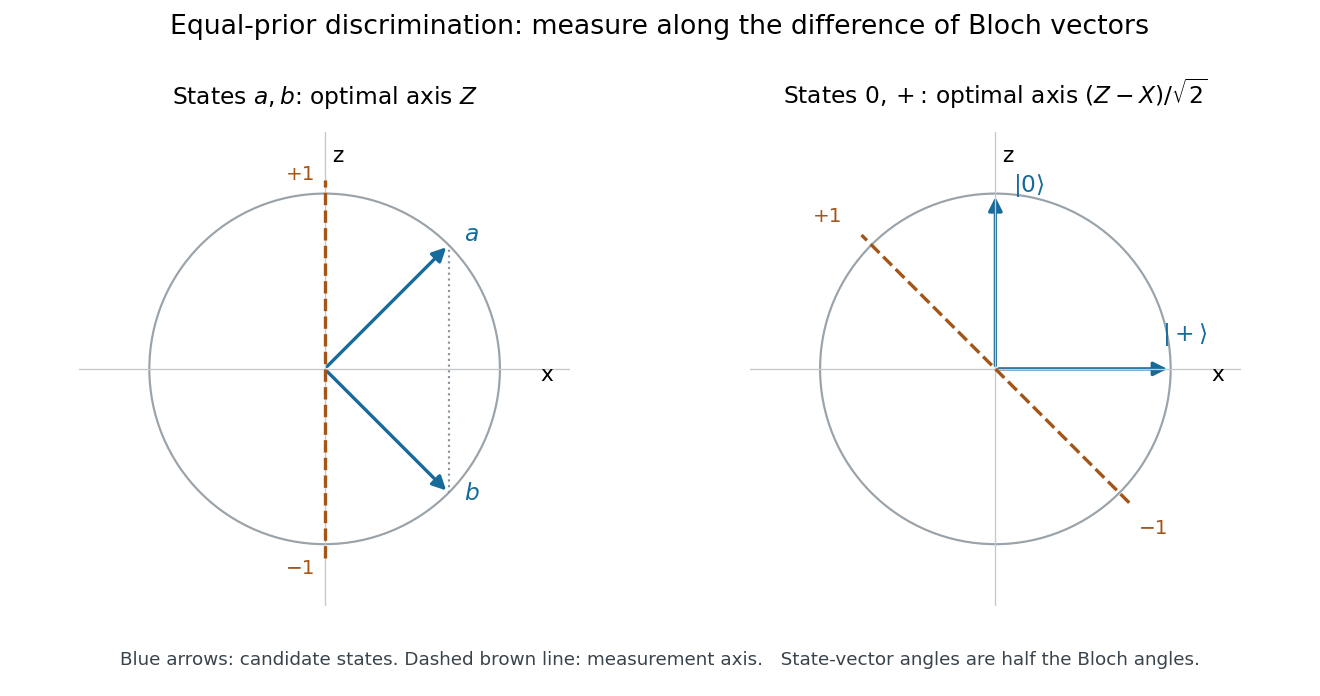
Bloch-sphere cross-sections for the two equal-prior discrimination problems
. Solid arrows are the candidate-state Bloch vectors. Dashed lines show the optimal measurement axes. The first pair has identical projections; the second is separated most strongly along . Details.For completeness, if a projective measurement guesses along a unit Bloch axis , its average success is . The Cauchy-Schwarz inequality bounds , with equality at the axis above. The Holevo–Helstrom theorem shows this optimum also holds among general POVMs. Thus
Past exam of the laser science and quantum information processing course of the University of Oxford 2008 5 3 Solution by Codex 0 2026-10-25
Codex 0 2026-10-25Put and . In the computational basis, input has outcome probabilities , while has . The marginal outcomes are equally likely; the Bayesian posterior probabilities areGuess after zero and after one. Each guess is correct with probability and wrong with probability . Neither outcome is certain evidence for one input.
For a real state , the Born rule in the Hadamard basis gives . Both angles and have . Thus both preparations give and . By Bayes' theorem, either outcome leaves the two input hypotheses equally likely. The biased outcome frequencies carry no information about which state was prepared; the best success probability with this measurement is .
Past exam of the laser science and quantum information processing course of the University of Oxford 2008 5 2 Solution by Codex 0 2026-10-25
Codex 0 2026-10-25The overlap is nonzero, whereas perfect discrimination of pure states requires orthogonality. Consequently no single-copy quantum measurement can identify both preparations with certainty. After a nondegenerate projective measurement, the loss of preparation information after a nondegenerate projective measurement prevents further measurements from recovering the missing label: conditional on the first outcome, the post-measurement state is the same for every compatible initial hypothesis. Repeating the same basis gives that outcome again; changing basis probes the collapsed state. Fresh, independently prepared copies would be additional resources.
In the computational basis, input always gives zero and remains . Input gives zero or one with probability , leaving the corresponding basis state. Combining these likelihoods with equal prior probabilities, the Bayesian update after a projective measurement givesFor example, Bayes' theorem gives . Outcome one certifies input ; outcome zero is ambiguous. Both inputs that give outcome zero leave exactly the same post-measurement state .
In the Hadamard basis, input always gives , while input gives or equally. ThereforeOutcome minus certifies input ; outcome plus is ambiguous. Guessing the more likely input after the ambiguous outcome gives success probability for either of these two fixed-basis measurements.
Past exam of the laser science and quantum information processing course of the University of Oxford 2008 5 1 Solution by Codex 0 2026-10-25
Codex 0 2026-10-25For a normalized pure state, expand in an orthonormal basis of eigenvectors of the measured Hermitian operator. The Born rule assigns outcome the probability . Under the ideal projective measurement update, a nondegenerate outcome leaves , up to a global phase. The sum of the outcome probabilities is one, and the expectation value is ; a single trial reports one eigenvalue, not that average.
If , thensince . A nonzero eigenvector has positive squared norm, so is real. For two eigenvectors,Thus : distinct eigenvalues have orthogonal eigenvectors.
Past exam of the laser science and quantum information processing course of the University of Oxford 2007 5 3 Solution by Codex 0 2026-10-25
Codex 0 2026-10-25Calibrate the two-Hadamard Mach-Zehnder interferometer so that the passive box leaves no relative wave phase or path disturbance. Then , and port 1 is dark. A photon at port 1 is therefore impossible for the passive box under these assumptions.
For an active ideal detector in arm 1, the first Hadamard gate prepares . Absorption, which triggers the detector, has probability . On a no-absorption outcome, the surviving unnormalized state is . Applying the second Hadamard givesIts squared norm is , the survival probability; normalizing it earlier and forgetting that probability would overcount successful trials. The unconditional outcomes for an active detector areThus a port-1 click identifies an active detector without triggering it, with single-pass success probability , conditional on testing an active device. A port-0 click is inconclusive. Among trials in which the photon survives, half are successful, but that conditional fraction is not the single-pass success probability.
This is the balanced Hadamard interaction-free measurement version of the Elitzur-Vaidman bomb tester. Conditioning on no absorption changes the quantum coherence available for recombination; a calibrated dark-port click reveals that change. An uncontrolled phase shift in the passive arm could also brighten the port, so the inference depends on the stated optical calibration. It does not assign an observed classical trajectory to the photon before detection. If the same active device is retested after inconclusive clicks, the repeated weak-rotation bomb-test efficiency gives eventual success ; the requested single pass remains .
Past exam of the laser science and quantum information processing course of the University of Oxford 2007 5 2 Solution by Codex 0 2026-10-25
Codex 0 2026-10-25Write and , using the Pauli operators. The Hadamard gate obeys , so unitary conjugation of the matrix exponential gives . Therefore the symmetric z-x-z beam splitter factorization isThe rightmost operator acts first. Each factor is unitary, which also proves the given matrix is unitary. Choosinggives , so it is exactly a Hadamard gate up to global phase.
For the specified identical splitters with , put and . Here , and direct multiplication givesThus the upper-port probability iswith . These identical beam splitters in a two-path interferometer give a nonconstant interference fringe whenever . With this matrix and port convention, two identical balanced splitters swap the bright and dark ports relative to the two-Hadamard model: at , . The reflection phases must remain in the calculation.
The upper-port maximum and minimum are and . Hence the peak-to-peak modulation is and its normalized interferometric visibility isBoth measures of contrast are maximal precisely forThese are balanced beam splitters, with equal single-input transmission and reflection probabilities. When , only one route contributes to the output and the fringes disappear.
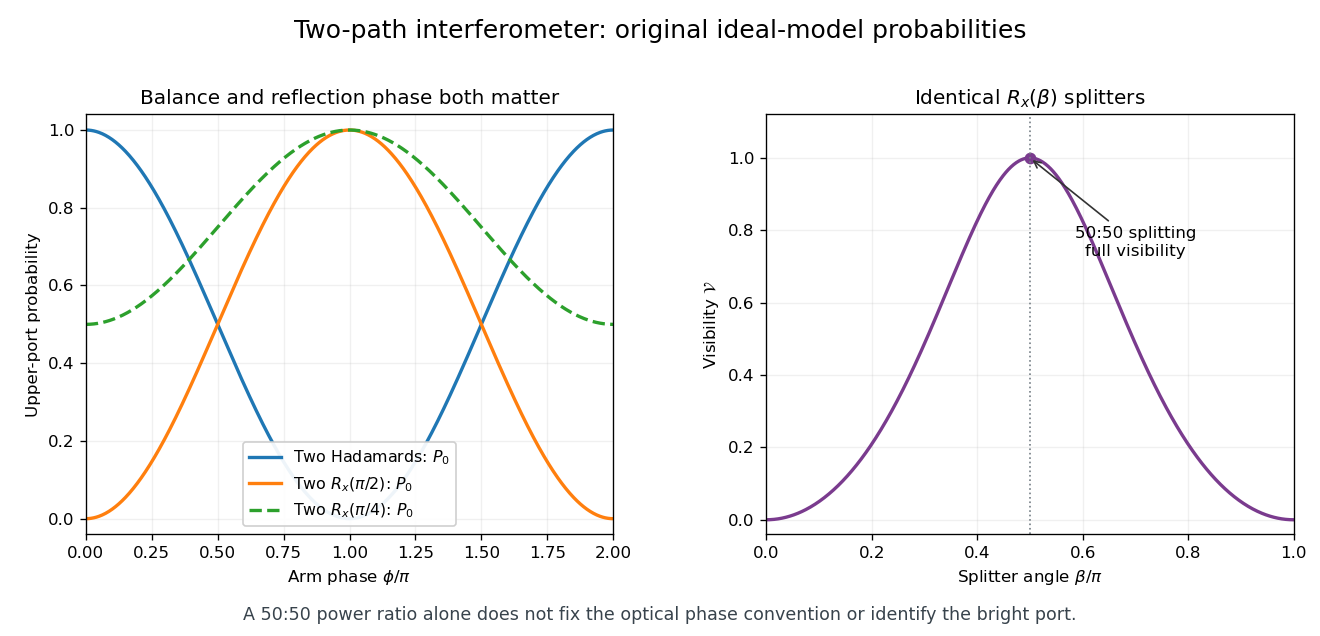
Interferometer fringes with explicit beam-splitter phases and the balance condition for full visibility
. Original ideal-model calculations, not measured data. The first panel compares the Hadamard convention with two identical splitters; the output-port phase shift remains visible even at 50:50 balance. The second panel shows the normalized upper-port visibility. Details. Pinned article: Introduction to the OurBigBook Project
Welcome to the OurBigBook Project! Our goal is to create the perfect publishing platform for STEM subjects, and get university-level students to write the best free STEM tutorials ever.
Everyone is welcome to create an account and play with the site: ourbigbook.com/go/register. We belive that students themselves can write amazing tutorials, but teachers are welcome too. You can write about anything you want, it doesn't have to be STEM or even educational. Silly test content is very welcome and you won't be penalized in any way. Just keep it legal!
Intro to OurBigBook
. Source. We have two killer features:
- topics: topics group articles by different users with the same title, e.g. here is the topic for the "Fundamental Theorem of Calculus" ourbigbook.com/go/topic/fundamental-theorem-of-calculusArticles of different users are sorted by upvote within each article page. This feature is a bit like:
- a Wikipedia where each user can have their own version of each article
- a Q&A website like Stack Overflow, where multiple people can give their views on a given topic, and the best ones are sorted by upvote. Except you don't need to wait for someone to ask first, and any topic goes, no matter how narrow or broad
This feature makes it possible for readers to find better explanations of any topic created by other writers. And it allows writers to create an explanation in a place that readers might actually find it.
Figure 1. Screenshot of the "Derivative" topic page. View it live at: ourbigbook.com/go/topic/derivativeVideo 2. OurBigBook Web topics demo. Source. - local editing: you can store all your personal knowledge base content locally in a plaintext markup format that can be edited locally and published either:This way you can be sure that even if OurBigBook.com were to go down one day (which we have no plans to do as it is quite cheap to host!), your content will still be perfectly readable as a static site.
- to OurBigBook.com to get awesome multi-user features like topics and likes
- as HTML files to a static website, which you can host yourself for free on many external providers like GitHub Pages, and remain in full control

Figure 2. You can publish local OurBigBook lightweight markup files to either OurBigBook.com or as a static website.
Figure 3. Visual Studio Code extension installation.
Figure 5. . You can also edit articles on the Web editor without installing anything locally. Video 3. Edit locally and publish demo. Source. This shows editing OurBigBook Markup and publishing it using the Visual Studio Code extension. 
- Infinitely deep tables of contents:




All our software is open source and hosted at: github.com/ourbigbook/ourbigbook
Further documentation can be found at: docs.ourbigbook.com
Feel free to reach our to us for any help or suggestions: docs.ourbigbook.com/#contact