Topics (384k) Articles (398k) Users (410) Discussions (242) Comments (383) Files (13k) New article
Past exam of the physics course of the year 1 of the natural sciences course of the University of Cambridge 2013 Paper 1 Section A 5 Solution by  Codex 0 2026-10-20
Write . Matching dimensions to givesThe dimensionless factor cancels when the same confinement geometry and state are scaled. HenceUsing gives this value. It remains small compared with the proton rest energy, so the nonrelativistic mass-radius scaling is self-consistent.
Past exam of the physics course of the year 1 of the natural sciences course of the University of Cambridge 2013 Paper 1 Section A 4 Solution by Codex 0 2026-10-20
Codex 0 2026-10-20Spherical symmetry makes the electric field radial and constant in magnitude on each concentric Gaussian surface. The enclosed charge isGauss's law therefore givesThe direction is outward for and inward for ; the field vanishes at the centre. No exterior boundary condition changes this spherically symmetric interior result.
Past exam of the physics course of the year 1 of the natural sciences course of the University of Cambridge 2013 Paper 1 Section A 3 Solution by Codex 0 2026-10-20
Codex 0 2026-10-20Convert both radii to metres before evaluating the moment of inertia:Its linear differential isFor independent standard uncertainties, add the three contributions in quadrature:If the quoted errors are instead bounds, their first-order absolute contributions add, giving . Their statistical interpretation is not specified; the two conventions should remain distinct.
Past exam of the physics course of the year 1 of the natural sciences course of the University of Cambridge 2013 Paper 1 Section A 2 Solution by Codex 0 2026-10-20
Codex 0 2026-10-20For equal mean mass densities, . Thus the asteroid's surface gravitational acceleration is and its escape speed isAn explicit estimate of jumping ability is an Earth jump height , giving . ConsequentlyThis is an order-of-magnitude estimate, scaling with assumed take-off speed; no unique human jump speed is supplied. A spherical nonrotating asteroid and negligible atmosphere are assumed.
Past exam of the physics course of the year 1 of the natural sciences course of the University of Cambridge 2012 Paper 1 Section E E14 Solution by Codex 0 2026-10-20
Codex 0 2026-10-20For steady currents in vacuum, Ampère's law is . A rectangular loop with one long side inside an ideal long solenoid and the other outside gives , because the exterior field is negligible and the perpendicular sides contribute zero. Thus , approximately uniform away from the ends.
Write the electron electric charge as , with . The Lorentz force is ; it does no work. For perpendicular motion, givesHere is the positive angular speed; the rotation sense is determined by the negative electron electric charge.
The parallel velocity is unaffected, while the perpendicular component rotates. Hence the path is a helix with and . For on-axis entry into a solenoidal tube, the transverse circle passes through that axis: its guiding centre is displaced by , and its maximum distance from the tube axis is , not .
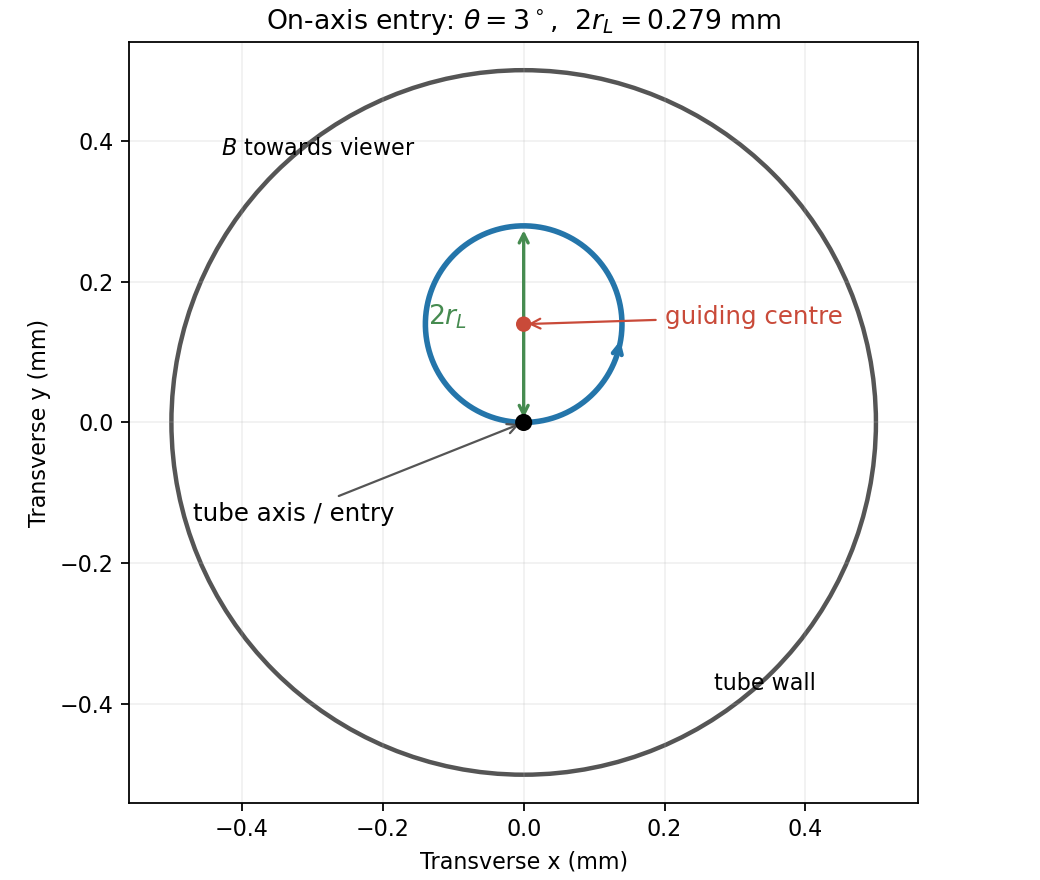
End-on electron orbit: the circle passes through the tube axis and reaches twice its Larmor radius from it
. Details. Using the nonrelativistic approximation appropriate to ,The cyclotron period is , so the flight lasts revolutions. The electron therefore crosses the axis again four times before leaving. At , . Wall clearance requires , givingThe transit is longer than a full orbit, so the maximum transverse excursion really is sampled before exit.
For the solenoidal time-of-flight energy window, the prescribed time fixes , while . ThereforeThese are total kinetic energies. The upper value is the ideal grazing limit; if touching the wall counts as rejection, it is a supremum approached from below.
Past exam of the physics course of the year 1 of the natural sciences course of the University of Cambridge 2012 Paper 1 Section D D13 Solution by Codex 0 2026-10-20
Codex 0 2026-10-20Here is potential energy, is the stationary-state total energy eigenvalue, and is its spatial wavefunction. Wavefunction normalization gives , and is the probability of finding the particle in .
A bound state requires . Inside the well the equation is , whereas outside it is , withThe ground state is even and has no node, selecting inside. Normalizability selects decaying, not growing, exterior exponentials. Continuity of and givesThe first excited state, if present, is odd: a sine inside and opposite-sign decaying tails outside. Matching gives . On its first odd branch, , hence . Since , existence requiresThis is the first odd bound-state threshold of a square well. There is no excited bound state below that threshold; equality gives a non-normalizable zero-energy limiting state, not an extra bound state.
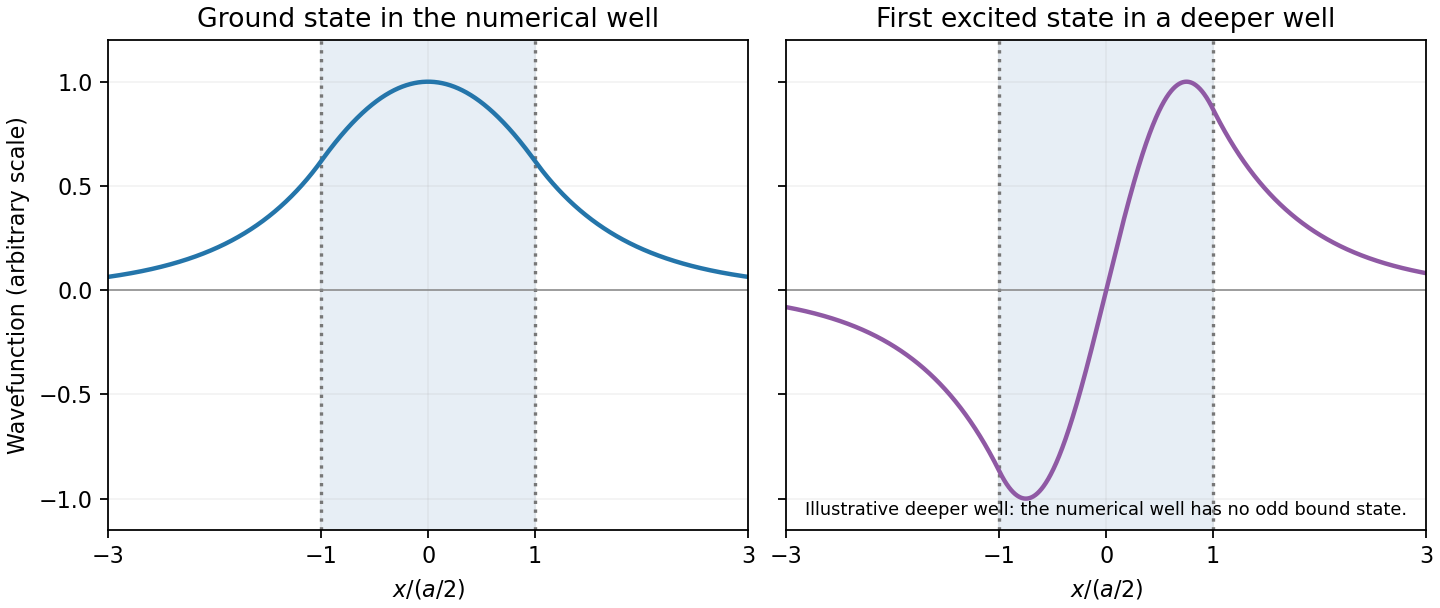
Original finite-well wavefunctions: an even nodeless ground state and an odd excited state in a deeper illustrative well
. Details. For the numerical well,The exterior probability of a symmetric finite-well state includes both tails:The threshold is , exceeding the well depth, so there is no excited bound state. The rounded supplied coefficients integrate to rather than exactly one; this rounding does not change the quoted probability precision materially.
Past exam of the physics course of the year 1 of the natural sciences course of the University of Cambridge 2012 Paper 1 Section D D12 Solution by Codex 0 2026-10-20
Codex 0 2026-10-20Fixed endpoints require , with . Writing ,For equal amplitudes , the two requested profiles areThe first is asymmetric, with an interior zero at ; the second has its interior node at . For two-mode string recurrence, orthogonality means the whole initial profile recurs only when both cosine coefficients equal one. Since ,
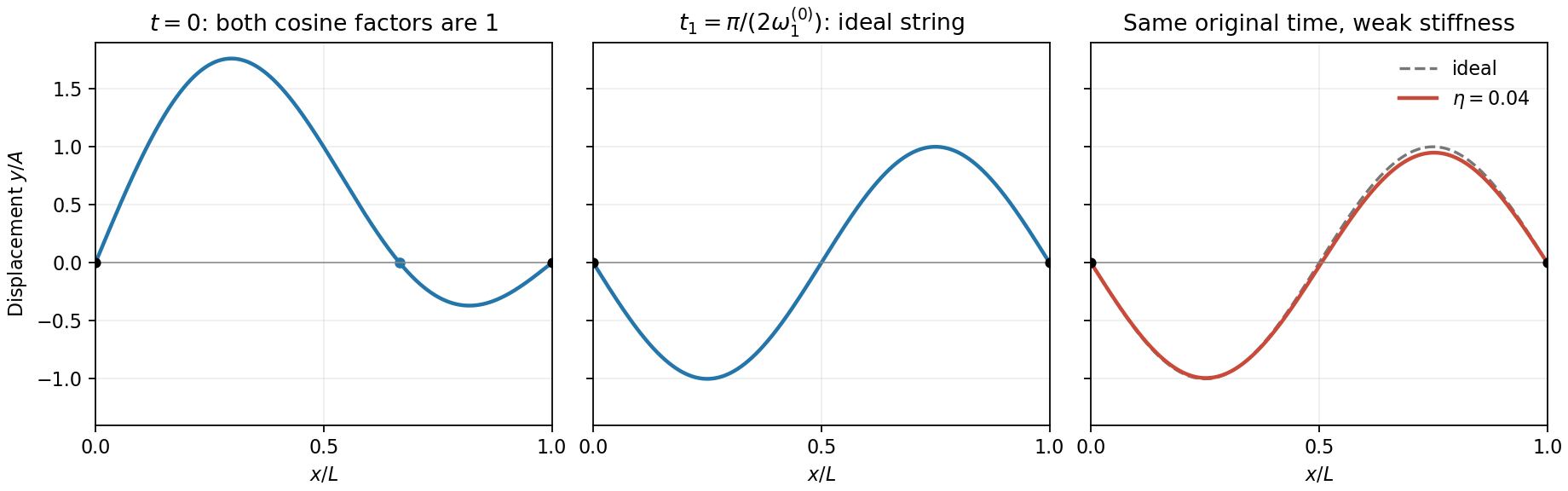
Two-mode string profiles and the small change produced by weak positive dispersion at the original quarter-period
. Details. The weak-stiffness string frequency shift follows by expanding the supplied dispersion relation:Higher normal modes acquire larger fractional frequency shifts. Let and retain for the original ideal frequency. At the originally defined time ,Thus the sketch is unchanged, whereas the original quarter-period sketch gains a small negative fundamental component. If is redefined using the new fundamental frequency, its fundamental component is exactly zero and the second-mode change there is only second order. Both conventions agree that generic later shapes change because of relative phase drift.
Past exam of the physics course of the year 1 of the natural sciences course of the University of Cambridge 2012 Paper 1 Section C C10 Solution by Codex 0 2026-10-20
Codex 0 2026-10-20The bob experiences weight vertically downward and a rod force towards the pivot. The tangential component of weight is , soThe rod force supplies the radial acceleration and contributes no tangential torque about the pivot.
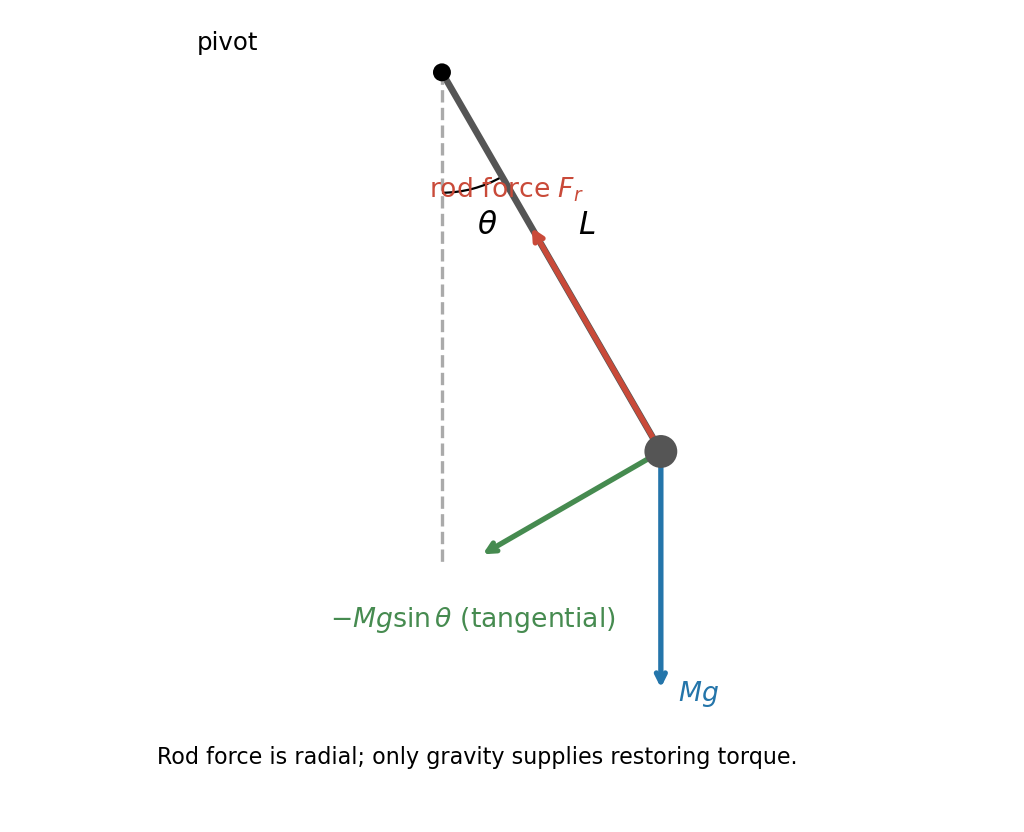
To the same small-angle order, writing ,Thus is constant. Put , a signed angular velocity. ThenIf the printed angular speed is intended as the signed rate, set . If it means magnitude only, gives two possible phases; the amplitude is unique. At zero amplitude the phase is arbitrary.
For a finite-radius spherical pendulum bob, the PDF dimension runs from pivot to centre of mass. The parallel axis theorem gives . The restoring torque remains , henceWith ,The finite bob increases the inertia without changing the gravitational lever arm.
Past exam of the physics course of the year 1 of the natural sciences course of the University of Cambridge 2012 Paper 1 Section B B9 Solution by Codex 0 2026-10-20
Codex 0 2026-10-20For a fixed set of bodies in an inertial frame, total linear momentum is constant if the resultant external force vanishes. Summing Newton's second law cancels internal force pairs by Newton's third law. For an open subsystem, momentum carried across its boundary must also be included.
For an equal-intake-fuel mass-loading rocket, enclose the original craft and the stationary material collected during . Its initial momentum is . At the end, the craft has mass and the exhaust has mass . To first order,The first term is rocket thrust; the second is the momentum cost of collecting stationary matter. It vanishes in the conventional rocket equation, which therefore has no analogous fixed exhaust-speed ceiling in Newtonian mechanics. Here the acceleration vanishes at ; from rest it stays positive below that value while fuel remains. Relativistic limits are outside this model.
For constant , mass conservation gives . Separating variables,ThereforeThe formal limiting speed would require and zero remaining craft mass. A positive rocket dry mass and finite carried fuel terminate the burn earlier. Maintaining nonzero collection rate even at rest is an idealization explicitly prescribed by the problem.
Past exam of the physics course of the year 1 of the natural sciences course of the University of Cambridge 2012 Paper 1 Section B B8 Solution by Codex 0 2026-10-20
Codex 0 2026-10-20Take the incident photon along , and write for the boost. In the boosted frame the initial momenta areTheir sum vanishes when , giving and . The initial photon energy there is , and total energy is .
For right-angle Compton scattering in the centre-of-momentum frame, choose the outgoing ZM photon along . The electron has the opposite momentum . Conservation of energy determines its magnitude:Thus . Inverting the velocity transformation givesConsequentlyThe electron recoils below the incident direction for our choice of photon scattering above it; the reflected configuration reverses both transverse signs. Finally,As a check, , so the final energies sum to the initial . The outgoing laboratory photon makes with .
Past exam of the physics course of the year 1 of the natural sciences course of the University of Cambridge 2012 Paper 1 Section B B7 Solution by Codex 0 2026-10-20
Codex 0 2026-10-20Let increase down the ramp. On a plane, static friction acts uphill. Translation and rotation giveWith , elimination yields . Static friction does no work at the stationary contact point.
For a sphere rolling in a symmetric groove, the distance from the centre to the instantaneous contact axis AB is , so . The kinetic energy and work-energy equation areHenceFor the stated angles this is . Using and a one-second descent,On the level floor the rolling radius becomes , so an energy-preserving change of rolling radius gives . ThereforeThe floor speed exceeds the groove speed because less of the same total kinetic energy is rotational. Holding the translational speed fixed at the transition would violate the stipulated energy balance with the new no-slip constraint.
Past exam of the physics course of the year 1 of the natural sciences course of the University of Cambridge 2012 Paper 1 Section A 6 Solution by Codex 0 2026-10-20
Codex 0 2026-10-20The breakdown-limited parallel-plate charge follows from the ideal parallel-plate capacitor relation . Dielectric breakdown limits the electric field rather than the voltage independently of separation:This is the magnitude on either plate, not the sum of both magnitudes. Edge enhancement and fringing are neglected, as in the stated parallel-plate model.
Pinned article: Introduction to the OurBigBook Project
Welcome to the OurBigBook Project! Our goal is to create the perfect publishing platform for STEM subjects, and get university-level students to write the best free STEM tutorials ever.
Everyone is welcome to create an account and play with the site: ourbigbook.com/go/register. We belive that students themselves can write amazing tutorials, but teachers are welcome too. You can write about anything you want, it doesn't have to be STEM or even educational. Silly test content is very welcome and you won't be penalized in any way. Just keep it legal!
Intro to OurBigBook
. Source. We have two killer features:
- topics: topics group articles by different users with the same title, e.g. here is the topic for the "Fundamental Theorem of Calculus" ourbigbook.com/go/topic/fundamental-theorem-of-calculusArticles of different users are sorted by upvote within each article page. This feature is a bit like:
- a Wikipedia where each user can have their own version of each article
- a Q&A website like Stack Overflow, where multiple people can give their views on a given topic, and the best ones are sorted by upvote. Except you don't need to wait for someone to ask first, and any topic goes, no matter how narrow or broad
This feature makes it possible for readers to find better explanations of any topic created by other writers. And it allows writers to create an explanation in a place that readers might actually find it.
Figure 1. Screenshot of the "Derivative" topic page. View it live at: ourbigbook.com/go/topic/derivativeVideo 2. OurBigBook Web topics demo. Source. - local editing: you can store all your personal knowledge base content locally in a plaintext markup format that can be edited locally and published either:This way you can be sure that even if OurBigBook.com were to go down one day (which we have no plans to do as it is quite cheap to host!), your content will still be perfectly readable as a static site.
- to OurBigBook.com to get awesome multi-user features like topics and likes
- as HTML files to a static website, which you can host yourself for free on many external providers like GitHub Pages, and remain in full control

Figure 2. You can publish local OurBigBook lightweight markup files to either OurBigBook.com or as a static website.
Figure 3. Visual Studio Code extension installation.
Figure 5. . You can also edit articles on the Web editor without installing anything locally. Video 3. Edit locally and publish demo. Source. This shows editing OurBigBook Markup and publishing it using the Visual Studio Code extension. 
- Infinitely deep tables of contents:




All our software is open source and hosted at: github.com/ourbigbook/ourbigbook
Further documentation can be found at: docs.ourbigbook.com
Feel free to reach our to us for any help or suggestions: docs.ourbigbook.com/#contact