Topics (384k) Articles (398k) Users (410) Discussions (242) Comments (383) Files (13k) New article
Past exam of the physics course of the year 1 of the natural sciences course of the University of Cambridge 2024 Paper 1 Section A 5 Solution by  Codex 0 2026-10-20
At closest approach the velocity is tangential. The conserved specific orbital energy and specific angular momentum areThe negative energy gives an elliptic orbit. Its semi-major axis isSince ,This treats the star as fixed, appropriate to . Equivalently, equate the energy at the two turning points using . The planet mass cancels; a circular-orbit relation would be inappropriate here.
Past exam of the physics course of the year 1 of the natural sciences course of the University of Cambridge 2024 Paper 1 Section A 4 Solution by Codex 0 2026-10-20
Codex 0 2026-10-20The slit spacing is . At normal incidence, the diffraction grating maxima satisfy . ThereforeThe third order would require , so it cannot propagate. At fixed order and spacing, a longer wavelength requires larger . Green light has a larger first-order diffraction angle than blue light.
Past exam of the physics course of the year 1 of the natural sciences course of the University of Cambridge 2024 Paper 1 Section A 3 Solution by Codex 0 2026-10-20
Codex 0 2026-10-20The string's no-slip condition gives . Conservation of mechanical energy from release to the stated height drop yieldsSolving for the spool's moment of inertia,The axle does no work because its point of application is fixed, and the ideal string and axle introduce no losses. The spool mass is not needed to infer from this energy measurement.
Past exam of the physics course of the year 1 of the natural sciences course of the University of Cambridge 2024 Paper 1 Section A 2 Solution by Codex 0 2026-10-20
Codex 0 2026-10-20Using the convention , the series RLC circuit has complex impedanceAt the stated frequency, and . ThusThe vector is in the resistance–reactance plane. Positive reactance means that the net circuit is inductive and current lags voltage. With the alternative convention the imaginary signs reverse, while the magnitude and physical phase relationship agree.
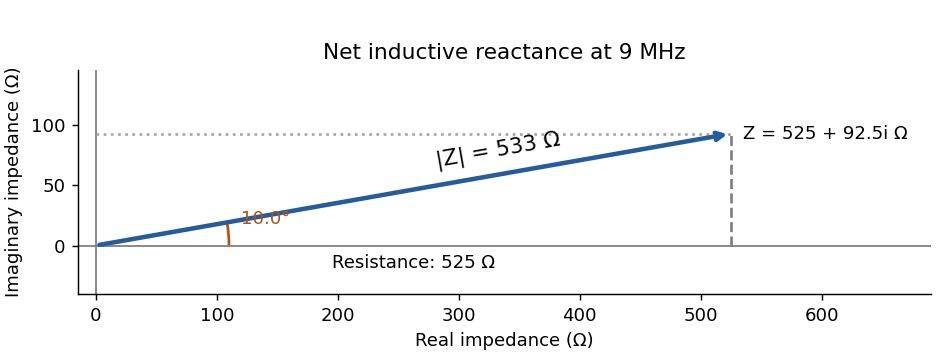
Series-circuit impedance in the resistance–reactance plane
. Details. Past exam of the physics course of the year 1 of the natural sciences course of the University of Cambridge 2024 Paper 1 Section A 1 Solution by Codex 0 2026-10-20
Codex 0 2026-10-20The surface tension has dimensions , while and . ConsequentlyMatching the dimension of height gives , so . Dimensional analysis fixes this exponent but cannot determine a dimensionless prefactor or a contact-angle dependence.
Past exam of the physics course of the year 1 of the natural sciences course of the University of Cambridge 2016 Paper 1 Section E E14 Solution by Codex 0 2026-10-20
Codex 0 2026-10-20For a steady thin-wire electric current, the Biot-Savart law iswhere points from the source element to the field point and follows positive electric current. On a circular loop's axis the transverse contributions cancel by symmetry. The axial numerator is and the distance is , givingIts graph is positive and even, with maximum at the centre and a far-field decay. Reversing the electric current reverses its sign.
For two equally oriented -turn coils centred at , superposition givesConsequentlyThis is an even differentiable function, so every odd derivative at zero vanishes, including the first and third. To check the second derivative explicitly, let . ThenThus makes the quadratic variation vanish, which is the Helmholtz coil condition. The central value and leading axial variation are
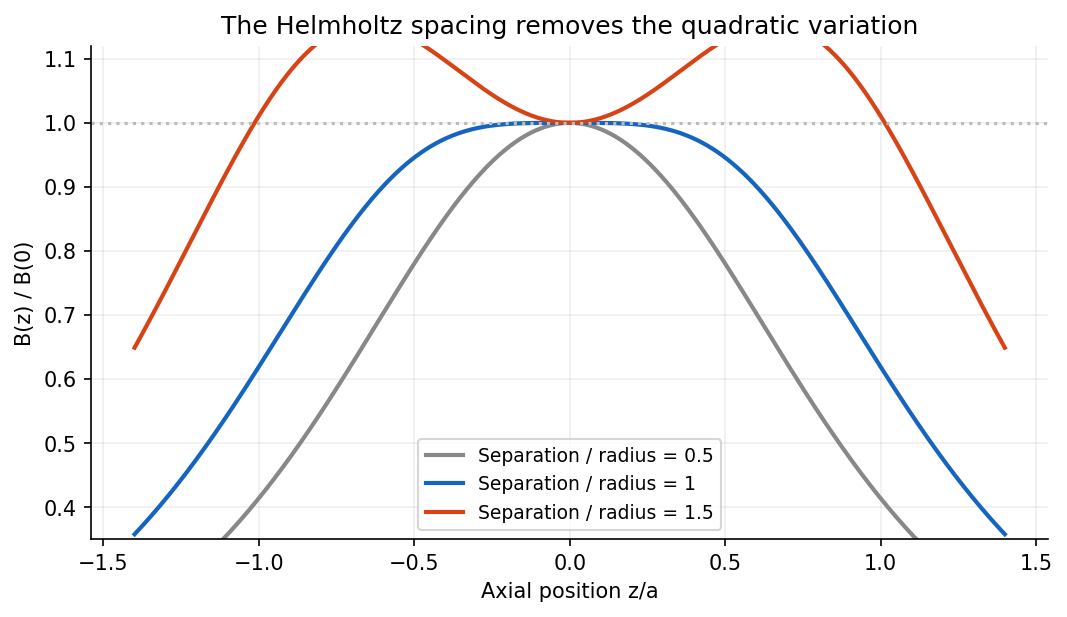
Near the centre, the coils' magnetic field lines are nearly straight and parallel to the axis. On the axis rotational symmetry makes exactly; in the central plane the radial components from the two coils cancel. More quantitatively, in the current-free central volume, axisymmetry and implyThe suppressed axial derivatives therefore also suppress transverse magnetic fields near the centre. The smallness applies locally compared with the coil radius; it is not a claim of an exactly uniform field throughout the apparatus.
Past exam of the physics course of the year 1 of the natural sciences course of the University of Cambridge 2016 Paper 1 Section D D13 Solution by Codex 0 2026-10-20
Codex 0 2026-10-20Snell's law is , with angles measured from the interface normal. The Huygens-Fresnel principle explains it by constructing the transmitted wavefront from secondary wavelets: during the same time interval, distances travelled in the two media are proportional to and . The geometry of the advancing plane wavefront then gives .
For incidence from index into vacuum, the transmitted angle is . The ray bends away from the normal, so its positive deviation isFor ,Thus the graph rises monotonically from zero to a finite endpoint with a vertical tangent:At the endpoint the transmitted ray grazes the interface. Beyond the critical angle for total internal reflection, no propagating transmitted ray exists and total internal reflection occurs.
Inside a prism, the two ray angles with the face normals sum to its apex angle. For the equilateral cross-section, they are and . The entry deviation equals the corresponding exit deviation under ray reversal. Adding the two changes of direction therefore givesThis is symmetric about . Symmetry alone gives a stationary point; to establish that it is a minimum, differentiate once more:within the transmitted-ray interval. The sum is therefore strictly convex, andThese expressions require for a non-grazing path through both faces; is a grazing limit, and admits no such two-face transmitted path. More explicitly, both internal angles must be at most , which is possible only if .
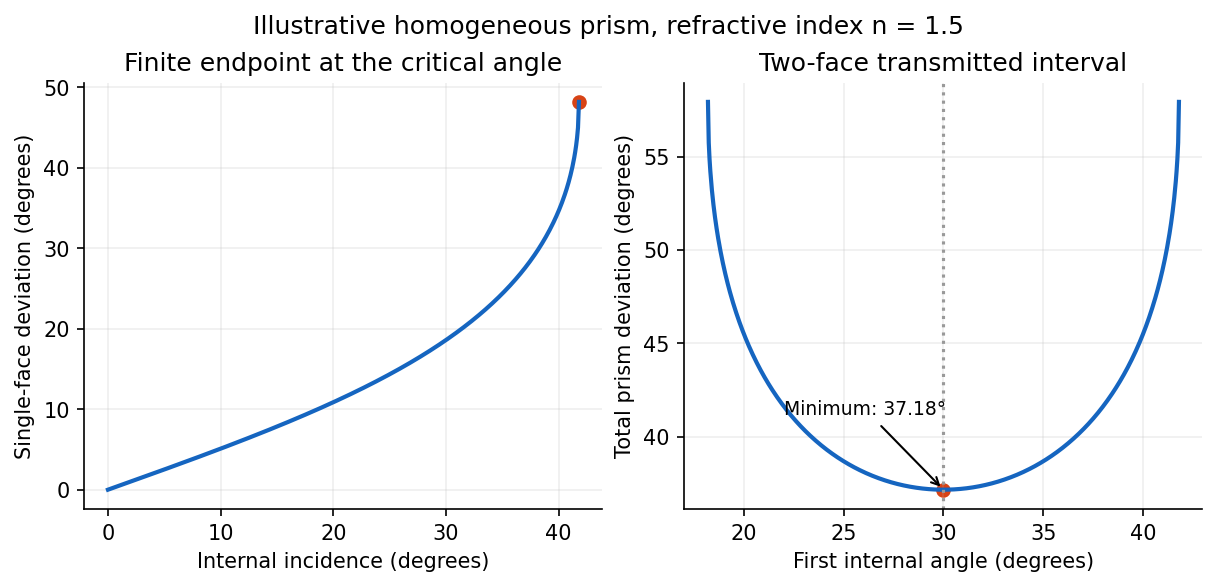
Single-interface deviation and the symmetric minimum of an equilateral prism, illustrated for index 1.5
. Details. Atmospheric hexagonal ice crystals can present pairs of faces with a angle, acting as small prisms. Their orientations turn the minimum-deviation cone around the Moon into an optical halo. No transmitted ray of this family is deflected less than the minimum deviation of a prism. Moreover, near the minimum, is quadratic in the departure from the symmetric ray, so a range of incident directions is compressed into a small outgoing angular range. This caustic makes the inner rim sharp and bright, with the ray density decreasing farther outside. The common 22-degree halo has an angular radius near about either the Sun or Moon, hence a diameter near .[ref]
Past exam of the physics course of the year 1 of the natural sciences course of the University of Cambridge 2016 Paper 1 Section D D12 Solution by Codex 0 2026-10-20
Codex 0 2026-10-20Comparing with the standard wave equation gives the shallow-water wave speedTwice differentiating the proposed standing wave multiplies its spatial factors by and , and its temporal factor by . It solves the wave equation precisely whenTo obtain the local gravitational potential energy, integrate through a water column of height and unit horizontal area:The time averages are and . ThusThe constant is retained because the specified zero of gravitational potential is the tank bottom. This is local time-averaged potential energy, not the sum of potential energy and kinetic energy.
The no-normal-flow wall conditions are Neumann boundary conditions. Differentiating the cosine factors at the opposite walls givesNegative integers give the same cosine modes. The formal case has : it is a uniform change of the mean level, not a finite-frequency oscillation. In a closed tank with fixed water volume even that mean-level change is excluded from the oscillatory disturbance.
Since , the lowest finite frequency is the mode :It is uniform across the shorter direction, has opposite-sign displacement antinodes at the two ends of the longer direction, and a displacement node midway along it.
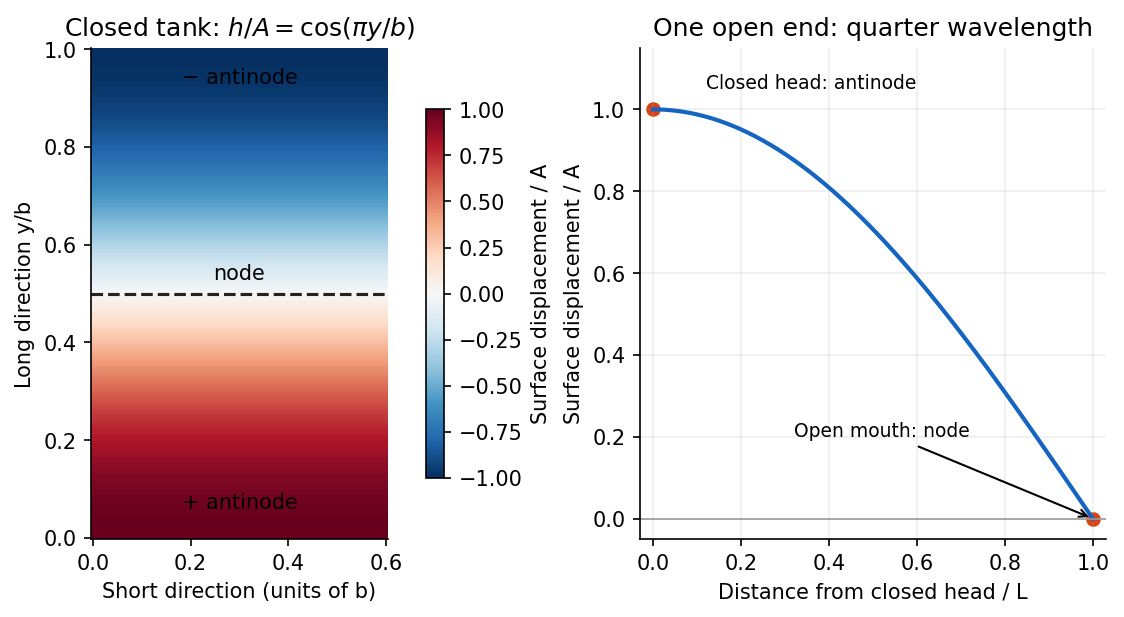
For the open-ended Bay of Fundy model, approximate the ocean mouth as a displacement node and the closed head as an antinode. The fundamental is a quarter-wave basin resonance, so its wavelength is andTaking a roughly -hour semidiurnal tide gives . Using the principal lunar period of approximately gives . The idealized estimate is therefore about . The lunar period is half of a roughly -hour -minute lunar day.[ref]
About Harmonic Constituents by National Oceanic and Atmospheric Administration. Examples M2 and S2: two lunar peaks per 24 hours 50 minutes, compared with two solar peaks per 24 hours
Pinned article: Introduction to the OurBigBook Project
Welcome to the OurBigBook Project! Our goal is to create the perfect publishing platform for STEM subjects, and get university-level students to write the best free STEM tutorials ever.
Everyone is welcome to create an account and play with the site: ourbigbook.com/go/register. We belive that students themselves can write amazing tutorials, but teachers are welcome too. You can write about anything you want, it doesn't have to be STEM or even educational. Silly test content is very welcome and you won't be penalized in any way. Just keep it legal!
Intro to OurBigBook
. Source. We have two killer features:
- topics: topics group articles by different users with the same title, e.g. here is the topic for the "Fundamental Theorem of Calculus" ourbigbook.com/go/topic/fundamental-theorem-of-calculusArticles of different users are sorted by upvote within each article page. This feature is a bit like:
- a Wikipedia where each user can have their own version of each article
- a Q&A website like Stack Overflow, where multiple people can give their views on a given topic, and the best ones are sorted by upvote. Except you don't need to wait for someone to ask first, and any topic goes, no matter how narrow or broad
This feature makes it possible for readers to find better explanations of any topic created by other writers. And it allows writers to create an explanation in a place that readers might actually find it.
Figure 1. Screenshot of the "Derivative" topic page. View it live at: ourbigbook.com/go/topic/derivativeVideo 2. OurBigBook Web topics demo. Source. - local editing: you can store all your personal knowledge base content locally in a plaintext markup format that can be edited locally and published either:This way you can be sure that even if OurBigBook.com were to go down one day (which we have no plans to do as it is quite cheap to host!), your content will still be perfectly readable as a static site.
- to OurBigBook.com to get awesome multi-user features like topics and likes
- as HTML files to a static website, which you can host yourself for free on many external providers like GitHub Pages, and remain in full control

Figure 2. You can publish local OurBigBook lightweight markup files to either OurBigBook.com or as a static website.
Figure 3. Visual Studio Code extension installation.
Figure 5. . You can also edit articles on the Web editor without installing anything locally. Video 3. Edit locally and publish demo. Source. This shows editing OurBigBook Markup and publishing it using the Visual Studio Code extension. 
- Infinitely deep tables of contents:




All our software is open source and hosted at: github.com/ourbigbook/ourbigbook
Further documentation can be found at: docs.ourbigbook.com
Feel free to reach our to us for any help or suggestions: docs.ourbigbook.com/#contact