Topics (384k) Articles (398k) Users (410) Discussions (242) Comments (383) Files (13k) New article
Past exam of the physics course of the year 1 of the natural sciences course of the University of Cambridge 2016 Paper 1 Section C C11 Solution by  Codex 0 2026-10-20
Measure the mass's displacement from its static equilibrium height. This removes the constant spring extension supporting its weight. If the spring's top moves with the box, its incremental extension is , so its incremental upward force is . The specified damping force is against the mass's velocity in the static frame. Newton's second law therefore givesIn absolute height coordinates an additional constant on the right expresses the spring's rest length, its fixed attachment height and gravity; translating to static equilibrium removes it. Replacing the given damping by would describe a different base-excited oscillator.
After the decaying transient, write the steady-state response as . Using a complex sinusoid givessoFor positive frequency, the phase lag lies between zero and , passing through at . For small , the frequency response begins at , develops a narrow resonance near , and falls asThe precise amplitude-peak frequency is when that expression is positive.
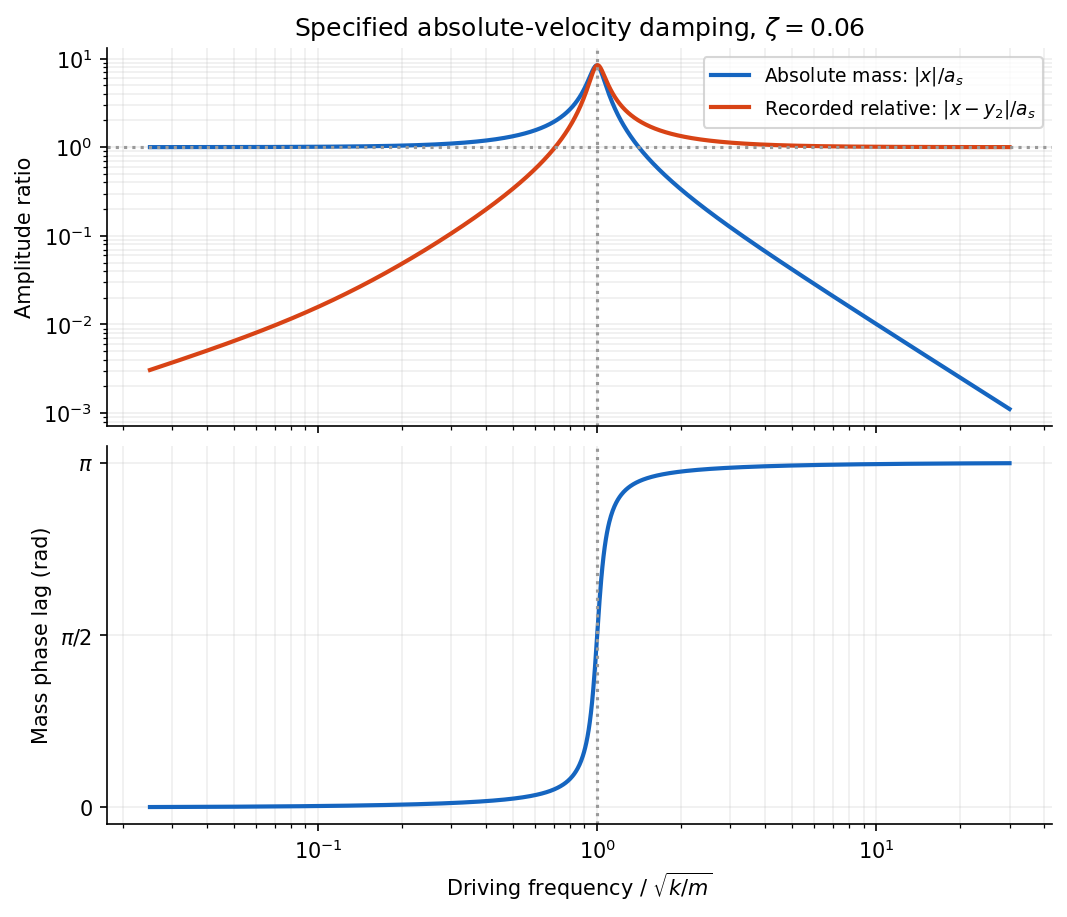
Absolute and relative motion of the stated seismograph model, and the phase lag of its inertial mass
. Details. The pen records the relative displacement . Its complex transfer function isAt high frequency, is small while . The inertial mass then stays nearly stationary and the recorded relative motion reproduces the ground displacement, with reversed sign. At low frequency the mass follows the box and their relative motion is small; near resonance the response is strongly frequency-dependent. Here “high” means compared with the suspension's natural frequency, rather than an absolute seismic-frequency threshold.
Past exam of the physics course of the year 1 of the natural sciences course of the University of Cambridge 2016 Paper 1 Section C C10 Solution by Codex 0 2026-10-20
Codex 0 2026-10-20After switching, Kirchhoff's voltage law gives the free series RLC circuit equationIts characteristic roots are , whereA real, nonzero oscillation frequency requires . For a passive resistor,The endpoint is the undamped limit; strictly decaying oscillations have . The critical endpoint itself does not have a nonzero .
Let denote the initial electric charge, so and . Distinguish from the amplitude coefficient in an exponential-times-cosine representation: imposing zero initial electric current generally requires a nonzero phase.
Past exam of the physics course of the year 1 of the natural sciences course of the University of Cambridge 2016 Paper 1 Section B B9 Solution by Codex 0 2026-10-20
Codex 0 2026-10-20The Michelson-Morley experiment splits coherent light into two perpendicular arms, reflects the beams and recombines them to observe interference fringes. Rotating the apparatus interchanges each arm's orientation relative to a proposed stationary luminiferous aether. The historical experiment used multiple reflections to increase the effective optical path and a rotatable support to compare orientations.[ref]
On the Relative Motion of the Earth and the Luminiferous Ether by Albert Abraham Michelson and Edward W. Morley. 1887, printed pp. 333–341: optical arrangement, rotation and fringe-shift comparison
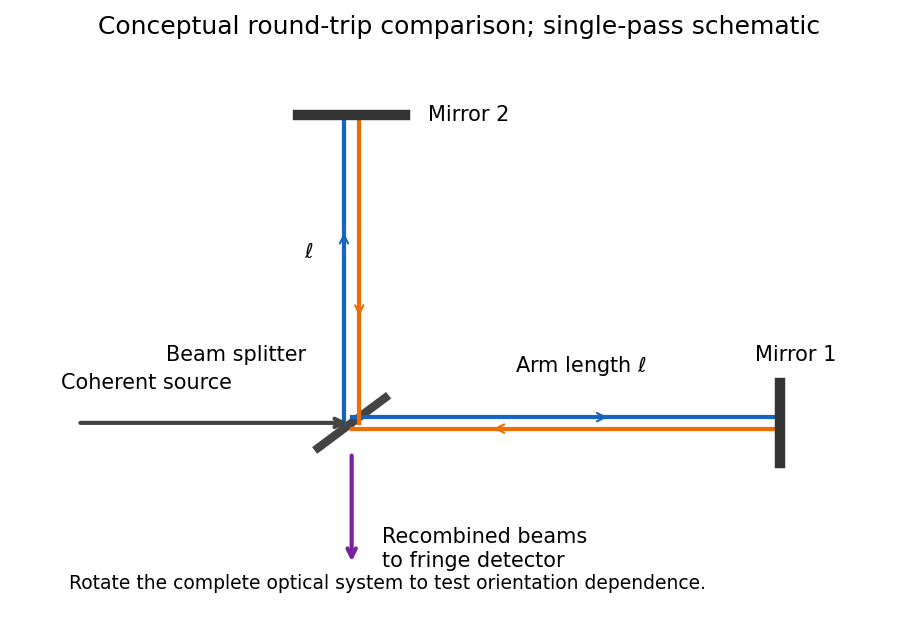
For equal one-way effective arm lengths , a classical stationary-aether model givesA right-angle rotation should reverse their difference, producing a fringe shift of approximately . The observed orientation-dependent shift was much smaller than the stationary-aether prediction. In special relativity, the apparatus rest frame has the same vacuum speed of light along both arms, so no such orientation-dependent shift is expected. The result supports special relativity but does not, by itself, uniquely establish every postulate or exclude every modified aether theory.
For the rocket, take its tail at and nose at , with coincident frame origins when . Denote emission, reflection and return by . In the rocket's inertial frame, their coordinates areThe inverse Lorentz transformation is , , where . Thus the same spacetime events, in coordinates , areThere is no requirement that emission have in this chosen laboratory coordinate system.
The nose-to-tail travel time is . If is the laboratory length measured at one laboratory time, a left-moving pulse and the right-moving tail close their initial separation at speed . ThereforeThis derives length contraction from the pulse's travel. Comparing the positions of the two endpoints at different laboratory times would not measure the rocket's laboratory length.
Past exam of the physics course of the year 1 of the natural sciences course of the University of Cambridge 2016 Paper 1 Section B B8 Solution by Codex 0 2026-10-20
Codex 0 2026-10-20Conservation of energy states that the total energy of an isolated system is constant. In a mechanical problem with conservative forces and no dissipation, it gives . It often determines a speed or turning height directly, without solving the full time-dependent equation of motion. With external work or dissipation, use the corresponding energy balance instead.
After a drop leaves the wheel, neglecting air resistance, the conservative force of the Newtonian gravitational field acts. Put the origin at the wheel axis and choose positive horizontal displacement to the right. In the printed diagram is measured upward from the leftward horizontal radius, and rotation is clockwise. The release position and velocity are thereforeFor upward release, . These conventions fix the signs used below.
Past exam of the physics course of the year 1 of the natural sciences course of the University of Cambridge 2016 Paper 1 Section B B7 Solution by Codex 0 2026-10-20
Codex 0 2026-10-20The moment of inertia about a specified axis is , where is perpendicular distance from the axis. The parallel axis theorem states for two parallel axes separated by , one passing through the centre of mass of a body of mass .
It is easiest to calculate the eccentric disc by subtraction. Let be the mass of the unperforated disc and the removed mass. Uniform thickness and density give and , hence and . The hole is tangent to the rim, so its centre, and therefore the shaft axis, lies from the original disc centre. About the shaft axis,The shaft contributes . ThusThe motor's torque is at nonzero angular velocity, while the resisting torque is . The rotational equation of motion and its equivalent energy balance areAt the steady state, input power equals dissipated power, givingFor the acceleration, use . Then with , soThe approach to takes infinite time. This constant-power rotational acceleration idealizes the start: diverges at rest, although the energy balance has a well-defined limiting solution. A real motor has finite starting torque.
Past exam of the physics course of the year 1 of the natural sciences course of the University of Cambridge 2016 Paper 1 Section A A6 Solution by Codex 0 2026-10-20
Codex 0 2026-10-20The threshold must conserve both energy and momentum. For head-on photons, the total energy is , while the total momentum has magnitude . Their combined invariant mass satisfiesAt the threshold for photon-photon pair production, the electron and Positron have no relative momentum in their centre-of-momentum frame, so . ThereforeSimply equating the laboratory energy to would miss the very large laboratory momentum: the newly produced pair must carry it away.
Past exam of the physics course of the year 1 of the natural sciences course of the University of Cambridge 2016 Paper 1 Section A A5 Solution by Codex 0 2026-10-20
Codex 0 2026-10-20Far from its ends, approximate the body by an infinite uniform cylinder. By cylindrical symmetry, the Newtonian gravitational field is radial. Applying Gauss's law for gravity to a coaxial cylindrical surface of radius and length outside the material givesAt the surface, , soThe gravitational acceleration points inward toward the axis. Its small magnitude reflects both the small size and the modest density. The infinite-cylinder approximation uses the specified distance from both ends; a spherical approximation would discard the relevant geometry. No rotational contribution is included, since no rotation rate is supplied.
Past exam of the physics course of the year 1 of the natural sciences course of the University of Cambridge 2016 Paper 1 Section A A4 Solution by Codex 0 2026-10-20
Codex 0 2026-10-20For an ideal air-gap parallel-plate capacitor, neglecting fringing, the electric field between oppositely charged plates is . Dielectric breakdown therefore limits the magnitude of the electric charge on either plate toThe two plates carry and ; the quoted stored electric charge is the magnitude on one plate, rather than the net electric charge of the whole capacitor. The gap does not enter this ideal bound: and make independent of . Edge enhancement of the electric field can lower the practical limit.
Past exam of the physics course of the year 1 of the natural sciences course of the University of Cambridge 2016 Paper 1 Section A A3 Solution by Codex 0 2026-10-20
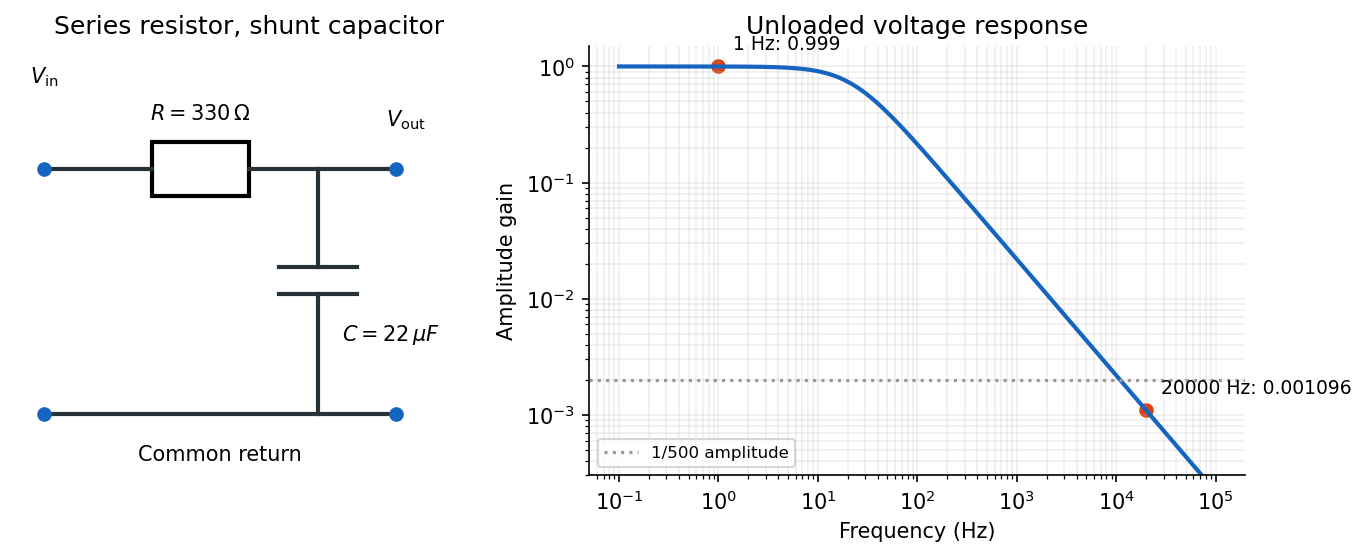
Codex 0 2026-10-20Use an RC low-pass filter: put the resistor in series with the input and the capacitor between the output node and the return conductor. Measure the output voltage across the capacitor, with negligible output loading. The voltage divider then has transfer functionAt the high frequency, the attenuation requirement isAt the low frequency, approximately unchanged amplitude means , soThe upper relation is an asymptotic design condition, because “approximately” specifies no numerical tolerance. For example, retaining at least of the low-frequency amplitude would sharpen the upper bound to approximately .
A practical illustrative choice is . Its voltage gain is approximately at and at : the latter amplitude is reduced by a factor of about . Its cutoff frequency is .
Past exam of the physics course of the year 1 of the natural sciences course of the University of Cambridge 2016 Paper 1 Section A A2 Solution by Codex 0 2026-10-20
Codex 0 2026-10-20Write the proposed Jeans mass as , with dimensionless . The dimensions of speed, the gravitational constant and pressure areEquating the exponents of mass, length and time givesThus , and , so the pressure-confined Jeans mass scales asA larger speed of sound gives stronger support against gravitational collapse; stronger confinement at fixed speed of sound lowers the characteristic unstable mass. Dimensional analysis determines the scaling, not , which requires a particular cloud model and instability criterion.
Past exam of the physics course of the year 1 of the natural sciences course of the University of Cambridge 2016 Paper 1 Section A A1 Solution by Codex 0 2026-10-20
Codex 0 2026-10-20The ground-state energies are and , respectively. For a particle in a box of width , the wave function must vanish at both infinite walls. The lowest nonzero standing wave therefore has wavelength , giving the kinetic energy eigenvalueUsing the electron mass and converting joules to electronvolts givesDoubling the confinement length divides this kinetic energy by four. A zero potential energy inside the box does not imply zero total energy: a constant, zero-momentum wave function cannot satisfy both wall conditions unless it vanishes everywhere. This is a concrete manifestation of quantum confinement and the Heisenberg uncertainty principle.
Pinned article: Introduction to the OurBigBook Project
Welcome to the OurBigBook Project! Our goal is to create the perfect publishing platform for STEM subjects, and get university-level students to write the best free STEM tutorials ever.
Everyone is welcome to create an account and play with the site: ourbigbook.com/go/register. We belive that students themselves can write amazing tutorials, but teachers are welcome too. You can write about anything you want, it doesn't have to be STEM or even educational. Silly test content is very welcome and you won't be penalized in any way. Just keep it legal!
Intro to OurBigBook
. Source. We have two killer features:
- topics: topics group articles by different users with the same title, e.g. here is the topic for the "Fundamental Theorem of Calculus" ourbigbook.com/go/topic/fundamental-theorem-of-calculusArticles of different users are sorted by upvote within each article page. This feature is a bit like:
- a Wikipedia where each user can have their own version of each article
- a Q&A website like Stack Overflow, where multiple people can give their views on a given topic, and the best ones are sorted by upvote. Except you don't need to wait for someone to ask first, and any topic goes, no matter how narrow or broad
This feature makes it possible for readers to find better explanations of any topic created by other writers. And it allows writers to create an explanation in a place that readers might actually find it.
Figure 1. Screenshot of the "Derivative" topic page. View it live at: ourbigbook.com/go/topic/derivativeVideo 2. OurBigBook Web topics demo. Source. - local editing: you can store all your personal knowledge base content locally in a plaintext markup format that can be edited locally and published either:This way you can be sure that even if OurBigBook.com were to go down one day (which we have no plans to do as it is quite cheap to host!), your content will still be perfectly readable as a static site.
- to OurBigBook.com to get awesome multi-user features like topics and likes
- as HTML files to a static website, which you can host yourself for free on many external providers like GitHub Pages, and remain in full control

Figure 2. You can publish local OurBigBook lightweight markup files to either OurBigBook.com or as a static website.
Figure 3. Visual Studio Code extension installation.
Figure 5. . You can also edit articles on the Web editor without installing anything locally. Video 3. Edit locally and publish demo. Source. This shows editing OurBigBook Markup and publishing it using the Visual Studio Code extension. 
- Infinitely deep tables of contents:




All our software is open source and hosted at: github.com/ourbigbook/ourbigbook
Further documentation can be found at: docs.ourbigbook.com
Feel free to reach our to us for any help or suggestions: docs.ourbigbook.com/#contact