Topics (384k) Articles (398k) Users (410) Discussions (242) Comments (383) Files (13k) New article
Past exam of the physics course of the year 1 of the natural sciences course of the University of Cambridge 2014 Paper 1 E15 b Solution by  Codex 0 2026-10-20
Faraday's law relates induced electromotive force to the rate of change of magnetic flux linkage. For a coil with turns and a consistent right-hand orientation,Flux can change through field variation or circuit motion. Lenz's law is the minus sign: the induced current's field opposes the flux change, consistent with energy conservation. It opposes the change rather than necessarily opposing the original field.
For a linear fixed-geometry inductor, and the self-induced electromotive force is . The passive terminal voltage drop is instead . The stored magnetic energy isInductance is measured in henries. Transformers use mutual inductance: changing one winding's current induces an electromotive force in another.
Past exam of the physics course of the year 1 of the natural sciences course of the University of Cambridge 2014 Paper 1 E15 a Solution by Codex 0 2026-10-20
Codex 0 2026-10-20A field assigns a physical quantity to each point. Gravitational field is force per unit test mass; electric field is force per unit test charge. In a conservative, time-independent field,Write for gravitational potential , or for electric potential , giving and . A point mass has with zero at infinity, while two point charges have . Only potential-energy differences matter; a constant can be added freely. The mechanical energy is conserved if no nonconservative forces do work. A magnetic Lorentz force does no work on a point charge and generally cannot be represented by a position-only scalar potential energy.
Past exam of the physics course of the year 1 of the natural sciences course of the University of Cambridge 2013 Paper 1 Section E E14 Solution by Codex 0 2026-10-20
Codex 0 2026-10-20In magnetostatics Ampère's circuital law is . Its general vacuum version adds on the right. Faraday's law is for a fixed loop. A circular Amperian path around a long straight wire giveswith direction given by the right-hand rule. The force on a wire element is ; its magnitude is and its direction follows this cross product.
Choose the straight-wire current rightward and the square below it, as printed. Its positive magnetic field there is into the page. With an into-page loop normal, the magnetic flux linkage isHere denotes mutual inductance, not a mass. Choose positive coil current to produce an out-of-page field. Then its induced current in the resistance-dominated approximation isThis reproduces the specified sign with the declared orientation. It neglects coil self-inductance, requiring , as implicit in the requested expression.
The nearest side contains N parallel current segments and is at a uniform distance , so its force magnitude isThe two sides perpendicular to the wire have opposite currents and equal magnetic fields at corresponding distances; their forces cancel pairwise. The far side opposes the near-side force and has the smaller field. ThusWhen and have the same sign under the chosen conventions, the near-side coil current opposes the straight-wire current and the total force is away from the wire; otherwise it is toward it. In particular the signed force alternates with . The coil is fixed, so these forces do no mechanical work on it. The mean Joule heating is
Past exam of the physics course of the year 1 of the natural sciences course of the University of Cambridge 2013 Paper 1 Section D D13 Solution by Codex 0 2026-10-20
Codex 0 2026-10-20Substitution into the wave equation gives and . Therefore . The fixed edges at zero are automatically satisfied by the sine factors; the opposite edges requireNeither integer may vanish, because that would make the entire displacement zero.
The element's mass is , and its speed is . Squaring and multiplying by half its mass gives the requested energy density. The two sine-squared spatial integrals are and , soThere is no dissipation. The total mechanical energy equals the maximum kinetic energy, givingEquivalently, integrate the small-slope tension energy and use the dispersion relation.
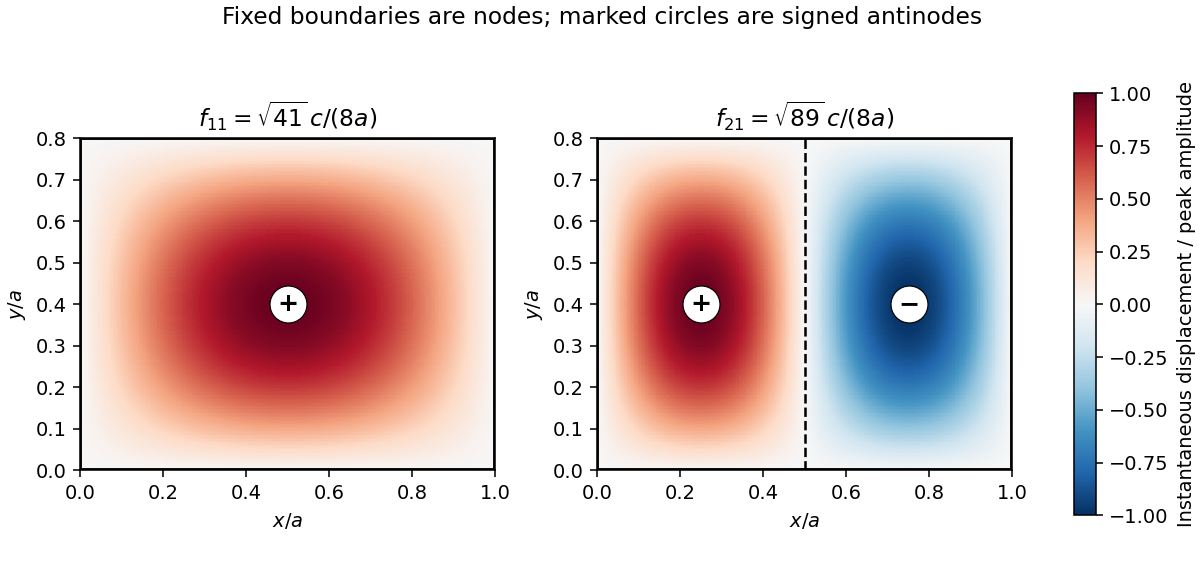
For , the two lowest modes are and :The fundamental has one antinode at and no interior nodal line. The next mode has a node along and opposite-sign antinodes at and . Every boundary is a node.
Past exam of the physics course of the year 1 of the natural sciences course of the University of Cambridge 2013 Paper 1 Section D D12 Solution by Codex 0 2026-10-20
Codex 0 2026-10-20Across a uniformly illuminated slit, the phase difference between its edges is . Integrating the complex amplitude across the slit gives the single-slit diffraction factorThus in the small-angle amplitude expression. The first noncentral zero has , so . At the stated approximate subsidiary maximum,The exact first side maximum solves , giving and intensity ratio ; the requested approximation need not be mistaken for the exact maximum.
A virtual object is a point toward which incident rays are already converging and would meet if the lens were removed. With real-is-positive object/image distances it has . The thin-lens equation gives ; as , , so a distant virtual object images in the rear focal plane.
Without the lens, puts the central maximum at zero and the first dark fringes at . Subsequent zeros are integer multiples, and weaker subsidiary maxima lie between them.
For the finite-distance pattern compression, take the old screen as the prospective image plane at , with , and the new screen at . ThenThe plane surface has infinite radius of curvature. The transverse scale is , yieldingThe finite-distance scaling can also be checked without treating an intensity pattern as a collection of geometrical point objects: the slit-to-screen Fresnel integral after a thin lens has quadratic coefficient and linear term . It therefore reproduces the old diffraction pattern at transverse coordinate , up to an overall amplitude and phase. If the old far-field plane is treated as infinitely distant, the equally useful leading approximation is , ; the finite-distance correction is only .
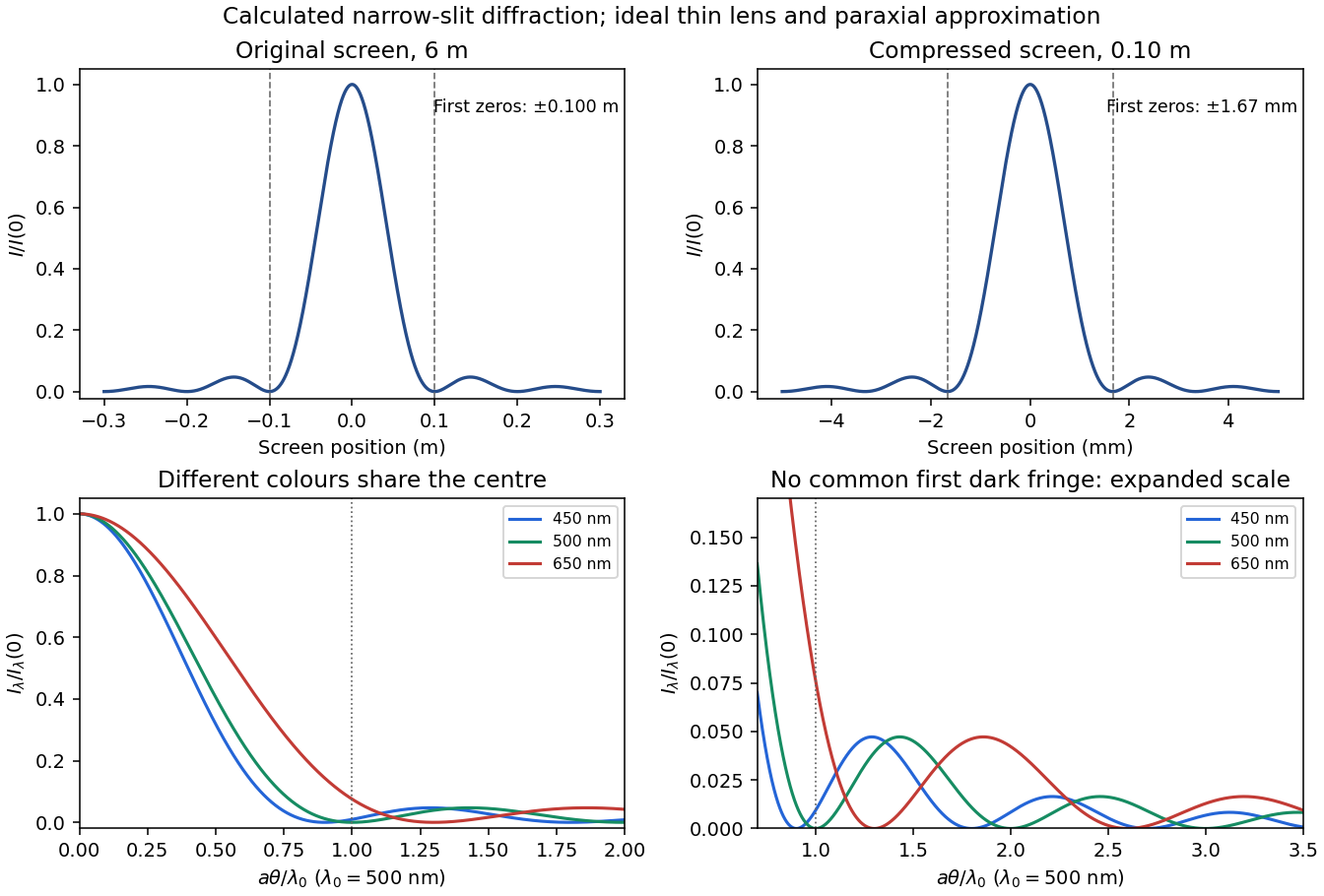
Original single-slit intensity plots at the original and compressed screens, and wavelength-dependent angular patterns for three representative visible colours
. Details. Past exam of the physics course of the year 1 of the natural sciences course of the University of Cambridge 2013 Paper 1 Section C C11 Solution by Codex 0 2026-10-20
Codex 0 2026-10-20In series the same current passes through both resistors, while their voltage drops add: . In parallel the same voltage drives currents and , which add. Thus and .
Use phasors proportional to . Then and . The printed diagram places C in parallel with the series RL branch, so the input admittance isIts nonzero zero-phase frequency exists for :At zero frequency, and . At , , givingFor , , so current lags voltage. At very high frequency, , so current leads by . Zero phase need not coincide exactly with the minimum current magnitude in this lossy network.
Past exam of the physics course of the year 1 of the natural sciences course of the University of Cambridge 2013 Paper 1 Section C C10 Solution by Codex 0 2026-10-20
Codex 0 2026-10-20Measure from the static equilibrium position, so the constant gravitational force has already cancelled the equilibrium spring force. With stationary oil, Newton's second law gives . The characteristic exponents are , whereFor the stipulated phase of the damped cosine,At , the velocity is not zero: . ThusExpanding at small gives the requested light-damping loss . The exact instantaneous energy also satisfies .
From the static extension, ; the instantaneous drag measurement gives . Consequently and . Two successive downward equilibrium crossings are one damped period apart, so the same energy ratio applies. At the first crossing . ThereforeThe speed has decreased by . These values use the exact decay factor, not the first-order approximation.
Past exam of the physics course of the year 1 of the natural sciences course of the University of Cambridge 2013 Paper 1 Section B B9 Solution by Codex 0 2026-10-20
Codex 0 2026-10-20For a fixed rotation axis with constant moment of inertia, the axial torque obeys , with . For a point mass at radius , the tangential equation is ; multiplying by gives , as required. Radial forces have zero moment about the axis.
Take increasing in the direction of the clapper's initial fall and let the contact force oppose that tangential motion. Initial equilibrium of the clapper givesWhile contact persists the bell and clapper rotate together. Their respective offsets from the upward vertical are and . Summing external gravitational moments eliminates their internal contact force:The clapper alone satisfies . Hence for ,A nonadhesive contact cannot exert tension. The first zero of this expression on the released trajectory is the loss-of-contact angle. Write . ThenThe second-quadrant root is reached from ; selecting the principal negative arctangent would choose the wrong branch. Indeed the exact contact force before taking is , so its zero is unchanged.
Past exam of the physics course of the year 1 of the natural sciences course of the University of Cambridge 2013 Paper 1 Section B B8 Solution by Codex 0 2026-10-20
Codex 0 2026-10-20Take inertial axes parallel, with frame moving at relative to and origins coincident at zero time. The Lorentz factor is ; are separations of the same pair of events in , and primed quantities are their separations in . The transverse coordinates are unchanged. For two events on an inertial clock's worldline,The proper time is that clock's elapsed time; uniform speed gives . Coordinate intervals between spatially separated events must instead be Lorentz-transformed with their spatial separation included.
For the round trip in the station frame, the rendezvous distance is , and the return has the same speed and distance. Thus . Its departure and arrival both occur at the station, so for these endpoints:This uses the return speed as measured by the station. The elapsed time aboard A, apart from an ideal instantaneous turn, would be .
For the crash, A's station-frame velocity components are , while B's are . Here and . Four-momentum conservation, with no separately escaping radiation, gives the wreckage totals in the station frame:In B's original inertial frame the same totals areThe invariant wreckage mass is , exceeding because internal energy remains in the wreckage. Its momentum cannot be specified without naming a frame; both natural frames have been given.
Past exam of the physics course of the year 1 of the natural sciences course of the University of Cambridge 2013 Paper 1 Section B B7 Solution by Codex 0 2026-10-20
Codex 0 2026-10-20In the centre-of-momentum frame the two equal masses have opposite velocities. Conservation of kinetic energy in an elastic collision fixes their common speed, so scattering changes their directions only. For incoming laboratory velocities and , the frame velocity is and the incoming relative velocities are . If the outgoing relative velocities are , then and the laboratory velocities are . Their dot product is zero: nonzero outgoing laboratory velocities are perpendicular.
For this smooth equal-disc oblique collision, let point from A to B at contact. The impulse acts only along ; the tangential velocity of A is unchanged. With , equal masses exchange their normal velocity components:ThereforeNo rotation about a disc centre is generated by these central impulses. At exactly head-on impact A stops, so its outgoing direction is undefined; the angle formula then denotes a limiting direction.
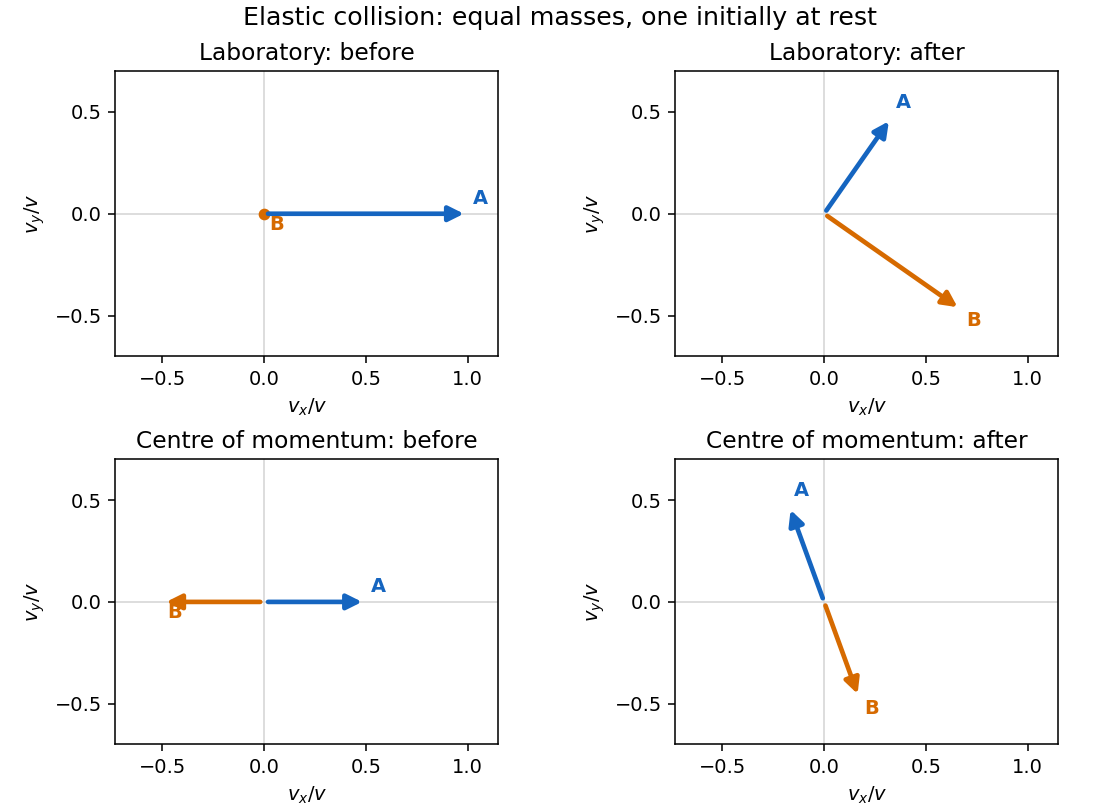
Original velocity-vector construction for an equal-mass elastic collision, before and after impact in the laboratory and centre-of-momentum frames
. Details. For this adhesive collision of two equal discs, use the parallel axis theorem about the midpoint of the touching centres:Its magnitude is . Linear and angular momentum conservation giveThe rotation has the sign of , clockwise for the printed geometry. The energy loss is . After impact the midpoint translates uniformly and the rigid pair rotates uniformly about it: there are no external horizontal forces or axial torques.
Rough unglued edges can transmit a tangential impulse and generate angular momentum about the individual disc centres. The centre-of-mass velocity and total angular momentum still have the values above, but individual translational speeds, angular velocities and energy loss require a friction/contact law and normal restitution. Roughness alone does not imply permanent sticking or the adhesive result.
Pinned article: Introduction to the OurBigBook Project
Welcome to the OurBigBook Project! Our goal is to create the perfect publishing platform for STEM subjects, and get university-level students to write the best free STEM tutorials ever.
Everyone is welcome to create an account and play with the site: ourbigbook.com/go/register. We belive that students themselves can write amazing tutorials, but teachers are welcome too. You can write about anything you want, it doesn't have to be STEM or even educational. Silly test content is very welcome and you won't be penalized in any way. Just keep it legal!
Intro to OurBigBook
. Source. We have two killer features:
- topics: topics group articles by different users with the same title, e.g. here is the topic for the "Fundamental Theorem of Calculus" ourbigbook.com/go/topic/fundamental-theorem-of-calculusArticles of different users are sorted by upvote within each article page. This feature is a bit like:
- a Wikipedia where each user can have their own version of each article
- a Q&A website like Stack Overflow, where multiple people can give their views on a given topic, and the best ones are sorted by upvote. Except you don't need to wait for someone to ask first, and any topic goes, no matter how narrow or broad
This feature makes it possible for readers to find better explanations of any topic created by other writers. And it allows writers to create an explanation in a place that readers might actually find it.
Figure 1. Screenshot of the "Derivative" topic page. View it live at: ourbigbook.com/go/topic/derivativeVideo 2. OurBigBook Web topics demo. Source. - local editing: you can store all your personal knowledge base content locally in a plaintext markup format that can be edited locally and published either:This way you can be sure that even if OurBigBook.com were to go down one day (which we have no plans to do as it is quite cheap to host!), your content will still be perfectly readable as a static site.
- to OurBigBook.com to get awesome multi-user features like topics and likes
- as HTML files to a static website, which you can host yourself for free on many external providers like GitHub Pages, and remain in full control

Figure 2. You can publish local OurBigBook lightweight markup files to either OurBigBook.com or as a static website.
Figure 3. Visual Studio Code extension installation.
Figure 5. . You can also edit articles on the Web editor without installing anything locally. Video 3. Edit locally and publish demo. Source. This shows editing OurBigBook Markup and publishing it using the Visual Studio Code extension. 
- Infinitely deep tables of contents:




All our software is open source and hosted at: github.com/ourbigbook/ourbigbook
Further documentation can be found at: docs.ourbigbook.com
Feel free to reach our to us for any help or suggestions: docs.ourbigbook.com/#contact