Topics (384k) Articles (398k) Users (410) Discussions (242) Comments (383) Files (13k) New article

A lipid-anchored protein attaches through a covalently linked lipid. The anchor inserts into the lipid bilayer; the polypeptide chain need not cross it. This is a description of attachment rather than a synonym for transmembrane protein.[ref]
Cell Membranes. The Cell: A Molecular Approach, 2nd edition by Geoffrey M. Cooper; Cell Membranes, Membrane Proteins: covalently attached lipid anchors on either membrane face
A peripheral membrane protein associates with a membrane face through noncovalent interactions, without spanning its hydrophobic interior. Association with another membrane protein can suffice; peripheral describes attachment, not an unimportant function.[ref]
Membrane Proteins. Molecular Biology of the Cell, 4th edition by Bruce Alberts and others; Membrane Proteins Can Be Associated with the Lipid Bilayer in Various Ways: noncovalent attachment and peripheral proteins
An integral membrane protein is firmly incorporated into a membrane, commonly through contact with the hydrophobic interior of the lipid bilayer. Extraction behavior is an operational distinction: it resists treatments that remove many peripheral membrane proteins. Transmembrane proteins are one class; integral does not mean spanning.[ref]
Membrane Proteins. Molecular Biology of the Cell, 4th edition by Bruce Alberts and others; Membrane Proteins Can Be Associated with the Lipid Bilayer in Various Ways, Figure 10-17 and extraction-based distinction
A mechanical configuration specifies the positions and orientations of all parts of a system, subject to its constraints. It is a point of the mechanical configuration space ; generalized coordinates label such points locally. A configuration does not by itself specify velocities, so it generally does not determine the system's full dynamical state. For a bead on a fixed circular hoop, its angle specifies its configuration, while its angular velocity is additional data.
The Weiss molecular field replaces exchange coupling to neighbouring moments by an effective local field proportional to the average magnetization. For two-state moments and , self-consistency gives at zero applied field, where and , with . This field represents a quantum exchange energy, not generally the actual magnetostatic field generated by the moments.
A solution is unique when any two objects satisfying the stated conditions are equal. This is an at-most-one assertion; existence is a separate requirement. A common proof assumes two solutions, subtracts their equations, and proves that their difference vanishes. For a linear differential equation this turns the task into a homogeneous problem with zero boundary or initial data.
A solution exists when at least one object satisfies all the stated conditions. In first-order logic, this is expressed by existential quantification. Uniqueness additionally requires that any two solutions are equal.
A description of how mass is assigned to positions, expressed for example by point masses, a mass density, or a measure. Writing allows centre of mass and moment of inertia formulas to cover both discrete and continuous cases.
In Newtonian mechanics, inertial mass is the coefficient in , measuring a body's response to a net force. The weak equivalence principle makes its ratio to passive gravitational mass universal; choosing compatible units then sets the two equal.
Passive gravitational mass is the coefficient in for an imposed Newtonian gravitational field. Active gravitational mass instead measures a body's contribution to the source of that field in Newton's law of universal gravitation. Universality of the ratio of passive gravitational mass to inertial mass is the Newtonian content of the weak equivalence principle. In general relativity, the source is the full stress-energy tensor, rather than a single scalar gravitational mass.
The 1955 paper by James Power Gordon, Herbert Jack Zeiger and Charles Hard Townes acknowledged Nikolay Basov and Aleksandr Prokhorov's independent proposal.[ref]
The Maser—New Type of Microwave Amplifier, Frequency Standard, and Spectrometer by James Power Gordon and others. p. 1264, Introduction and reference 2
The latter authors' theory paper states that they presented the molecular-generator possibility in May 1952, cites their 1954 publication, and separately cites the Gordon–Zeiger–Townes experimental realization. These are contributions from independent groups.[ref]Theory of the Molecular Generator and Molecular Power Amplifier by Nicolay Gennadiyevich Basov and Aleksandr Mikhailovich Prokhorov. p. 426, historical footnote and references 3–4; manuscript submitted December 10, 1954, English publication October 1956
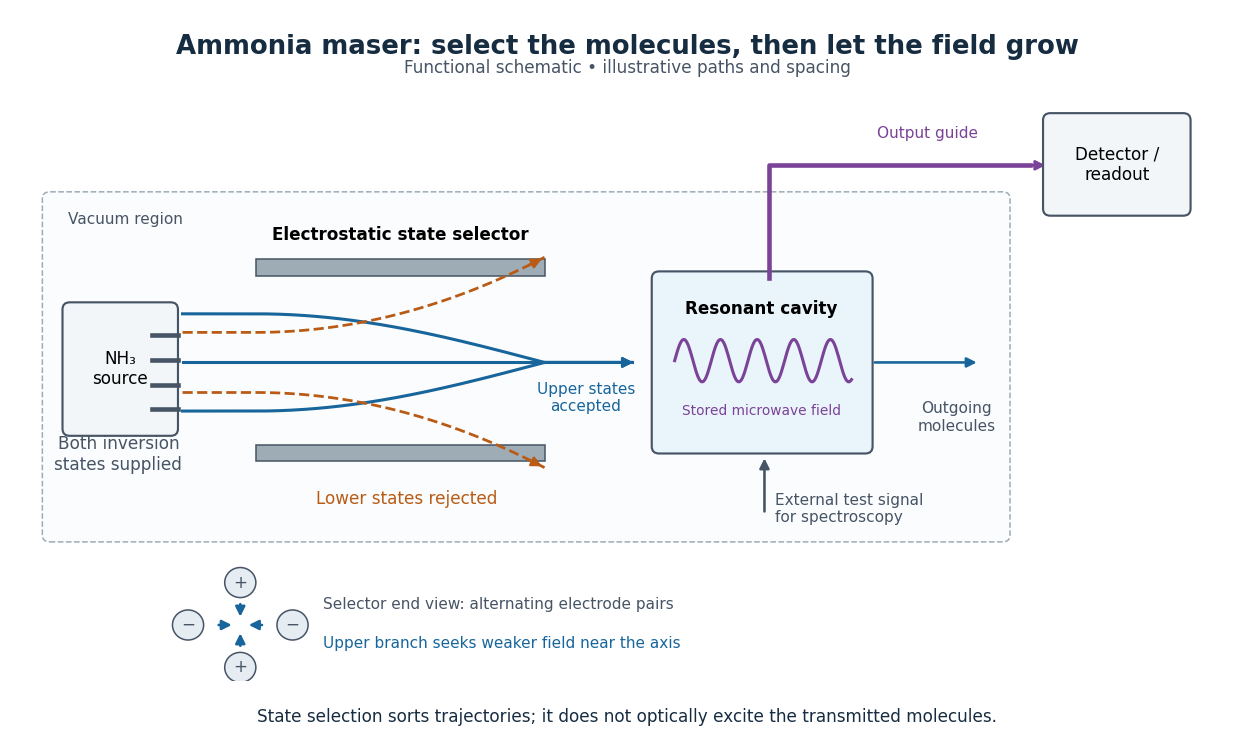
An ammonia maser uses an Ammonia molecular beam, maser state selection and a maser cavity to obtain amplification or sustained microwave oscillation. In the 1954 experiment by James Power Gordon, Herbert Jack Zeiger and Charles Hard Townes, a quadrupolar static electric field focused upper-state molecules toward the cavity and deflected lower-state molecules away. The reported ammonia inversion transition lies near .[ref]
Molecular Microwave Oscillator and New Hyperfine Structure in the Microwave Spectrum of NH3 by James Power Gordon and others. pp. 282–283, Fig. 1 and Fig. 2 caption; 23 870 Mc/sec
A hydrogen maser uses a ground-state hyperfine structure transition of the hydrogen atom to provide a stable microwave signal. A beam source and magnetic state selector prepare a favorable atomic population; a storage bulb within a microwave resonator lets atoms interact with the field for an extended time.
An active device sustains oscillation through stimulated emission, while a passive arrangement interrogates the atomic response with an external signal. Long interrogation supports a narrow frequency reference, but magnetic shifts, wall interactions and cavity resonance still affect its measured output. Short-term stability and long-term accuracy are different properties. [ref]
https://www.nist.gov/pml/time-and-frequency-division/popular-links/time-frequency-z/time-and-frequency-z-h. NIST Time and Frequency from A to Z, Hydrogen maser: atomic transition, stability and cavity-frequency drift
Pinned article: Introduction to the OurBigBook Project
Welcome to the OurBigBook Project! Our goal is to create the perfect publishing platform for STEM subjects, and get university-level students to write the best free STEM tutorials ever.
Everyone is welcome to create an account and play with the site: ourbigbook.com/go/register. We belive that students themselves can write amazing tutorials, but teachers are welcome too. You can write about anything you want, it doesn't have to be STEM or even educational. Silly test content is very welcome and you won't be penalized in any way. Just keep it legal!
Intro to OurBigBook
. Source. We have two killer features:
- topics: topics group articles by different users with the same title, e.g. here is the topic for the "Fundamental Theorem of Calculus" ourbigbook.com/go/topic/fundamental-theorem-of-calculusArticles of different users are sorted by upvote within each article page. This feature is a bit like:
- a Wikipedia where each user can have their own version of each article
- a Q&A website like Stack Overflow, where multiple people can give their views on a given topic, and the best ones are sorted by upvote. Except you don't need to wait for someone to ask first, and any topic goes, no matter how narrow or broad
This feature makes it possible for readers to find better explanations of any topic created by other writers. And it allows writers to create an explanation in a place that readers might actually find it.
Figure 1. Screenshot of the "Derivative" topic page. View it live at: ourbigbook.com/go/topic/derivativeVideo 2. OurBigBook Web topics demo. Source. - local editing: you can store all your personal knowledge base content locally in a plaintext markup format that can be edited locally and published either:This way you can be sure that even if OurBigBook.com were to go down one day (which we have no plans to do as it is quite cheap to host!), your content will still be perfectly readable as a static site.
- to OurBigBook.com to get awesome multi-user features like topics and likes
- as HTML files to a static website, which you can host yourself for free on many external providers like GitHub Pages, and remain in full control

Figure 2. You can publish local OurBigBook lightweight markup files to either OurBigBook.com or as a static website.
Figure 3. Visual Studio Code extension installation.
Figure 5. . You can also edit articles on the Web editor without installing anything locally. Video 3. Edit locally and publish demo. Source. This shows editing OurBigBook Markup and publishing it using the Visual Studio Code extension. 
- Infinitely deep tables of contents:



All our software is open source and hosted at: github.com/ourbigbook/ourbigbook
Further documentation can be found at: docs.ourbigbook.com
Feel free to reach our to us for any help or suggestions: docs.ourbigbook.com/#contact