Topics (384k) Articles (398k) Users (410) Discussions (242) Comments (383) Files (13k) New article

The physics course entries follow the Cavendish Laboratory's 2025–26 teaching list.[ref]
https://www.phy.cam.ac.uk/study/undergraduate/undergraduate-courses/. Undergraduate Courses: course list and academic-year notice
Past examination papers: Physics Teaching Information System past-paper search (University sign-in required). Specific paper years and their solution availability must be checked inside the system.
A public release includes physics papers for 2017–2019 and 2021–2022, with examiner reports and some answers. [ref]
https://www.whatdotheyknow.com/request/natural_science_tripos_physics_e. Cambridge freedom-of-information response, 20 September 2022
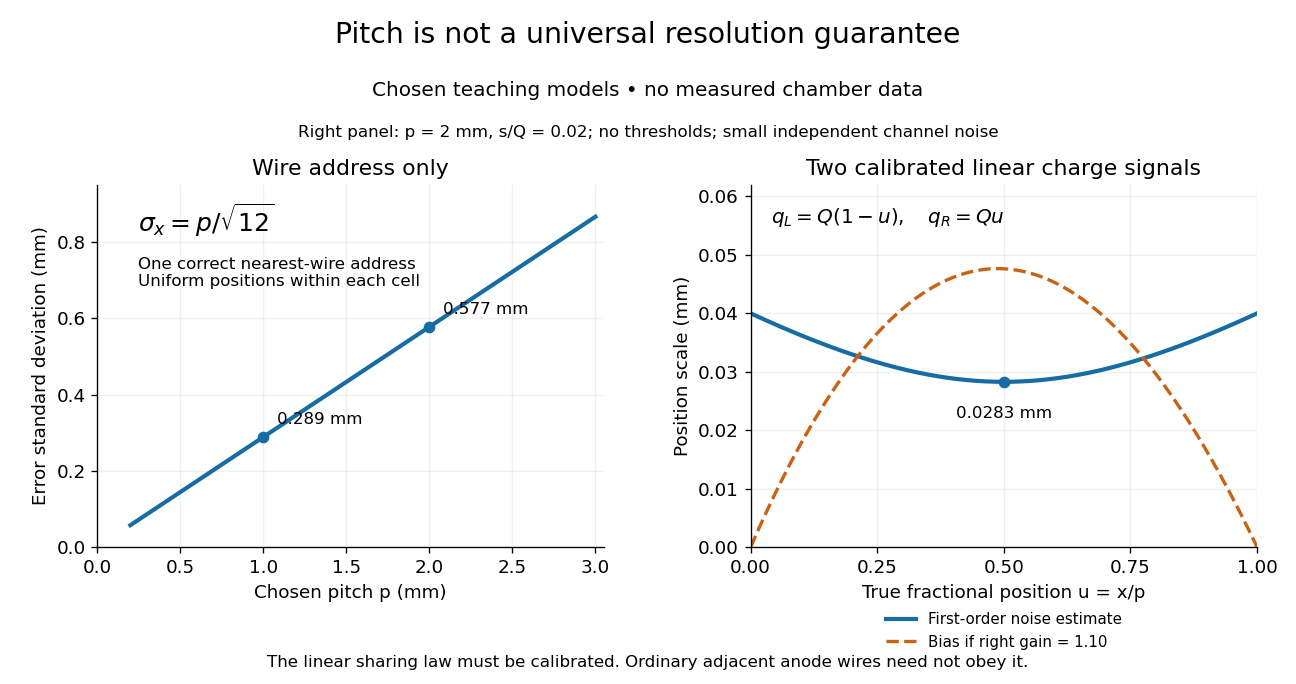
Can two readout values locate a hit between wires? Only with a specified response model. Place two readout wires at and , put , and stipulate calibrated, noiseless electric chargesThese are assumptions for a toy sensor response, not the natural response law of adjacent anode wires. Under these assumptions the centroidrecovers position exactly. The apparent gain in precision comes from adding calibrated analogue information. Taking the mean of two fired wire addresses without their electric charges would instead give the fixed midpoint .
For a chosen noise model, replace the two electric charges by and , with independent random variables of zero expected value and common standard deviation . Assume and no threshold censoring. First-order expansion of the ratio givesFor stipulated and , this approximation gives at the midpoint and at either endpoint. The endpoint values describe uncensored signed channel readouts, including small negative values after baseline subtraction. They do not assume that both channels would pass a positive threshold. A ratio with a fluctuating denominator also need not have exactly zero bias; this is a local small-noise approximation.
Three original counterexamples show why calibration and selection matter:
- If the right channel retains a relative gain , then . At , the bias is for the chosen pitch, larger than the midpoint noise estimate above.
- Suppose symmetric electronic leakage transforms the normalized right signal to . Treating as gives a position bias . A known permits inversion; destroys position information entirely. This is a stipulated crosstalk model, not a measurement.
- Requiring both noiseless channels to exceed accepts only : of uniformly distributed hits. Computing a position spread after that cut describes a selected sample. It does not establish improved spatial resolution for all incident hits.
Likewise, two equal hits at and have exactly the same total two-channel response as one hit at with twice the electric charge. A centroid can hide multiplicity even when each charge measurement is exact.
Consider an original idealized track reconstruction model. Let equally spaced wires have positions and assign each event to the nearest wire, reporting . Assume exactly one correct wire address, perfect detection efficiency, exact wire positions and a uniform distribution of true positions within each cell. These assumptions explicitly exclude missed pulses, false addresses and several unresolved tracks.
Writing , the measurement error is , with uniform on . Symmetry gives zero expected value. Its variance and standard deviation follow by integration:For chosen wire pitches and this gives and respectively. These are model standard deviations, not measured chamber spatial resolutions. The largest possible absolute error in this model is , which is a different quantity.
A useful subtlety is that the formula depends on the illumination. For an unresolved pencil beam fixed at , every reconstructed position is . The repeated estimates have zero variance, but every error is . Small repeat-to-repeat spread can coexist with a biased position. The uniform-cell result therefore cannot be transferred to an arbitrary beam profile or detector selection.
The wire address supplies one transverse coordinate in this model. Combining several separated measurements supports track reconstruction; a single address does not specify a complete trajectory. If two charged particles enter the same cell during one accepted interval, an address-only record can be identical to that from one particle. No reconstruction of that record can recover the lost multiplicity without additional information.
The original apparatus used stainless-steel wires between meshes away, flowing argon with organic vapor, negative mesh voltage and individual electronic amplifiers. A X-ray source calibrated pulse height while voltage was varied.[ref]
A coincidence circuit defined a narrow proton or pion beam. Scanning it across wires tested localization; the response edge matched the beam width, limiting the inference. Distant counts were attributed to accidental coincidences. Separate electron scans measured pulse delay versus position, comparing gas mixtures and pulse-height-dependent electronics.[ref]
Thresholds rejected small pulses, reducing detection efficiency. Wire-independence tests did not establish unlimited separation of overlapping tracks.[ref]
Multiple Coulomb scattering is the accumulated deflection of a charged particle passing through matter, mainly through repeated Rutherford scattering by atomic nuclei. Many small deflections broaden a beam or make a reconstructed particle track wander. A roughly Gaussian distribution describes the central angular core in a useful regime, while rarer large-angle encounters produce tails.[ref]
Passage of Particles Through Matter by Donald E. Groom and Spencer Klein. §34.3, Multiple scattering through small angles: nuclear Coulomb deflections, Gaussian core and non-Gaussian tails
The angular width increases with traversed material and decreases as particle momentum increases. It is commonly parameterized using material thickness relative to the radiation length. In a particle detector, adding measurement layers can improve position sampling while also increasing Multiple Coulomb scattering; track precision therefore depends on material as well as sensor accuracy. A width projected onto one measurement plane must be distinguished from the full spatial deflection angle.
A vector space whose coordinates are the components of a particle's momentum; a distribution in momentum space describes momenta rather than positions.
For an integer , add residue classes by adding their representatives and taking the class modulo . This is well-defined because replacing either representative by a multiple-of- translate changes the sum by a multiple of . The associativity, identity class and inverse are inherited from integer addition. The result is the additive cyclic group .
Respiratory control can be investigated outside an intact biological cell by supplying isolated mitochondria with substrates and ADP. This makes the boundary between oxygen consumption and ATP formation experimentally accessible. The historical mitochondrial oxygen electrode assay describes the 1955 experiment; the following authored protocol adds modern preparation and inhibitor controls.
In Functional Assessment of Isolated Mitochondria In Vitro (2009), Ian R. Lanza and K. Sreekumaran Nair describe human skeletal-muscle biopsy mincing, cold protease treatment, homogenization and differential centrifugation. A low-speed spin removes coarse material; subsequent spins collect and wash mitochondria. A stirred, closed Oxygraph-2k chamber at uses a calibrated polarographic oxygen electrode. Its signal gives dissolved oxygen concentration; the negative time derivative gives consumption. Instrument corrections include electrode consumption and oxygen leakage.[ref]
Functional Assessment of Isolated Mitochondria In Vitro. Methods in Enzymology, volume 457: Mitochondrial Function, Part B; Tissue homogenization; Separation of mitochondria by differential centrifugation; Mitochondrial respiration, Overview; An oxygraph protocol for mitochondrial assessment, steps 1–2
Their additions include glutamate plus malate, an ADP pulse, then saturating ADP. Added cytochrome c tests outer-membrane damage: stimulation suggests loss of endogenous cytochrome c. Later oligomycin inhibits ATP synthase; FCCP produces respiratory uncoupling; antimycin A inhibits respiratory complex III to estimate residual background. Figure 6 includes intervening succinate dehydrogenase and respiratory complex I interventions; the modeled traces below simplify that sequence. Isolation can damage or select mitochondria, and saturating assay conditions differ from those in living biological tissue.[ref]
The control logic matters more than a single steep slope. If ADP accelerates consumption and a finite pulse is followed by slowing, demand is affecting respiratory flux. If oligomycin slows consumption, but subsequent FCCP accelerates it, the electron transport chain can still turn over while ATP synthase remains inhibited. That contrast separates restricted coupled turnover from a completely inactive chain. Failure of FCCP to restore a rate is less specific: substrate limitation, damage, low oxygen or excessive uncoupler can also restrict respiration.
Neither the cytochrome c test alone nor a large respiratory control ratio establishes every aspect of mitochondrial integrity. Likewise, oxygen consumption is not a direct ATP assay: respiratory uncoupling provides a concrete counterexample. The preparation, additions and normalization denominator determine what comparison the experiment can support.
The outer mitochondrial membrane separates the surrounding cytosol from the intermembrane space. Channels permit passage of many small molecules, while the inner mitochondrial membrane supplies the main selective barrier between them and the mitochondrial matrix.[ref]
Molecular Biology of the Cell, 4th edition by Bruce Alberts and others. Chapter 14, The Mitochondrion Contains an Outer Membrane, an Inner Membrane, and Two Internal Compartments: outer-membrane channels and inner-membrane selectivity
Small-solute access does not imply unrestricted access for proteins. The cytochrome c addition in the isolated mitochondria respiration experiment tests a consequence of damage to this boundary. Organelle protein import describes purposeful delivery across mitochondrial boundaries.
In a mitochondrion, the intermembrane space lies between the outer mitochondrial membrane and inner mitochondrial membrane, extending into the interiors of cristae. It includes the side of the inner mitochondrial membrane from which protons return through ATP synthase to the mitochondrial matrix.
A useful sidedness check is to follow a single arrow: outward pumping goes from green to yellow in the diagram, while coupled return goes from yellow to green. These are opposing movements of protons, not a circuit in which electrons return through ATP synthase. The mitochondrial respiratory chain and chemiosmosis articles distinguish the two ledgers.
The mitochondrial matrix is the compartment enclosed by the inner mitochondrial membrane, containing mitochondrial DNA, ribosomes and many enzymes. Most citric acid cycle steps occur here; succinate dehydrogenase is membrane-associated. The citric acid cycle supplies NADH for the mitochondrial respiratory chain.[ref]
Molecular Biology of the Cell, 4th edition by Bruce Alberts and others. Chapter 14, The Mitochondrion Contains an Outer Membrane, an Inner Membrane, and Two Internal Compartments; Figure 14-8, matrix enzymes and inner-membrane succinate dehydrogenase
Distinguish the location of a chemical reaction from the location of its detection. An external oxygen electrode can report consumption by an intact preparation without entering the mitochondrial matrix. That signal does not locate every intermediate, establish protein targeting or directly count newly formed ATP.
The inner mitochondrial membrane separates mitochondrial matrix from intermembrane space. Its selective permeability permits distinct chemical conditions, while embedded mitochondrial respiratory chain proteins and ATP synthase support oxidative phosphorylation. Cristae increase its surface area.[ref]
Molecular Biology of the Cell, 4th edition by Bruce Alberts and others. Chapter 14, The Mitochondrion Contains an Outer Membrane, an Inner Membrane, and Two Internal Compartments; Figure 14-8
A selective boundary and a productive enzyme have different jobs. Even active respiratory enzymes cannot sustain a useful electrochemical gradient if protons return freely across the boundary. Conversely, an intact boundary without an electron donor does not supply the energy for continued pumping. The isolated mitochondria respiration experiment separates some of these dependencies by additions to the same preparation.
For a two-body W boson decay into a charged lepton and a neutrino, neglect both daughter masses and use natural units . Let be the angle between the daughter transverse momenta. Identifying the missing transverse momentum with the neutrino's givesThis observable uses no . The 1983 UA1 experiment paper already used transverse mass as a lower bound on parent mass, before making additional decay-model assumptions for a mass estimate.[ref]
The bound follows directly from the energy–momentum relation. For each massless daughter write its four-momentum, using rapidity and azimuth , asUsing the Minkowski inner product with positive time sign, , the two daughter four-momenta give the true parent invariant mass :Since , , with equality at equal daughter rapidities when both transverse momenta are nonzero. Thus the unmeasured longitudinal information can enlarge the true invariant mass, but cannot lower it below this ideal transverse mass.
For an original example, stipulate and . Then . Equal rapidities give ; choosing with exactly the same transverse readout gives . One measured transverse configuration therefore permits different true parent masses.
Pinned article: Introduction to the OurBigBook Project
Welcome to the OurBigBook Project! Our goal is to create the perfect publishing platform for STEM subjects, and get university-level students to write the best free STEM tutorials ever.
Everyone is welcome to create an account and play with the site: ourbigbook.com/go/register. We belive that students themselves can write amazing tutorials, but teachers are welcome too. You can write about anything you want, it doesn't have to be STEM or even educational. Silly test content is very welcome and you won't be penalized in any way. Just keep it legal!
Intro to OurBigBook
. Source. We have two killer features:
- topics: topics group articles by different users with the same title, e.g. here is the topic for the "Fundamental Theorem of Calculus" ourbigbook.com/go/topic/fundamental-theorem-of-calculusArticles of different users are sorted by upvote within each article page. This feature is a bit like:
- a Wikipedia where each user can have their own version of each article
- a Q&A website like Stack Overflow, where multiple people can give their views on a given topic, and the best ones are sorted by upvote. Except you don't need to wait for someone to ask first, and any topic goes, no matter how narrow or broad
This feature makes it possible for readers to find better explanations of any topic created by other writers. And it allows writers to create an explanation in a place that readers might actually find it.
Figure 1. Screenshot of the "Derivative" topic page. View it live at: ourbigbook.com/go/topic/derivativeVideo 2. OurBigBook Web topics demo. Source. - local editing: you can store all your personal knowledge base content locally in a plaintext markup format that can be edited locally and published either:This way you can be sure that even if OurBigBook.com were to go down one day (which we have no plans to do as it is quite cheap to host!), your content will still be perfectly readable as a static site.
- to OurBigBook.com to get awesome multi-user features like topics and likes
- as HTML files to a static website, which you can host yourself for free on many external providers like GitHub Pages, and remain in full control

Figure 2. You can publish local OurBigBook lightweight markup files to either OurBigBook.com or as a static website.
Figure 3. Visual Studio Code extension installation.
Figure 5. . You can also edit articles on the Web editor without installing anything locally. Video 3. Edit locally and publish demo. Source. This shows editing OurBigBook Markup and publishing it using the Visual Studio Code extension. 
- Infinitely deep tables of contents:



All our software is open source and hosted at: github.com/ourbigbook/ourbigbook
Further documentation can be found at: docs.ourbigbook.com
Feel free to reach our to us for any help or suggestions: docs.ourbigbook.com/#contact