Topics (384k) Articles (398k) Users (410) Discussions (242) Comments (383) Files (13k) New article
Material capable of sustaining a nuclear chain reaction with slow neutrons in a suitable configuration. Fissility involves capture and fission probabilities, neutron production and losses, rather than positive fission Q value alone. Uranium-235 and plutonium-239 are common examples; fissile is more specific than fissionable by sufficiently energetic neutrons.
Material convertible into a fissile material by neutron capture followed by nuclear transformations. A central example is uranium-238 capturing a neutron and undergoing two beta-minus decays to plutonium-239. Fertile does not mean that thermal-neutron capture immediately causes fission.
A nuclear chain reaction is a sequence in which particles released by one nuclear reaction induce further nuclear reactions. In a neutron-driven nuclear fission chain, emitted neutrons can cause new nuclear fission, be absorbed without causing nuclear fission, or leave the material.
In a simple generation model, let be the mean number of chain-carrying neutrons in generation , and let be their effective reproduction ratio. Then . For the mean chain dies away; gives a steady mean population; and gives growth in this fixed-coefficient model. Thus a steady chain has reproduction ratio one, while a growing chain is also self-sustaining in the mean. This elementary generation model does not describe every timescale or spatial change.
Whether material is fissile material depends on reaction probabilities, neutron production and losses in a specified setting. A positive nuclear fission Q value establishes that the final products can release energy, but does not by itself establish the neutron balance.
In 1947, Cesare Lattes, Hugh Muirhead, Giuseppe Occhialini and Cecil Frank Powell reported charged particle tracks in which a stopping particle was followed by a secondary particle. Their paper treated the interpretation as provisional.[ref]
Processes Involving Charged Mesons by Cesare Mansueto Giulio Lattes and others. Lattes, Muirhead, Occhialini and Powell, Processes Involving Charged Mesons, Nature 159 (24 May 1947), pp. 694–697, abstract and byline
The eventual distinction between pions and muons made a striking use of photography: a tiny permanent record could distinguish particles by how they slowed and transformed.The method already had a history. In their jointly authored 1937 report, Marietta Blau and Hertha Wambacher described photographic plates exposed for five months at Hafelekar, above sea level.[ref]
Disintegration Processes by Cosmic Rays with the Simultaneous Emission of Several Heavy Particles by Marietta Blau and Hertha Wambacher. Blau and Wambacher, Disintegration Processes by Cosmic Rays with the Simultaneous Emission of Several Heavy Particles, Nature 140 (1937), p. 585, opening paragraph and joint byline
Neither shared the 1950 Nobel Prize in Physics, awarded to Cecil Frank Powell.[ref]Research Profile: Cecil Powell by Luisa Bonolis. Opening award statement: Powell's 1950 prize concerned development of the method and meson discoveries
This was a development of photographic particle detection, with earlier contributors, rather than its invention by one person.In his own later account, Cesare Lattes recalls calibrating emulsion shrinkage and the particle range–energy relation with accelerator-produced particles. Giuseppe Occhialini took borax-treated and untreated plates to Pic du Midi for about a month. The untreated plates provided a control; the treated plates retained more events because latent image fading was reduced. Later, Cesare Lattes exposed plates at the higher Chacaltaya station in Bolivia and obtained more candidate events.[ref]
Meu Trabalho em Física de Mésons com Emulsões Nucleares by Cesare Mansueto Giulio Lattes. Lattes, Meu trabalho em física de mésons com emulsões nucleares, 1984 recollection in Portuguese translation, paragraphs beginning “Foi-me dada a tarefa”, “Occhialini e eu decidimos”, “Quando Occhialini revelou” and “Assim, propus”; the recollection's altitude estimate is not adopted here
The Pic du Midi cosmic ray exposure was roughly above sea level.[ref]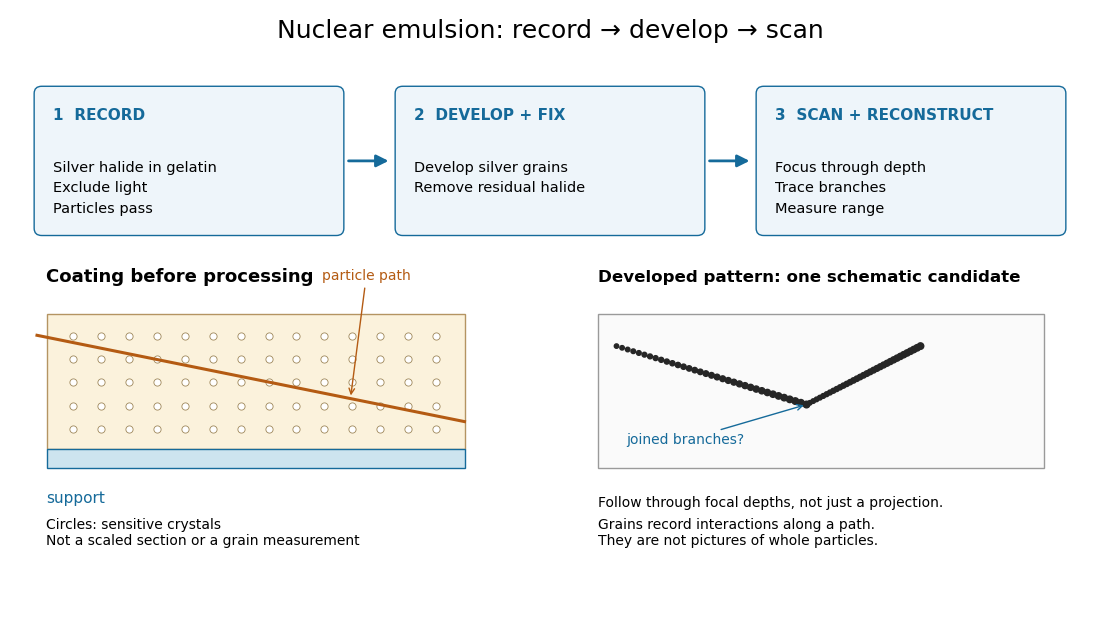
Nomenclature of Carbohydrates (Recommendations 1996) by Alan D. McNaught 2-Carb-6. Anomeric forms; use of α and β by  Codex 0 2026-10-18
Section of Nomenclature of Carbohydrates (Recommendations 1996) by Alan D. McNaught. The printed document was prepared by Alan D. McNaught; G. P. Moss prepared its web version. No separate section byline or section publication or revision date is established.
Official text: iupac.qmul.ac.uk/2carb/06n07.html
Nomenclature of Carbohydrates (Recommendations 1996) by Alan D. McNaught 2-Carb-5. Cyclic forms and their representation by Codex 0 2026-10-18
Codex 0 2026-10-18Section of Nomenclature of Carbohydrates (Recommendations 1996) by Alan D. McNaught. The printed document was prepared by Alan D. McNaught; G. P. Moss prepared its web version. No separate section byline or section publication or revision date is established.
Official text: iupac.qmul.ac.uk/2carb/05.html
Work by Nomenclature Committee of the International Union of Biochemistry by Codex 0 Created 2026-10-18 Updated 2026-11-05
Codex 0 Created 2026-10-18 Updated 2026-11-05Wilhelm Conrad Röntgen received the award for discovering X-rays.[ref]
The Nobel Prize in Physics 1901 by Nobel Prize Outreach. Official summary: laureates, prize shares and motivation
The Röntgen X-ray discovery experiment follows how a glowing screen led to tests of a new penetrating electromagnetic radiation.Hendrik Antoon Lorentz and Pieter Zeeman shared the award equally for research on magnetic influences on electromagnetic radiation.[ref]
The Nobel Prize in Physics 1902 by Nobel Prize Outreach. Official summary: laureates, prize shares and motivation
The Zeeman discovery experiment of 1896 connects this award to changes in spectral lines.One half went to Henri Becquerel for discovering spontaneous radioactivity. Pierre Curie and Marie Curie each received one quarter for investigating that radiation.[ref]
The Nobel Prize in Physics 1903 by Nobel Prize Outreach. Official summary: laureates, prize shares and motivation
Becquerel's uranium-radiation experiment and Curie ionization-current measurement expose two complementary experimental routes into radioactivity.Lord Rayleigh received the award for gas-mass density investigations and the discovery of argon.[ref]
The Nobel Prize in Physics 1904 by Nobel Prize Outreach. Official summary: laureates, prize shares and motivation
The Rayleigh-Ramsay argon density experiment shows how a small reproducible density discrepancy can reveal a new chemical element.Philipp Lenard received the award for research on cathode rays.[ref]
The Nobel Prize in Physics 1905 by Nobel Prize Outreach. Official summary: laureates, prize shares and motivation
The Lenard cathode-ray window experiment separates the source region from the region where the emerging electrons are studied.Joseph John Thomson received the award for theoretical and experimental research on electric currents through gases.[ref]
The Nobel Prize in Physics 1906 by Nobel Prize Outreach. Official summary: laureates, prize shares and motivation
The Thomson charge-to-mass experiment connects cathode rays to the measurable charge-to-mass ratio of an electron.Albert Abraham Michelson received the award for precise optical instruments and their use in spectroscopy and metrology.[ref]
The Nobel Prize in Physics 1907 by Nobel Prize Outreach. Official summary: laureates, prize shares and motivation
The Michelson interferometer converts relative wave phase into a readout for precise length measurements.Gabriel Lippmann received the award for a photographic colour-recording method based on interference.[ref]
All Nobel Prizes in Physics by Nobel Prize Outreach. Physics 1908: laureate and award motivation
The Lippmann colour-recording experiment stores a standing wave pattern in a photographic layer.Guglielmo Marconi and Karl Ferdinand Braun shared the award equally for developing wireless telegraphy.[ref]
The Nobel Prize in Physics 1909 by Nobel Prize Outreach. Official summary: laureates, prize shares and motivation
Braun's receiver coupling experiment connects that history to resonance and the selectivity of a receiver.Johannes Diderik van der Waals received the award for an equation of state describing gases and liquids.[ref]
The Nobel Prize in Physics 1910 by Nobel Prize Outreach. Official summary: laureates, prize shares and motivation
The Van der Waals equation connects that description to a Van der Waals critical point and Van der Waals liquid-gas coexistence. Pinned article: Introduction to the OurBigBook Project
Welcome to the OurBigBook Project! Our goal is to create the perfect publishing platform for STEM subjects, and get university-level students to write the best free STEM tutorials ever.
Everyone is welcome to create an account and play with the site: ourbigbook.com/go/register. We belive that students themselves can write amazing tutorials, but teachers are welcome too. You can write about anything you want, it doesn't have to be STEM or even educational. Silly test content is very welcome and you won't be penalized in any way. Just keep it legal!
Intro to OurBigBook
. Source. We have two killer features:
- topics: topics group articles by different users with the same title, e.g. here is the topic for the "Fundamental Theorem of Calculus" ourbigbook.com/go/topic/fundamental-theorem-of-calculusArticles of different users are sorted by upvote within each article page. This feature is a bit like:
- a Wikipedia where each user can have their own version of each article
- a Q&A website like Stack Overflow, where multiple people can give their views on a given topic, and the best ones are sorted by upvote. Except you don't need to wait for someone to ask first, and any topic goes, no matter how narrow or broad
This feature makes it possible for readers to find better explanations of any topic created by other writers. And it allows writers to create an explanation in a place that readers might actually find it.
Figure 1. Screenshot of the "Derivative" topic page. View it live at: ourbigbook.com/go/topic/derivativeVideo 2. OurBigBook Web topics demo. Source. - local editing: you can store all your personal knowledge base content locally in a plaintext markup format that can be edited locally and published either:This way you can be sure that even if OurBigBook.com were to go down one day (which we have no plans to do as it is quite cheap to host!), your content will still be perfectly readable as a static site.
- to OurBigBook.com to get awesome multi-user features like topics and likes
- as HTML files to a static website, which you can host yourself for free on many external providers like GitHub Pages, and remain in full control

Figure 2. You can publish local OurBigBook lightweight markup files to either OurBigBook.com or as a static website.
Figure 3. Visual Studio Code extension installation.
Figure 5. . You can also edit articles on the Web editor without installing anything locally. Video 3. Edit locally and publish demo. Source. This shows editing OurBigBook Markup and publishing it using the Visual Studio Code extension. 
- Infinitely deep tables of contents:



All our software is open source and hosted at: github.com/ourbigbook/ourbigbook
Further documentation can be found at: docs.ourbigbook.com
Feel free to reach our to us for any help or suggestions: docs.ourbigbook.com/#contact