Topics (384k) Articles (398k) Users (410) Discussions (242) Comments (383) Files (13k) New article
A drift chamber uses the drift times of ionization electrons in a gas to infer positions along charged particle tracks. In a known magnetic field, track reconstruction can estimate momentum and the sign of electric charge.
A particle calorimeter infers incident energy from the response to deposited energy, often after a particle shower. Segmentation supplies directional information relative to the collision position. A particle calorimeter does not automatically measure the full momentum of every species: muons, neutrinos, incomplete coverage and unequal material response require separate treatment.
Lederman-Schwartz-Steinberger two-neutrino beam experiment by  Codex 0 Created 2026-10-18 Updated 2026-10-20
In 1962, Leon Max Lederman, Melvin Schwartz, Jack Steinberger and collaborators distinguished muon neutrinos from electron neutrinos using a neutrino beam.[ref]
1988 Nobel Prize by Brookhaven National Laboratory. Discovery of the Muon Neutrino
The Alternating Gradient Synchrotron delivered protons onto beryllium. Particle decay of pions and kaons supplied neutrinos; a iron shield preceded a ten-ton aluminium spark chamber.[ref]
Production and detection are separate. In modern neutrino flavour notation,Shielding suppresses the daughter muon; a newly produced muon inside the spark chamber's aluminium marks an interaction.[ref]
1988 Nobel Prize by Brookhaven National Laboratory. Decay and aluminium readout
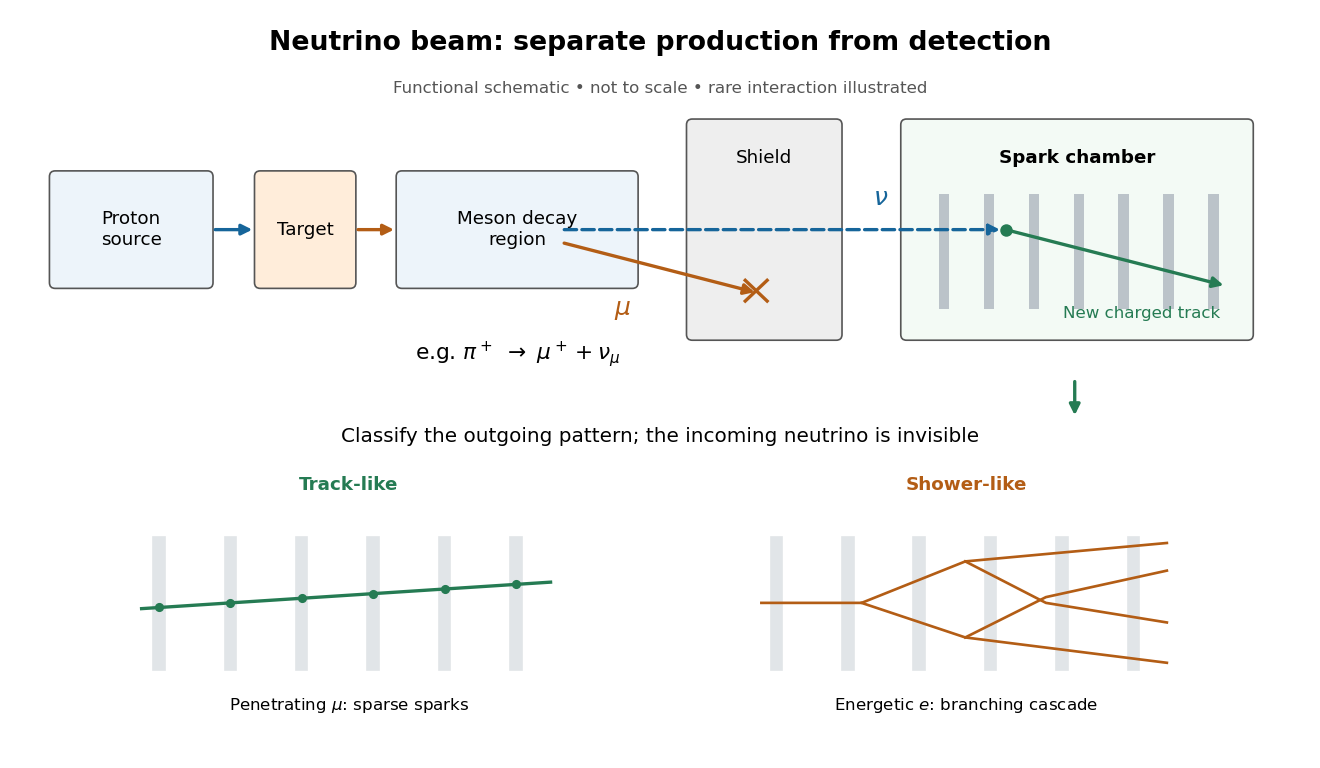
Beam-timed coincidence circuits and veto counters rejected entering tracks. Machine-off runs measured cosmic ray contamination; shield-thickness changes tested neutrons. Placing lead near the target shortened the meson decay path and reduced events. Cosmotron electron calibration established particle shower recognition.[ref]
Observation of High-Energy Neutrino Reactions and the Existence of Two Kinds of Neutrinos by G. Danby and others. pp. 38–42, Table II, Figs. 8–9
The paper compared single-muon candidates, including estimated cosmic ray events, with six shower candidates unlike calibrated electron showers. Kaon decays could supply genuine electron neutrinos. The deficit favored distinct neutrino flavours under lepton universality.[ref]
The inference concerns production and detection channels. It does not measure neutrino mass or establish permanently fixed neutrino flavour. Later neutrino oscillation experiments address changes during propagation.[ref]
A multiwire proportional chamber is a proportional counter: parallel anode wires between cathodes in a gas. Charged particle ionization frees electrons; an electric field drives them toward wires, triggering an electron avalanche read by electronic amplifiers.[ref]
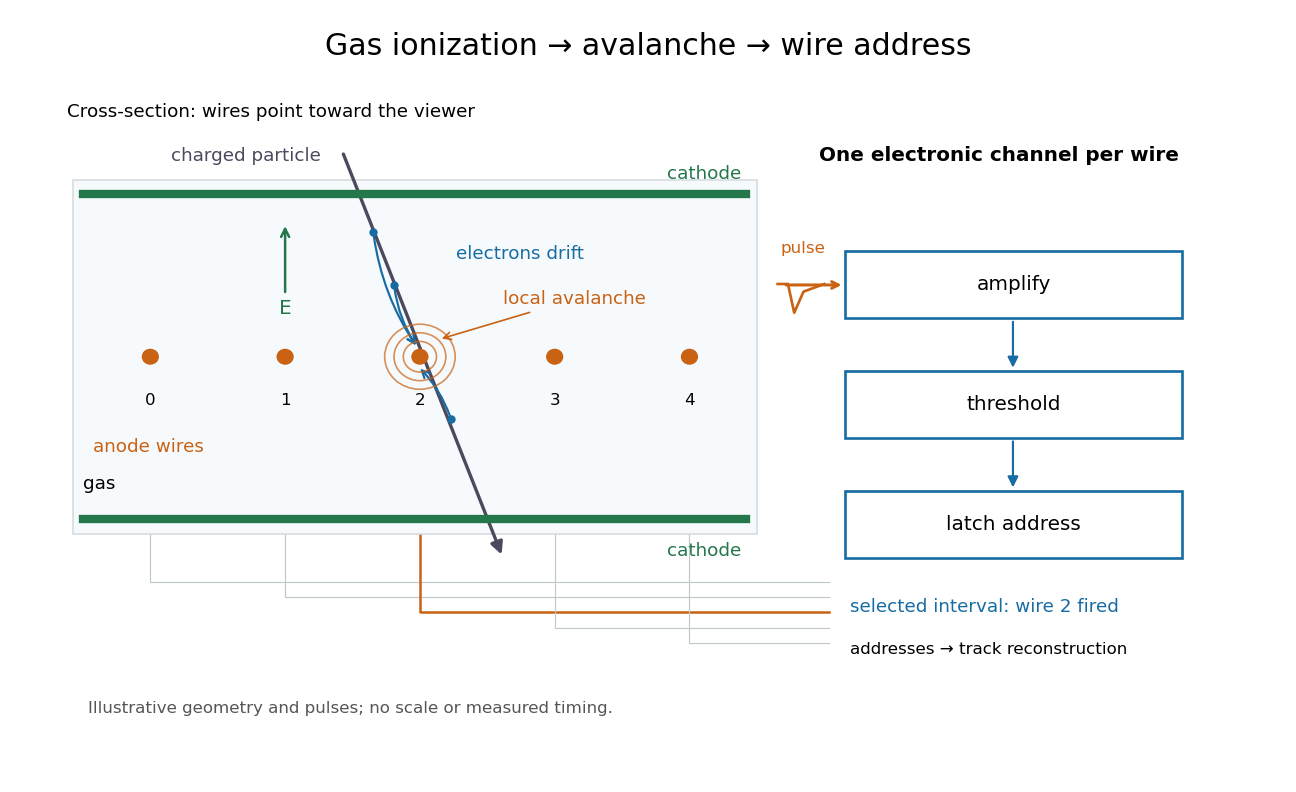
Opposite polarities identify the avalanche wire. Positive ion motion dominates integrated signal; detection precedes complete collection. Calibrated electron travel times enable drift chambers.[ref]
An anticoincidence detector vetoes a candidate event when another detector fires during the specified coincidence interval, helping reject penetrating charged particles.
A decay channel specifies a possible final state of a particle decay, such as an electron, a neutrino and an antineutrino in a specified muon decay. Different channels can have different interaction amplitudes, available phase space and experimental visibility.
For disjoint final-state classes, the partial decay widths add: . The branching fraction is , so increasing one partial width changes the fractions assigned to the others even if their own amplitudes are unchanged. Intermediate resonances leading to the same final state can interfere; they cannot always be treated as mutually exclusive counting bins.
A Dalitz decay replaces a radiated real photon with a virtual photon converting to a charged-lepton pair. The neutral-pion example is . Double Dalitz decay converts both virtual photons in the two-photon mode.
A semileptonic decay contains both final-state hadrons and leptons, typically through a weak charged current. This distinguishes it from a purely leptonic decay.
A particle decay cascade follows successive unstable daughters to longer-lived or stable particles. Probabilities of specified independent decay paths multiply their branching fractions. Waiting times are governed by each particle's mean lifetime, with time dilation relating proper and laboratory times. A particle which appears stable on one observation timescale can be an intermediate on another.
A nonleptonic meson decay contains final hadrons and no final leptons. Weak quark transitions set flavour factors, but strong hadronization and additional hadronic matrix elements are needed to determine exclusive rates.
A weak interaction decay of a baryon into final hadrons without final leptons. A weak charged current changes quark flavour, while spectator quarks and the produced quarks undergo hadronization. A quark-flow Feynman diagram specifies a possible weak topology; it does not calculate the full hadronic decay amplitude.
A particle decay into three daughter particles subject to four-momentum conservation and the relativistic energy-momentum relation. The daughter energies generally vary continuously even in the parent's rest frame. Grouping two daughters into a recoil system of variable invariant mass turns the remaining kinematics into a relativistic two-body decay.
A stream of positive ions in a gas discharge. Historical canal rays pass through holes in the cathode; collisions can also produce moving neutral chemical atoms.
An ion source produces ions for a beam or another experiment. Ionization changes the charge state of an atom or molecule; an applied electric field can then extract charged particles into a transport region. The resulting particle beam depends on the ionization mechanism, extraction geometry and the distribution of initial positions and velocities.
One arrangement uses an electron beam to ionize a gas and an electrode voltage to extract the products. Surface ionization is another mechanism: suitable atoms can leave a hot surface as ions, as in the surface ionization detector. Producing an ion and identifying its species are separate operations, so a source may need downstream mass spectrometry or other selection when several charged species are present.
Here particle flux means the number of particles crossing a surface per unit area and unit time, with the area taken perpendicular to the incident particle beam. Multiplying by the target interaction cross section gives an event rate per target particle in the ideal independent-target model.
A particle beam dominated by neutrinos. Accelerator beams can use particle decay of focused charged pions and kaons, followed by shielding that suppresses other beam components.
Beam cooling reduces random deviations around a beam's reference motion, such as its momentum spread and transverse spread. A highly energetic beam can be cool in this sense: its large common directed kinetic energy is distinct from the spread. Concentrating the occupied phase space helps accumulated particles fit the next machine's acceptance. Stochastic cooling achieves this through measured beam fluctuations and feedback control.
The Super Proton-Antiproton Synchrotron used the converted SPS ring for counterrotating proton and antiproton beams. In the discovery running, two beams provided , unlike a stationary-target collision at the same incident energy. Antiproton production, accumulation and stochastic cooling supplied the collisions used in the W and Z discovery experiments.[ref]
Experimental Observation of the Intermediate Vector Bosons W+, W− and Z0 by Carlo Rubbia. Section 3, printed p.247 and Fig.5: counterrotating beams, accumulation and SPS conversion
Why can opposite electric charges share the bending magnets? Reversing both and velocity leaves the Lorentz force unchanged at a given point. Both circulating species can therefore bend toward the same ring center in the same magnetic field, with equal magnetic rigidity magnitudes. This argument explains the bending geometry; actual injection, focusing, timed acceleration and collisions still require a complete particle accelerator system.
An accelerator technician supports the construction, alignment, operation and maintenance of a particle accelerator and its subsystems. Vacuum equipment, magnets, electrical power, radio-frequency systems and diagnostics must work together to maintain a specified beam.
A beam-loss observation can have several causes, so troubleshooting compares instrument signals with the expected transport and timing. Reliable measurements and documented subsystem behavior are part of making accelerator experiments reproducible.
Pinned article: Introduction to the OurBigBook Project
Welcome to the OurBigBook Project! Our goal is to create the perfect publishing platform for STEM subjects, and get university-level students to write the best free STEM tutorials ever.
Everyone is welcome to create an account and play with the site: ourbigbook.com/go/register. We belive that students themselves can write amazing tutorials, but teachers are welcome too. You can write about anything you want, it doesn't have to be STEM or even educational. Silly test content is very welcome and you won't be penalized in any way. Just keep it legal!
Intro to OurBigBook
. Source. We have two killer features:
- topics: topics group articles by different users with the same title, e.g. here is the topic for the "Fundamental Theorem of Calculus" ourbigbook.com/go/topic/fundamental-theorem-of-calculusArticles of different users are sorted by upvote within each article page. This feature is a bit like:
- a Wikipedia where each user can have their own version of each article
- a Q&A website like Stack Overflow, where multiple people can give their views on a given topic, and the best ones are sorted by upvote. Except you don't need to wait for someone to ask first, and any topic goes, no matter how narrow or broad
This feature makes it possible for readers to find better explanations of any topic created by other writers. And it allows writers to create an explanation in a place that readers might actually find it.
Figure 1. Screenshot of the "Derivative" topic page. View it live at: ourbigbook.com/go/topic/derivativeVideo 2. OurBigBook Web topics demo. Source. - local editing: you can store all your personal knowledge base content locally in a plaintext markup format that can be edited locally and published either:This way you can be sure that even if OurBigBook.com were to go down one day (which we have no plans to do as it is quite cheap to host!), your content will still be perfectly readable as a static site.
- to OurBigBook.com to get awesome multi-user features like topics and likes
- as HTML files to a static website, which you can host yourself for free on many external providers like GitHub Pages, and remain in full control

Figure 2. You can publish local OurBigBook lightweight markup files to either OurBigBook.com or as a static website.
Figure 3. Visual Studio Code extension installation.
Figure 5. . You can also edit articles on the Web editor without installing anything locally. Video 3. Edit locally and publish demo. Source. This shows editing OurBigBook Markup and publishing it using the Visual Studio Code extension. 
- Infinitely deep tables of contents:




All our software is open source and hosted at: github.com/ourbigbook/ourbigbook
Further documentation can be found at: docs.ourbigbook.com
Feel free to reach our to us for any help or suggestions: docs.ourbigbook.com/#contact