Topics (384k) Articles (398k) Users (410) Discussions (242) Comments (383) Files (13k) New article

An electrostatic accelerator gives a charged particle kinetic energy by taking it through a sustained electric potential difference. Its ion source, accelerating tube and target form a particularly direct chain: prepare a charge, let an electric field do work, and measure what arrives or what the target emits. A vacuum reduces collisions with gas before the beam reaches its target. The Cockcroft-Walton generator supplies the potential by accumulating electric charge on capacitors.
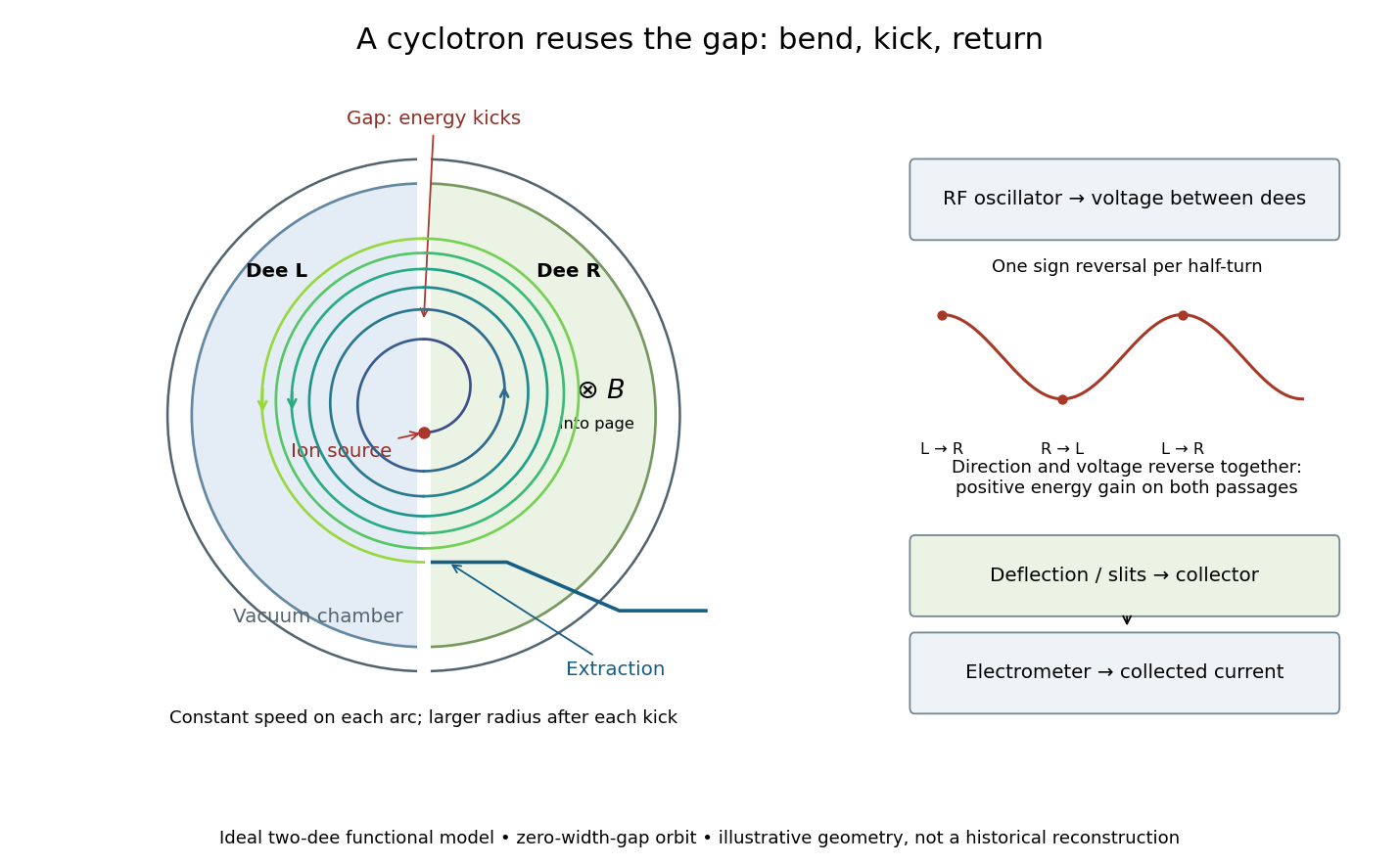
A cyclotron repeatedly passes ions through an alternating electric field between two hollow electrodes called cyclotron dees. A nearly uniform magnetic field perpendicular to their plane bends the charged particles back toward the gap. Inside each cyclotron dee, ideal shielding suppresses the accelerating electric field, so each segment is a constant-speed circular motion. The next gap crossing increases the speed and the radius of curvature. The complete path consists of connected, progressively larger arcs, rather than one circle or a smooth spiral with continuous acceleration everywhere.
The striking feature is a timing cancellation: the longer arc traveled by a faster particle takes the same time. This cyclotron resonance condition lets one fixed radio frequency accelerate many successive gap crossings. The following construction and cyclotron energy and orbit radius example describe an ideal model; the Lawrence-Livingston cyclotron experiment explains what the builders actually measured.
A particle accelerator in which a beam gains kinetic energy along a substantially straight sequence of accelerating structures.
The Bevatron was a proton synchrotron at Berkeley. Its circulating beams supplied high-energy protons to fixed targets, producing secondary particles that could be selected and measured downstream. It played a central role in the 1955 discovery of the antiproton. [ref]
https://newscenter.lbl.gov/2005/10/27/the-golden-anniversary-of-the-antiproton/. Berkeley Lab, The Golden Anniversary of the Antiproton: Bevatron proton beam and secondary-particle experiment
A fixed target makes the production threshold more demanding than simply supplying the new particle's rest energy: conservation of momentum requires outgoing motion, and conserved quantum numbers require accompanying particles. This is why accelerator beam energy, collision center-of-mass energy and produced-particle kinetic energy are different quantities.
The Large Hadron Collider is a particle accelerator at CERN using two counter-circulating beams in a roughly 27-kilometre underground ring. It collides protons and can also operate with heavy ions. Superconducting magnets steer and focus the beams, while radiofrequency electric fields add energy along their direction of motion.[ref]
Large Hadron Collider by CERN. Accelerator description: ring, beam types, magnets and accelerating structures
The functional division matters: an ideal static magnetic field bends a particle's momentum without doing work, while the accelerating electric field changes its kinetic energy. ATLAS experiment and Compact Muon Solenoid surround collision points and reconstruct outgoing products; the accelerator itself supplies the incoming beams rather than measuring every final particle.
An illustrative abrupt-junction depletion approximation assumes uniform, fully ionized donor impurities and acceptor impurities, negligible mobile space charge in the depleted layer, and permittivity . For area , doping number densities and built-in electric potential difference , it givesHere is the elementary charge and is positive for forward bias. Increasing both doping densities reduces in this estimate. That explains the preparation strategy for a tunnel diode; it does not make this sharp-depletion approximation a precise microscopic model of a degenerate semiconductor.
A tunnel diode is a p-n junction with sufficiently heavy semiconductor doping on both sides to make a thin depletion region and permit substantial interband tunnelling. The neutral regions are degenerate semiconductors. Its distinctive forward current-voltage characteristic contains a peak followed by a valley: over part of the curve, increasing the applied electric potential difference decreases the electric current. The Esaki tunnel-diode experiment made this behavior experimentally concrete.
The useful quantity is the local slope, not the ratio of total voltage to total electric current. With conventional electric current entering the positive-voltage terminal, defineNegative differential resistance means , hence where defined. A forward operating point can still have , and absorbed power . A small voltage increase then gives a negative current increment; this does not make the total electric current negative or turn the device into an unlimited source of energy. The external supply sets the operating point and supplies the energy available for an electronic amplifier.
An original idealized construction explains the shape. Put the n-type semiconductor on the left and the p-type semiconductor on the right. Take as the elementary charge and . Increasing forward bias lowers the right-hand electron energy levels relative to the left. Denote the two reservoir electrochemical potentials by , so that . At zero temperature, occupied left-hand conduction band states extend up to ; empty right-hand valence band states start at . For transfer conserving electron energy, the available interval isIt is nonempty only when its upper endpoint exceeds its lower endpoint. Both an occupied initial quantum state and an empty final quantum state must exist at the same energy. The Pauli exclusion principle prevents transfer into an already occupied final quantum state.
For the original diagram, choose arbitrary energy units with , , and , where is in those units. The available interval has widthThus , , , and . Initially forward bias opens a transfer window; further forward bias closes it by moving the right-hand valence band edge below the left-hand conduction band edge. This is a state-counting illustration, not a formula for a measured electric current.
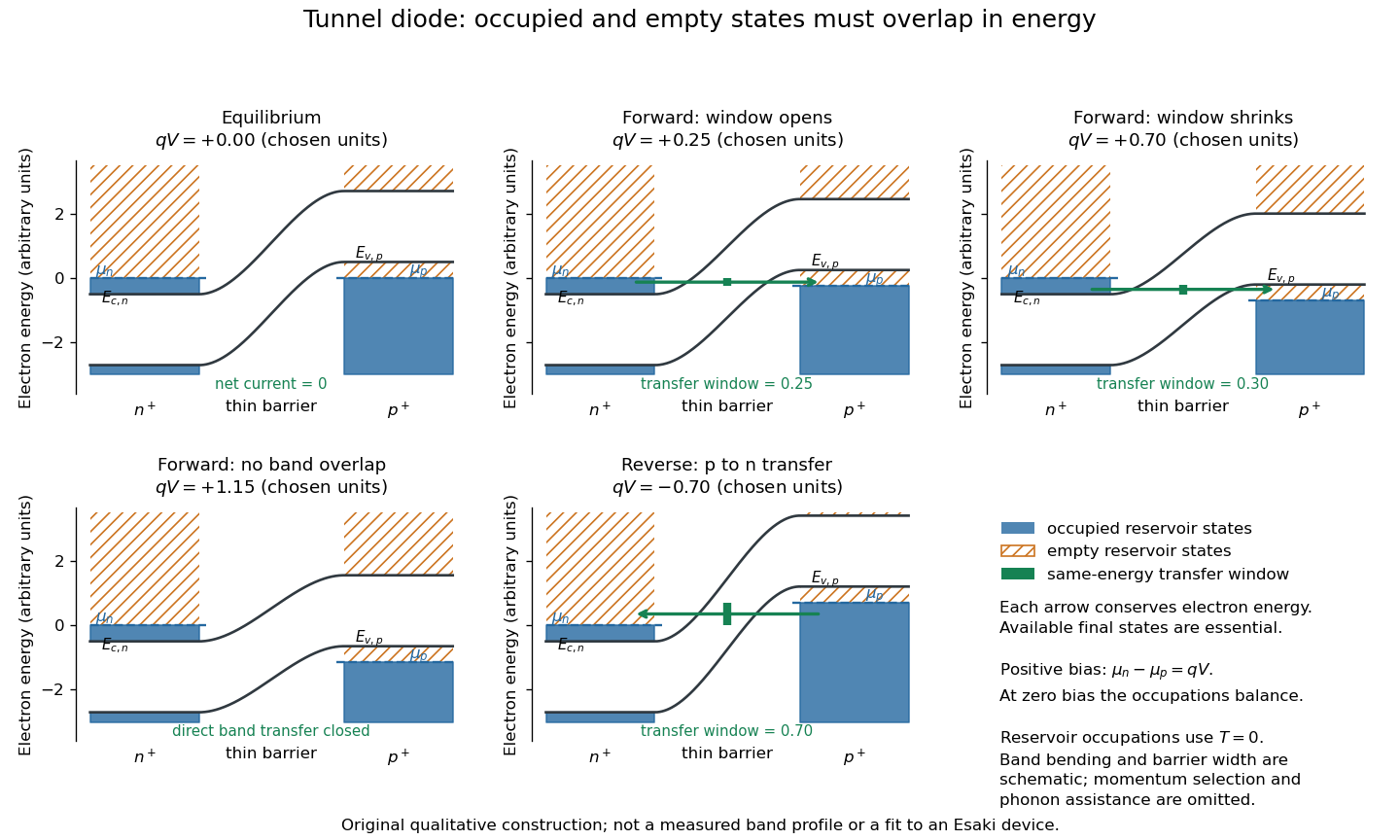
Tunnel diode: energy band alignment and occupied-to-empty state overlap
. Original chosen energy band construction, with n-type semiconductor on the left and p-type semiconductor on the right. Blue shading denotes occupied reservoir states; orange hatching denotes empty reservoir states. Green arrows mark equal-energy transfer. The central barrier and band bending are schematic; all energies are arbitrary, and the drawing is not an experimental image or measured band profile. Source. Details.For reverse bias, the transfer direction changes: occupied right-hand valence band states can feed empty left-hand conduction band states. In the same construction, opens the interval for this reverse transfer. A narrow depletion region allows a large reverse quantum tunnelling electric current at small electric potential difference, whereas the ordinary Shockley diode equation predicts only a small reverse saturation electric current before diode reverse breakdown. At zero biasing, equal reservoir occupations give zero net electric current; quantum tunnelling does not require a net equilibrium flow.
A finite-temperature refinement replaces sharp occupation cutoffs with the Fermi-Dirac distribution. An illustrative weak-transfer expression isHere describes allowed initial/final quantum states and their coupling, and are Fermi-Dirac distributions with the respective electrochemical potentials. The occupation difference follows by subtracting the reverse transfer factor from the forward one: . An overlap interval alone does not determine : transmission probability, density of states, crystal momentum selection and phonons can matter. A complete germanium calculation is more demanding than multiplying two constant density of states factors. At larger forward bias, ordinary carrier injection and diffusion supply a rising current branch even after direct band overlap is lost.
The built-in potential of a p-n junction is the electrostatic potential difference established when carrier diffusion exposes ionized dopants until the opposing drift and diffusion currents balance. The equilibrium electrochemical potential is constant even though the electric potential and band edges vary. In a nondegenerate homojunction with neutral-edge majority densities , . This is band bending within the same material, not necessarily a discontinuous offset of different materials' band edges.
A linearly graded p-n junction has net ionized doping near the metallurgical junction. In the depletion approximation, . With vanishing external field, neutrality places the depletion edges at and integration of Poisson equation givesThe field points from n to p and has largest magnitude at . The potential is cubic inside the layer.
Pinned article: Introduction to the OurBigBook Project
Welcome to the OurBigBook Project! Our goal is to create the perfect publishing platform for STEM subjects, and get university-level students to write the best free STEM tutorials ever.
Everyone is welcome to create an account and play with the site: ourbigbook.com/go/register. We belive that students themselves can write amazing tutorials, but teachers are welcome too. You can write about anything you want, it doesn't have to be STEM or even educational. Silly test content is very welcome and you won't be penalized in any way. Just keep it legal!
Intro to OurBigBook
. Source. We have two killer features:
- topics: topics group articles by different users with the same title, e.g. here is the topic for the "Fundamental Theorem of Calculus" ourbigbook.com/go/topic/fundamental-theorem-of-calculusArticles of different users are sorted by upvote within each article page. This feature is a bit like:
- a Wikipedia where each user can have their own version of each article
- a Q&A website like Stack Overflow, where multiple people can give their views on a given topic, and the best ones are sorted by upvote. Except you don't need to wait for someone to ask first, and any topic goes, no matter how narrow or broad
This feature makes it possible for readers to find better explanations of any topic created by other writers. And it allows writers to create an explanation in a place that readers might actually find it.
Figure 1. Screenshot of the "Derivative" topic page. View it live at: ourbigbook.com/go/topic/derivativeVideo 2. OurBigBook Web topics demo. Source. - local editing: you can store all your personal knowledge base content locally in a plaintext markup format that can be edited locally and published either:This way you can be sure that even if OurBigBook.com were to go down one day (which we have no plans to do as it is quite cheap to host!), your content will still be perfectly readable as a static site.
- to OurBigBook.com to get awesome multi-user features like topics and likes
- as HTML files to a static website, which you can host yourself for free on many external providers like GitHub Pages, and remain in full control

Figure 2. You can publish local OurBigBook lightweight markup files to either OurBigBook.com or as a static website.
Figure 3. Visual Studio Code extension installation.
Figure 5. . You can also edit articles on the Web editor without installing anything locally. Video 3. Edit locally and publish demo. Source. This shows editing OurBigBook Markup and publishing it using the Visual Studio Code extension. 
- Infinitely deep tables of contents:




All our software is open source and hosted at: github.com/ourbigbook/ourbigbook
Further documentation can be found at: docs.ourbigbook.com
Feel free to reach our to us for any help or suggestions: docs.ourbigbook.com/#contact