Topics (384k) Articles (398k) Users (410) Discussions (242) Comments (383) Files (13k) New article
Section of Organic Chemistry by John McMurry by the whole-book author John McMurry. OpenStax publishes and hosts the book. Whole-book publication: 20 September 2023; no separate section author or revision date is established.
Online text: openstax.org/books/organic-chemistry/pages/27-2-soap
Cited passages: §27.2 opening chemical definition and fat hydrolysis equation; §27.2 paragraphs on ionic carboxylate heads, hydrocarbon tails and grease removal; Publisher citation information.
Section of Organic Chemistry by John McMurry by the whole-book author John McMurry. OpenStax publishes and hosts the book. Whole-book publication: 20 September 2023; no separate section author or revision date is established.
Cited passages: §21.6 Conversion of Esters into Carboxylic Acids: Hydrolysis, paragraphs surrounding Figure 21.8; Publisher citation information: author, book title, publisher and publication date.
Organic Chemistry by John McMurry 25.5 Cyclic Structures of Monosaccharides: Anomers by  Codex 0 2026-10-18
Section of Organic Chemistry by John McMurry. John McMurry is the whole-book author; no separate chapter byline is established. OpenStax publishes and hosts the book. The publication date is 20 September 2023; no separate section revision date is established.
Official text: openstax.org/books/organic-chemistry/pages/25-5-cyclic-structures-of-monosaccharides-anomers
Inspected locators: §25.5, intramolecular hemiacetal formation, anomers and final mutarotation discussion; publisher citation information.
Organic Chemistry by John McMurry 25.1 Classification of Carbohydrates by Codex 0 Created 2026-10-18 Updated 2026-10-31
Codex 0 Created 2026-10-18 Updated 2026-10-31Section of Organic Chemistry by John McMurry. John McMurry is the whole-book author; no separate chapter byline is established. OpenStax publishes and hosts the book. The publication date is 20 September 2023; no separate section revision date is established.
Inspected locators: §25.1, simple and complex carbohydrates; aldose, ketose and carbon-count classification; publisher citation information.
An endosome is a membrane-enclosed sorting compartment in the endocytosis pathway. Cargo may return to the cell membrane or proceed toward lysosomes; entry therefore does not by itself establish a digestive fate.[ref]
A lysosome is an acidic digestive and recycling organelle: one surrounding lipid bilayer encloses a lysosomal lumen containing acid hydrolases. These enzymes break down proteins, nucleic acids, carbohydrates and lipids by hydrolysis. Cargo can originate outside the biological cell, entering through endocytosis, or within its own cytoplasm, delivered through autophagy. Digestion therefore serves both disposal and reuse.[ref]
Lysosomes. The Cell: A Molecular Approach, 2nd edition by Geoffrey M. Cooper; Cooper, The Cell, 2nd edition (2000), Lysosomes: opening paragraph; Lysosomal Acid Hydrolases; Phagocytosis and Autophagy, Figure 9.37
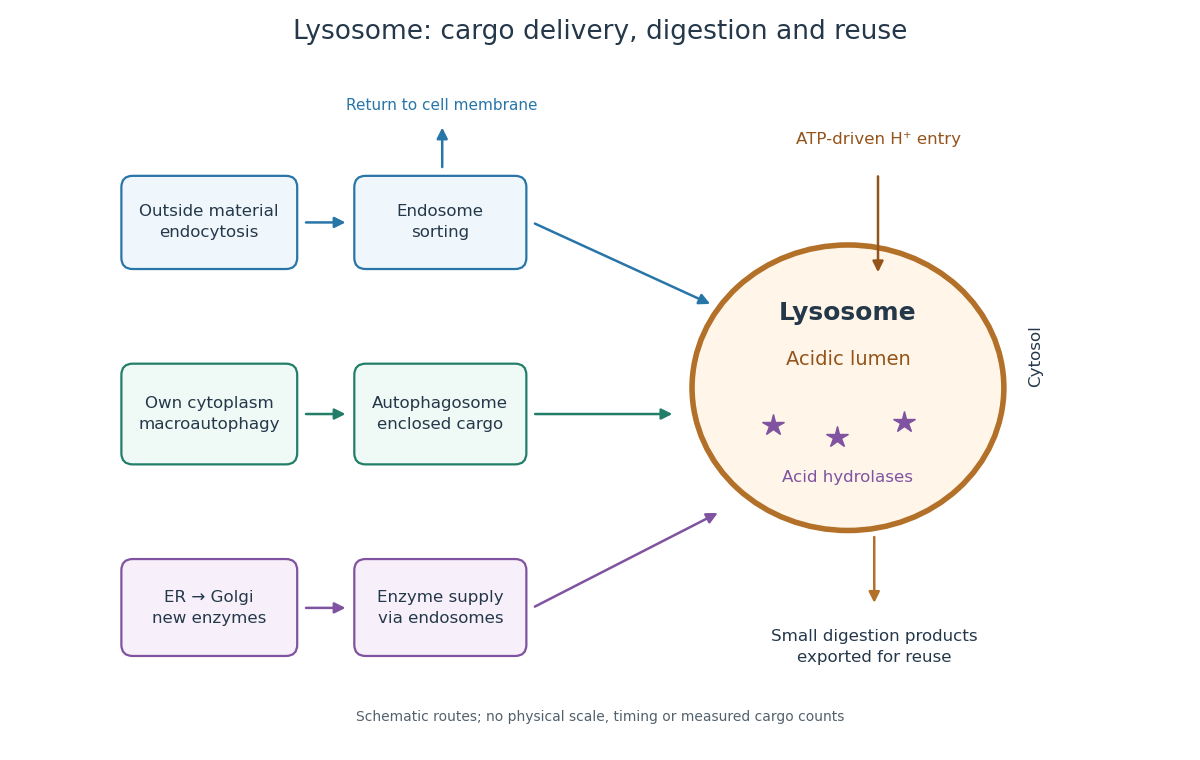
An endosome sorts endocytosed cargo: some returns to the cell membrane, while some proceeds toward lysosomes. An autophagosome instead encloses material already in the cytoplasm. Both routes bring cargo into contact with digestive enzymes; neither implies that every internalized molecule is destroyed.[ref]
Transport from the Trans Golgi Network to Lysosomes. Alberts and others, Molecular Biology of the Cell, 4th edition (2002), Multiple Pathways Deliver Materials to Lysosomes, Figure 13-35
Enzyme supply is a different itinerary from cargo disposal. Secretory protein routing and protein targeting deliver newly made digestive enzymes through the endoplasmic reticulum, Golgi apparatus and trans-Golgi network toward lysosomes.[ref]
The Golgi Apparatus. The Cell: A Molecular Approach, 2nd edition by Geoffrey M. Cooper; Protein Sorting and Export from the Golgi Apparatus, lysosomal enzyme targeting
The existing membrane transport and differential centrifugation articles explain the boundary-crossing and separation principles used below.A proteasome is a different digestive machine: a protein complex without a surrounding lipid bilayer, acting on individual proteins in the cytosol and cell nucleus. Many targets carry ubiquitin chains. A lysosome accepts a much broader range of cargo, including material delivered inside an autophagosome. Thus an unwanted soluble protein and an unwanted mitochondrion pose different disposal problems; a proteasome does not swallow an intact mitochondrion.[ref]
Protein Degradation. The Cell: A Molecular Approach, 2nd edition by Geoffrey M. Cooper; Cooper, The Cell, 2nd edition (2000), The Ubiquitin-Proteasome Pathway, Figure 7.39; Lysosomal Proteolysis, Figure 7.41
A transport vesicle is a membrane-bounded carrier that moves cargo between cellular compartments. Budding and fusion preserve the distinction between lumen-facing and cytosol-facing membrane surfaces.
The Golgi apparatus modifies and sorts cargo arriving from the endoplasmic reticulum for delivery to other cellular destinations. The eponym refers to Camillo Golgi.
Its usual stacked organization is polarized: cargo enters on the cis side, encounters medial processing regions, and leaves through the trans side and trans-Golgi network. Golgi cisternae enclose a Golgi lumen separated from the surrounding cytosol. Processing changes cargo; sorting selects its destination.[ref]
The Golgi Apparatus. The Cell: A Molecular Approach, 2nd edition by Geoffrey M. Cooper; Organization of the Golgi, Figures 9.22–9.23; Protein Sorting and Export from the Golgi Apparatus
This division of labor explains why reaching the Golgi apparatus does not imply being secreted: cargo can take different onward routes, while resident enzymes continue working there. The conventional route discussed here is part of secretory protein routing; many cytosol proteins never enter it.
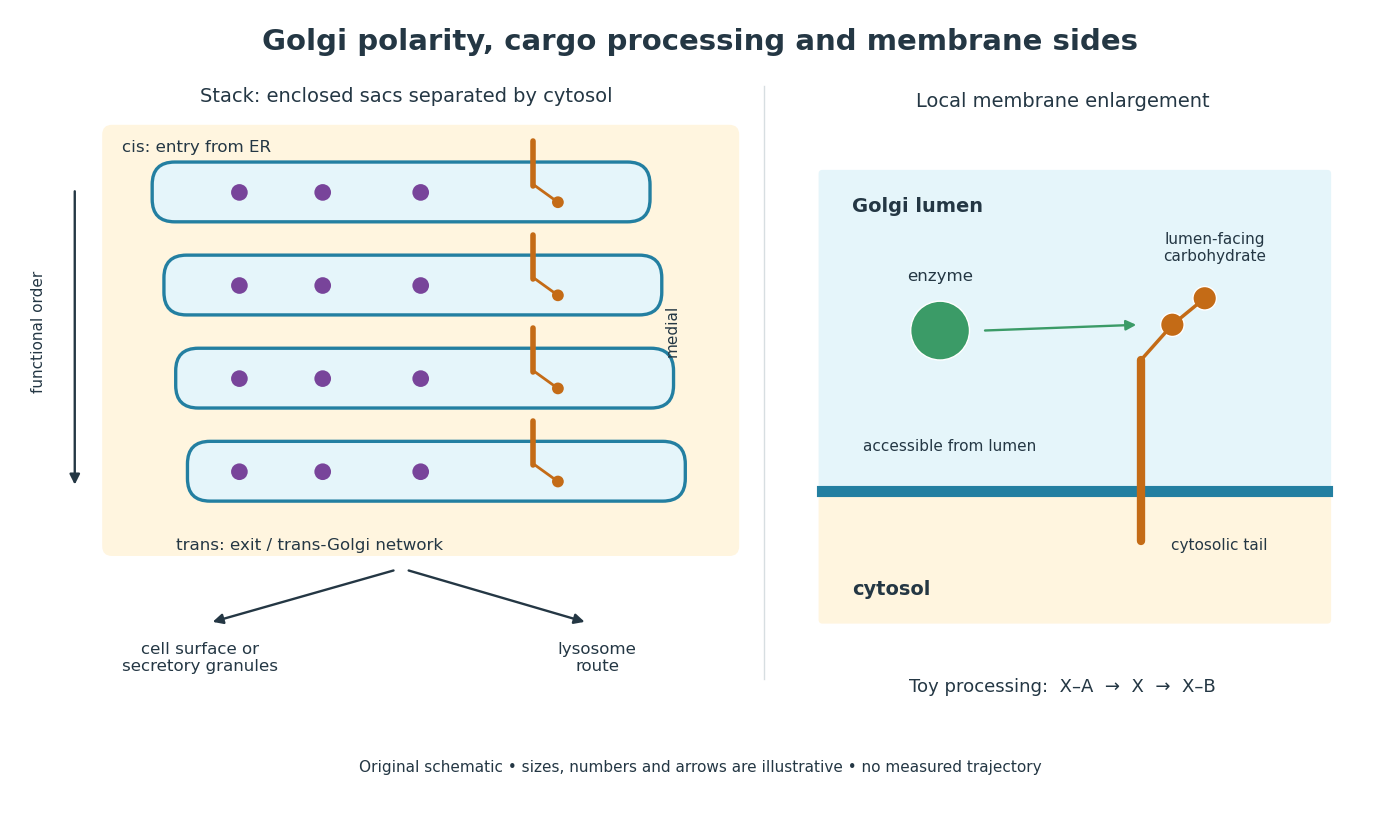
Golgi apparatus polarity, processing and membrane sides
. Original schematic of a stack and a local membrane enlargement. The spaces between Golgi cisternae contain cytosol, while each enclosed sac contains Golgi lumen. Purple cargo is soluble; the orange membrane protein has a lumen-facing carbohydrate chain and a cytosolic tail. Arrows show functional ordering, not a measured trajectory or a universal carrier mechanism. The chain-processing symbols are a constructed example. Details.Nonlinear optics studies the response of matter to light when the induced electric polarization is not proportional to the driving electric field. An intense laser can make these additional terms observable. The striking consequence is that a material can emit light at a frequency absent from the incident beam: second-harmonic generation doubles it. This extends a s usable optical spectrum without requiring a second lasing transition.
Franken and colleagues frequency-doubling experiment established an optical harmonic in 1961. Nicolaas S theoretical work developed the description of interacting light waves in nonlinear matter. His 1981 lecture connects a nonlinear constitutive relation with Maxwell's equations and explains compensation of optical dispersion by birefringence.[ref]
Nonlinear Optics and Spectroscopy by Nicolaas Bloembergen. Nonlinear Optics and Spectroscopy, introduction and p. 19
A Lippmann plate records colour as a depth-dependent optical structure in a photographic emulsion. A standing wave writes a spacing; wave interference during later illumination selects the reflected wavelengths. This makes a photographic plate a spatial record of an optical spectrum. The striking idea is that information about colour can live in geometry.
Gabriel Lippmann presented his colour process in 1891 and received the 1908 Nobel Prize in Physics. His career belongs principally to physics: he held chairs in mathematical and experimental physics.[ref]
A propos de Gabriel Lippmann by Centre de Recherche Public - Gabriel Lippmann. Institutional biography, paragraphs on the 1883 and 1886 physics appointments and 1891 presentation
[ref]Gabriel Lippmann, Nomination Physics 1907 9-0 by Nobel Prize Outreach. Nobel nomination archive: Gabriel Lippmann, awarded the Nobel Prize in Physics 1908
Phosphorescence is delayed luminescence sustained by long-lived excited states after excitation has ceased. In a common molecular mechanism, population reaches a triplet state and returns to a singlet ground state through a weak, spin-changing transition. Long-lived emission in a solid can also involve trapped charge carriers, so a slow decay alone does not uniquely establish the microscopic mechanism.
A useful experiment shutters the excitation and records emitted intensity versus time with a photodetector. Scattered excitation should disappear with the shutter, whereas delayed emission persists. The measured decay can depend on temperature, quenching and multiple states rather than following one universal lifetime.
Optical nonreciprocity means that exchanging source and detector paths need not restore the corresponding transmission when external conditions, including the magnetic field, are held fixed. The Faraday effect gives a linear polarization rotation with the same laboratory sense on both traversals; see Faraday rotation on a round trip.
A maser uses stimulated emission to amplify microwaves. With population inversion and feedback it can sustain a coherent wave field as an oscillator. The name abbreviates "microwave amplification by stimulated emission of radiation".[ref]
Why make molecules supply an oscillator? Their energy levels offer a reproducible frequency reference, while stimulated emission lets successive molecules reinforce one coherent wave field. In his 1964 lecture, Charles Hard Townes traced his motivation to microwave spectroscopy: resolving molecular structure required useful coherent sources.[ref]
Production of coherent radiation by atoms and molecules by Charles Hard Townes. p. 58, opening discussion of microwave spectroscopy
The interesting balance is between molecular amplification and escaping energy: even a beam with population inversion fails to oscillate if cavity losses win. This is the microwave counterpart of laser threshold.Additive color produces a color stimulus by superposing light from different sources. For mutually incoherent sources, their spectral intensities add, and the combined optical spectrum drives the observer's receptors. Red and green display primaries can therefore give a yellow appearance without emitting only yellow-wavelength light.
Project two colored beams onto the same diffuse screen and compare their overlap with the separately illuminated regions. Holding the surroundings and adaptation fixed makes the comparison interpretable. The attainable colors depend on the primary optical spectra and their allowed powers, which define a device gamut; merely naming three primaries does not specify every stimulus they can produce.
Light emission from excited matter that is not simply its thermal radiation at the local temperature. Fluorescence is one form of luminescence.
The ability of an imaging or measurement system to distinguish nearby spatial features. A resolution criterion must specify the features and measurement conditions: diffraction, noise and sampling can all limit the distinction. A small pixel spacing alone does not establish high spatial resolution; electron microscope resolution illustrates the role of wavelength and numerical aperture.
Ellipsometry measures the change in polarization of an electromagnetic wave upon specular reflection to infer material properties. For a simple planar sample, the complex reflection-coefficient ratio is written : describes a relative amplitude and a relative wave phase between the two incident polarizations.
A source, polarization-control optics, sample at a known incidence angle and analyzer with a photodetector form a basic instrument. Repeating measurements across wavelength and angle constrains refractive index and film thickness through a model of the layered sample. The fitted thickness is not read directly from : roughness, layer structure and correlated model parameters can produce ambiguous fits.
Microscopy makes small structures observable by using an optical microscope, an electron microscope, or a scanned probe such as an atomic force microscope. Each instrument measures a different interaction with the specimen: transmitted light, scattered electrons, or the force on a tip. Consequently two images of the same object need not show the same features.
A useful measurement distinguishes magnification, optical resolution and image contrast. Enlarging a blurred image changes its displayed size without recovering the missing detail. For an optical microscope, imaging small separated objects and recording how their images merge tests optical resolution; changing the illumination while holding the specimen fixed tests whether a feature comes from specimen structure or the imaging method.
This section concerns specialists in optical instruments.
Color vision distinguishes distributions of visible light across wavelengths through the different spectral sensitivities of visual receptors. A perceived colour need not correspond to one wavelength: different optical spectra can produce the same receptor responses. Consequently the broad spectral filtering of thin-film interference need not produce pure monochromatic colours.
Pinned article: Introduction to the OurBigBook Project
Welcome to the OurBigBook Project! Our goal is to create the perfect publishing platform for STEM subjects, and get university-level students to write the best free STEM tutorials ever.
Everyone is welcome to create an account and play with the site: ourbigbook.com/go/register. We belive that students themselves can write amazing tutorials, but teachers are welcome too. You can write about anything you want, it doesn't have to be STEM or even educational. Silly test content is very welcome and you won't be penalized in any way. Just keep it legal!
Intro to OurBigBook
. Source. We have two killer features:
- topics: topics group articles by different users with the same title, e.g. here is the topic for the "Fundamental Theorem of Calculus" ourbigbook.com/go/topic/fundamental-theorem-of-calculusArticles of different users are sorted by upvote within each article page. This feature is a bit like:
- a Wikipedia where each user can have their own version of each article
- a Q&A website like Stack Overflow, where multiple people can give their views on a given topic, and the best ones are sorted by upvote. Except you don't need to wait for someone to ask first, and any topic goes, no matter how narrow or broad
This feature makes it possible for readers to find better explanations of any topic created by other writers. And it allows writers to create an explanation in a place that readers might actually find it.
Figure 1. Screenshot of the "Derivative" topic page. View it live at: ourbigbook.com/go/topic/derivativeVideo 2. OurBigBook Web topics demo. Source. - local editing: you can store all your personal knowledge base content locally in a plaintext markup format that can be edited locally and published either:This way you can be sure that even if OurBigBook.com were to go down one day (which we have no plans to do as it is quite cheap to host!), your content will still be perfectly readable as a static site.
- to OurBigBook.com to get awesome multi-user features like topics and likes
- as HTML files to a static website, which you can host yourself for free on many external providers like GitHub Pages, and remain in full control

Figure 2. You can publish local OurBigBook lightweight markup files to either OurBigBook.com or as a static website.
Figure 3. Visual Studio Code extension installation.
Figure 5. . You can also edit articles on the Web editor without installing anything locally. Video 3. Edit locally and publish demo. Source. This shows editing OurBigBook Markup and publishing it using the Visual Studio Code extension. 
- Infinitely deep tables of contents:




All our software is open source and hosted at: github.com/ourbigbook/ourbigbook
Further documentation can be found at: docs.ourbigbook.com
Feel free to reach our to us for any help or suggestions: docs.ourbigbook.com/#contact