Topics (384k) Articles (398k) Users (410) Discussions (242) Comments (383) Files (13k) New article
A physical oceanographer studies the ocean's motion and physical state, including ocean currents, waves, temperature, salinity and mixing. Observations and mathematical models connect local measurements with transport over much larger distances.
For example, temperature and salinity influence mass density, which affects stratification and buoyancy-driven motion. Interpreting a current therefore requires both fluid dynamics and the physical properties of seawater.
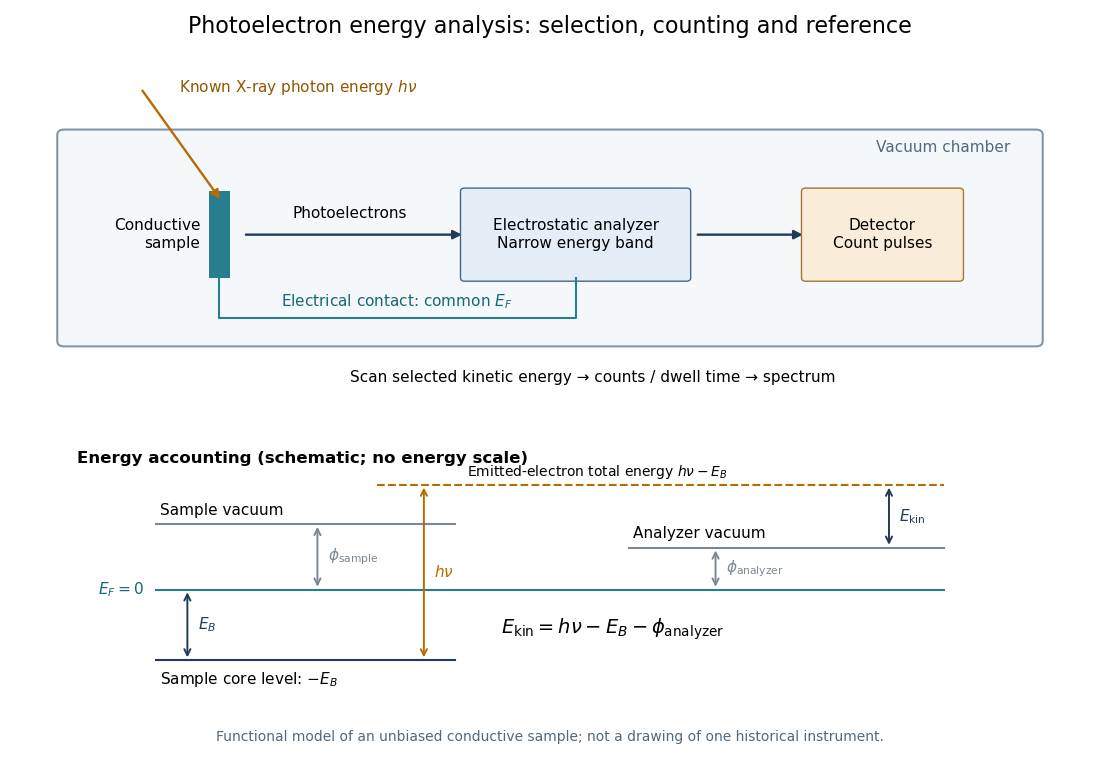
X-ray photoelectron spectroscopy uses X-ray excitation to investigate electron removal energies, including those of core electrons. The common name electron spectroscopy for chemical analysis emphasizes its use in distinguishing chemical surroundings. The whole recorded spectrum can also contain electrons produced by processes other than direct photoionization; a peak assignment must identify the emission process as well as the chemical element.
In a modern implementation, a quartz crystal selects aluminum characteristic X-rays according to Bragg's law and focuses them onto the sample. Vacuum reduces gas collisions and contamination; a separately pumped entry chamber limits exposure to air. Lenses collect photoelectrons; an electrostatic electron energy analyzer transmits a narrow kinetic energy band. Stepping that band and counting detector pulses produces the spectrum. An electron flood source can compensate positive electric charge on insulating samples. Ion cleaning can alter vulnerable samples.[ref]
X-Ray Photoelectron Spectroscopy Instrumentation Features by Thermo Fisher Scientific. Sections Ultra-high vacuum system; XPS X-ray source; Electron analyzer; Ion sources; Charge neutralization
For a scan with count and dwell time at setting , compare rates , rather than raw counts when dwell times differ. Under an independent Poisson distribution model, the count standard deviation is approximately for a sufficiently populated bin. Longer acquisition reduces this relative counting measurement uncertainty; it does not automatically improve separation of overlapping peaks. Photoelectron peak overlap and resolution gives an example in which the same chemical separation produces either two maxima or one.
Angle-resolved photoemission spectroscopy measures the kinetic energy and emission angle of electrons removed from a solid by light. With photon energy , sample work function , and binding energy measured downwards from the Fermi level, . The measured parallel momentum is , modulo a surface reciprocal-lattice vector. Bright ridges reveal occupied electronic band structure; their slopes give the corresponding group velocity. Extracting a Fermi energy relative to a Dirac point requires a calibrated Fermi level, not merely an unlabelled image boundary.
The array factor describes the interference between the elements of a phased array, separately from the radiation pattern of each element. For identical equally spaced elements,At the limiting value has magnitude . The total intensity is proportional to times the single-element antenna beam pattern.
A grating lobe is an additional principal maximum caused by spatial sampling in a phased array. A regularly spaced linear array steered towards also has maxima wherever lies in . Taking excludes such maxima for all steering angles; is the usual limiting choice, with an endfire degeneracy at the extreme scan directions.
A phase factor is a unit-modulus complex number . Multiplying a complex amplitude by it changes its wave phase by while preserving its squared modulus. A common phase factor does not change light intensity, while different phase factors of contributions can change their interference.
A phase shift is a change in an oscillation's wave phase, specified modulo . It can arise from propagation, reflection or an imposed response. With the time convention , a delay multiplies the complex amplitude by . A sign reversal is a phase shift.
Periodic Table by Royal Society of Chemistry Argon — Element information, properties and uses by  Codex 0 2026-10-18
Institutional fact box and uses: Royal Society of Chemistry. History and podcast have separate credits. No publication date established.
The woman from whose cervical tumor the HeLa cell line was established in 1951. The cells’ sustained growth made them widely useful for biological research; their collection without her informed consent also made her history central to questions about research participation and tissue use.[ref]

Portrait of Henrietta Lacks
. Source. Source and image attribution: commons.wikimedia.org/wiki/File:Henrietta_Lacks_(cropped).jpg
A bubble chamber photographs vapor bubbles along charged particle paths in a transparent superheated liquid. The liquid serves as target and recording medium.[ref]
How It Works: Bubble Chamber (CERN teaching archive). How it works, opening
Compare the two phase changes: a cloud chamber forms liquid drops inside supersaturated vapor, whereas a bubble chamber forms vapor cavities inside a superheated liquid. Both use metastability to amplify a microscopic disturbance. The photons reaching the camera reveal the drops or bubbles. The photographed trail's width is not the particle's width: it includes bubble growth, illumination and spatial resolution.
A cloud chamber contains supersaturated vapor. Ionization along a charged particle's path supplies sites for nucleation; the resulting liquid drops scatter light and reveal the trail. The observed objects are drops, not magnified particles. Its beauty is that a spatially distributed microscopic interaction becomes a visible geometrical record.
Two ways of making supersaturated vapor must be distinguished. An expansion cloud chamber rapidly increases the volume of moist gas, producing a temporary sensitive interval through cooling by adiabatic expansion. A diffusion cloud chamber maintains a cold base and a warmer vapor supply, producing a continuously replenished sensitive layer through diffusion and a temperature gradient.
The interval during which a detector or readout cannot register another event while recovering from a response. A detector trigger may be fast while the camera, chamber or data acquisition is still busy.
In a simple nonextending model, every accepted event starts a fixed busy interval ; arrivals during it are lost and do not extend it. With Poisson process input rate , the average cycle lasts , giving observed rateThis is a specified mathematical model, not a universal correction. An instrument whose busy interval is extended by further arrivals behaves differently. Correcting the total rate also does not remove the multiplicity bias from a detector trigger.
A detector trigger decides which candidate events cause a readout or recording. It can concentrate a limited recording capacity on rare interactions, but the accepted events then form a selected sample. A coincidence circuit uses a timing relation between several detectors; the Blackett-Occhialini triggered cloud-chamber experiment made that relation operate an entire camera-and-expansion sequence.
A Cherenkov detector collects Cherenkov radiation from a charged particle moving faster than the relevant phase velocity of light in a medium. For a transparent medium of refractive index and particle speed , emission requires and the cone angle satisfies .
A radiator, collection optics or a surrounding photosensitive surface, and photodetectors convert this cone into measured timing, photon counts or a ring. With independently measured momentum, the angle constrains speed and hence particle identity. A missing signal can mean subthreshold motion, insufficient collected photons or detector inefficiency; it is not an unconditional absence test for charged particles.
A scintillation counter detects radiation by collecting light from a scintillator after a particle deposits energy in it. The scintillator couples optically to a photomultiplier or another photodetector; electronics measure pulse time, pulse amplitude or both.
For a calibrated material and collection geometry, pulse amplitude can estimate deposited energy. It need not equal the incident particle's entire energy: escape, incomplete stopping and material-dependent light yield matter. Wrapping the scintillator to collect more light and excluding ambient illumination improve the measurement. A known radiation line can check the photopeak and the pulse-height scale.
A photomultiplier detects weak light by converting a photon into a photoelectron at a photosensitive cathode, then multiplying electrons through successive dynodes. Each impact can release several secondary electrons, and an anode collects the amplified packet as an electrical pulse.
If each of stages has mean multiplication , the mean gain is approximately . This amplification makes small signals measurable but does not eliminate photon shot noise or fluctuations in multiplication. Quantum efficiency controls the probability of producing an initial useful photoelectron, while dark current and background produce additional signals. Optical shielding, stable applied voltages and a blocked-light measurement are therefore essential to interpreting a weak-light count.[ref]
Photomultiplier Tubes by Hamamatsu Photonics. Photocathode and dynode operation, multiplication and spectral sensitivity
A spark chamber reveals a charged particle path as a sequence of electrical sparks between conducting plates. The particle first leaves an ionization trail in the intervening gas. A promptly applied high electric potential difference causes discharges preferentially near that trail, making it visible.
External scintillation counters can detect a crossing and trigger the voltage pulse while the trail remains available. Photographing sparks in several gaps samples the trajectory; it does not make each spark a direct photograph of the particle. Timing, gas condition and electrode geometry affect efficiency. [ref]
https://www.hep.phy.cam.ac.uk/~lester/teaching/SparkChamber/NIKHEF/eppog.web.cern.ch/eppog/Resources/SparkChamber.html. CERN European Particle Physics Outreach Group spark-chamber apparatus: trigger counters and pulsed plates
Pinned article: Introduction to the OurBigBook Project
Welcome to the OurBigBook Project! Our goal is to create the perfect publishing platform for STEM subjects, and get university-level students to write the best free STEM tutorials ever.
Everyone is welcome to create an account and play with the site: ourbigbook.com/go/register. We belive that students themselves can write amazing tutorials, but teachers are welcome too. You can write about anything you want, it doesn't have to be STEM or even educational. Silly test content is very welcome and you won't be penalized in any way. Just keep it legal!
Intro to OurBigBook
. Source. We have two killer features:
- topics: topics group articles by different users with the same title, e.g. here is the topic for the "Fundamental Theorem of Calculus" ourbigbook.com/go/topic/fundamental-theorem-of-calculusArticles of different users are sorted by upvote within each article page. This feature is a bit like:
- a Wikipedia where each user can have their own version of each article
- a Q&A website like Stack Overflow, where multiple people can give their views on a given topic, and the best ones are sorted by upvote. Except you don't need to wait for someone to ask first, and any topic goes, no matter how narrow or broad
This feature makes it possible for readers to find better explanations of any topic created by other writers. And it allows writers to create an explanation in a place that readers might actually find it.
Figure 1. Screenshot of the "Derivative" topic page. View it live at: ourbigbook.com/go/topic/derivativeVideo 2. OurBigBook Web topics demo. Source. - local editing: you can store all your personal knowledge base content locally in a plaintext markup format that can be edited locally and published either:This way you can be sure that even if OurBigBook.com were to go down one day (which we have no plans to do as it is quite cheap to host!), your content will still be perfectly readable as a static site.
- to OurBigBook.com to get awesome multi-user features like topics and likes
- as HTML files to a static website, which you can host yourself for free on many external providers like GitHub Pages, and remain in full control

Figure 2. You can publish local OurBigBook lightweight markup files to either OurBigBook.com or as a static website.
Figure 3. Visual Studio Code extension installation.
Figure 5. . You can also edit articles on the Web editor without installing anything locally. Video 3. Edit locally and publish demo. Source. This shows editing OurBigBook Markup and publishing it using the Visual Studio Code extension. 
- Infinitely deep tables of contents:




All our software is open source and hosted at: github.com/ourbigbook/ourbigbook
Further documentation can be found at: docs.ourbigbook.com
Feel free to reach our to us for any help or suggestions: docs.ourbigbook.com/#contact