Topics (122k) Articles (123k) Users (291) Discussions (237) Comments (383) Files (715) New article
Why do symmetries such as SU(3), SU(2) and U(1) matter in particle physics? by  Ciro Santilli 40 Updated 2025-07-16
Ciro Santilli 40 Updated 2025-07-16Physicists love to talk about that stuff, but no one ever has the guts to explain it into enough detail to show its beauty!!!
Perhaps the wisest thing is to just focus entirely on the part to start with, which is the quantum electrodynamics one, which is the simplest and most useful and historically first one to come around.
Perhaps the best explanation is that if you assume those internal symmetries, then you can systematically make "obvious" educated guesses at the interacting part of the Standard Model Lagrangian, which is the fundamental part of the Standard Model. See e.g.:
- derivation of the quantum electrodynamics Lagrangian
- Physics from Symmetry by Jakob Schwichtenberg (2015) chapter 7 "Interaction Theory" derives all three of quantum electrodynamics, weak interaction and quantum chromodynamics Lagrangian from each of the symmetries!
Notably, axelmaas.blogspot.com/2010/08/global-and-local-symmetries.html gives a good overview:so it seems that that's why they are so key: local symmetries map to the forces themselves!!!
A local symmetry transformation is much more complicated to visualize. Take a rectangular grid of the billiard balls from the last post, say ten times ten. Each ball is spherical symmetric, and thus invariant under a rotation. The system now has a global and a local symmetry. A global symmetry transformation would rotate each ball by the same amount in the same direction, leaving the system unchanged. A local symmetry transformation would rotate each ball about a different amount and around a different axis, still leaving the system to the eye unchanged. The system has also an additional global symmetry. Moving the whole grid to the left or to the right leaves the grid unchanged. However, no such local symmetry exists: Moving only one ball will destroy the grid's structure.Such global and local symmetries play an important role in physics. The global symmetries are found to be associated with properties of particles, e. g., whether they are matter or antimatter, whether they carry electric charge, and so on. Local symmetries are found to be associated with forces. In fact, all the fundamental forces of nature are associated with very special local symmetries. For example, the weak force is actually associated in a very intricate way with local rotations of a four-dimensional sphere. The reason is that, invisible to the eye, everything charged under the weak force can be characterized by a arrow pointing from the center to the surface of such a four-dimensional sphere. This arrow can be rotated in a certain way and at every individual point, without changing anything which can be measured. It is thus a local symmetry. This will become more clearer over time, as at the moment of first encounter this appears to be very strange indeed.
axelmaas.blogspot.com/2010/09/symmetries-of-standard-model.html then goes over all symmetries of the Standard Model uber quickly, including the global ones.
- always upvote questions you care about, to increase the probability that they will get answered
- never upvote other people's answers unless you might gain from it somehow, otherwise you are just giving other high reputation users more reputation relative to you
- only mark something to close or as a duplicate if it will bring you some advantage, because closing things creates enemies, especially if the OP has a high profileOne example advantage is if you have already answered the question (and the duplicate as well in case of duplicates), because this will prevent competitors from adding new better answers to overtake you.
- protect questions you've answered whenever someone with less than 10 reputation answers it with a bad answer, to prevent other good contributors from coming along and beating you
- when you find a duplicate pool answer every question with similar answers.Alter each answer slightly to avoid the idiotic duplicate answer detector.If one of the question closes, it is not too bad, as it continues netting you to upvotes, and prevents new answers from coming in.
- follow on Twitter/RSS someone who comments on the top features of new software releases. E.g. for Git, follow GitHub on Twitter, C++ on Reddit. Then run back to any question which has a new answer.
- always upvote the question when you answer it:
- the more upvotes, more likely people are to click it.
- the OP is more likely to see your answer and feel good and upvote you
- if a niche question only has few answers and you come with a good one, upvote the existing ones by other high profile users.This may lead to them upvoting or liking you.
- always upvote comments that favor you:
- "I like this answer!" on your answers
- "also look at that question" when you have answered that question
- if you answer a question by newbie without 15 reputation, find their other questions if any and upvote them, so that the OP can upvote your answer in addition to just accepting
- if a question has 50 million answers and you answer it (often due to a new feature), make a comment on the question pointing to your answer
- if you get a downvote, always leave a comment asking why. It is not because you care about their useless opinion, but because other readers might see the comment, feel sorry for you, and upvote.
- ask any questions under a separate anonymous accounts. Because:
- intelligent people are born knowing, and don't ever ask any questions, so that would hurt your reputation
- downvoting questions does not take 1 reputation away from the downvoter, and so it greatly opens the door for your opponents to downvote you without any cost.
How do you think Ciro got his rep? Just kidding.
Stack Overflow later forbade Ciro from advertising this project as described at: Section "Ciro Santilli's Stack Overflow suspension for vote fraud script 2019". Those newbs know nothing about security through obscurity.
Ciro's Edict #8 Article metadata shown next to every header by Ciro Santilli 40 Updated 2025-07-16
Ciro Santilli 40 Updated 2025-07-16This is a major feature: we have now started to inject the following buttons next to every single pre-rendered header:
This crucial feature makes it clear to every new user that every single header has its own separate metadata, which is a crucial idea of the website.
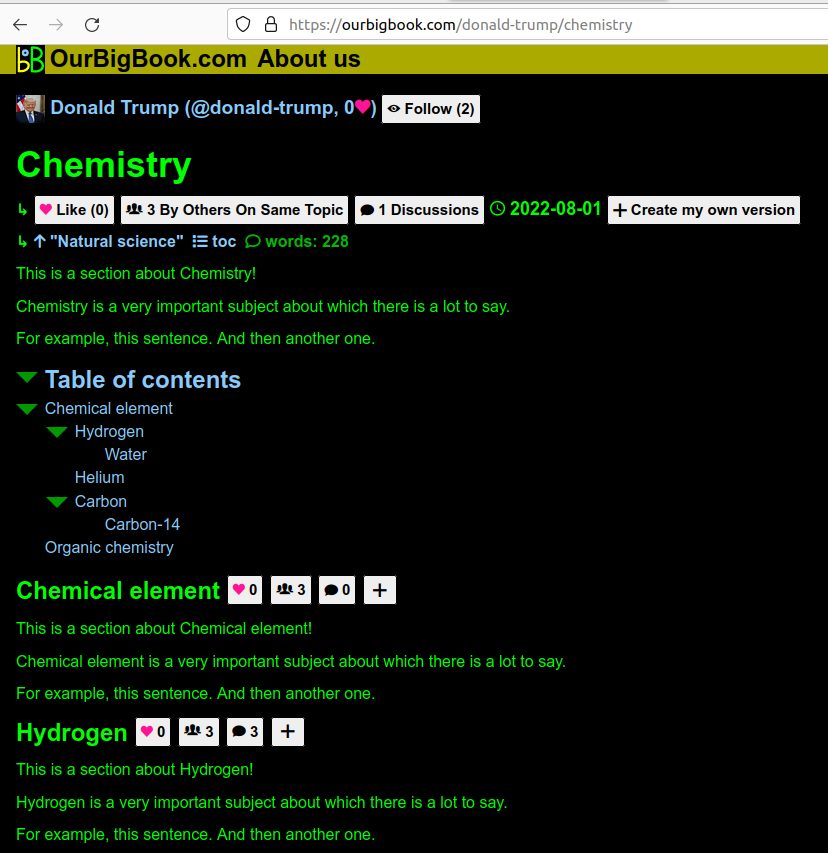
Screenshot showing metadata next to each header
. The page is: ourbigbook.com/donald-trump/chemistry. Note how even the subheaders "Chemical element" and "Hydrogen" show the metadata.The new default homepage for a logged out user how shows a list of the topics with the most articles.
This is a reasonable choice for default homepage, and it immediately exposes users to this central feature of the website: the topic system.
Doing this required in particular calculating the best title for a topic, since it is possible to have different titles with the same ID, the most common way being with capitalization changes, e.g.:would both have topic ID
JavaScript
Javascriptjavascript.The algorithm chosen is to pick the top 10 most upvoted topics, and select the most common title from amongst them. This should make topic title vandalism quite hard. This was made in a single SQL query, and became the most complext SQL query Ciro Santilli has ever written so far: twitter.com/cirosantilli2/status/1549721815832043522
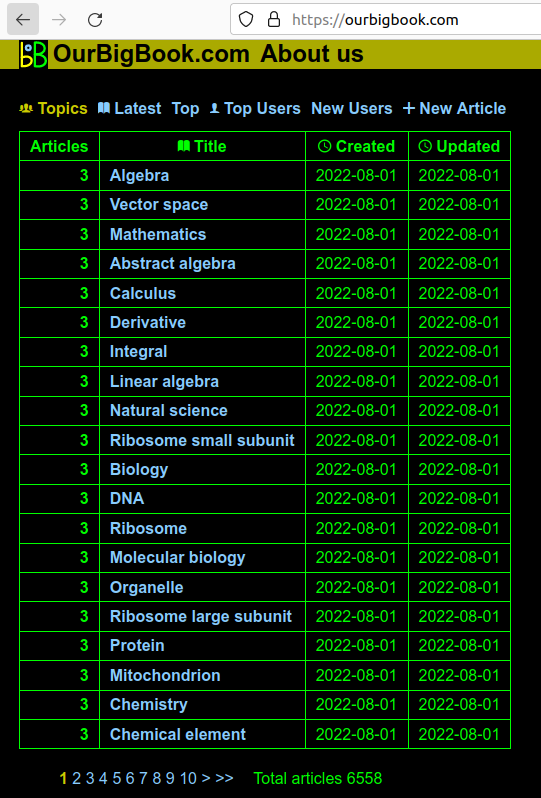
Screenshot showing the list of topics
. The page is: ourbigbook.com for the logged out user, ourbigbook.com/go/topics for the logged in user.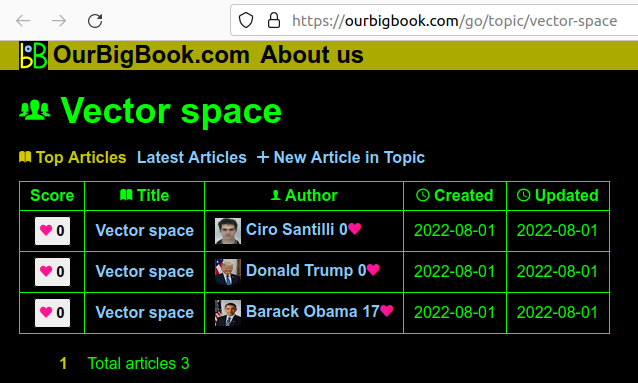
Screenshot showing a topic page
. The page is: ourbigbook.com/go/topic/vector-space. Before this sprint, we didn't have the "Vector Space" at the top, as it wasn't necessarily trivial to determine what the preferred title would be.Limited the number of articles, and the size of article bodies. This, together with the reCAPTCHA setup from Email verification and reCAPTCHA signup protection should prevent the most basic types of denial-of-service attacks by filling up our database.
Ciro's Edict #7 Email verification and reCAPTCHA signup protection by Ciro Santilli 40 Updated 2025-07-16
Ciro Santilli 40 Updated 2025-07-16Added this basic but fundamental protection layer to the website.
The email setup will of course be reused when notifications are eventually implemented.
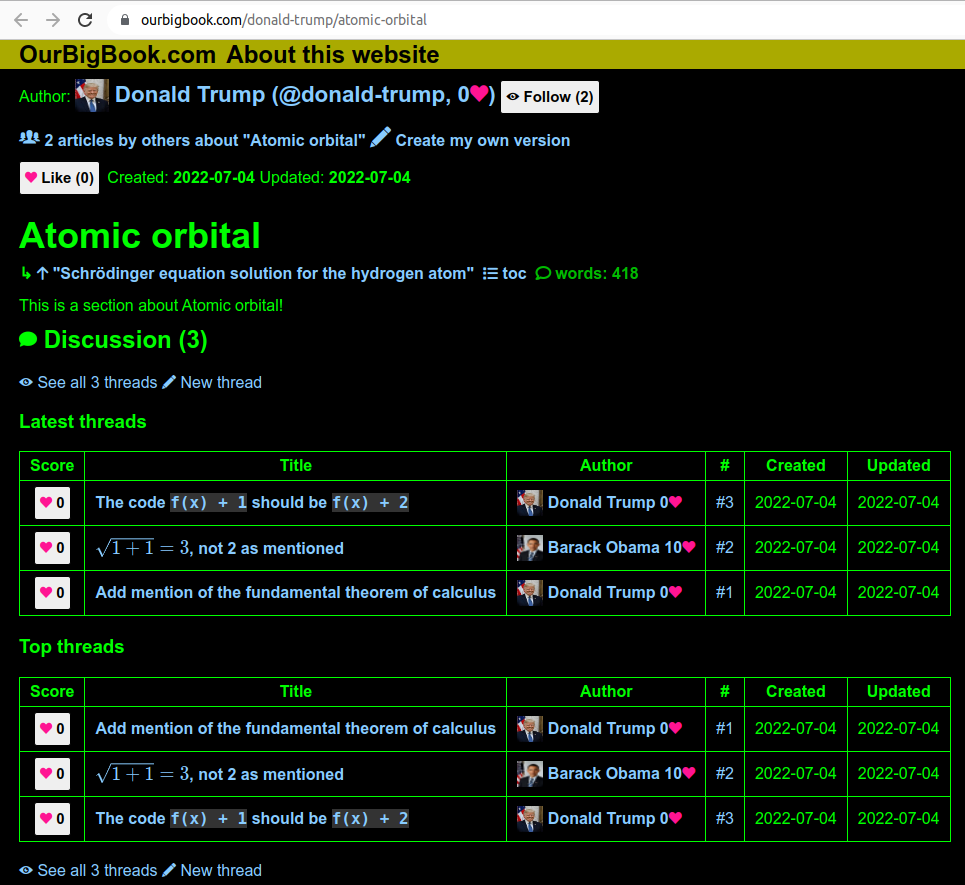
Every article now has a (very basic) GitHub-like issue tracker. Comments now go under issues, and issues go under articles. Issues themselves are very similar to articles, with a title and a body.
This was part of 1.0, but not the first priority, but I did it now anyways because I'm trying to do all the database changes ASAP as I'm not in the mood to write database migrations.
Here's an example:
- ourbigbook.com/go/issue/2/donald-trump/atomic-orbital a specific issue about the article "Atomic Orbital" by Donald Trump. Note the comments possibly by other users at the bottom.
- ourbigbook.com/go/issues/1/donald-trump/atomic-orbital list of issues about the article "Atomic Orbital" by Donald Trump
You can now write:in lieu of the old:
<Blue cats> are nice.

= Blue cat

= Big blue cat
{parent=Blue cat}\x[blue-cat]{c}{p} are nice.
= Blue cat
= Big blue cat
{parent=blue-cat}Added
ourbigbook --format-source automatic code formatting. I implemented it for the following reasons:- I want to do certain automatic modifications to source code on web, e.g.:
- later on, much later, this will allow WYSIWYG export to plaintext
This also ended up having one unexpected benefit: whenever a new feature is added that deprecates an old feature, by converting the large corpus from github.com/cirosantilli/cirosantilli.github.io to the new feature I can test the new preferred feature very well.
For example, converting
\x[blue cat] en masse to the new insane syntax <blue cat> found several bugs with the new insane syntax.This seemed somewhat easy at first, so I started it as a way of procrastinating more urgent Web features (web scares me, you know), but it ended being insanely hard to implement, because there are many edge cases. Also, most bugs are not acceptable, as they would corrupt your precious source code and potentially output.
But well, it is done!
Ciro's Edict #6 cirosantilli.com content uploaded to ourbigbook.com/cirosantilli by Ciro Santilli 40 Updated 2025-07-16
Ciro Santilli 40 Updated 2025-07-16Managed to upload the content from the static website cirosantilli.com (OurBigBook Markup source at github.com/cirosantilli/cirosantilli.github.io) to ourbigbook.com/cirosantilli.
Although most of the key requirements were already in place since the last update, as usual doing things with the complex reference content stresses the system further and leads to the exposition of several new bugs.
The upload of OurBigBook Markup files to ourbigbook.com was done with the newly added OurBigBook CLI
ourbigbook --web option. Although fully exposed to end users, the setup is not super efficient: a trully decent implementation should only upload changed files, and would basically mean reimplementing/using Git, since version diffing is what Git shines at. But I've decided not to put much emphasis on CLI upload for now, since it is expected that initially the majority of users will use the Web UI only. The functionality was added primarily to upload the reference content.This is a major milestone, as the new content can start attracting new users, and makes the purpose of the website much clearer. Just having this more realistic content also immediately highlighted what the next development steps need to be.
Once v1.0 is reached, I will actually make all internal links of cirosantilli.com to point to ourbigbook.com/cirosantilli to try and drive some more traffic.
The new content blows up by far the limit of the free Heroku PostgreSQL database of 10k lines. This meant that I needed to upgrade the Heroku Postgres plugin from the free Hobby Dev to the 9 USD/month Hobby Basic: elements.heroku.com/addons/heroku-postgresql, so now hosting costs will increase from 7 USD/month for the dyno to 7 + 9 = 16 UDS/month. After this upgrade and uploading all of cirosantilli.com to ourbigbook.com, Heroku dashboard reads reads:so clearly if we are ever forced to upgrade plans again, it means that a bunch of people are using the website and that things are going very very well! Happy how this storage cost turned out so far.
One key limitation found was that Heroku RAM memory is quite limited at 512MB, and JavaScript is not exactly the most memory economical language out there. Started investigation at: github.com/ourbigbook/ourbigbook/issues/230 Initially working around that by simply splitting the largest files. We were just on the verge of what could be ran however luckily, so a few dozen splits was enough, it managed to handle 70 kB OurBigBook Markup inputs. So hopefully if we manage to optimize a bit more we will be able to set a maximum size of 100 kB and still have a good safety margin.
Ciro's Edict #5 Ciro Santilli 40 Updated 2025-07-16
\Include and \x and working on dynamic website by Ciro Santilli 40 Updated 2025-07-16This was the major final step of fully integrating the OurBigBook CLI into the dynamic website (besides fixing some nasty bugs that escaped passed by me from the previous newsletter).

Before
. 
After
. Added font awesome icons. github.com/ourbigbook/ourbigbook/issues/151
Didn't manage to subset, but so be it for now: stackoverflow.com/questions/62395038/how-can-i-export-only-one-character-from-ttf-woff-file-to-avoid-load-unnecessa/71197892#71197892
Ciro's Edict #5 Skip ID extraction and rendering based on database timestamps by Ciro Santilli 40 Updated 2025-07-16
Ciro Santilli 40 Updated 2025-07-16This means while developing a website locally with the OurBigBook CLI, if you have a bunch of files with an error in one of them, your first run will run slowly until the error:but further runs will blast through the files that worked, skipping all files that have sucessfully converted:so you can fix file by file and move on quickly.
extract_ids README.ciro
extract_ids README.ciro finished in 73.82836899906397 ms
extract_ids art.ciro
extract_ids art.ciro finished in 671.1738419979811 ms
extract_ids ciro-santilli.ciro
extract_ids ciro-santilli.ciro finished in 1009.6256089992821 ms
extract_ids science.ciro
error: science.ciro:13686:1: named argument "parent" given multiple times
extract_ids science.ciro finished in 1649.6193730011582 msextract_ids README.ciro
extract_ids README.ciro skipped by timestamp
extract_ids art.ciro
extract_ids art.ciro skipped by timestamp
extract_ids ciro-santilli.ciro
extract_ids ciro-santilli.ciro skipped by timestamp
extract_ids science.ciroMore details at: cirosantilli.com/ourbigbook#no-render-timestamp
This was not fully trivial to implement because we had to rework how duplicate IDs are checked. Previously, we just nuked the DB every time on a directory conversion, and then repopulated everything. If a duplicated showed up on a file, it was a duplicate.
But now that we are not necessarily extracing IDs from every file, we can't just nuke the database anymore, otherwise we'd lose the information. Therefore, what we have to do is to convert every file, and only at the end check the duplicates.
Managed to do that with a single query as documented at: stackoverflow.com/questions/71235548/how-to-find-all-rows-that-have-certain-columns-duplicated-in-sequelize/71235550#71235550
Pinned article: Introduction to the OurBigBook Project
Welcome to the OurBigBook Project! Our goal is to create the perfect publishing platform for STEM subjects, and get university-level students to write the best free STEM tutorials ever.
Everyone is welcome to create an account and play with the site: ourbigbook.com/go/register. We belive that students themselves can write amazing tutorials, but teachers are welcome too. You can write about anything you want, it doesn't have to be STEM or even educational. Silly test content is very welcome and you won't be penalized in any way. Just keep it legal!
Intro to OurBigBook
. Source. We have two killer features:
- topics: topics group articles by different users with the same title, e.g. here is the topic for the "Fundamental Theorem of Calculus" ourbigbook.com/go/topic/fundamental-theorem-of-calculusArticles of different users are sorted by upvote within each article page. This feature is a bit like:
- a Wikipedia where each user can have their own version of each article
- a Q&A website like Stack Overflow, where multiple people can give their views on a given topic, and the best ones are sorted by upvote. Except you don't need to wait for someone to ask first, and any topic goes, no matter how narrow or broad
This feature makes it possible for readers to find better explanations of any topic created by other writers. And it allows writers to create an explanation in a place that readers might actually find it.
Figure 1. Screenshot of the "Derivative" topic page. View it live at: ourbigbook.com/go/topic/derivativeVideo 2. OurBigBook Web topics demo. Source. - local editing: you can store all your personal knowledge base content locally in a plaintext markup format that can be edited locally and published either:This way you can be sure that even if OurBigBook.com were to go down one day (which we have no plans to do as it is quite cheap to host!), your content will still be perfectly readable as a static site.
- to OurBigBook.com to get awesome multi-user features like topics and likes
- as HTML files to a static website, which you can host yourself for free on many external providers like GitHub Pages, and remain in full control

Figure 2. You can publish local OurBigBook lightweight markup files to either OurBigBook.com or as a static website.
Figure 3. Visual Studio Code extension installation.
Figure 5. . You can also edit articles on the Web editor without installing anything locally. Video 3. Edit locally and publish demo. Source. This shows editing OurBigBook Markup and publishing it using the Visual Studio Code extension. 
- Infinitely deep tables of contents:


All our software is open source and hosted at: github.com/ourbigbook/ourbigbook
Further documentation can be found at: docs.ourbigbook.com
Feel free to reach our to us for any help or suggestions: docs.ourbigbook.com/#contact