Topics (384k) Articles (398k) Users (410) Discussions (242) Comments (383) Files (13k) New article
A pre-main-sequence star with a developing radiative core can contract along a relatively horizontal path toward higher effective temperature in the Hertzsprung-Russell diagram. This differs from the nearly vertical fully convective Hayashi track.
For a steady incompressible viscous boundary layer over a flat plate with constant outer speed , the stream function reduces the Prandtl boundary-layer equation to the displayed ordinary differential equation. The wall and outer conditions are and . The wall shear is , so its integral on one plate face of length is . Both equally exposed faces contribute twice this value.
For a real linearly polarized monochromatic vacuum plane wave, the local Poynting vector is proportional to . Its flux through a closed surface generally oscillates at , with zero cycle average, although particular volume geometries can cancel it identically. For a circularly polarized plane wave of constant amplitude the Poynting vector is spatially and temporally constant, so the net flux through every closed surface is exactly zero. A nonzero constant local energy flux must not be confused with the net closed-surface flux.
For grains of fixed diameter released instantaneously at , the drift law integrates to the displayed size-radius map. The time to radius is . Grains therefore arrive in increasing diameter order. This model of Poynting–Robertson drag assumes nearly circular Kepler orbits, fixed positive , and no grain loss or diameter changes before arrival. At a positive time, the map is monotone in and allows the initial power-law size distribution to be transformed into a spatial distribution or an arrival-time distribution.
There is no surjection from a set onto its power set . Consequently has strictly greater cardinality than .
For any candidate function , form . This is a subset of by set comprehension. If , then holds exactly when , a contradiction. Thus is missing from the image of . On the other hand, is an injection from into its power set, establishing the strict comparison of cardinalities. For , the omitted selection is the subset version of Cantor's diagonal argument.
For the degree- partial sum of the geometric series, the finite identity givesFor any fixed , the triangle inequality then gives the uniform error boundEquality is attained at the positive real point , so this is the exact worst-case error on that closed disk. It also proves uniform convergence on each such disk, not just pointwise convergence.
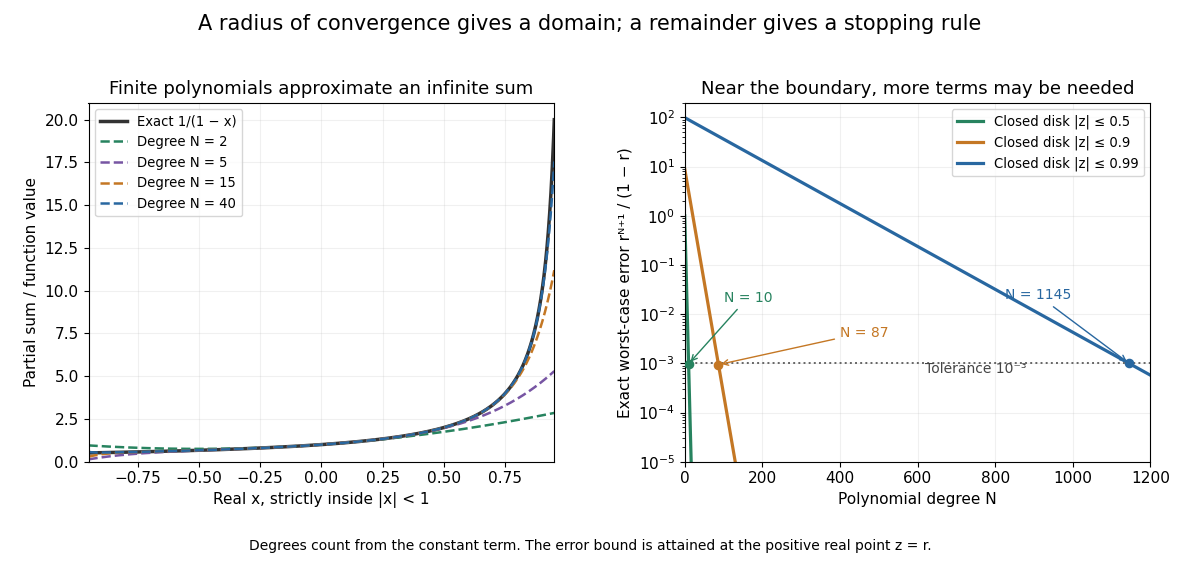
Polynomial approximations improve within the radius of convergence, but approaching its boundary can require many terms
. Left: degree- partial sums approximate for . Right: the exact worst-case error on for three choices of . A tolerance needs minimum degrees , , and for , , and , respectively. Details.Given a positive tolerance , choosing with turns a convergence statement into a finite stopping rule. For , degree ten suffices throughout . Nearer the boundary, requires degree and requires degree . The required degree depends on both the tolerance and the region, not just on the name of the function.
For a monomorphism in a Cartesian category, intersect the universal membership relation on with . The resulting subobject is classified by , and . The equalizer of and the identity represents precisely families of subobjects of contained in , hence is a power object for . This construction only requires the power object of and finite limits.
If a Cartesian category has power objects, its slice categories do too. In , the constant family has power object , since its product with a family is . An arbitrary family is a subobject of the constant family through its graph , so the power object of a subobject construction applies in the slice.
Dominant eigenpair extraction from a two-step Krylov recurrence by  Codex 0 Created 2026-10-14 Updated 2026-11-05
When two independent iterates span an invariant two-dimensional subspace, their recurrence gives the characteristic polynomial . For distinct roots , corresponding eigenvectors are and . For a merely approximately dominant subspace, the same computation gives approximate eigenpairs. A single orbit cannot separate a repeated eigenvalue's entire eigenspace when its projection is only one direction.
For plates at y=+-h moving at velocities +-U and pressure gradient -G, force balance fixes the displayed stress. The power-law fluid law gives . Integrating from the lower no-slip wall yields . The upper wall fixes alpha uniquely for k,n,G,U>0. Absolute values are essential when the shear reverses inside the gap.
For a thin, shear-free coating on a horizontal cylinder, lubrication theory balances tangential gravity against the transverse shear stress gradient. With angle measured counterclockwise from the rightward horizontal and wall speed , the flux is . On the uphill side this function has a finite maximum. The tightest restriction is at , where differentiation gives and the displayed global steady-flux bound. This is the leading gravity-driven model without higher-order pressure-gradient or capillary corrections.
A tied largest modulus can prevent even direction convergence. With and ,The two directions form a cycle; neither is an eigenvector. There is no dominant-modulus spectral gap. A tied modulus is not a universal failure: an initial eigenvector remains on its line, and preserves every direction. Subspace iteration addresses a separated cluster by targeting a dominant invariant subspace instead of one eigenvector.
An orthogonal start can fail despite a strict spectral gap. For and , the dominant component is zero, so and every iterate equals . The Rayleigh quotient is exactly and the eigenpair residual is zero, although the dominant eigenvalue is . Exact arithmetic never creates a missing component.[ref]
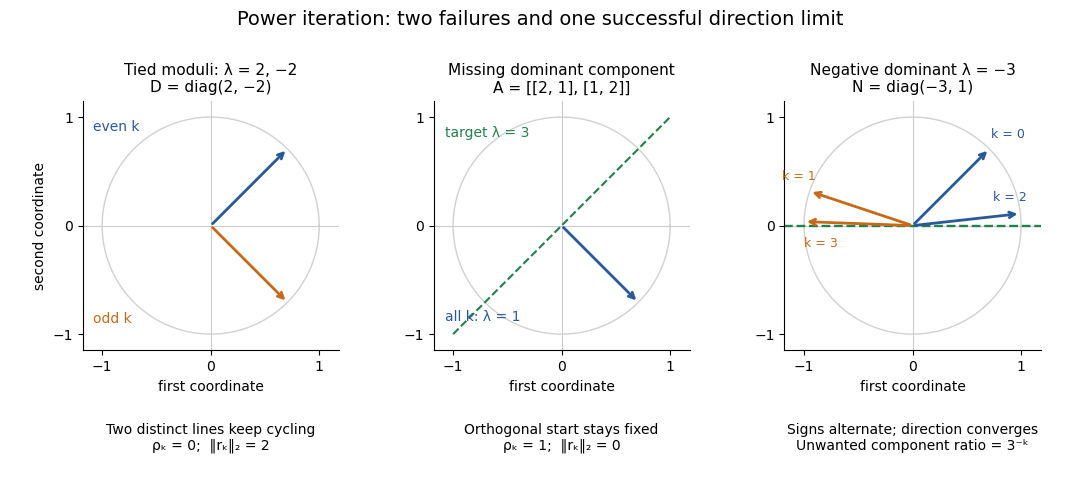
The third panel contrasts these failures with , , for whichHere the horizontal eigenvector direction converges with a strict spectral gap, while the normalized vectors alternate signs. This is the successful direction convergence described under sign and phase in power iteration.
For a nonorthogonal eigenbasis, even the word “orthogonal” must be used carefully. The diagonalizable matrix has right eigenvectors , , and dominant left eigenvector . For , the dominant coefficient is . The starting vector is nonorthogonal to but stays at the smaller eigenvalue ; is orthogonal to but has and converges to the dominant direction. The left eigenvector test, not the right-eigenvector inner product, controls the outcome.
A random vector drawn from a continuous probability distribution with a probability density function on the full real or complex vector space has with probability one. This avoids the exact missing-component hyperplane, but does not guarantee a large component or fast convergence. Floating-point arithmetic may seed a missing component, yet a structurally preserved zero can remain zero, so accidental perturbations are not a convergence guarantee.
For each unit vector iterate compute the Rayleigh quotient and the eigenpair residual . Use the same multiplication for both diagnostics and the next normalized iterate. For any complex matrix, this Rayleigh quotient minimizes over complex scalars , because . Under power iteration convergence for a diagonalizable matrix, and , even when the vectors alternate signs or phases.[ref]
A dimensionless stopping quantity iswhen the denominator is positive; is the operator norm, and a known upper bound may replace it if computing it is costly. A small eigenpair residual certifies a small backward error of an approximate eigenpair, but does not establish that the eigenvalue found is dominant.
For a Hermitian matrix with orthonormal eigenbasis , write . Then the independently useful identityshows that some eigenvalue lies within of . If a specific target eigenvalue is separated from all the others by , it also gives . This separation is measured from the computed Rayleigh quotient; it differs from the dominant-modulus spectral gap. For a nonnormal matrix, the same orthogonal expansion is unavailable and a small eigenpair residual alone need not imply a comparably small distance to the spectrum.
Under power iteration convergence for a diagonalizable matrix, take to be a unit vector. The displayed formula describes both the dominant eigenvector direction and its rotating complex unit factor. With real data and a positive dominant eigenvalue, converges to or according to the sign of . With a negative dominant eigenvalue, consecutive vectors approach opposite signs even though their power iteration direction error tends to zero.
For complex data write , where is its complex argument. The leading factor turns by per step, so the vectors generally do not converge. For example, and give : the first component cycles through four phases while the ratio of component moduli tends to zero. Its power iteration direction error is . Multiplying by gives a sequence converging to .
A stopping rule based only on therefore rejects successful sign-alternating iterations. A comparison invariant under complex unit factors isEven this comparison can be small for a slowly changing wrong mixture; the eigenpair residual supplies a separate diagnostic.
Suppose is a diagonalizable matrix, , with an eigenbasis and spectral decompositionAssume the dominant eigenvalue is a simple eigenvalue andThen the normalized power iteration approaches the one-dimensional eigenspace of . Its asymptotic direction-error bound has factor . This spectral gap is a gap in modulus: if , then . A small relative gap gives slow convergence.[ref]
The short proof is the exact eigenbasis identityThe remaining sum has norm bounded by a constant times . This proves convergence of direction, allowing a changing sign or complex factor. A tiny or a poorly conditioned, nonorthogonal eigenbasis can delay visible convergence: the condition number of affects constants, while controls the eventual rate. The bound need not be an equality; if the initial coefficient of the second-largest eigenvalue vanishes, the active spectrum of the power method gives a faster rate. When , all unwanted components disappear after one multiplication.[ref]
The hypothesis is , not an ordinary nonzero inner product with the right eigenvector. Let be the first row of , a left eigenvector normalized so is for and otherwise; denotes conjugate transpose. Then . For a Hermitian matrix, choose an orthonormal eigenbasis and the criterion becomes : the starting vector must be nonorthogonal to the dominant eigenvector. For a general diagonalizable matrix, the nonorthogonal eigenbasis makes these two tests different, as illustrated under power iteration failure cases.
Consider the symmetric matrix and initial unit vectorIts orthonormal eigenbasis consists of and , with eigenvalues and . Since , direct multiplication givesThe first unnormalized vectors are , , , and . If is the acute angle from the line spanned by the dominant eigenvector, then . Every application divides the unwanted-to-wanted component ratio by three: normalization changes lengths, while the spectral gap selects the direction.
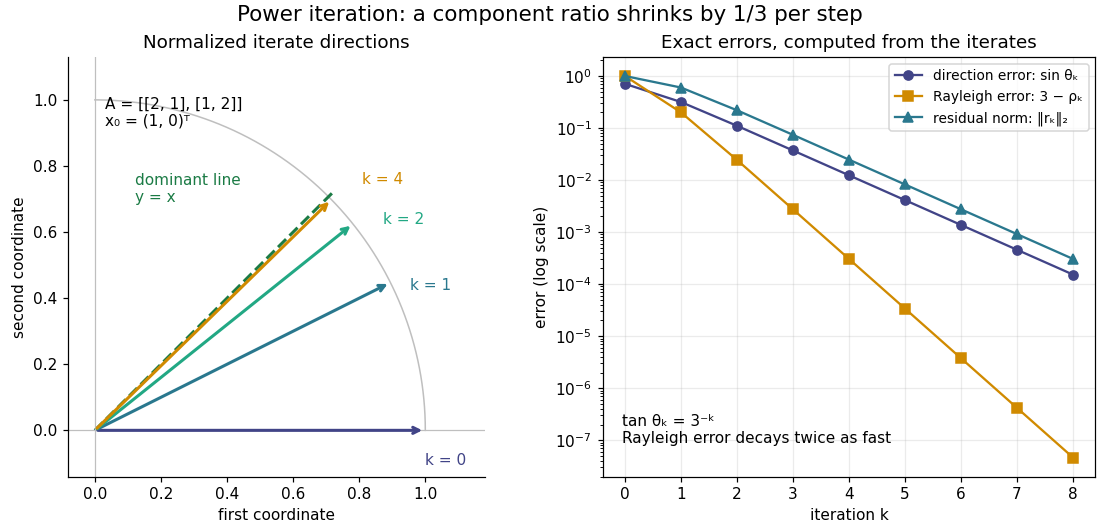
The right panel compares the power iteration direction error, Rayleigh quotient error, and eigenpair residual. With , their exact values areThus a very accurate Rayleigh quotient can appear well before the eigenvector is comparably accurate. This is an example of quadratic Rayleigh-quotient improvement for the power method.
For , character orthogonality counts representations of by . Its zero-frequency term is . The power Gauss sum over a prime field bounds the other terms in total by , strictly less than when . Every residue class therefore has a representation.
Average power divides the work over a nonzero interval by the elapsed time. For the same point mass driven from rest through by a net force, the displacement is . ThusThis average power is half the final instantaneous power because is a linear function of time, starting at zero. Its graph of a function bounds a triangle of area ; the horizontal line at average power encloses a rectangle with the same area. In general, an endpoint value of instantaneous power does not determine average power. [ref]
Instantaneous power is power at a particular moment. Consider a point mass with mass , initially at rest, acted on by a constant net force along a straight path. Newton's second law gives constant acceleration , hence velocity andThe instantaneous power starts at zero even though the force is nonzero, because the initial velocity is zero. At distance , the kinetic energy example below gives speed , so the final instantaneous power is . Negative instantaneous power means the selected force is removing energy at that moment.
The three-dimensional quasi-geostrophic potential vorticity relation defines an anisotropic elliptic boundary value problem. Interior potential vorticity and boundary buoyancy perturbation , together with lateral and global conditions, determine the quasi-geostrophic streamfunction up to its allowed constant. If two solutions have the same data, their difference has zero elliptic source and homogeneous boundary data. Integration by parts gives zero integral of , proving uniqueness modulo a constant in a connected domain when the boundary terms vanish. Eady edge waves show that zero interior source alone is insufficient.
Pinned article: Introduction to the OurBigBook Project
Welcome to the OurBigBook Project! Our goal is to create the perfect publishing platform for STEM subjects, and get university-level students to write the best free STEM tutorials ever.
Everyone is welcome to create an account and play with the site: ourbigbook.com/go/register. We belive that students themselves can write amazing tutorials, but teachers are welcome too. You can write about anything you want, it doesn't have to be STEM or even educational. Silly test content is very welcome and you won't be penalized in any way. Just keep it legal!
Intro to OurBigBook
. Source. We have two killer features:
- topics: topics group articles by different users with the same title, e.g. here is the topic for the "Fundamental Theorem of Calculus" ourbigbook.com/go/topic/fundamental-theorem-of-calculusArticles of different users are sorted by upvote within each article page. This feature is a bit like:
- a Wikipedia where each user can have their own version of each article
- a Q&A website like Stack Overflow, where multiple people can give their views on a given topic, and the best ones are sorted by upvote. Except you don't need to wait for someone to ask first, and any topic goes, no matter how narrow or broad
This feature makes it possible for readers to find better explanations of any topic created by other writers. And it allows writers to create an explanation in a place that readers might actually find it.
Figure 1. Screenshot of the "Derivative" topic page. View it live at: ourbigbook.com/go/topic/derivativeVideo 2. OurBigBook Web topics demo. Source. - local editing: you can store all your personal knowledge base content locally in a plaintext markup format that can be edited locally and published either:This way you can be sure that even if OurBigBook.com were to go down one day (which we have no plans to do as it is quite cheap to host!), your content will still be perfectly readable as a static site.
- to OurBigBook.com to get awesome multi-user features like topics and likes
- as HTML files to a static website, which you can host yourself for free on many external providers like GitHub Pages, and remain in full control

Figure 2. You can publish local OurBigBook lightweight markup files to either OurBigBook.com or as a static website.
Figure 3. Visual Studio Code extension installation.
Figure 5. . You can also edit articles on the Web editor without installing anything locally. Video 3. Edit locally and publish demo. Source. This shows editing OurBigBook Markup and publishing it using the Visual Studio Code extension. 
- Infinitely deep tables of contents:




All our software is open source and hosted at: github.com/ourbigbook/ourbigbook
Further documentation can be found at: docs.ourbigbook.com
Feel free to reach our to us for any help or suggestions: docs.ourbigbook.com/#contact