Topics (384k) Articles (398k) Users (410) Discussions (242) Comments (383) Files (13k) New article
A perturbation is a small change in a model, operator, state or parameter. It can be organized as a family in a specified norm. If and is invertible, differentiating at zero gives . The implicit function theorem justifies this continued solution locally. Singular derivatives at a bifurcation instead require an unfolding or reduced equation; smallness of the change alone does not preserve a degenerate bifurcation.
A nonempty collection of real continuous subharmonic functions on a connected Riemann surface is a Perron family if it is closed under pairwise maxima and harmonic lifting of a continuous subharmonic function on every relatively compact coordinate disk. Its pointwise supremum is either everywhere infinite or a harmonic function on a Riemann surface. At a point where the supremum is finite, take increasing disk lifts approaching that value. The Harnack inequality for harmonic functions gives a finite harmonic limit on the disk. Lifting their maxima with any other member gives a larger harmonic limit with the same value at the chosen point, hence the same limit by the strong maximum principle for harmonic functions. The supremum is therefore harmonic on that disk; connectedness propagates finiteness to the whole surface.
For even degree the augmentation hyperplane has an alternating dot product whose radical is the all-ones line. Quotienting by that line gives a nondegenerate symplectic space of dimension two less than the permutation degree. Coordinate permutations preserve the form. In degree at least six their quotient action is faithful, since two distinct weight-two coordinate vectors cannot differ by the all-ones vector. In degree six this gives ; in degree four the quotient action instead has Klein-four kernel.
For a finite group action on a finite set , is the free -module with basis , with the group permuting that basis. For a transitive set it is . Disjoint unions of sets give direct sums of permutation modules.
The rank is the number of orbits on ordered pairs under the diagonal group action. Its fixed-pair count at is , since the permutation character counts fixed points. Burnside's lemma identifies its average with the orbit count, while real-valuedness makes that average the character inner product of with itself. For a transitive action on at least two points, rank two is equivalent to transitivity on distinct ordered pairs.
If every row and column of an -by- zero-one matrix has more than ones, its permanent of a matrix has a fully polynomial randomized approximation scheme. The short augmenting paths in a dense bipartite graph bound makes the leading coefficient dominate the matching generating function at polynomially large activity. The weighted matching Markov chain samples polynomially bounded activities in polynomial mixing time. Estimate successive annealing ratios for a matching generating function and divide by the final activity to the power .
Permanent as probability of distinct independent choices by  Codex 0 Created 2026-10-14 Updated 2026-10-20
Let be independent random variables, each choosing a label from . Put their probabilities in the matrix , where . Each row sums to one. All choices are distinct precisely when their ordered list is one of the permutations of the labels. These are mutually exclusive events, and independence makes the probability of one list equal to . Adding the list probabilities gives the permanent of a matrix:In particular, this permanent lies between zero and one.
For a two-person example,The distinct outcomes and have probabilities and . ThereforeThe colliding outcomes and have probabilities and , totaling . All four outcomes are shown below; their probabilities sum to one.
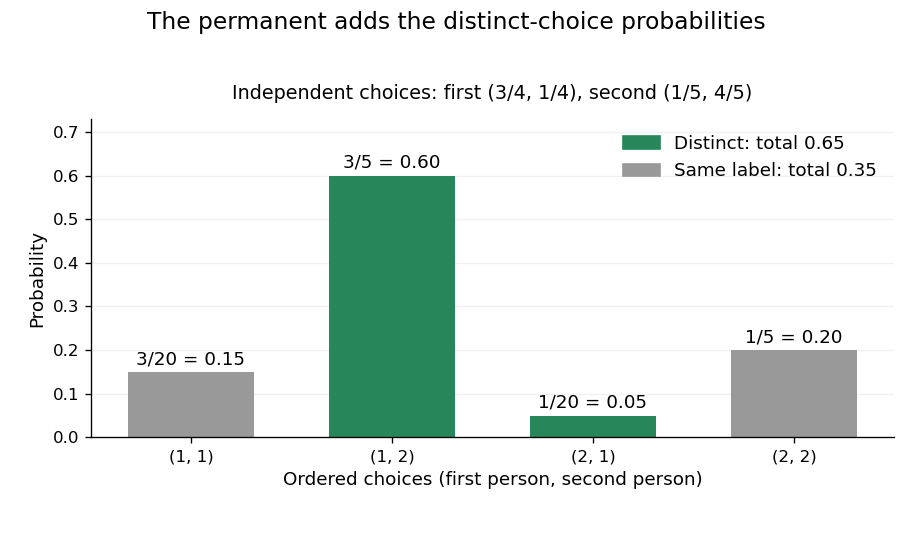
The permanent adds the probabilities of distinct choices: two successful outcomes have total probability 0.65
. Details. If every choice has the uniform distribution on a finite set of labels, then and the distinct-choice probability is . For three choices and three labels it is . This counts a subset of all ordered outcomes, not independent pairwise collision events. Independence of the original choices is essential: without it, the individual rows of do not determine the joint probabilities.
For negligible inertia, periodic forcing , resistance and prescribed mean area , write . First-order area obeys . Its mean square is . Averaging the second-order friction balance gives , proving the displayed forward pumping rate. Periodicity entails zero mean pressure drop; the mean-area convention fixes the expansion's otherwise free constant.
A holomorphic periodic point is attracting when its return multiplier has modulus strictly less than one. For the return map , choose a local coordinate at the fixed point and a number strictly between and one. Taylor expansion gives on a sufficiently small disc. It maps that disc into itself, and successive returns converge uniformly to there. Composing with the finitely many intervening maps gives locally uniform convergence to the periodic orbit and places its basin in the Fatou set.
A holomorphic periodic point is repelling when its return multiplier has modulus greater than one. It belongs to the Julia set: if the iterates were normal near it, a subsequence of the return iterates, all fixing the point, would converge locally uniformly in the spherical metric. Near their fixed finite value the limit lies in a finite coordinate chart, so Cauchy's derivative estimate would bound their derivatives at the point. Those derivatives are the successive powers of the multiplier and are unbounded. The same argument in a reciprocal coordinate handles infinity.
An exact -cycle consists of distinct points with , indices read modulo . Every point has exact period . The return multiplier is , computed in local charts if necessary; cyclically changing the starting point leaves it unchanged. Thus an attracting, superattracting or repelling return is of the same type at every point of the cycle. If a period- root coincides with a lower-period point at a parameter limit, multiplicity in the equation need not represent distinct points of an exact cycle.
A generalized flip is a codimension-two period-doubling point with a simple multiplier , a vanishing cubic coefficient in its scalar centre-manifold map, and a nonzero quintic coefficient. In the odd normal form , symmetric two-cycles solve . The discriminant of this quadratic in produces a fold of two-cycles where its positive roots collide. For , , this fold is , , . At the amplitude is proportional to .
A period-doubling cascade is a succession of period-doubling bifurcations creating attracting periods , with bifurcation parameters tending to an accumulation value. Superstable periodic orbits inside successive stability intervals give a second parameter sequence with the same limiting parameter-scaling ratio in a quadratic universality class.
// Target: dynamical-systems.bigb
Slip-line field theory solves certain two-dimensional problems of plastic deformation by constructing two orthogonal families of characteristic curves, called slip lines. Its classical assumptions include plane strain, negligible inertia and body force, and a rigid, perfectly plastic material. The curves are aligned with the directions of maximum in-plane shear stress, rather than the principal stress directions.[ref]
Applied Mechanics of Solids by A. F. Bower. §6.2, assumptions 1–5; §6.2.1, interpreting a slip-line field and stress state
The curve network encodes both the stress field and constraints on admissible velocity. Indentation of a thick workpiece by a rigid flat punch provides a motivating application: the construction predicts a plastic flow region and the load needed to sustain that flow. It is useful because geometry can turn coupled field equations into relations integrated along curves. A slip line is a continuum characteristic, however, not necessarily a microscopic crystal slip system or the actual path of a moving material particle.
In antiplane perfect plasticity, velocity and shear stresses depend only on . Force balance is , the fixed yield surface is , and the associated flow rule is with . Differentiating the yield equation in each coordinate and combining it with equilibrium shows that are constant along characteristic curves tangent to . For example . Nonzero regular yield gradient is needed for a characteristic direction.
A perfect fluid with equation of state is called a stiff fluid. For positive energy density, its constant equation-of-state parameter is . The cosmological continuity equation gives . In a flat universe dominated by this fluid, the Friedmann equation then gives . This statement assumes a nonzero fluid density and negligible other components.
For metric signature , a perfect fluid has . The Einstein field equations and static Killing field is a Ricci eigenvector imply . Two nonzero timelike vectors cannot be orthogonal, so . If , the four-velocity is parallel to the static Killing vector. Choosing both future-directed gives the displayed normalization. For , the stress-energy tensor is proportional to the metric tensor and does not determine a preferred fluid velocity; the strict enthalpy hypothesis is therefore material.
For number density , rest-frame energy density and pressure , the enthalpy per particle is . In an isentropic barotropic fluid, and . It differs from enthalpy per unit mass by the particle mass when that mass is fixed. Using as thermodynamic variable gives and .
The number current is , where is the rest-frame number density and the unit four-velocity. Its covariant continuity equation is , equivalently . Integration over a spacetime volume and the divergence theorem equate the particle numbers crossing its boundary. This conservation law is separate from stress-energy conservation.
In signature , the matter action uses independent . Variations of give , , and particle number conservation in a relativistic fluid for . Its Hilbert stress-energy tensor is . The action describes isentropic potential flow, with vanishing canonical vorticity of a relativistic fluid, rather than every vortical perfect-fluid solution.
Pinned article: Introduction to the OurBigBook Project
Welcome to the OurBigBook Project! Our goal is to create the perfect publishing platform for STEM subjects, and get university-level students to write the best free STEM tutorials ever.
Everyone is welcome to create an account and play with the site: ourbigbook.com/go/register. We belive that students themselves can write amazing tutorials, but teachers are welcome too. You can write about anything you want, it doesn't have to be STEM or even educational. Silly test content is very welcome and you won't be penalized in any way. Just keep it legal!
Intro to OurBigBook
. Source. We have two killer features:
- topics: topics group articles by different users with the same title, e.g. here is the topic for the "Fundamental Theorem of Calculus" ourbigbook.com/go/topic/fundamental-theorem-of-calculusArticles of different users are sorted by upvote within each article page. This feature is a bit like:
- a Wikipedia where each user can have their own version of each article
- a Q&A website like Stack Overflow, where multiple people can give their views on a given topic, and the best ones are sorted by upvote. Except you don't need to wait for someone to ask first, and any topic goes, no matter how narrow or broad
This feature makes it possible for readers to find better explanations of any topic created by other writers. And it allows writers to create an explanation in a place that readers might actually find it.
Figure 1. Screenshot of the "Derivative" topic page. View it live at: ourbigbook.com/go/topic/derivativeVideo 2. OurBigBook Web topics demo. Source. - local editing: you can store all your personal knowledge base content locally in a plaintext markup format that can be edited locally and published either:This way you can be sure that even if OurBigBook.com were to go down one day (which we have no plans to do as it is quite cheap to host!), your content will still be perfectly readable as a static site.
- to OurBigBook.com to get awesome multi-user features like topics and likes
- as HTML files to a static website, which you can host yourself for free on many external providers like GitHub Pages, and remain in full control

Figure 2. You can publish local OurBigBook lightweight markup files to either OurBigBook.com or as a static website.
Figure 3. Visual Studio Code extension installation.
Figure 5. . You can also edit articles on the Web editor without installing anything locally. Video 3. Edit locally and publish demo. Source. This shows editing OurBigBook Markup and publishing it using the Visual Studio Code extension. 
- Infinitely deep tables of contents:



All our software is open source and hosted at: github.com/ourbigbook/ourbigbook
Further documentation can be found at: docs.ourbigbook.com
Feel free to reach our to us for any help or suggestions: docs.ourbigbook.com/#contact