Topics (384k) Articles (398k) Users (410) Discussions (242) Comments (383) Files (13k) New article

The canonical vorticity two-form is , with specific enthalpy per particle . Potential flow has for a torsion-free connection. Contracting this identity with yields , the isentropic relativistic Euler equation in signature . This canonical condition does not mean the unweighted four-velocity one-form is closed.
For a canonical scalar with timelike gradient, its stress-energy tensor has perfect-fluid form. In a homogeneous background, and . Potential domination gives negative pressure, while the scalar's physical rest-frame sound speed is one. A constant negative background therefore does not force its perturbations to obey the adiabatic barotropic closure .
// Target: cosmology.bigb
A percolation measure has the finite-energy property if, conditional on all exterior states, every prescribed state of any finite collection of sites or edges has positive probability almost surely. This permits finite local modifications within events of positive probability. It is a hypothesis on the measure and does not follow merely from invariance under graph symmetries.
In bond percolation on a directed graph, independently open each directed edge with probability . The out-cluster of consists of vertices reachable by open directed paths. In site percolation, independently open vertices and require every vertex of the directed path, including , to be open. The same definitions allow a multigraph. The orientation matters: an infinite underlying connected graph need not contain an infinite out-cluster from a specified root.
For the Kruskal–Szekeres coordinates of a positive-mass Schwarzschild spacetime, . The displayed conformal compactification makes radial null geodesics lines of slope . The Killing horizons are , and the spacelike curvature singularities lie at , with . Two asymptotically flat exterior regions each have past null infinity, null infinity to the future, timelike infinity and spacelike infinity. The two exterior regions cannot communicate by any causal curve; future-directed curves that cross a future horizon instead end at the black-hole singularity.
In a real quadratic integer ring, multiplying by a positive norm-one fundamental unit preserves a prescribed norm. Choose an exponent so that a positive representative lies in a half-open interval . Its conjugate is the prescribed norm divided by the representative, so both integer coefficients are bounded on that interval. Enumerating these reduced representatives gives a complete finite list of unit orbits of solutions.
For a finite game, let range over all pure strategy strategy profiles, and let be player 's probability of choosing . Under independent mixed strategies, the probability of is . The displayed sum is the expected value of player 's payoff. Holding everyone else's mixed strategy fixed makes a linear function of ; this is why checking pure strategy deviations suffices to check all mixed strategy deviations.
For tensor products of Pauli factors from , let count the sites where both factors are nonidentity and different. Distinct nonidentity Pauli matrices anticommute, and equal or identity factors commute. Reversing the product site by site therefore gives . Thus two Pauli strings commute exactly when is even. The criterion applies to the perfect-correlation observables in the GHZ theorem.
Two light quarks in a symmetric spatial state and the antisymmetric colour pair inside a three-quark colour singlet require symmetric spin-flavour symmetry. Their isospin singlet and spin singlet are both antisymmetric, while their respective triplets are symmetric. Thus the allowed pairs have or ; opposite exchange parities are excluded. Coupling an isospin-zero spin-one-half quark gives an baryon or baryons.
The Swift–Hohenberg equation is a partial differential equation for pattern formation. In one spatial dimension, a cubic-quintic version isLinearizing at and substituting a Fourier mode gives . The first unstable modes therefore have wavenumber near one when becomes positive. Replacing one by inside the differential operator selects wavenumbers near .
There is also a useful Lyapunov functional. On a periodic interval, or with sufficient decay at infinity, defineTwice using integration by parts gives the functional derivative . The equation is therefore a gradient flow, andThis dissipative structure constrains the evolution without requiring the final spatial pattern to be uniform. For , the cubic term enhances finite amplitudes while the quintic term limits growth. Near onset, a slowly varying envelope can satisfy a quintic real Ginzburg-Landau equation.
A phase modulation changes the local position of a periodic pattern. If has period in its argument, a transverse modulation can be writtenA constant translates the entire pattern; a varying bends its constant-phase lines. For the basic profile , the local wavevector is . The orientation changes at first order in the slope, while the local wavenumber is .
In the method of multiple scales, a correction depends both on its fast coordinate and on its slow coordinate . Differentiating at fixed physical therefore uses the chain ruleFor instance, differentiates to , not just the second term. The translation-covariant phase expansion calculates the second derivative needed in solvability conditions. Omitting the fast-coordinate dependence can change the nonlinear coefficient of the reduced amplitude equation while leaving its linear coefficients unchanged.
A planform is the spatial arrangement of a pattern, especially its horizontal structure in a fluid layer. In a Fourier mode description it includes the active wavevectors, their relative amplitudes and their phases. Those data determine more than a list of preferred wavelengths.
For example, describes parallel bands, with wavevectors . Adding an equal perpendicular pair gives , a square-symmetric planform. Unequal coefficients retain the two directions but generally lose the symmetry exchanging them.
A common translation symmetry changes the phases by without changing the physical shape. Relative phase combinations that cannot be removed by a translation can distinguish different arrangements, as the translation invariants of Fourier-mode phases show. Thus choosing a planform identifies a symmetry type; the amplitude equations still have to determine whether that state exists and is stable.
Osmosis is net movement of water across a boundary whose permeability differs for water and relevant solutes. The direction depends on the chemical potential of water, including both dissolved material and pressure. A cell wall can let water reach the cell membrane, yet oppose expansion through turgor pressure. Zero net movement does not mean individual water molecules have stopped crossing.
Imagine pure water on side A and a chemical solution on side B of a semipermeable membrane. At equal temperature and pressure, dissolved particles lower the chemical potential of water in B, and net water transfer initially favors A to B. Retaining the solutes lets water redistribute without simply mixing everything. Increasing B's pressure opposes entry; enough pressure gives thermodynamic equilibrium with unequal solute concentrations. This is why “water moves toward more solute” requires a pressure condition.[ref]
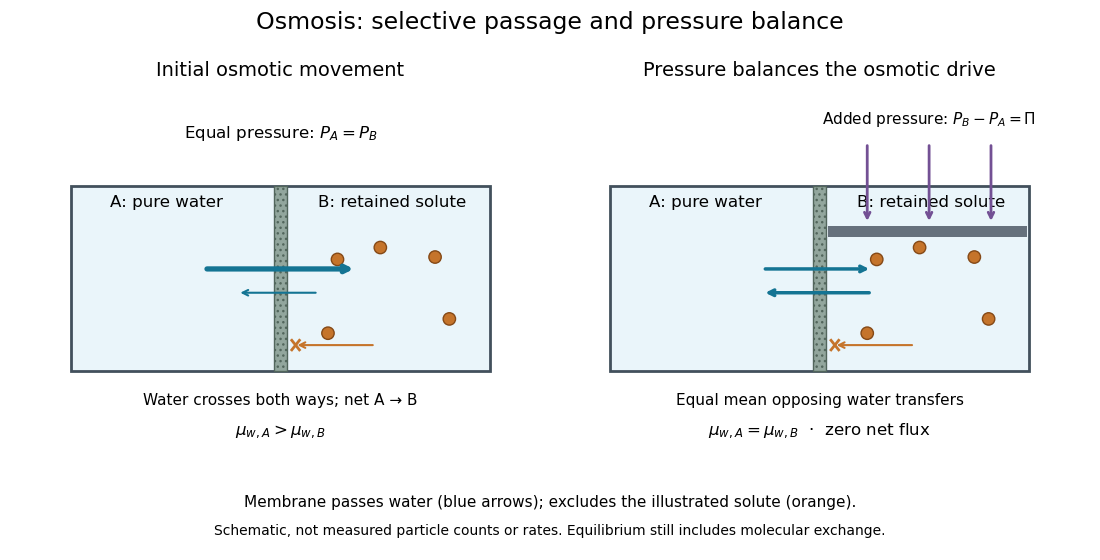
At thermodynamic equilibrium, the chemical potentials of exchangeable water are equal. Individual water molecules still move and cross in both directions, with equal mean opposing transfer rates and zero net flux. A stationary liquid level alone does not prove this: a blocked route can also give no visible transfer. Selective permeability provides a route; water potential supplies the direction, and neither alone determines the speed. The cell wall, turgor pressure and plasmolysis articles show why a living boundary's mechanical support and its selective permeability must be distinguished.
Facilitated diffusion is passive transport through a membrane transport protein, such as an ion channel or carrier protein, down the relevant electrochemical gradient. The protein supplies a route; it does not by itself provide free energy for uphill transfer.
Obukhov-Corrsin theory concerns transfer of scalar variance across scales in turbulent mixing. In the inertial-convective range, a constant scalar-variance flux and an eddy turnover time predict the displayed second-order scalar structure function. It assumes a passive scalar, local transfer, approximate statistical equilibrium and separation from the molecular diffusion and forcing scales.
For a homogeneous scalar, . Decorrelation at large separation gives saturation at twice the variance. If the scalar is mean-square differentiable and isotropic, at small separation. Statistical isotropy and zero mean alone do not imply decorrelation at infinity.
Differentiate the advection equation componentwise: . Along a Lagrangian trajectory, the scalar gradient therefore evolves by the negative transpose of the velocity gradient tensor. If is the deformation gradient, this says , as expected for a covector. Fluid material vectors and scalar gradients transform oppositely under stretching.
The molecular Schmidt number is the ratio of kinematic viscosity to scalar diffusivity. A large value allows a passive scalar to develop structure below the viscous smoothing scale of the velocity field. It is distinct from the turbulent Schmidt number, which compares effective turbulent transport coefficients, and from the Schmidt number used for quantum entanglement.
For in two dimensions, take positive definite, and positive conserved mass . The Gaussian integral gives , and . Substitution in the advection-diffusion equation gives and , equivalently the displayed moment equation. If , its solution is , with .
In the trap frame, a particle under linear drag has relative speed . A uniform strictly negative relative speed guarantees finite passage through a compact support. For a bounded continuous force, supplies that condition. For ordinary smooth forces, an encountered zero of the relative speed is an equilibrium or a passage bottleneck, not a finite crossing. Negative forces do not impede forward trap passage.
Pinned article: Introduction to the OurBigBook Project
Welcome to the OurBigBook Project! Our goal is to create the perfect publishing platform for STEM subjects, and get university-level students to write the best free STEM tutorials ever.
Everyone is welcome to create an account and play with the site: ourbigbook.com/go/register. We belive that students themselves can write amazing tutorials, but teachers are welcome too. You can write about anything you want, it doesn't have to be STEM or even educational. Silly test content is very welcome and you won't be penalized in any way. Just keep it legal!
Intro to OurBigBook
. Source. We have two killer features:
- topics: topics group articles by different users with the same title, e.g. here is the topic for the "Fundamental Theorem of Calculus" ourbigbook.com/go/topic/fundamental-theorem-of-calculusArticles of different users are sorted by upvote within each article page. This feature is a bit like:
- a Wikipedia where each user can have their own version of each article
- a Q&A website like Stack Overflow, where multiple people can give their views on a given topic, and the best ones are sorted by upvote. Except you don't need to wait for someone to ask first, and any topic goes, no matter how narrow or broad
This feature makes it possible for readers to find better explanations of any topic created by other writers. And it allows writers to create an explanation in a place that readers might actually find it.
Figure 1. Screenshot of the "Derivative" topic page. View it live at: ourbigbook.com/go/topic/derivativeVideo 2. OurBigBook Web topics demo. Source. - local editing: you can store all your personal knowledge base content locally in a plaintext markup format that can be edited locally and published either:This way you can be sure that even if OurBigBook.com were to go down one day (which we have no plans to do as it is quite cheap to host!), your content will still be perfectly readable as a static site.
- to OurBigBook.com to get awesome multi-user features like topics and likes
- as HTML files to a static website, which you can host yourself for free on many external providers like GitHub Pages, and remain in full control

Figure 2. You can publish local OurBigBook lightweight markup files to either OurBigBook.com or as a static website.
Figure 3. Visual Studio Code extension installation.
Figure 5. . You can also edit articles on the Web editor without installing anything locally. Video 3. Edit locally and publish demo. Source. This shows editing OurBigBook Markup and publishing it using the Visual Studio Code extension. 
- Infinitely deep tables of contents:



All our software is open source and hosted at: github.com/ourbigbook/ourbigbook
Further documentation can be found at: docs.ourbigbook.com
Feel free to reach our to us for any help or suggestions: docs.ourbigbook.com/#contact