Topics (384k) Articles (398k) Users (410) Discussions (242) Comments (383) Files (13k) New article

If the maximum force-induced speed is smaller in magnitude than , expand the passage denominator as a uniformly convergent geometric series. For a localized conservative well with equal outside potential levels, the first force moment vanishes and displacement starts at order . An odd force has no cubic moment, giving the next correction at order . Compact force support alone does not guarantee a vanishing first moment or positive displacement.
For every infinite cardinal , every coloring of pairs from by colors has a monochromatic subset of size . Construct an end-homogeneous tree by routing a new vertex through the least preceding vertices that match its colors to all previously chosen ancestors. An ancestor's color to every later vertex on a branch is constant. A node at height is determined by its color sequence of length , so levels below have size at most . The whole tree has more than vertices, forcing a branch of length . One of the ancestor-colors occurs times, giving the required set.
For an infinite cardinal and finite , put and . Every -coloring of -element subsets of has a homogeneous subset of size . The case is the Erdős-Rado theorem for pairs. For the induction, the end-homogeneous routing tree yields a sequence of length on which the color of an -tuple depends only on its first entries. The previous-arity theorem homogenizes those entries. The case is the infinite pigeonhole principle at a successor cardinal.
Choose a representative of each class of countably infinite sets modulo finite symmetric difference, and colour by the parity of . Removing one element stays in the same class and flips the parity. Every infinite candidate homogeneous set therefore has two countably infinite subsets of opposite colours. With choice, this refutes unrestricted countably infinite-arity positive partition relations on every infinite cardinal.
For parity acting as , the Dirac adjoint transforms as . A bilinear with matrix therefore transforms by , with its fields evaluated at . Since and the chirality matrix anticommutes with , the scalar bilinear is even and the pseudoscalar bilinear is odd. The same calculation shows that parity exchanges the chiral projectors.
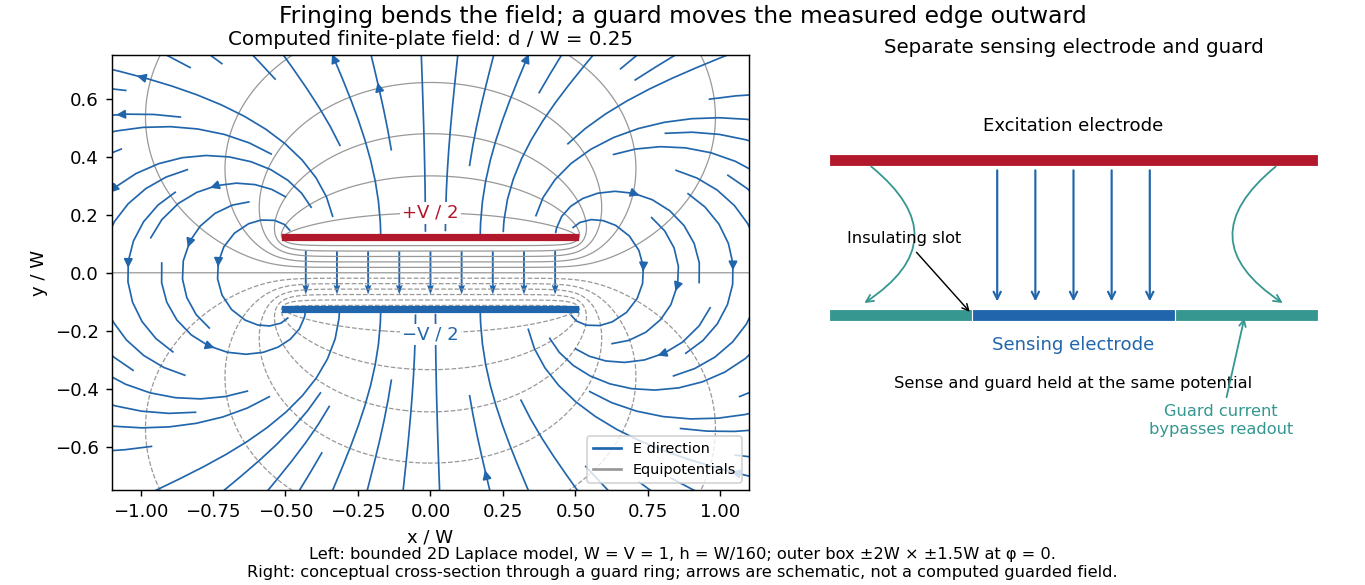
The fringing field of a capacitor is the nonuniform electric field near the edges of its electrical conductors, extending outside the gap. For a parallel-plate capacitor, neglecting it is useful when the gap is much smaller than both plate widths; the approximation is less reliable when these lengths become comparable.
Finite plates break the translational symmetry of the infinite-plate model. Each conductor in electrostatic equilibrium is an equipotential, so the electric field must meet a smooth conducting surface normally. Near an edge, the equipotentials curve into the surrounding space and the electric field changes both direction and magnitude. The surface charge density adjusts to enforce the conducting boundary conditions; it is not uniform all the way to a sharp edge. The electrostatic boundary conditions at a conductor explain why zero electric field inside the metal does not imply zero electric field just outside it.
The practical issue is where the nearly uniform region ends. A probe near the centre can support while a probe close to an edge detects a lateral component and a different magnitude. A total capacitance reading also includes electric flux outside the simple footprint. The fringing field of a capacitor can therefore matter in permittivity measurements even when a central electric field measurement looks nearly ideal. Keysight's three-electrode fixture diverts the fringe contribution away from the measured response.[ref]
Materials Measurement: Dielectric Materials. Solution: fringe capacitance and the three-electrode 16451B fixture
For with zero Dirichlet boundary condition, choose . The constants and are a supersolution and a subsolution. More explicitly, testing with gives , since the reaction derivative is at most and the reaction at is nonpositive. The Gronwall inequality and the corresponding argument for prove that is invariant. A local variation-of-constants formula in the supremum norm then has a lifespan depending only on , which prevents finite-time loss of the classical solution.
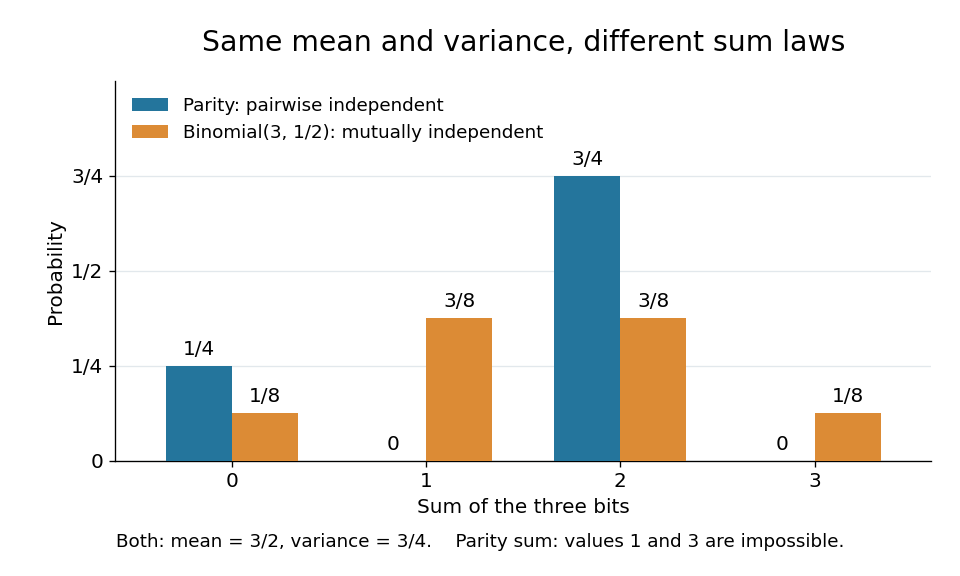
The parity construction of pairwise independent bits turns two independent fair bits into three pairwise independent random variables. With , , and , their allowed triples are , each of probability . Every coordinate has the Bernoulli distribution with parameter . Every pair has the same joint probability mass function:All twelve pair cells equal the product of the corresponding probabilities in their marginal distributions. This establishes pairwise independent random variables, a requirement involving every pair of value-events, rather than merely one chosen event per coordinate. For general real-valued random variables , the requirement isfor every pair of Borel sets . For these binary random variables, checking all four cells of each pair suffices: any value-event is a union of the checked cells. In fact, for binary random variables, independence of their one-value events also gives the other cells by taking complements. Siegrist gives the all-set definition and its connection to indicator random variables in Random Services: independence of random variables.
The full joint probability mass function tells a different story:The integer parity of is always even. Any two bits determine the third: , , and . Each coordinate is independent of either other coordinate individually, but is dependent on the pair together. For example, the conditional probabilities satisfy and . See also pairwise independence does not imply joint independence for the general distinction.
The constraint changes the sum's probability distribution without changing its expected value or variance. Let . Only gives ; each other allowed triple gives . Direct calculation givesThe same variance follows from the variance of a sum: each Bernoulli distribution has variance , and pairwise independent random variables have zero cross covariances. Linearity of expectation gives the expected value even without independence.
For comparison, the sum of three mutually independent fair bits has the binomial distribution :Both sums have identical expected values and variances, but never takes the values one or three. Even their third moments differ: , whereas . Pairwise independence preserves these first two sum summaries while allowing a different joint probability distribution and a different sum law. The calculation is an exact finite example.
The inward radial geodesic congruence with unit Killing energy has , where . Its metric dual is , so is a synchronized proper time for the congruence. Locally . This yields Painlevé–Gullstrand coordinates with flat spatial slices and a regular future horizon.
Choose Kruskal–Szekeres coordinates with the right exterior at and . The ingoing Painlevé–Gullstrand coordinates cover that exterior and the future black-hole region , together with their common future horizon. They exclude the other exterior, the white hole, the bifurcation sphere and the singularity. Indeed , with and ; the difference is finite at , whereas requires infinite coordinate time.
Looking up page table entries to obtain a page frame number and effective access attributes. On ordinary x86 hardware paging, a TLB miss can initiate this lookup without entering the operating system.
// Target: computer-science.bigb
A hierarchy of page tables indexed by successive groups of virtual page number bits. Unused regions can omit lower-level tables.
The useful omission is an entire lower-level array, not merely an invalid page table entry. One absent upper-level entry can represent a large unmapped interval of the address space. The Linux kernel's documented hierarchy uses this idea to avoid allocating tables for unused regions; its software levels can also be folded to match the hardware. [ref]
Page Tables by The kernel development community. Page Tables: opening hierarchy discussion, paragraph beginning "One could of course imagine"; Page Table Folding
One record in a page table, holding a page frame number or a next-level table reference together with architecture-dependent flags. Effective permissions in a multi-level page table can depend on several entries, not just the final one.
Let be the number of accesses, the miss count and the number of dirty-victim page writebacks. Assume every requested memory page has a backing copy, every miss reads it, writes modify only part of its contents, transfers succeed and occur serially, and there is no background or final flushing. With common access cost , additional load cost per miss, and additional outgoing write cost per dirty victim, an illustrative total service time isBookkeeping and other operating system costs are omitted. The two transfer directions are separate: a miss can require a read with no write, or both a victim write and a requested-page read. A retained dirty memory page contributes no outgoing write to this finite-page-reference trace count until evicted. Future flushing would need its own accounting boundary.
For three-page frame FIFO page replacement on the displayed page-reference trace, all reads give . Change only access 1 to a partial write of memory page 1. Its initial miss still loads the old contents, the write marks it dirty, and eviction at access 4 adds exactly one page writeback. Later loads of memory page 1 are clean because the remaining accesses read. The result is : identical residency and nine misses, but one extra outgoing write. With illustrative nanoseconds, millisecond and milliseconds, total service time changes from to milliseconds. These are model costs, not hardware measurements.
Preferring a clean victim can save an immediate page writeback, but evicting a soon-needed clean memory page can add later misses. This tradeoff is why a miss-minimizing optimal page replacement benchmark and a minimum-cost policy are different questions. Real page faults can also initialize a new memory page or perform copy-on-write without reading backing storage; those cases require different load costs.
// Destination: computer-science.bigb
A resident memory page with modifications that must be preserved in its backing storage before its page frame can be reused. In the simple model here, a write sets its dirty flag, and successful page writeback clears it. A clean memory page with a recoverable backing copy can be discarded without an outgoing data write.[ref]
Beyond Physical Memory: Policies. Section 22.9, p. 13: modified/dirty bit and the outgoing I/O difference between dirty and clean eviction
Increasing the number of page frames can increase misses under a given page replacement policy on the same page-reference trace. For FIFO page replacement on the displayed twelve-reference sequence, an empty start with three page frames gives nine misses, while an empty start with four gives ten. The larger run hits only at indices 5 and 6; it misses at 1–4 and 7–12. These are miss counts, not observed running times.[ref]
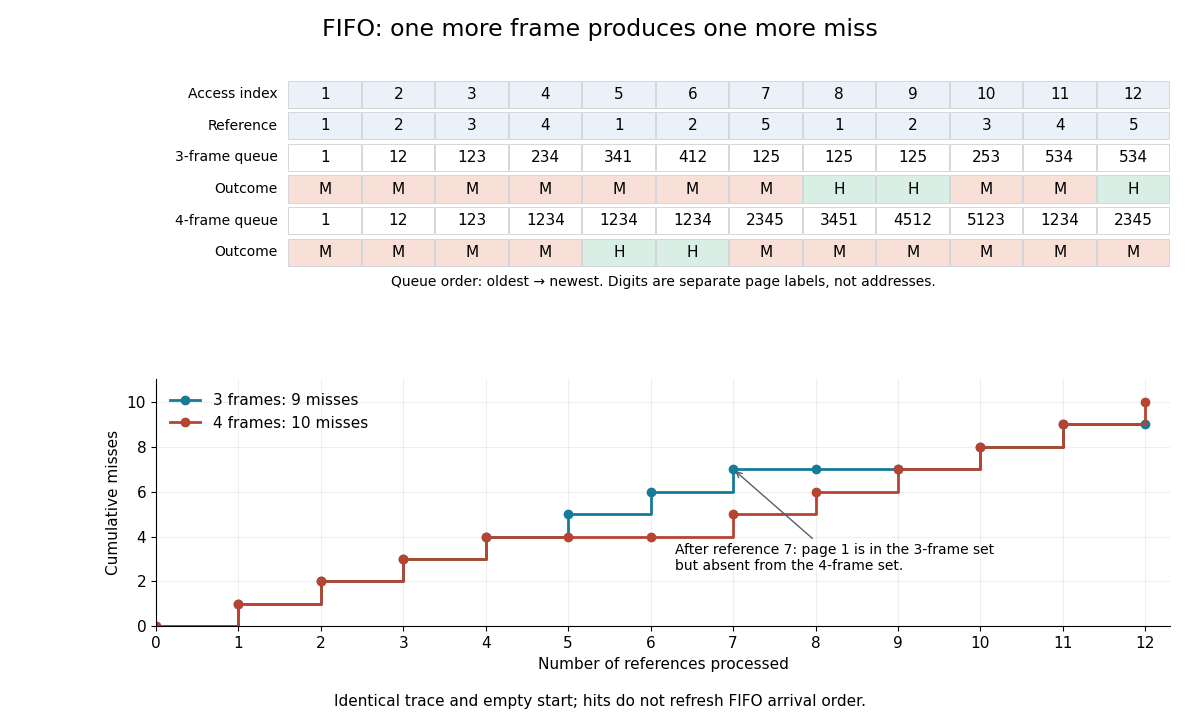
FIFO page replacement queue states and cumulative misses: four page frames give ten misses versus nine with three
. Details. The explanation is visible before the final count. After access 6, the three-page frame queue is and the four-page frame queue is , both oldest first. Loading memory page 5 at access 7 removes memory page 4 in the smaller run but memory page 1 in the larger. Their resulting resident sets are and . The smaller resident set is not a subset of the larger: its next access to memory page 1 hits while the larger run misses. Different earlier evictions create different histories; an extra page frame is not simply an extra unchanged slot. FIFO page replacement can improve on other sequences; the anomaly is an existence claim, not a claim that more page frames usually hurt.
On a miss with all page frames occupied, evict the resident memory page whose next access is farthest in the remaining page-reference trace. Treat no further access as farther than any finite next-use index; in the diagram, ties choose the lowest-numbered page frame. This is an offline, clairvoyant benchmark: a general operating system cannot know its future memory references. It minimizes miss count in the stated fixed-capacity demand paging model, rather than predicting the future from temporal locality.[ref]
Beyond Physical Memory: Policies. Section 22.2, pp. 2–4: farthest-future MIN policy, minimum misses, and the unavailable-future limitation
In the page-reference trace, seven misses with three page frames is therefore a lower bound for any policy using the same assumptions; with four page frames the corresponding minimum is six. The benchmark is useful for judging how much improvement is possible on a recorded workload. Its objective counts each miss equally. Different page writeback costs or unequal loading costs require a different objective; minimum misses alone does not prove minimum elapsed time.
A memory access trace reduced to the ordered sequence of accessed memory page identities, retaining repetitions. An address-only reduction loses read/write information, so annotate writes when studying dirty memory pages. Use the following classic Belady anomaly sequence, where the numbers label memory pages, not physical addresses:Start with three empty, equal-sized page frames allocated to one operating-system process. Every memory page can occupy any page frame, and every resident memory page is eligible for eviction. Use demand paging: a hit finds the requested memory page in the resident set; a miss causes exactly one nonresident page fault and loads it before the next access. Fill the lowest-numbered empty page frame, then reuse the victim's page frame. Assume only reads, no fetching ahead of requests, no competing operating-system processes, and no external removal of memory pages. CLOCK page replacement uses its declared hand rule, which fills the same initial page frames here. The memory page labels alone do not determine the result without these assumptions.
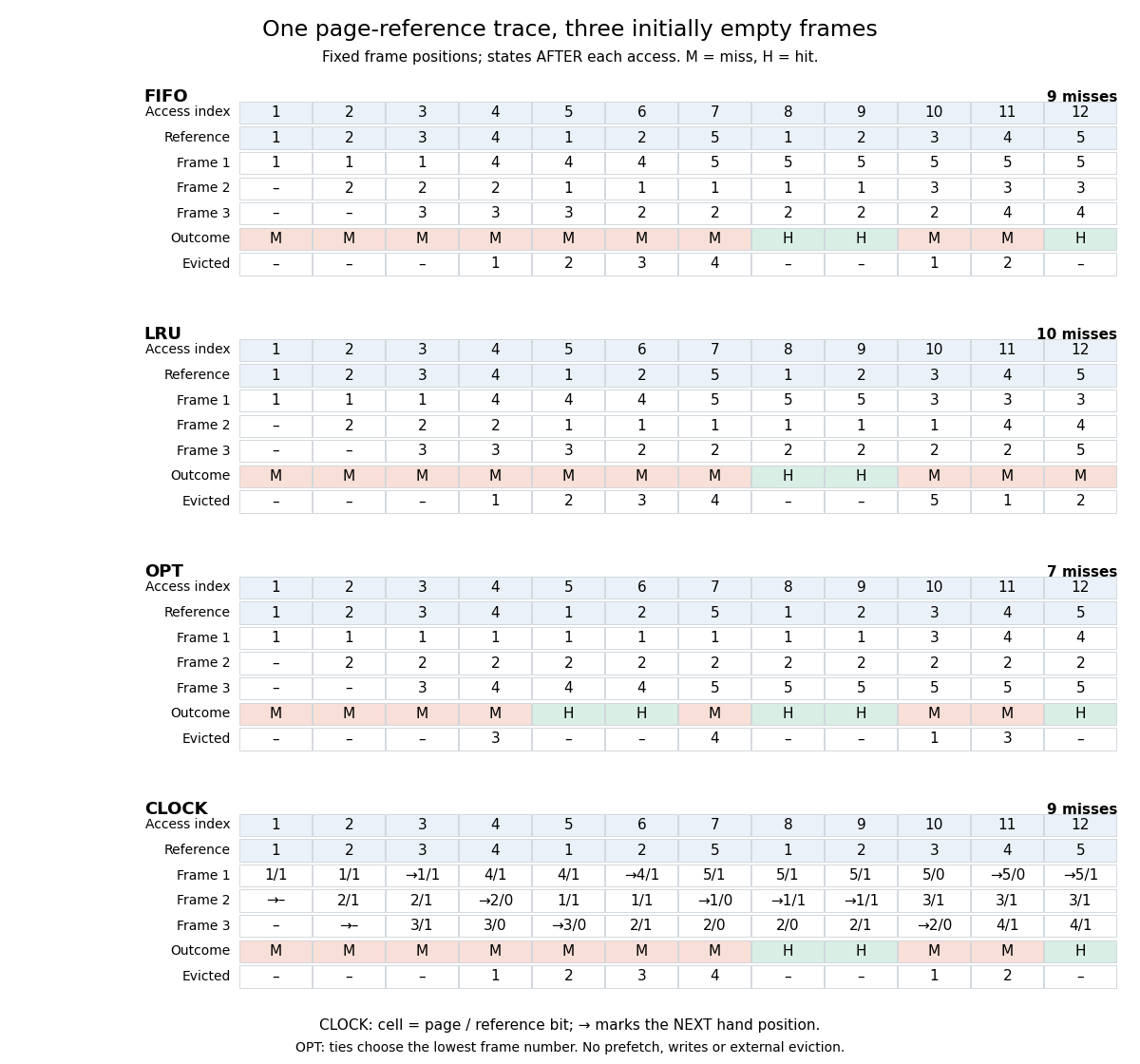
All twelve accesses with three page frames: FIFO page replacement, exact LRU replacement, offline optimal page replacement and the stated CLOCK page replacement variant
. Details. Each column shows the state after servicing that access. Rows keep physical page frame positions fixed, rather than silently sorting the resident set. The CLOCK page replacement entries also show reference bits and the next hand position. The independently computed totals are:
The first three misses fill unused page frames; the fourth miss needs eviction. At access 4, FIFO page replacement and LRU replacement evict memory page 1. Optimal page replacement instead evicts memory page 3: the next uses of resident memory pages 1, 2 and 3 are at indices 5, 6 and 10. At access 10, FIFO page replacement evicts memory page 1 while LRU replacement evicts memory page 5. Consequently the last access to memory page 5 hits under FIFO page replacement but misses under LRU replacement. Matching totals for FIFO page replacement and CLOCK page replacement on this sequence do not make the policies equivalent. The generators compute every displayed state; a separate search over all legal victims confirms the seven-miss optimal page replacement bound for three page frames.
Evict the memory page loaded earliest among currently resident memory pages, without refreshing its position on access. It is simple but ignores temporal locality and can evict a frequently accessed memory page.
Implement this ranking with a FIFO queue of resident memory pages: append on loading, remove the oldest on eviction, and leave the queue unchanged on a hit. Belady anomaly shows why preserving arrival order can give more misses with more page frames. The comparison uses the same page-reference trace and empty initial resident sets in both runs.[ref]
Beyond Physical Memory: Policies. Section 22.3, pp. 4–5: FIFO ordering; Belady's Anomaly aside, p. 5: the twelve-reference counterexample and contrast with stack policies
Evict the least recently accessed eligible item. Exact recency tracking on every memory reference can be expensive, whereas accesses to a buffer cache already pass through software. Recency captures temporal locality but a long scan can evict frequently reused items before their next use.
For page replacement, update recency on hits as well as misses; evict only when a miss requires a page frame and all eligible page frames are occupied. The four-page cycle in memory thrashing shows how exact LRU replacement behaves at capacities three and four.[ref]
The LRU stack property compares different capacities on one fixed page-reference trace; it does not say that LRU replacement always beats FIFO page replacement. On the displayed sequence, three-page frame LRU replacement has ten misses, versus nine for FIFO page replacement, while four-page frame LRU replacement has only eight.
Pinned article: Introduction to the OurBigBook Project
Welcome to the OurBigBook Project! Our goal is to create the perfect publishing platform for STEM subjects, and get university-level students to write the best free STEM tutorials ever.
Everyone is welcome to create an account and play with the site: ourbigbook.com/go/register. We belive that students themselves can write amazing tutorials, but teachers are welcome too. You can write about anything you want, it doesn't have to be STEM or even educational. Silly test content is very welcome and you won't be penalized in any way. Just keep it legal!
Intro to OurBigBook
. Source. We have two killer features:
- topics: topics group articles by different users with the same title, e.g. here is the topic for the "Fundamental Theorem of Calculus" ourbigbook.com/go/topic/fundamental-theorem-of-calculusArticles of different users are sorted by upvote within each article page. This feature is a bit like:
- a Wikipedia where each user can have their own version of each article
- a Q&A website like Stack Overflow, where multiple people can give their views on a given topic, and the best ones are sorted by upvote. Except you don't need to wait for someone to ask first, and any topic goes, no matter how narrow or broad
This feature makes it possible for readers to find better explanations of any topic created by other writers. And it allows writers to create an explanation in a place that readers might actually find it.
Figure 1. Screenshot of the "Derivative" topic page. View it live at: ourbigbook.com/go/topic/derivativeVideo 2. OurBigBook Web topics demo. Source. - local editing: you can store all your personal knowledge base content locally in a plaintext markup format that can be edited locally and published either:This way you can be sure that even if OurBigBook.com were to go down one day (which we have no plans to do as it is quite cheap to host!), your content will still be perfectly readable as a static site.
- to OurBigBook.com to get awesome multi-user features like topics and likes
- as HTML files to a static website, which you can host yourself for free on many external providers like GitHub Pages, and remain in full control

Figure 2. You can publish local OurBigBook lightweight markup files to either OurBigBook.com or as a static website.
Figure 3. Visual Studio Code extension installation.
Figure 5. . You can also edit articles on the Web editor without installing anything locally. Video 3. Edit locally and publish demo. Source. This shows editing OurBigBook Markup and publishing it using the Visual Studio Code extension. 
- Infinitely deep tables of contents:




All our software is open source and hosted at: github.com/ourbigbook/ourbigbook
Further documentation can be found at: docs.ourbigbook.com
Feel free to reach our to us for any help or suggestions: docs.ourbigbook.com/#contact