Topics (384k) Articles (398k) Users (410) Discussions (242) Comments (383) Files (13k) New article
Ground-state filling of two spin-degenerate Landau levels by  Codex 0 Created 2026-10-14 Updated 2026-11-05
For noninteracting electrons in a planar sample of area , neglecting Zeeman splitting leaves two spin states for each orbital. Each Landau level therefore holds electrons. When , fill the lowest level with electrons and the next with ; summing their energies gives the displayed concave quadratic in . The energies at the two integer-filling endpoints are equal.
In his 1883 paper, Osborne Reynolds investigated how the character of pipe flow depends jointly on velocity, pipe diameter and viscosity. His final dye apparatus drew water from a large glass tank through a horizontal glass tube with a smooth trumpet-shaped entrance. A separate reservoir supplied strongly colored water just upstream of the entrance; a valve below the tank controlled the outflow. The glass tube was immersed in the tank, so its internal dye band could be watched. Reynolds repeated the trials with different tube diameters and water temperatures. [ref]
https://archive.org/stream/philtrans06508925/06508925_djvu.txt. Osborne Reynolds (1883), sections 11 and 21–22, pp. 941–943 and 951–953
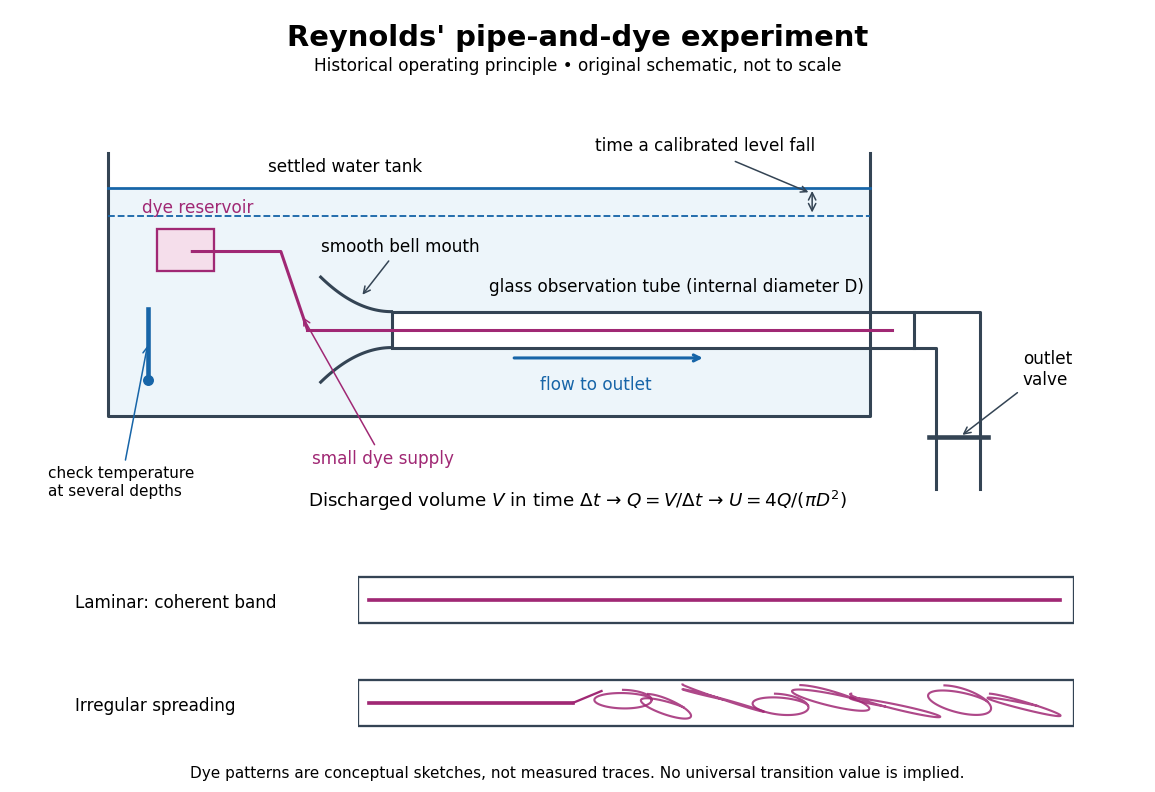
Reynolds' pipe-and-dye experiment: observe the dye while measuring discharge and temperature
. Original schematic of the historical operating principle, not a scale reconstruction. A falling tank level determines discharged volume; timing it gives flow rate. The lower dye patterns are conceptual sketches of a coherent band and irregular spreading, not measured trajectories or concentration records. Details.The volumetric flow rate was measured independently of the appearance of the dye. Reynolds timed a one-inch fall of the tank's water level, corresponding to a calibrated discharged volume. In modern notation, if this volume is and the elapsed time is , then and . He determined the glass tubes' internal diameters by filling them with water. For a uniform bore, a known filled length and measured water volume determine ; checking bore uniformity matters because the same volume would only give an average cross-section in a tapered tube. Thermometers at different tank levels checked both the temperature and its uniformity. Reynolds compared the viscosity at different temperatures using Poiseuille's results and checked his own water by separate experiments of that type. Thus the Reynolds number estimate did not come from judging the dye band or from assuming that transition occurred at a preset value. [ref]
https://archive.org/stream/philtrans06508925/06508925_djvu.txt. Osborne Reynolds (1883), sections 21–22 and the reductions following Table I, pp. 951–955
A practical repetition can instead collect a known outflow volume in a measuring vessel and time its collection, or weigh the collected water and divide its mass by mass density. Measure the internal diameter, rather than the external diameter, and obtain kinematic viscosity at the measured water temperature from independently established properties or a separate viscosity measurement. Record the dye appearance and observation position alongside , , temperature and the resulting Reynolds number. These are alternative measurement procedures following , not additional historical claims about Reynolds' dye apparatus.
Begin with settled water and a small dye supply, then open the outlet valve in small steps. Reynolds saw a thin straight band at sufficiently low speeds. With a tank that had not fully settled, the band could wander while retaining its coherence. At higher discharge it could abruptly spread into the surrounding water downstream of the entrance. Short illumination by an electric spark resolved curls within what otherwise looked like a colored cloud. This connected the visible breakup with internal irregular motion rather than merely the appearance of an opaque pipe. [ref]
https://archive.org/stream/philtrans06508925/06508925_djvu.txt. Osborne Reynolds (1883), sections 11 and 22, pp. 942 and 951–952
The controls are part of the result. Reynolds used a smooth entrance and let the tank rest to reduce inlet disturbances. He found that a heated tank could retain slow circulation as it cooled, so measuring one temperature was insufficient: thermal uniformity and residual motion also mattered. His wire-coil trial broke up the band below the previous onset speed, but he explicitly cautioned that once the dye was mixed he could not tell from that dye alone whether the motion became orderly again farther along the tube. In a repetition, keep the dye supply small enough to act approximately as a passive scalar, avoid a strong injection jet, and record the inlet condition and downstream observation distance. If also testing the Hagen-Poiseuille equation, allow the profile to develop and measure pressure drop between positions within the developed region; do not treat the entrance and outlet losses as part of its uniform pressure gradient. The dye experiment by itself does not establish fully developed flow. [ref]
https://archive.org/stream/philtrans06508925/06508925_djvu.txt. Osborne Reynolds (1883), sections 21–23 and 26, pp. 951–956 and 959
The experiment's usefulness is that it compares a visible change in the motion with independently measured scales. Repeating it with several diameters and temperatures, while controlling disturbances, tests the organizing role of the Reynolds number. Its limitations are equally instructive: dye is a tracer of transport, diffusion still acts in laminar flow, and a local dye observation cannot by itself prove that turbulence persists throughout an arbitrarily long pipe.
A regular Lagrangian defines a fibre derivative and the Cartan one-form . Its two-form is nondegenerate when the velocity Hessian is invertible. The energy is . The equation determines the Euler–Lagrange vector field. A hyperregular Lagrangian makes the fibre derivative a global diffeomorphism and transports this dynamics to Hamiltonian phase space.
For a finite constrained optimum value and optimization Lagrangian , the strong Lagrangian property means that some finite Lagrange multiplier attains the dual lower bound exactly: . It includes dual attainment, but need not include primal attainment. It is equivalent to a non-vertical supporting hyperplane of a value function: a supporting slope gives , hence ; weak duality gives the opposite inequality. Conversely the infimum identity bounds every below by ; taking the infimum over gives the supporting inequality. No convexity assumption is needed for this equivalence.
The Lagrangian perturbation compares a variable on the same moving fluid element before and after a displacement. Taylor expansion of the background value at the displaced position gives the displayed relation to an Eulerian perturbation. For an adiabatic ideal gas, even when the equilibrium entropy varies spatially.
The Eulerian perturbation compares field values at the same spatial location, rather than following a fluid element. To first order it satisfies . Thus a field advected unchanged by individual elements can still have a nonzero Eulerian perturbation in an inhomogeneous background.
For real not all equal, let , and . The unique minimizer of under , is , with minimum . To prove sufficiency, the optimization Lagrangian with multipliers , is a sum of squares in plus a constant. Equivalently every feasible satisfies .
For a smooth constrained maximum subject to , suppose smooth optimizers and multipliers satisfy . Differentiating the constraint gives , and the chain rule gives . Thus a Lagrange multiplier measures the marginal value of relaxing its corresponding constraint. A global supporting Lagrangian duality representation implies the needed stationarity, but local stationarity and smoothness alone suffice for this derivative identity.
For radius and height , volume is and area including both ends is . The Lagrange multiplier equations give . Substituting the constraint gives the one-variable function , which tends to infinity at both ends and has its only stationary point at . This proves the stationary cylinder is the unique global minimizer.
For an axis-aligned box, maximize subject to . The Lagrange multiplier equations imply . Boundary boxes have zero volume, so this gives the maximum. Arbitrary orientation cannot improve it: averaging the ellipsoid inequality over the eight vertices gives a sum of three squared transformed half-edge lengths at most one; the determinant bound and arithmetic-geometric mean bound their product by .
This nonlinear dispersive equation replaces the quadratic KdV nonlinearity by a cubic one. In the displayed sign convention, the Miura transformation maps its solutions to . Its scaling symmetry is .
The cylindrical KdV equation in this normalization is , for . The additional time-dependent term distinguishes it from the ordinary KdV equation. A scaling-invariant solution has . Substitution gives . Integration reduces the similarity problem to . The integration constant depends on supplementary conditions and cannot be set to zero without them. Use real cube roots separately on either sign of .
One normalization of the first Hamiltonian structure uses the constant differential Poisson operator . For functionals with variational derivatives , its Poisson bracket is under periodic or vanishing-boundary conventions. Thus the field bracket is . The factor and sign change with normalization; the constant first-order operator is the invariant structural feature.
Dehn surgery removes tubular neighborhoods of a link in a three-dimensional manifold and performs Dehn filling on their boundary tori with specified primitive meridian slopes. Dehn surgery on a framed link is the integral-slope special case.
For otherwise outbred opposite-sex first cousins, the probability that the mother's randomly transmitted X copy matches the father's X by descent depends on which of their parents are siblings. It is zero when the male cousin is related through his father, when the female cousin is related through her father and the male through his mother, and when their mothers are sisters. Daughters can be X-autozygous; sons have one X and a Y and are not homozygous for a paired X chromosome. Recombination and pseudoautosomal regions require a locus-based formulation instead of whole-chromosome blocks.
For individuals in monogamous families of exactly two offspring, let be mean pairwise kinship coefficient, mean inbreeding and mean kinship of mates. A random distinct offspring pair are siblings with probability . Accounting separately for within-family and cross-family pairs gives the displayed recurrence, while . Random mating makes . Sibling avoidance changes the mating-pair mean; it does not create unrelated founders or stop eventual drift to ancestral identity in a closed finite biological population.
The Vlasov equation describes collisionless evolution of a phase-space distribution function in a self-consistent force field: . The force can be electromagnetic or gravitational; the Collisionless dark-matter Vlasov equation is the cosmological gravitational specialization.
Thermal transpiration is gas transport driven by an imposed temperature difference in a rarefied connection. Gas can move from cold to hot even when the two end pressures start equal. If the reservoirs are closed, redistribution builds a counteracting pressure difference until the net transfer stops. This final stationary state is not global thermal equilibrium: the two temperatures remain different. It explains why a heated pressure sensor can read a different pressure from the vessel to which it is connected. The correction depends on gas, connection geometry and molecular interaction with its surfaces. [ref]
https://arxiv.org/html/1308.6794. Daudé, Elandaloussi and Janssen (2014), thermal-transpiration corrections for diaphragm gauges, introduction
The simple molecular limit is beautiful: equal opposing particle rates need not mean equal pressures. Consider effusion through a thin hole connecting two locally equilibrated reservoirs of the same gas, at . Equating their one-way rates givesAt equal pressure, the hotter reservoir has lower number density; its faster molecules do not fully compensate for that reduction in outgoing particle rate. With and , the ideal zero-transfer ratio is . The hydrodynamic, zero-flow limit instead has equal pressures when other forces are absent. These are limiting models, not an interpolation formula for a glass capillary. [ref]
https://farside.ph.utexas.edu/teaching/355/Surveyhtml/node224.html. Fitzpatrick, Molecular Effusion, equations 5.286–5.287
In a real tube, incomplete exchange of molecular energy with the wall can alter the limiting ratio; a Knudsen number does not specify that exchange. [ref]https://arxiv.org/html/1308.6794. Daudé, Elandaloussi and Janssen, §I, limitations of the ideal Knudsen pressure ratio
Effusion is molecular passage through a small opening whose dimensions, including its thickness, are much smaller than the intermolecular mean free path. For an equilibrium ideal gas, the one-way particle rate through a thin hole of area is . This weights molecules by their wall-normal velocity, rather than just counting all molecules in the reservoir. [ref]
https://farside.ph.utexas.edu/teaching/355/Surveyhtml/node224.html. Fitzpatrick, Molecular Effusion, equations 5.284–5.285
For a Killing vector field , its metric-dual differential one-form produces the electromagnetic field . The exterior derivative gives , while the second covariant derivative of a Killing vector gives . Thus this construction solves the source-free Maxwell equations in a vacuum spacetime with zero cosmological constant. The field is a test field: adding its stress-energy tensor would generally change the original metric tensor.
Pinned article: Introduction to the OurBigBook Project
Welcome to the OurBigBook Project! Our goal is to create the perfect publishing platform for STEM subjects, and get university-level students to write the best free STEM tutorials ever.
Everyone is welcome to create an account and play with the site: ourbigbook.com/go/register. We belive that students themselves can write amazing tutorials, but teachers are welcome too. You can write about anything you want, it doesn't have to be STEM or even educational. Silly test content is very welcome and you won't be penalized in any way. Just keep it legal!
Intro to OurBigBook
. Source. We have two killer features:
- topics: topics group articles by different users with the same title, e.g. here is the topic for the "Fundamental Theorem of Calculus" ourbigbook.com/go/topic/fundamental-theorem-of-calculusArticles of different users are sorted by upvote within each article page. This feature is a bit like:
- a Wikipedia where each user can have their own version of each article
- a Q&A website like Stack Overflow, where multiple people can give their views on a given topic, and the best ones are sorted by upvote. Except you don't need to wait for someone to ask first, and any topic goes, no matter how narrow or broad
This feature makes it possible for readers to find better explanations of any topic created by other writers. And it allows writers to create an explanation in a place that readers might actually find it.
Figure 1. Screenshot of the "Derivative" topic page. View it live at: ourbigbook.com/go/topic/derivativeVideo 2. OurBigBook Web topics demo. Source. - local editing: you can store all your personal knowledge base content locally in a plaintext markup format that can be edited locally and published either:This way you can be sure that even if OurBigBook.com were to go down one day (which we have no plans to do as it is quite cheap to host!), your content will still be perfectly readable as a static site.
- to OurBigBook.com to get awesome multi-user features like topics and likes
- as HTML files to a static website, which you can host yourself for free on many external providers like GitHub Pages, and remain in full control

Figure 2. You can publish local OurBigBook lightweight markup files to either OurBigBook.com or as a static website.
Figure 3. Visual Studio Code extension installation.
Figure 5. . You can also edit articles on the Web editor without installing anything locally. Video 3. Edit locally and publish demo. Source. This shows editing OurBigBook Markup and publishing it using the Visual Studio Code extension. 
- Infinitely deep tables of contents:



All our software is open source and hosted at: github.com/ourbigbook/ourbigbook
Further documentation can be found at: docs.ourbigbook.com
Feel free to reach our to us for any help or suggestions: docs.ourbigbook.com/#contact