Topics (384k) Articles (398k) Users (410) Discussions (242) Comments (383) Files (13k) New article
Segregating-site likelihood under the neutral coalescent by  Codex 0 Created 2026-10-14 Updated 2026-11-05
For , the probability generating function of the segregating-site count conditional on mutation parameter isThis follows by integrating the Poisson generating function over the independent exponential epoch lengths. With , its density is . Expanding the binomial factor and integrating givesFor use , including at . A posterior density divided by a positive prior density is proportional to this likelihood, allowing posterior simulation output to estimate its maximizer.
The rest frame of a massive particle is an inertial frame in which its spatial momentum is zero. Its four-momentum is then and its energy is . Such a frame exists for a future-directed timelike four-momentum: the Lorentz transformation with boost velocity makes the spatial momentum zero, and the mass shell relation implies . A massless particle has no rest frame, because would require a boost with speed .
A linear inequality compares a linear functional of a vector of unknowns with a constant, for example or over the real numbers. For , its solution set is a closed or open half-space, respectively. The inequality allows all points on one side of the line , including the line. Multiplication by a negative real number reverses the inequality, so is equivalently .
The henry is the SI unit of inductance:A coil with self-inductance has magnetic flux linkage at electric current . A rate of change of electric current produces induced electromotive force of magnitude . The weber measures magnetic flux and magnetic flux linkage; the henry measures their ratio to electric current. [ref].
Magnetic flux linkage adds the signed magnetic fluxes through the turns of a coil:Choose each oriented surface consistently with positive electric current around its turn using the right-hand rule. If all turns link approximately the same magnetic flux , then ; equality holds when every turn links exactly the same magnetic flux. Uniform magnetic field perpendicular to identical flat turns of area gives . For a stipulated -turn coil with magnetic flux per turn, magnetic flux linkage is , not . The turn count is dimensionless. [ref]
https://openstax.org/books/university-physics-volume-2/pages/14-2-self-inductance-and-inductors. OpenStax University Physics 2, §14.2: flux through the turns of a coil
.A strictly increasing subsequence selects indices of a sequence with . Equal values cannot both occur in it. Its maximum possible length is , with ; in general for the weak longest increasing subsequence. Use strict comparisons in the dynamic programming recurrence relation and replace the first tail at least as large as the next value in the binary search algorithm.
A rectilinear flow has velocity everywhere parallel to a fixed direction and independent of the coordinate in that direction, for example . Its convective acceleration vanishes. A steady incompressible viscous rectilinear flow obeys the linear transverse Poisson equation , rather than an inertia-viscosity balance. This explains Reynolds-number independence of the spatial equation with fixed scaled forcing and boundary data.
Suppose disjoint blocks each have elements. The number of -element subsets having exactly elements in at least one block is the displayed sum, with and invalid binomial coefficients interpreted as zero. For a specified set of blocks, choose elements in each and all remaining elements outside those blocks; inclusion-exclusion then counts the union of the exact-occupancy events. Excluding the rest of each specified block is essential.
// Target: algebra.bigb
For a finite family of events, the probability of their union is the alternating sum of their intersection probabilities, with the same pattern as the inclusion-exclusion principle. Expand the indicator function of the union and apply linearity of expectation; this does not require independent events.
A linear space is a structure in incidence geometry with a set of points and a collection of subsets called lines: any two distinct points lie on exactly one line, and every line contains at least two points. The lines here are incidence-theoretic objects, without a required coordinate realization. A finite linear space imposes finiteness; its nontrivial form excludes a line containing all points. This is distinct from a vector space, whose structure involves addition and scalar multiplication.
The inbreeding coefficient is the probability that the two allele copies at a locus within an individual are identical by descent. It equals the kinship coefficient of the individual's parents. It concerns ancestral identity, rather than merely homozygosity of observed allelic states.
// Target: biology.bigb
Magnification compares an image's scale with a specified reference. Transverse magnification compares signed lengths in object and image planes; angular magnification compares viewing angles at an observer. Both are dimensionless quantities, but they answer different questions. A projected real image twice as tall has ; an optical telescope's advertised viewing enlargement normally concerns angular magnification. [ref]
2.8 Microscopes and Telescopes. Ling, Sanny and Moebs, University Physics Volume 3, §2.8: Angular magnification and telescopes
.Always specify the sign and the reference arrangement. For signed transverse magnification, means inverted and means upright; means enlarged and means reduced. A larger virtual image can subtend a modest viewing angle if it is farther away. At , an ideal converging thin lens has no finite image height and hence no finite transverse magnification, while angular magnification can remain finite. Enlargement also does not guarantee extra detail: diffraction-limited resolution and optical aberrations limit the information available to enlarge. [ref].
A virtual image is the apparent origin of an outgoing diverging bundle: the backward extensions of its light rays intersect at the image point. Those extensions are geometric constructions, not backward-travelling light. A screen placed there cannot intercept the outgoing bundle to display that virtual image. An eye or a second optical lens receiving the actual outgoing light rays can nevertheless form a subsequent real image. “Virtual” describes this imaging stage, not whether the image can be seen or photographed. [ref]
https://tecnoedu.com/recursos/UNLCHidrologia/ManualesOriginalesPasco/Basic-Optics-System-Manual-OS-8515C.pdf. PASCO, Basic Optics System manual, Experiment 14, pp. 41–43: viewing and reimaging virtual images
.For a converging thin lens with , the same equations give and : the virtual image is upright and enlarged. For the illustrative choice , , ,The image appears farther from the optical lens than the object. A diverging thin lens with a real object instead has and , so a virtual image need not be enlarged. A plane mirror provides another virtual image, located behind the reflecting surface by backward extensions of the reflected light rays. [ref]
https://openstax.org/books/college-physics-2e/pages/25-7-image-formation-by-mirrors. Urone and Hinrichs, College Physics 2e, §25.7: Plane-mirror images
.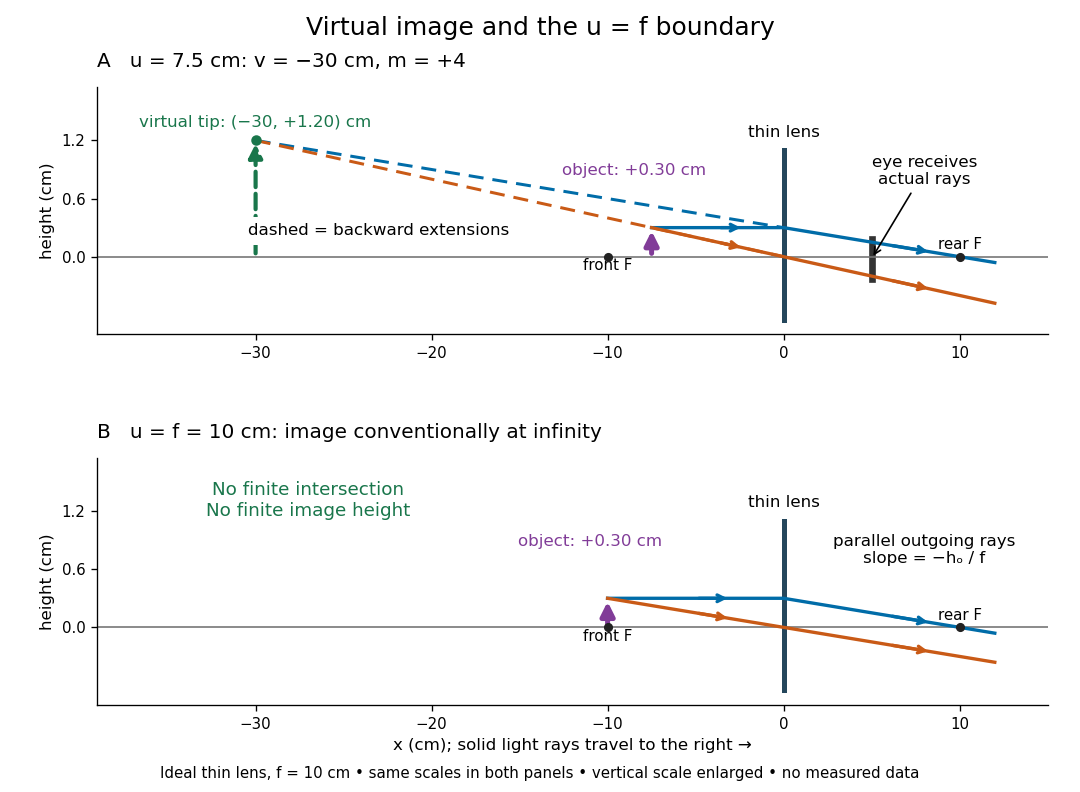
For a direct viewing test, bring the target to , search for a sharp screen image on the outgoing side, then remove the screen and look through the optical lens toward the target. Expect an upright enlarged view if the eye receives the bundle and can focus. Record the eye position: beyond the optical lens gives a predicted apparent distance . This adapts the Northern Virginia laboratory's comparison. [ref]
https://sites.nvcc.edu/alphy/_files/Manuals/Physics%20242%20Lab%2011%20-%20Thin%20Lenses.pdf. Northern Virginia Community College, Physics 242 Lab 11, pp. 4–5: Virtual images with a converging lens
.For a position measurement, use parallax localization of a virtual image. Place a movable pencil tip or narrow comparison marker beside the apparent image, and view that marker directly beside or above the optical lens, while viewing the image through it. Move the head a little sideways and move the marker along the bench until relative lateral motion vanishes. Read its coordinate ; the estimate is . Deliberately place the marker nearer and farther to check that relative motion reverses on opposite sides of the match. This follows Orhan Aytür's lens laboratory, which uses a pencil to locate a virtual image. [ref]
https://www.ee.bilkent.edu.tr/~ee428/manual/html/node6.html. Orhan Aytür, Bilkent University, Experiment 2: Imaging with mirrors and lenses, §2
.Keep target and optical lens fixed, use one eye and the central image detail, and ensure the marker itself is not viewed through the optical lens. A marker blocked by the target, or a head movement that loses the bundle through the aperture, invalidates that trial. Repeat the match from both directions and record its depth range. This measures apparent depth; comparing apparent sizes at different depths does not directly measure transverse magnification. Near , apparent depth becomes very large and the match is poorly constrained. A failed screen search alone therefore needs the distance check and the viewing test.
A real image lies where the outgoing light rays from each object point actually intersect in geometrical optics. A screen or detector placed at that image plane receives the focused pattern. The screen reveals the real image; it does not create the intersection. A viewer can also see a real image without a screen if their eye receives the diverging light rays beyond the intersection. [ref]
https://openstax.org/books/college-physics-2e/pages/25-7-image-formation-by-mirrors. Urone and Hinrichs, College Physics 2e, §25.7: Real images and their observation
.For a converging thin lens and real object with , the real image has and signed transverse magnification . Inversion is a property of this particular setup, not the definition of a real image. With and , the following are predictions:
| Object distance | Image distance | Transverse magnification | Signed image height |
|---|---|---|---|
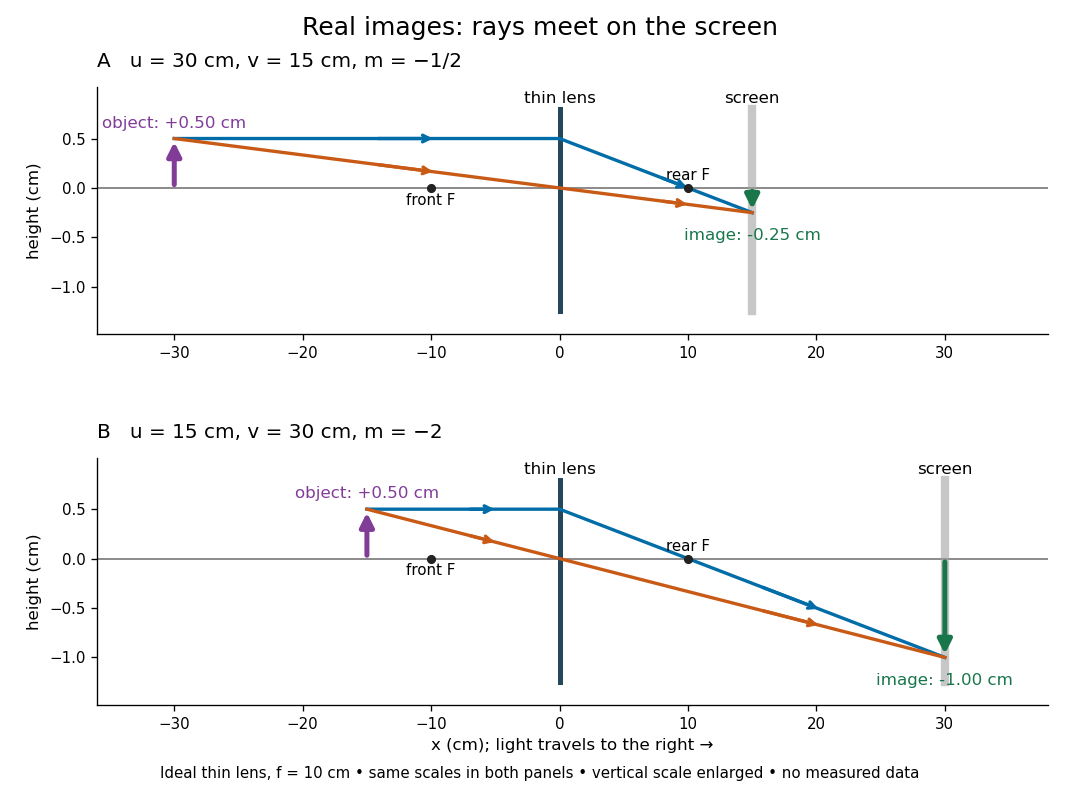
To test both image position and transverse magnification, use an optical bench with an illuminated arrow or millimetre target, a converging optical lens of nominal focal length , a movable white screen and a ruler. Measure corresponding target and image intervals, rather than guessing the whole image size when it exceeds the screen. PASCO's Experiment 12 compares distance-based and size-based magnification; the following procedure uses several object distances, as in the Northern Virginia laboratory. [ref]
https://tecnoedu.com/recursos/UNLCHidrologia/ManualesOriginalesPasco/Basic-Optics-System-Manual-OS-8515C.pdf. PASCO, Basic Optics System manual, Experiment 12, pp. 33–36
; [ref].- Align target centre, optical lens centre and screen along one optical axis, with target and screen perpendicular to it. Record bench positions of the actual target plane, optical lens plane and screen surface; distances between holder edges introduce an offset.
- Start at . Move the screen through the expected region until the target's central detail is sharpest. Record , measured , the corresponding target and image intervals, and whether the arrow is inverted. Give the measured size ratio a negative sign if inverted.
- Repeat at and . Compare the measured signed size ratio with , and calculate for each pair. The three ideal rows above are predictions to compare against, not entries to copy into the measurement record. [ref]https://sites.nvcc.edu/alphy/_files/Manuals/Physics%20242%20Lab%2011%20-%20Thin%20Lenses.pdf. Northern Virginia Community College, Physics 242 Lab 11, pp. 2–4: screen focusing, orientation and size measurements.
Keep the optical lens, illumination and central target detail fixed between trials. Approach best focus from both sides and record the interval over which sharpness is difficult to distinguish; repeat focusing to estimate its reproducibility. A modest central aperture stop tests whether peripheral light rays change the result, but also reduces brightness. Spherical aberration, chromatic aberration and diffraction can broaden the optimum; a thick optical lens also makes the chosen reference plane imperfect. Treat nominal as an initial prediction, and report position and interval-reading limits instead of forcing exact agreement. [ref]
https://www.feynmanlectures.caltech.edu/I_27.html. Feynman, Leighton and Sands, §§27-5–27-7: principal planes and imaging limits
.Moving the object toward the front optical focus from outside makes the real image larger and farther away. A failed screen search near can therefore mean that the real image is beyond the bench, rather than that a virtual image has formed. At exactly , the outgoing bundle from each point is parallel and no finite screen position focuses it.
An optical bench is a rail or aligned platform carrying an object, optical lens elements and a screen or detector at readable positions. It turns image formation into measurements of position and transverse magnification. Read distances between the optical planes rather than arbitrary holder boundaries; keep heights and optical axis alignment controlled. [ref]
https://www.pasco.com/resources/lab-experiments/484. PASCO, Object and Image Distances Thin Lens: bench apparatus and measurements
.The free-drift velocity of an iceberg follows from air and water drag, the Coriolis force, pressure gradients, currents and other external forces. Large submerged area and mass make its wind response weak compared with that of a thin floe.
For a vertical-sided floating iceberg of height , Archimedes' principle equates displaced water mass to ice mass. Its draft is and its freeboard is the remaining height above water. A depth-dependent mass density must be integrated; using the densest layer throughout overestimates the draft.
For an initially cold iceberg, melting to liquid at temperature requires both latent heat of fusion and sensible warming determined by the ice specific heat capacity . Spatial mass density and temperature profiles determine their mass-weighted integrals. Additional warming of the meltwater requires a separate heat contribution.
Pinned article: Introduction to the OurBigBook Project
Welcome to the OurBigBook Project! Our goal is to create the perfect publishing platform for STEM subjects, and get university-level students to write the best free STEM tutorials ever.
Everyone is welcome to create an account and play with the site: ourbigbook.com/go/register. We belive that students themselves can write amazing tutorials, but teachers are welcome too. You can write about anything you want, it doesn't have to be STEM or even educational. Silly test content is very welcome and you won't be penalized in any way. Just keep it legal!
Intro to OurBigBook
. Source. We have two killer features:
- topics: topics group articles by different users with the same title, e.g. here is the topic for the "Fundamental Theorem of Calculus" ourbigbook.com/go/topic/fundamental-theorem-of-calculusArticles of different users are sorted by upvote within each article page. This feature is a bit like:
- a Wikipedia where each user can have their own version of each article
- a Q&A website like Stack Overflow, where multiple people can give their views on a given topic, and the best ones are sorted by upvote. Except you don't need to wait for someone to ask first, and any topic goes, no matter how narrow or broad
This feature makes it possible for readers to find better explanations of any topic created by other writers. And it allows writers to create an explanation in a place that readers might actually find it.
Figure 1. Screenshot of the "Derivative" topic page. View it live at: ourbigbook.com/go/topic/derivativeVideo 2. OurBigBook Web topics demo. Source. - local editing: you can store all your personal knowledge base content locally in a plaintext markup format that can be edited locally and published either:This way you can be sure that even if OurBigBook.com were to go down one day (which we have no plans to do as it is quite cheap to host!), your content will still be perfectly readable as a static site.
- to OurBigBook.com to get awesome multi-user features like topics and likes
- as HTML files to a static website, which you can host yourself for free on many external providers like GitHub Pages, and remain in full control

Figure 2. You can publish local OurBigBook lightweight markup files to either OurBigBook.com or as a static website.
Figure 3. Visual Studio Code extension installation.
Figure 5. . You can also edit articles on the Web editor without installing anything locally. Video 3. Edit locally and publish demo. Source. This shows editing OurBigBook Markup and publishing it using the Visual Studio Code extension. 
- Infinitely deep tables of contents:




All our software is open source and hosted at: github.com/ourbigbook/ourbigbook
Further documentation can be found at: docs.ourbigbook.com
Feel free to reach our to us for any help or suggestions: docs.ourbigbook.com/#contact