Topics (384k) Articles (398k) Users (410) Discussions (242) Comments (383) Files (13k) New article

James Clerk Maxwell connected changing electrical and magnetic phenomena in a common field description. The displacement current makes that description compatible with charge conservation. In modern SI notation, taking the divergence of and using gives . The correction therefore has a concrete purpose when charge is accumulating, as in a charging capacitor. His treatise develops the general field equations and their connection with circuits and electromagnetic induction.[ref]
A Treatise on Electricity and Magnetism by James Clerk Maxwell. Volume II, Part IV, Chapter IX, sections 604–608; continuity check in modern SI notation

Portrait of James Clerk Maxwell
. Historical photograph reproduced in Practical Physics (1920), scanned by Benjamin Crowell. Public domain. Source and usage information on the linked Wikimedia file page. Source.Length measures spatial extent or separation. It is a base physical dimension in dimensional analysis, distinguished from the choice of units used to express a particular value.
A dimensionless quantity has zero exponent for every base physical dimension. It can be formed by dividing two quantities with the same dimensions, such as or . Its value is independent of the choice of units for those dimensions. The quantities and both have dimensions of energy, so is dimensionless. A dimensionless variable is such a quantity used as an unknown or independent variable in an equation.
Amount of substance measures a count of specified entities, such as chemical atoms, molecules, ions, or electrons, using the mole as its SI base unit. It differs from mass: equal amounts of substance of different chemical substances contain equal entity counts but generally have different masses. If entities are present, , where is the Avogadro constant. The specified entity matters: one mole of water molecules contains two moles of hydrogen chemical atoms. [ref]
Absorbance is the dimensionless quantity , where and are reference and transmitted radiant powers at the chosen wavelength. For example, means one tenth of the reference power is transmitted. Under the Beer-Lambert law, absorbance can determine an absorbing species' concentration; attenuation by cloudiness or unrelated colored solutes needs separate controls. [ref]
Beer–Lambert law. IUPAC Compendium of Chemical Terminology, fifth edition (Gold Book) by International Union of Pure and Applied Chemistry; IUPAC Gold Book: absorbance and its concentration relation
Hydrophobicity describes unfavorable mixing with water, as illustrated by long hydrocarbon regions. The hydrophobic regions of membrane-forming phospholipids face the interior of a lipid bilayer. This organization is explained by the hydrophobic effect, rather than by imagining that chains actively repel water. See IUPAC Gold Book: hydrophobic interaction.
An amphiphile is a molecule containing distinct hydrophilic and hydrophobic regions. Amphiphilic and amphipathic describe this combination. Membrane-forming phospholipids are examples; their two regions give different parts of one molecule different affinities for water. The word describes a structure, not a guarantee of a particular aggregate shape. See IUPAC Gold Book: amphiphilic.
Hydrophilicity describes affinity for water. Regions with chemical polarity or electric charge can interact favorably with water, including through hydrogen bonds where suitable groups are present. Hydrophilic regions of membrane-forming phospholipids face the water on either side of a lipid bilayer. Such affinity does not mean forming covalent bonds with every neighboring substance, nor does it require a net negative electric charge. See Alberts et al.: the chemical components of a cell.
Chemical polarity concerns unequal distribution of electron density in a chemical bond or molecule. A polar molecule has a permanent electric dipole moment; the effects of individual bonds must be combined with their spatial arrangement. In a symmetric linear carbon dioxide molecule, opposing bond-dipole contributions cancel. In water, its bent molecular geometry prevents that cancellation, giving a permanent electric dipole moment.[ref]
Theoretical reduction relates theories by deriving the laws or predictions of one from another together with explicit identifications of quantities and appropriate domain assumptions. A reduction can require approximation, coarse-graining or a limiting construction. Deduction of an ideal limiting model is different from exact deduction of the same properties for every finite member of a model sequence.
Emergence concerns novel collective patterns or explanatory structures relative to a lower-level description. Robust effective behaviour can emerge through coarse-graining or singular limits while remaining derivable from the microscopic theory. The stronger claim that genuinely new causal powers cannot be reduced to that theory requires an additional argument; nonanalyticity of a limiting function alone does not establish it.
A classical common-cause explanation seeks past variables which screen off a correlation: conditioned on a sufficiently complete common cause, the correlated events become independent. A Bell local causality model adds local dependence on settings and a single compatible past-variable distribution for all measurement contexts. Providing a different setting-dependent screening variable for each pair of settings does not establish that stronger Bell model. The distinction between a causal mechanism and a purely probabilistic screening construction matters when interpreting this principle.
A formulation of stochastic Einstein locality restricts an event's objective chance to its relevant causal past, rather than spacelike-separated interventions or facts. Different versions constrain either marginal chances or joint conditional probabilities. A one-wing marginal condition alone does not supply outcome independence. To derive a Bell theorem by this route, the proposed locality assumptions must include the appropriate screening-off relation for the two outcomes, together with a common setting-independent past distribution.
Here is a finite word over an alphabet, every letter of the word has positive probability, and is the set of lengths of its borders of a word, including its full length. Start a unit-capital gambler before every draw, betting successively on the word's letters and dividing surviving capital by the required letter probability. Total capital minus the number of entrants is a martingale. At the first full match, the surviving gamblers correspond exactly to the borders, giving the displayed formula by optional stopping. Disjoint blocks of full word length give a geometric tail bound from a uniform escape probability, so the waiting time is integrable; bounded word length and positive letter probabilities give bounded martingale increments and justify stopping.
A fossil is preserved evidence of past life in a geological context. A body fossil retains evidence of an organism's body, such as a tooth, bone or leaf; a trace fossil, such as a footprint or burrow, records activity. Complete replacement by minerals is not required for something to be a fossil.[ref]
What is a Fossil? by the National Park Service. Introduction and Definition
Fossilization can preserve different kinds of information. Permineralization fills spaces in biological material with minerals, while an impression may retain only external shape. These pathways help explain why the fossil record samples some anatomy characters much better than others, and why a transitional fossil is assessed through a combination of characters rather than overall resemblance.
A eukaryote is an organism belonging to the lineage characterized by a membrane-bounded cell nucleus and extensive cellular compartmentalization. A nuclear envelope surrounds the nuclear genome; nuclear chromosomes are typically linear. Ribosomes perform biological translation outside the cell nucleus. See OpenStax Microbiology, 3.4: nuclear organization and protein synthesis. Specialized biological cells can lose their cell nucleus, as mature mammalian red blood cells do, while remaining parts of eukaryotic organisms; see OpenStax Biology 2e, 40.2: mature red blood cells.
Yeasts, plants and animals are all eukaryotes. Typical cells in these groups have mitochondria, but chloroplasts belong to photosynthetic plant and algae lineages, not to every eukaryote. A cell wall occurs in typical plant and fungus cells but is absent from animal cells. These are comparisons of representative cells, not a checklist every specialized cell must satisfy. See OpenStax Biology 2e, 4.3: nucleus, organelles and representative cells.
The interesting feature is controlled separation: cell membranes and organelle membranes let different cellular processes occupy distinct compartments while membrane transport connects them. The evolution of eukaryotes also involved partnership: mitochondria descend from a bacterial endosymbiosis. Modern phylogenetics supports an archaeal ancestry for the nuclear lineage, alongside this bacterial contribution; see two-domain system. Thus the history of a whole eukaryote cannot be read as the history of just one of its genes.
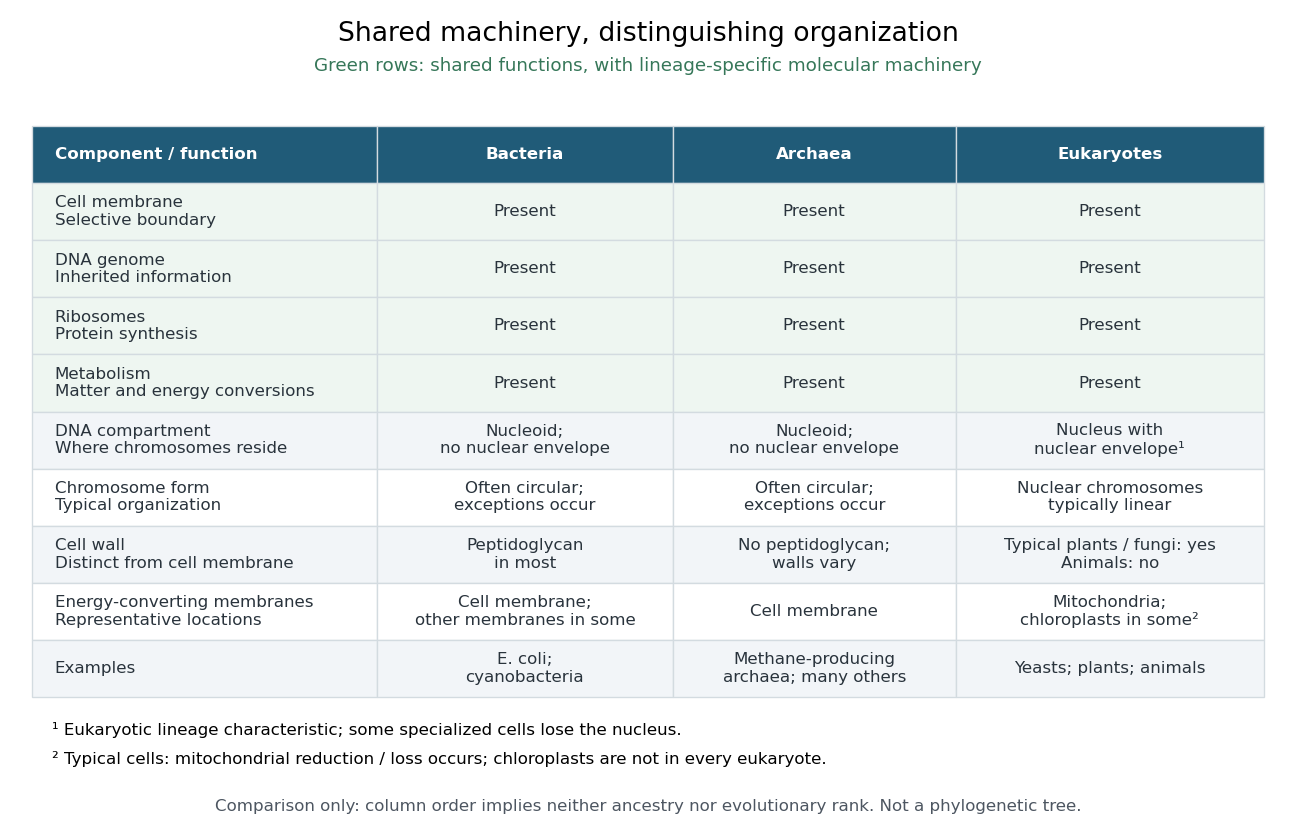
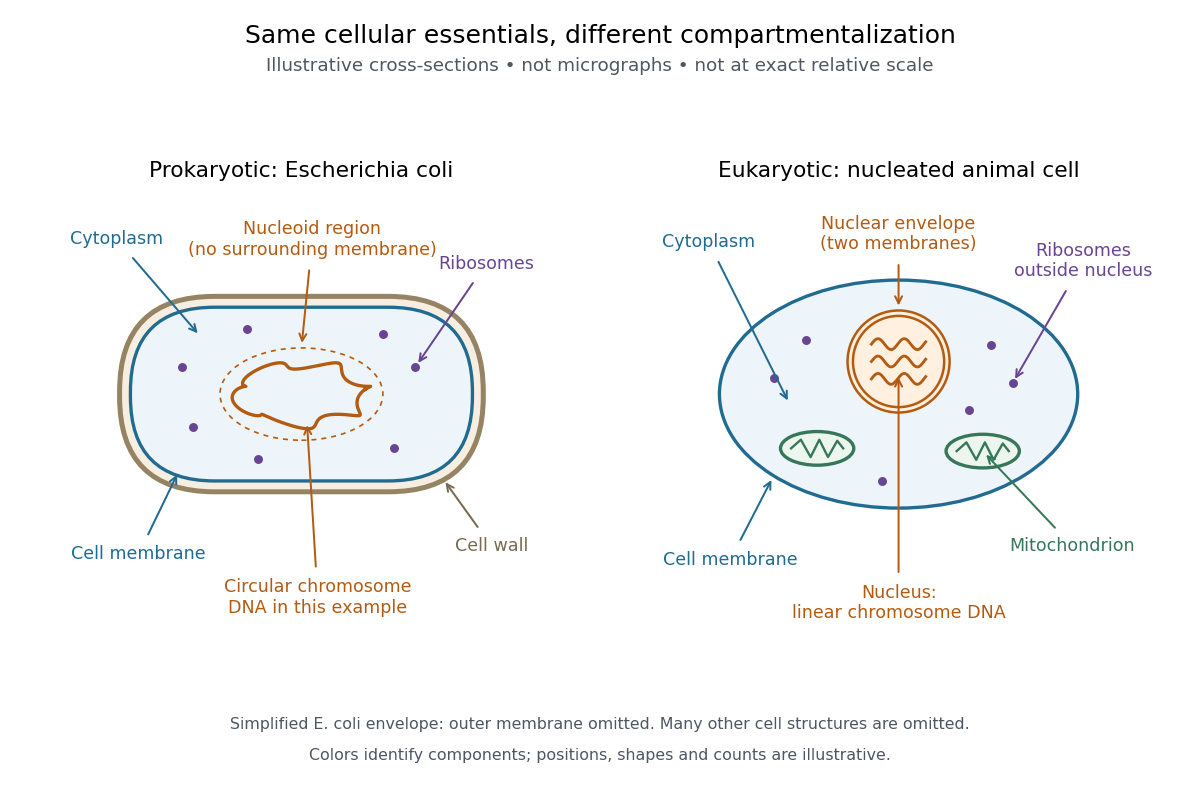
A prokaryote is an organism whose biological cells lack a membrane-bounded cell nucleus. The DNA of its chromosomes occupies a nucleoid within the cytoplasm. Bacteria and archaea have this cellular organization. Both contain ribosomes that perform biological translation and a selective cell membrane; neither is a bag of unorganized chemicals. See OpenStax Biology 2e, 4.2: prokaryotic organization.
The word prokaryotic describes organization, not a single exclusive clade. Grouping bacteria and archaea by the absence of a cell nucleus is useful for comparing biological cells, but does not establish that they share a more recent ancestor with one another than either does with eukaryotes. See three-domain system and two-domain system for the different ancestry models.
Prokaryotic does not mean membrane-free. Cyanobacteria contain internal thylakoid membranes for oxygenic photosynthesis, despite lacking chloroplasts and a cell nucleus. Many prokaryotes have circular chromosomes, but circular shape and a single chromosome are not defining requirements. See OpenStax Biology 2e, 22.2: bacterial and archaeal structures.
A biological colony is an associated group of organisms or biological cells. The name alone specifies neither cell differentiation nor a particular mode of biological development. A colony can arise from related descendants or from previously separate members; see clonal development and the Queller and Strassmann discussion cited under unicellular organism.
A multicellular organism has a body of multiple biological cells whose growth and activities are integrated into the life of the whole organism. Extensive cell differentiation is common in complex examples, but specialized biological cells are not a prerequisite for every simple form. Ask how the body develops, how its parts cooperate and how it produces descendants, rather than counting attached biological cells alone. The boundary with a biological colony depends on the degree of integration and the criteria being investigated; there is no universal cell-count threshold. See the Queller and Strassmann account cited under unicellular organism.
Specialization makes the whole capable of combinations that one general-purpose biological cell cannot achieve in the same way. In an animal, a neuron transmits signals while a red blood cell carries oxygen; each still requires a working cell membrane and metabolism. A mature mammalian red blood cell lacks a cell nucleus and mitochondria, illustrating how a useful part need not retain the equipment of a self-reproducing organism. See Clark, Douglas and Choi, Biology 2e, 40.2: red blood cell specialization. Cell differentiation generally involves different gene expression, rather than a different inherited genome for each function. Biological development must coordinate growth, position, interactions and specialization: increasing the number of biological cells is only one component. See Alberts et al., Molecular Biology of the Cell, chapter 21 (2002): construction of multicellular bodies.
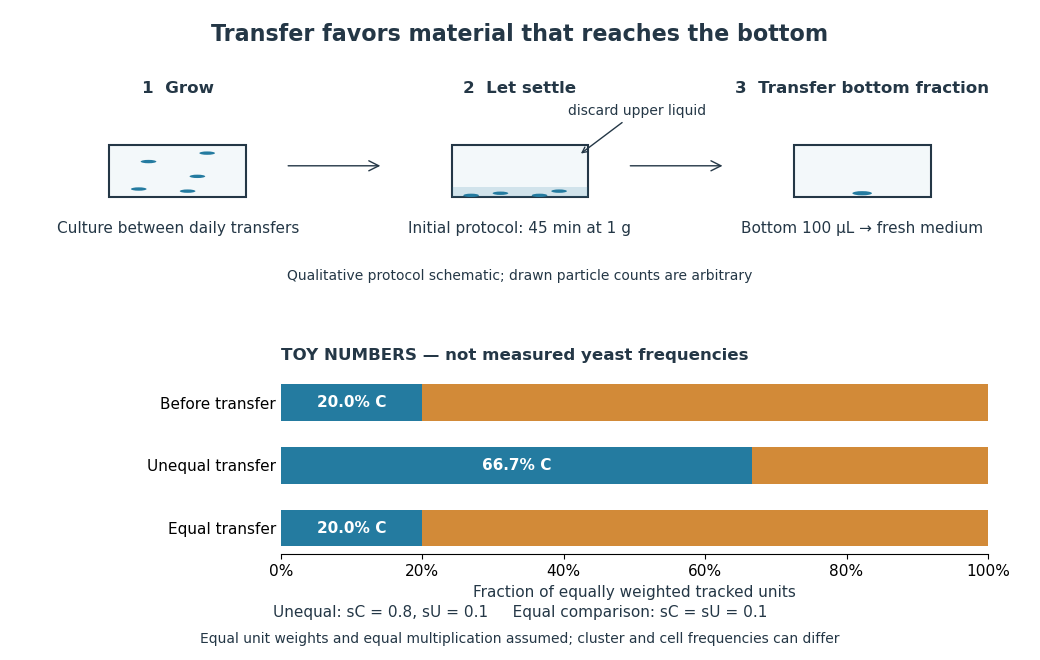
A motivating experiment: select for a property of groups. Ratcliff, Denison, Borrello and Travisano's 2012 study began with Saccharomyces cerevisiae growing as unicellular organisms. Daily transfer favored rapidly settling material. Their initial protocol allowed a culture to settle for , discarded the upper , and transferred the bottom into fresh medium. After seven days, they instead sampled and centrifuged it at times gravitational acceleration for , again transferring the bottom . Faster settling made it more likely that a lineage would seed tomorrow's culture; the procedure selected a physical outcome without specifying how it must arise. These protocol details are explicitly recounted in Gulli, Herron and Ratcliff, Evolution of altruistic cooperation among nascent multicellular organisms (2019): original settling protocol.
Settling selection and an explicitly stipulated enrichment example
. Original qualitative transfer schematic with toy numerical bars. The workflow represents the initial settling protocol described above. The lower panel assumes equally weighted tracked units and transfer probabilities and ; these values and the resulting frequencies are invented for explanation, not fitted to snowflake yeast measurements. The equal-transfer comparison is a model control, distinct from the experimental comparisons described below. Details.The primary 2012 paper reports snowflake yeast dominating all ten initial replicate populations by 60 transfers. To distinguish the joining of previously separate biological cells from clonal development, the researchers enzymatically separated clusters and followed individual biological cells for : attached descendants rebuilt clusters, with no such joining observed. Staining localized attachments at bud scars. Time-lapse observations also showed clusters releasing smaller multicellular offspring, called propagules; small clusters grew before they reproduced. See Ratcliff et al., Experimental evolution of multicellularity (2012), figures 1–3: emergence, development and reproduction.
The experimental comparisons ask different questions. Competition with the unicellular organism ancestor showed a reported advantage under settling selection. Without settling selection, the estimated disadvantage had a one-sided , so it was suggestive rather than decisive evidence of a cost. Separately, three populations derived from one evolved isolate retained the cluster form through 35 transfers without settling selection. That persistence tests stability, not whether clusters always outperform single biological cells. See Ratcliff et al. (2012), figure 2 and the cluster-formation results cited above.
A 2015 follow-up added a causal test: deleting the gene ACE2 in the unicellular organism ancestor produced snowflake yeast, while supplying functional ACE2 to one evolved isolate restored separation into single biological cells. Sequence changes altering the encoded protein were found in ACE2 in five of ten examined lineages; the study did not identify that same sequence-change mechanism in every lineage. The deletion and restoration comparisons support a mechanism beyond the observation that clusters settle quickly. See Ratcliff, Fankhauser, Rogers, Greig and Travisano, Origins of multicellular evolvability in snowflake yeast (2015), figure 1.
What follows, and what does not. The evidence supports inherited cluster formation, clonal development and a reproducing collective whose properties can respond to natural selection. Calling these simple multicellular organisms recognizes those demonstrated properties; it does not turn every clump into an animal or establish animal-like cell differentiation. This laboratory route also does not reconstruct the actual ancestry of animals or show that complex developmental integration must follow. The interesting achievement is narrower and testable: a change in how descendants remain connected creates a new scale at which growth and reproductive success can be measured.
For the toy figure, let be the fraction of tracked units of type C before transfer and let be the respective probabilities of transfer for C and U. Assume equally weighted units and equal multiplication between transfers. When overall transfer probability is nonzero, conditioning on transfer givesWith , and , the numerator is and the denominator , giving . If both types have the same nonzero transfer probability, the fraction stays . This is conditional probability, not a model of the full experimental life cycle: real cluster sizes, growth and fragmentation affect which quantity a frequency measures. In particular, a fraction of clusters is not automatically a fraction of biological cells.
A unicellular organism is an organism whose living body consists of one biological cell. That biological cell maintains itself, grows and participates in reproduction; it is not merely one specialized component of a larger body. Escherichia coli and ordinary free-living Saccharomyces cerevisiae illustrate prokaryotic and eukaryotic examples respectively. Cellular organization and the number of biological cells are separate questions. See Clark, Douglas and Choi, Biology 2e, 4.1: cells as units of organisms.
How can one biological cell do enough to sustain an organism? Its cell membrane retains useful material while membrane transport allows exchange; metabolism transforms nutrients and supplies usable energy; gene expression makes proteins needed to maintain and rebuild the machinery. These functions operate together inside the same boundary. In Saccharomyces cerevisiae, for example, glucose can support alcoholic fermentation and production of ATP, while the cell cycle and budding produce descendants. A single biological cell therefore combines chemical processing, regulated exchange and inherited organization. See Alberts et al., Molecular Biology of the Cell (2002): universal cellular machinery and the experimental accounts under Saccharomyces cerevisiae and yeast.
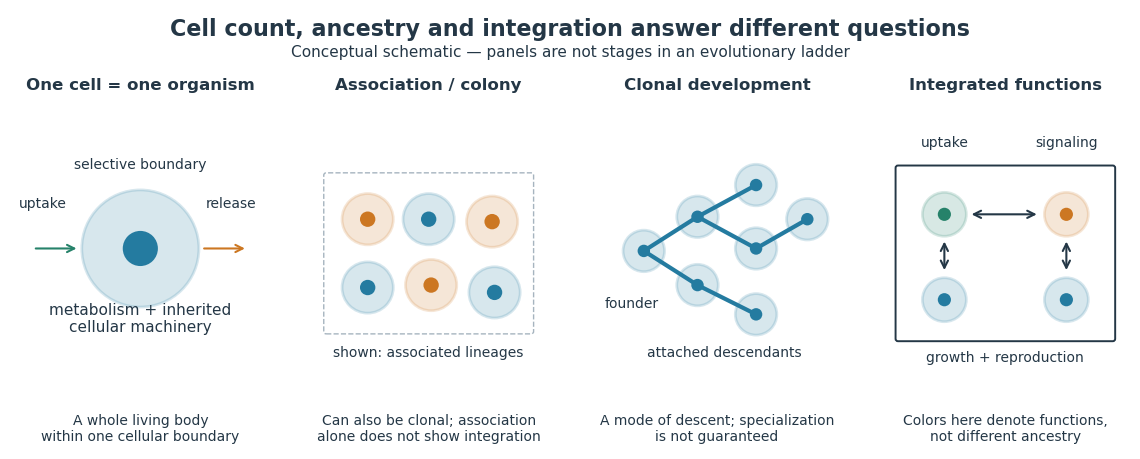
Being a unicellular organism does not mean isolated or independent of all other life. Unicellular organisms can interact and cooperate in groups. A biological colony describes association; clonal development describes descent; developmental integration describes coordination of the developing whole. Neither shared ancestry nor a visible clump alone establishes the latter. This distinction makes single-cell experiments easier to interpret: measuring the growth of one biological cell, the expansion of a group and the reproductive success of a reproducing cluster can answer different questions. See Queller and Strassmann, Beyond society: the evolution of organismality (2009): cooperation and the limits of simple organism criteria.
Pinned article: Introduction to the OurBigBook Project
Welcome to the OurBigBook Project! Our goal is to create the perfect publishing platform for STEM subjects, and get university-level students to write the best free STEM tutorials ever.
Everyone is welcome to create an account and play with the site: ourbigbook.com/go/register. We belive that students themselves can write amazing tutorials, but teachers are welcome too. You can write about anything you want, it doesn't have to be STEM or even educational. Silly test content is very welcome and you won't be penalized in any way. Just keep it legal!
Intro to OurBigBook
. Source. We have two killer features:
- topics: topics group articles by different users with the same title, e.g. here is the topic for the "Fundamental Theorem of Calculus" ourbigbook.com/go/topic/fundamental-theorem-of-calculusArticles of different users are sorted by upvote within each article page. This feature is a bit like:
- a Wikipedia where each user can have their own version of each article
- a Q&A website like Stack Overflow, where multiple people can give their views on a given topic, and the best ones are sorted by upvote. Except you don't need to wait for someone to ask first, and any topic goes, no matter how narrow or broad
This feature makes it possible for readers to find better explanations of any topic created by other writers. And it allows writers to create an explanation in a place that readers might actually find it.
Figure 1. Screenshot of the "Derivative" topic page. View it live at: ourbigbook.com/go/topic/derivativeVideo 2. OurBigBook Web topics demo. Source. - local editing: you can store all your personal knowledge base content locally in a plaintext markup format that can be edited locally and published either:This way you can be sure that even if OurBigBook.com were to go down one day (which we have no plans to do as it is quite cheap to host!), your content will still be perfectly readable as a static site.
- to OurBigBook.com to get awesome multi-user features like topics and likes
- as HTML files to a static website, which you can host yourself for free on many external providers like GitHub Pages, and remain in full control

Figure 2. You can publish local OurBigBook lightweight markup files to either OurBigBook.com or as a static website.
Figure 3. Visual Studio Code extension installation.
Figure 5. . You can also edit articles on the Web editor without installing anything locally. Video 3. Edit locally and publish demo. Source. This shows editing OurBigBook Markup and publishing it using the Visual Studio Code extension. 
- Infinitely deep tables of contents:




All our software is open source and hosted at: github.com/ourbigbook/ourbigbook
Further documentation can be found at: docs.ourbigbook.com
Feel free to reach our to us for any help or suggestions: docs.ourbigbook.com/#contact