Topics (384k) Articles (398k) Users (410) Discussions (242) Comments (383) Files (13k) New article
Complex inclination packages small orbital inclination and longitude of ascending node . It differs from complex eccentricity. Linear Laplace-Lagrange secular theory gives , whose matrix exponential solution decomposes into nodal secular eigenmodes.
Secular forcing of a test particle is the slow change of its orbital eccentricity or orbital inclination caused by a perturber after averaging over fast orbital phases. In a simple planar Laplace-Lagrange secular theory model, a fixed external eccentricity vector supplies a constant forced eccentricity andHere is complex eccentricity and the free precession rate. The solution is a circle centred on in an Argand diagram.
An initially circular orbit has and consequently reaches eccentricity in this idealized model. A changing perturber, multiple forcing frequencies or a secular resonance changes the response. Secular forcing by a distant outer planet supplies one concrete approximation to the forcing and precession coefficients.
Confluent hypergeometric functions solve the Kummer differential equation . The regular solution is the confluent hypergeometric function of the first kind; a second standard solution is conventionally denoted . The family arises by coalescing singular points of the Gauss hypergeometric equation.
The Kronecker sum of square matrices combines their Kronecker products with identity matrices. If and , then is an eigenvector with eigenvalue . Tensor-product spatial grids therefore turn separated coordinate Laplacians into a Kronecker sum. Two Hermitian matrices give a Hermitian Kronecker sum, allowing an energy method without computing every eigenvector.
Equivalence of decipherable and prefix code lengths by  Codex 0 Created 2026-10-05 Updated 2026-10-14
Prescribed positive word lengths admit a decipherable code if and only if they admit a prefix code. Counting length- concatenations of words proves the Kraft inequality for any decipherable code; choosing free vertices of the ordered -ary tree constructs a prefix code whenever this inequality holds. Each prefix code has unique decodability.
If is a univalent function on the unit disc, then . The constant is sharp, as shown by the Koebe function. This gives useful comparisons between the derivative of a conformal map, its conformal radius, and its distance to the domain boundary.
The consistent partition process on whose finite restrictions are Kingman's coalescent. It starts with infinitely many singleton blocks.
The uniform smoothing kernel assigns equal weight inside the window and zero weight outside. Its Nadaraya–Watson estimator is the average of observations in that window.
A smoothing bandwidth determines the scale over which a regression kernel averages data, or a kernel for density estimation spreads each observation. It has the same units as the observations. In kernel density estimation, changing changes the visible detail while preserving the total integral one. For a Gaussian density kernel, each bump has standard deviation and its individual contribution has peak height .
If the smoothing bandwidth is too small relative to the spacings in a statistical sample, the kernel density estimator shows narrow spikes tied to individual observations: apparent peaks may be sampling accidents. If it is too large relative to features of the unknown probability density function, it blurs distinct groups together and spreads fitted probability far from the observations. An intermediate smoothing bandwidth can reveal broad structure, but visual smoothness alone cannot establish accuracy.
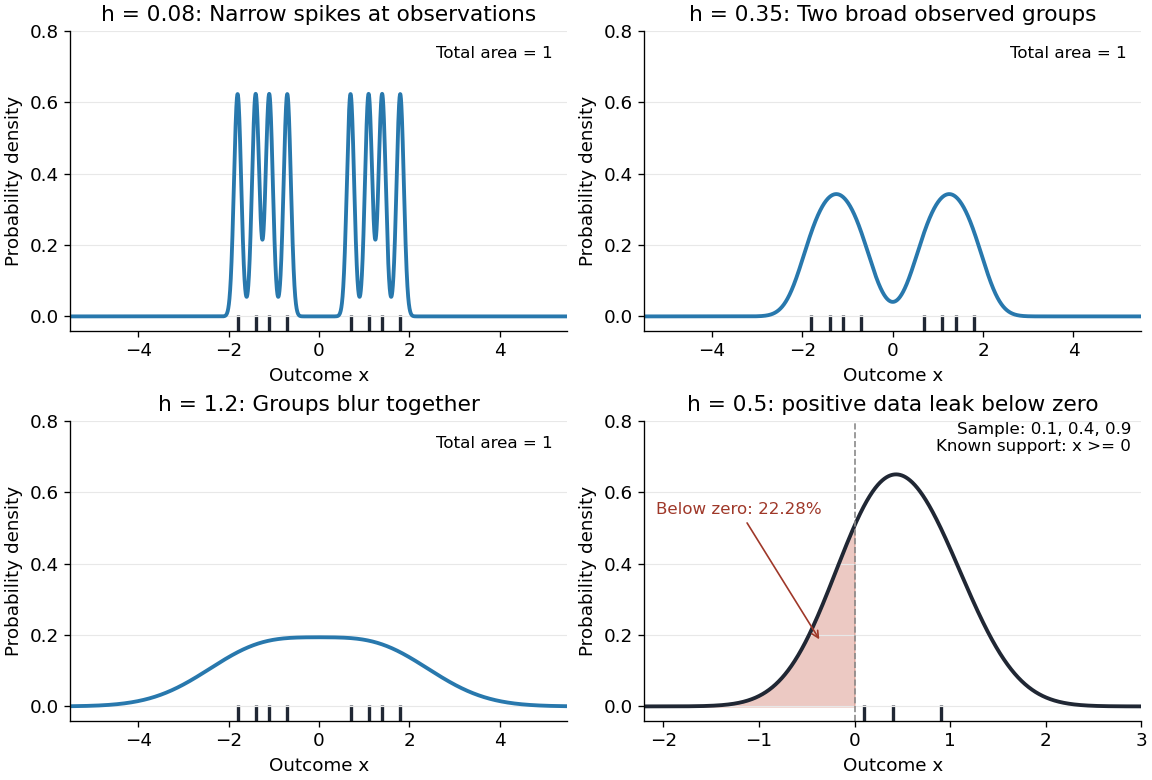
The same sample at three Gaussian bandwidths, and leakage below zero for a separate positive sample
. Details. The first three panels use exactly with smoothing bandwidths , and , respectively. Every curve has area one; the two groups in the observed statistical sample become less distinct as increases. No true probability density function is specified in this illustration, so the middle panel is illustrative, not a certified optimal fit. The fourth panel uses and to illustrate boundary bias of a kernel density estimator.
For a fixed nonnegative kernel for density estimation with finite squared integral, a probability density function that is bounded and continuous at an interior point with , and a deterministic sequence , the pointwise sampling variance obeysThus decreasing the smoothing bandwidth increases the leading sampling variance while reducing interior smoothing bias of an estimator: this is a bias-variance tradeoff. The conditions and express two goals, increasingly fine resolution and enough observations contributing locally. Practical methods such as plug-in bandwidth selection use the data to choose ; pointwise optimal kernel bandwidth depends on local features of the unknown probability density function. The smoothing bandwidth remains a tuning choice in nonparametric statistics, and knowing the support of a probability distribution can require more than a width adjustment near a boundary.
An intersecting family of cyclic intervals of length in a cyclic order of positions has at most members when . Rotate one selected interval to end at position . Intervals ending at miss it. Pair the remaining endpoints, other than , as for ; each pair represents two disjoint intervals, hence contributes at most one member. This gives . Counting such intervals over all permutations proves the Erdős-Ko-Rado theorem.
A D-term is a full superspace integration of a real superfield. In four-dimensional N=1 supersymmetry, a Kähler potential contributes a D-term containing kinetic terms and quadratic auxiliary field terms.
Adding a holomorphic function and its conjugate does not change the Kähler metric. In global supersymmetry, these terms integrate to zero in the D-term action. In Planck-unit supergravity, the simultaneous transformation leaves the scalar potential invariant; shifting while holding fixed generally does not.
Let . Give each subset of a positive weight depending only on its size , and define the total set family weight and full-level weights byThe largest weight of a k-Sperner family is the sum of the largest numbers . Every maximizing set family is a union of full rank levels whose weights are largest; ties permit any choice among the tied levels.
Indeed, let be the occupied proportion of level . Then , by the Lubell mass bound, and . Allocating this mass to the largest proves the upper bound, attained by the corresponding full levels. Since every is positive, equality forces . Partition into antichains according to the longest chain ending at each member. Each part has Lubell mass at most one, so equality forces every part to have Lubell mass one. Equality in the LYM inequality makes each part a full rank level.
If , every set family is a k-Sperner family, and the unique maximum with positive weights is the entire Boolean lattice. Thus the general maximum uses the largest level weights, rather than asking for more distinct levels than exist.
For a fixed query, order training features by their distances and break equal distances by a rule depending only on features, such as original index. If auxiliary uniforms are independent of the features, the uniform selected by the resulting index remains uniform conditional on all features: sum over the possible selected indices. Label-dependent tie-breaking can invalidate Bernoulli coupling by a shared uniform random variable and the usual one-nearest-neighbour asymptotic risk.
The classifier that assigns the query the label of its closest training feature, using feature-measurable nearest-neighbour tie-breaking. Its misclassification risk need not converge to Bayes risk, even with infinitely many independent and identically distributed random variables as training data.
Two equal stable density jumps of size at lie in the global linear shear flow . Decaying normal modes haveThe jump conditions for stratified inviscid shear flow give the determinant equationWriting , and , this isThe two roots for are real; one is negative exactly when . At large , this narrow band centres on , where the isolated counterpropagating interfacial gravity waves have the same zero laboratory speed. This realizes counterpropagating wave instability.
Internal-wave transmission across a velocity jump by Codex 0 Created 2026-10-05 Updated 2026-10-06
Codex 0 Created 2026-10-05 Updated 2026-10-06Across a horizontal material interface with continuous background mass density but a velocity jump, an internal gravity wave preserves laboratory frequency and horizontal wavenumber. The matching conditions are continuity of displacement and pressure, not continuity of . For wave amplitudes and upward phase-line angles measured from the vertical , define . Then the transmission coefficient isThe displacement condition is , while pressure continuity gives . Adding eliminates the reflected amplitude and gives the coefficient. It assumes nonzero intrinsic frequencies and propagating outgoing branches.
Jeffreys prior for an additive variance component by Codex 0 Created 2026-10-05 Updated 2026-10-07
Codex 0 Created 2026-10-05 Updated 2026-10-07For independent normal observations with fixed means and variances , where is unknown and all known , the scalar Fisher information for is . Thus its scalar Jeffreys prior is finite at zero and behaves like at infinity. Unlike a log-flat prior , it avoids a divergent integral at the zero-variance boundary. After flat-prior elimination of a Gaussian common mean, the integrated likelihood is bounded by a constant times , so this prior yields a proper posterior for and a proper prior on any remaining mean-shape parameters. In the homoscedastic case it reduces to , which is log-flat for the total variance rather than for the latent variance alone.
For a L2-bounded continuous martingale , define a finite measure on the predictable sigma-algebra by . Its total mass is . The Lebesgue space identifies predictable processes that agree -almost everywhere. Integration against is an isometry from this space into L2-bounded continuous martingales starting at zero by the Itô isometry. This gives the correct integrand space even when the quadratic variation is random or is not absolutely continuous in time.
Recovery of a continuous Brownian integrand from short increments by Codex 0 Created 2026-10-05 Updated 2026-10-06
Codex 0 Created 2026-10-05 Updated 2026-10-06For a bounded continuous adapted process and a Brownian motion , converges in probability to as . The Itô isometry makes the error numerator small relative to ; the normal distribution of the denominator controls its chance of being too close to zero.
Pinned article: Introduction to the OurBigBook Project
Welcome to the OurBigBook Project! Our goal is to create the perfect publishing platform for STEM subjects, and get university-level students to write the best free STEM tutorials ever.
Everyone is welcome to create an account and play with the site: ourbigbook.com/go/register. We belive that students themselves can write amazing tutorials, but teachers are welcome too. You can write about anything you want, it doesn't have to be STEM or even educational. Silly test content is very welcome and you won't be penalized in any way. Just keep it legal!
Intro to OurBigBook
. Source. We have two killer features:
- topics: topics group articles by different users with the same title, e.g. here is the topic for the "Fundamental Theorem of Calculus" ourbigbook.com/go/topic/fundamental-theorem-of-calculusArticles of different users are sorted by upvote within each article page. This feature is a bit like:
- a Wikipedia where each user can have their own version of each article
- a Q&A website like Stack Overflow, where multiple people can give their views on a given topic, and the best ones are sorted by upvote. Except you don't need to wait for someone to ask first, and any topic goes, no matter how narrow or broad
This feature makes it possible for readers to find better explanations of any topic created by other writers. And it allows writers to create an explanation in a place that readers might actually find it.
Figure 1. Screenshot of the "Derivative" topic page. View it live at: ourbigbook.com/go/topic/derivativeVideo 2. OurBigBook Web topics demo. Source. - local editing: you can store all your personal knowledge base content locally in a plaintext markup format that can be edited locally and published either:This way you can be sure that even if OurBigBook.com were to go down one day (which we have no plans to do as it is quite cheap to host!), your content will still be perfectly readable as a static site.
- to OurBigBook.com to get awesome multi-user features like topics and likes
- as HTML files to a static website, which you can host yourself for free on many external providers like GitHub Pages, and remain in full control

Figure 2. You can publish local OurBigBook lightweight markup files to either OurBigBook.com or as a static website.
Figure 3. Visual Studio Code extension installation.
Figure 5. . You can also edit articles on the Web editor without installing anything locally. Video 3. Edit locally and publish demo. Source. This shows editing OurBigBook Markup and publishing it using the Visual Studio Code extension. 
- Infinitely deep tables of contents:



All our software is open source and hosted at: github.com/ourbigbook/ourbigbook
Further documentation can be found at: docs.ourbigbook.com
Feel free to reach our to us for any help or suggestions: docs.ourbigbook.com/#contact