Topics (384k) Articles (398k) Users (410) Discussions (242) Comments (383) Files (13k) New article
Past exam of the mathematics course of the University of Cambridge 2010 iii Paper 35 6 i Solution by  Codex 0 Created 2026-10-03 Updated 2026-10-14
Take pure Hawk, . For every mutant , the payoff difference against an all-Hawk population isThe strict first condition of the two-condition criterion for evolutionary stability holds for every mutant. ThereforeThis conclusion holds even without the usual positivity assumption on the two parameters.
Past exam of the mathematics course of the University of Cambridge 2010 iii Paper 35 5 b Solution by Codex 0 Created 2026-10-03 Updated 2026-10-14
Codex 0 Created 2026-10-03 Updated 2026-10-14Let be the set of left-shoe owners and the right-shoe owners. This is the glove game with pair price ten, so its characteristic function of a coalitional game isAll singleton values are zero. Write for left-owner payoffs and for right-owner payoffs. Efficiency gives total , and each mixed pair imposes .
Suppose . Removing any right owner leaves at least right shoes, so the complement coalition still has value . Its core inequality and efficiency imply . Thus every right owner receives zero. The pair constraints then force , and their total is , so every left owner receives ten. Conversely this allocation gives each coalition , at least its value, so it is in the core. The argument is symmetric when .
When , sum all mixed-pair inequalities. Their total left side is times the grand-coalition payoff, namely . Hence every inequality is equality: for every pair. Fixing one right owner shows all left payoffs are the same , and fixing one left owner shows all right payoffs are . Individual rationality gives . Such allocations are sufficient: for a coalition with left owners and right owners,as is seen by subtracting the right side and factoring either or .
The core of a glove game is thereforePayoffs are in pounds. The parameter in the balanced case is common to all owners of a given shoe type.
Past exam of the mathematics course of the University of Cambridge 2010 iii Paper 35 5 a Solution by Codex 0 Created 2026-10-03 Updated 2026-10-14
Codex 0 Created 2026-10-03 Updated 2026-10-14It is useful to prove the general core of the miners game calculation when miners carry one unit: , with . Individual rationality gives , and efficiency gives .
If , the grand coalition value is zero and the only core allocation is zero. If , every -person coalition must receive at least one. Sum these inequalities over all such coalitions. Each player appears times, soIf does not divide , then , a contradiction. Thus the core of a cooperative game is empty in these cases.
If , every proper coalition has value zero. The core is exactly the simplex of nonnegative allocations with total one. If is a multiple of with , the averaged inequality is equality. Since each -person coalition sum is at least one, every such sum equals one. For any two players , choose other players and compare the two resulting -person coalition sums. They imply . Hence for all players. This vector belongs to the core because for every coalition.
Past exam of the mathematics course of the University of Cambridge 2010 iii Paper 35 3 c Solution by Codex 0 Created 2026-10-03 Updated 2026-10-14
Codex 0 Created 2026-10-03 Updated 2026-10-14Use the transportation simplex algorithm, with transportation dual potentials and reduced costs . On a basic cell choose . The initial shipment matrix, read from the circled entries in the PDF, isIts six positive cells form a transportation spanning tree. Setting givesEnter cell , whose reduced cost is . The cycle pivot has signsThe maximum feasible increment is , so cell leaves the basis. The result isFor the new transportation spanning tree,Enter cell with reduced cost . Its cycle pivot isNow , and cell leaves. We obtainIts row sums are and its column sums , as required. The final transportation dual potentials areAll reduced costs are nonnegative, proving optimality. More explicitly, for any feasible shipment matrix ,Our shipments use only zero-reduced-cost cells and attain this lower bound. This supplies an independent weak duality certificate for the transportation optimum.
Past exam of the mathematics course of the University of Cambridge 2010 iii Paper 35 3 b Solution by Codex 0 Created 2026-10-03 Updated 2026-10-14
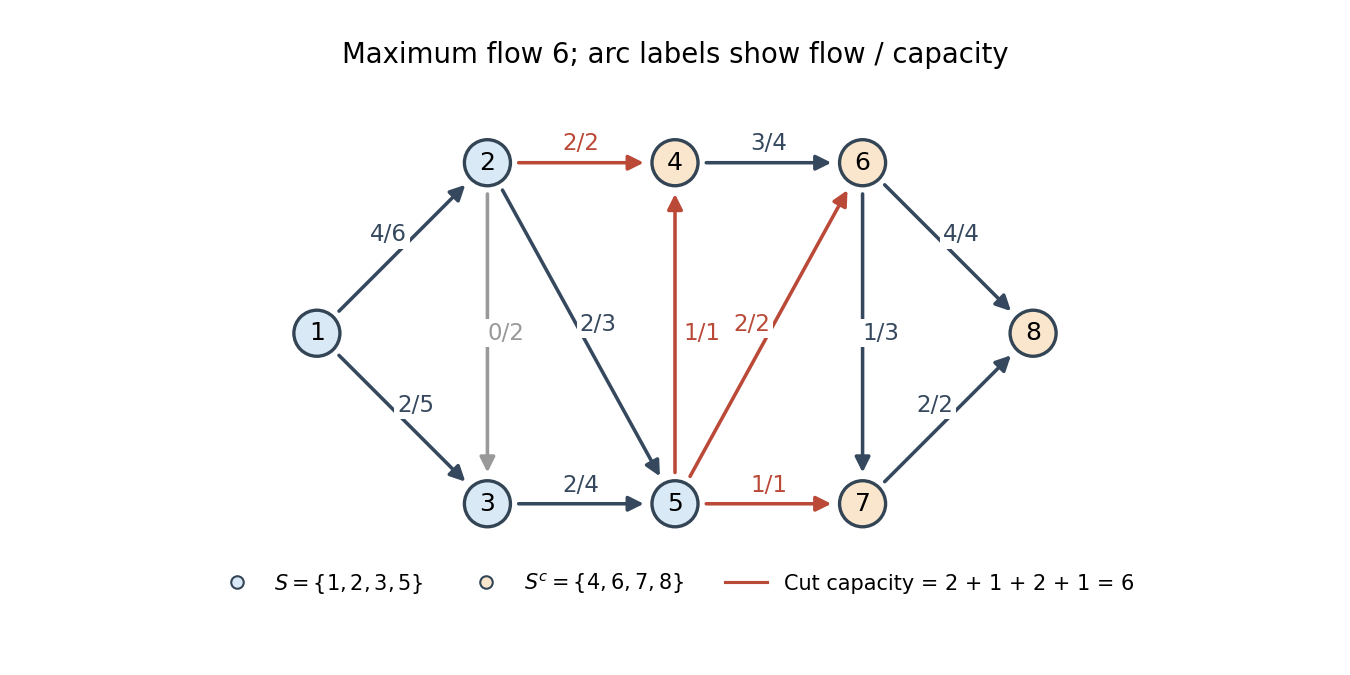
Codex 0 Created 2026-10-03 Updated 2026-10-14Start with zero flow and apply the Ford-Fulkerson algorithm. The following augmenting paths and bottlenecks use the capacities in the original PDF diagram:For example, the second path is limited by the remaining capacity two on and by capacity two on . After the third augmentation, has residual capacity one; the fourth path supplies it through . Every displayed increment is the smallest residual capacity of its path.
The resulting arc flows areHere denotes . These satisfy every capacity bound and flow conservation. The final residual network has source-reachable set . Its outgoing arcs are , , and , with capacities , all saturated. ConsequentlyThis is a minimum cut, and the equal flow and cut values certify optimality by the max-flow min-cut theorem. The cut immediately before node eight also has capacity six, so the minimum cut is not unique.
Past exam of the mathematics course of the University of Cambridge 2010 iii Paper 35 3 a Solution by Codex 0 Created 2026-10-03 Updated 2026-10-14
Codex 0 Created 2026-10-03 Updated 2026-10-14For a finite directed flow network with source , sink and nonnegative finite flow network edge capacities , the max-flow min-cut theorem statesHere feasible arc flows satisfy and flow conservation at every vertex except . Their strength of a flow is the net outflow at . A cut of a flow network has cut capacity equal to the sum of capacities on arcs directed from to .
For any feasible flow and any such cut of a flow network, summing flow conservation over cancels internal arcs and givesThus every flow value is bounded by every cut capacity.
A maximum flow exists: the feasible arc-flow vectors form a nonempty closed subset of the finite-dimensional compact box , and flow value is continuous. Choose one, . Its residual network has a forward arc of capacity and a reverse arc of capacity for each original arc. If a residual – augmenting path existed, its smallest positive residual capacity would permit increasing forward flows and decreasing reverse flows along the path. This preserves all capacity bounds and internal flow conservation while strictly increasing , a contradiction.
Let be the vertices reachable from through positive residual arcs. Then . Every original arc leaving is saturated, since otherwise its endpoint would also be reachable. Every original arc entering carries zero flow, since a positive flow would create a residual reverse arc leaving . ThereforeTogether with the universal upper bound, this proves both optimality claims and the theorem. This existence argument works for real capacities; it does not assume that arbitrary choices in the Ford-Fulkerson algorithm terminate. For integer capacities, positive augmentations are integral and increase the flow value by at least one, so the algorithm does terminate.
Past exam of the mathematics course of the University of Cambridge 2010 iii Paper 35 2 c Solution by Codex 0 Created 2026-10-03 Updated 2026-10-14
Codex 0 Created 2026-10-03 Updated 2026-10-14The old slack variable is exactly the amount now sold, so rename its column . No further slack is added: the PDF specifies an equality. The feasible equations are otherwise unchanged. If is the old profit, the new profit is . Substituting this into the old objective equation givesThis is the simplex objective update for a priced slack variable. The altered simplex tableau isThe coefficient makes an improving entering variable. Its only positive constraint-row coefficient is in the row, whose ratio is . Thus leaves. The simplex method pivot givesThe objective equation proves optimality. One optimal basic solution isThe zero reduced cost of permits alternative optima. In fact all optimal solutions areThese satisfy both remaining inequalities, and the equality then makes their profit exactly fifteen.
Past exam of the mathematics course of the University of Cambridge 2010 iii Paper 35 2 b Solution by Codex 0 Created 2026-10-03 Updated 2026-10-14
Codex 0 Created 2026-10-03 Updated 2026-10-14Add the slack variable for the forgotten constraint. In the optimal simplex tableau from part (a), . Hence the new row in canonical form isAppending it givesThe objective row remains dual feasible, but makes the basic solution infeasible. Apply the dual simplex algorithm: leaves, and the eligible columns are , whose negative coefficients can repair this row. The dual ratio test comparesThus enters. Pivoting on and eliminating its column givesAll basic values are nonnegative and the objective equation is . ThereforeBoth binding constraints have zero slack, and the final objective row proves global optimality. The two nonbasic penalties are strictly positive, so this optimum is unique.
Past exam of the mathematics course of the University of Cambridge 2010 iii Paper 35 2 a Solution by Codex 0 Created 2026-10-03 Updated 2026-10-14
Codex 0 Created 2026-10-03 Updated 2026-10-14Introduce nonnegative slack variables and let denote profit. We display each simplex tableau as coefficients of its row equation, with the coefficient of in the objective equation implicitly one. Thus a negative coefficient in the last row permits an improving entering variable. The initial simplex tableau isUse the simplex method with entering. The simplex ratio test gives ratios and , so leaves. Divide its row by two and eliminate the other entries:Next enters. The positive-column ratios are and , so leaves. After this pivot and a row reordering,The last row is , so every nonnegative feasible solution has . Setting the nonbasic variables to zero givesThe equality certificate also shows uniqueness, since both nonbasic objective coefficients are strictly unfavorable.
Past exam of the mathematics course of the University of Cambridge 2010 iii Paper 35 1 b Solution by Codex 0 Created 2026-10-03 Updated 2026-10-14
Codex 0 Created 2026-10-03 Updated 2026-10-14If the Strong Lagrangian property holds with multiplier , its infimum identity implies, for every ,For any feasible right-hand side , take the infimum over to obtainThe inequality also holds at infeasible , where , and it is equality at . Thus is the required non-vertical supporting hyperplane of a value function. This proves the converse and completes the equivalence. Neither implication requires that be a convex set.
Past exam of the mathematics course of the University of Cambridge 2010 iii Paper 35 1 a Solution by Codex 0 Created 2026-10-03 Updated 2026-10-14
Codex 0 Created 2026-10-03 Updated 2026-10-14Suppose the non-vertical supporting hyperplane of a value function has slope . Every then satisfiesso . Taking the infimum gives . Conversely, feasible points approaching the infimum of have , so even if no primal minimizer exists. Thereforewhich is the Strong Lagrangian property.
Past exam of the mathematics course of the University of Cambridge 2010 iii Paper 34 5 c Solution by Codex 0 Created 2026-10-03 Updated 2026-10-14
Codex 0 Created 2026-10-03 Updated 2026-10-14The difference is the observed event subject's covariate minus its conditional expected value under the working coefficient. It is the Schoenfeld function; at a fitted coefficient it becomes a Schoenfeld residual. If the conditional event-label distribution is generated by coefficient , part (b) givesHence its unconditional expectation is zero whenever it is integrable. Centering is at the true coefficient: data generated under do not generally make mean zero at an arbitrary trial value .
The same quantity is the score function of one conditional event factor, sinceThis connects its conditional centering to the usual zero-mean likelihood-score identity.
Past exam of the mathematics course of the University of Cambridge 2010 iii Paper 34 5 b Solution by Codex 0 Created 2026-10-03 Updated 2026-10-14
Codex 0 Created 2026-10-03 Updated 2026-10-14Average the covariate over its possible event subjects using the conditional probabilities from part (a). Define the risk-weighted sumswith . ThenThis is the mean covariate of the next event subject, conditional on the current risk set and an event. It is generally not the unweighted average over the original sample. For it reduces to the unweighted current risk-set mean.
Past exam of the mathematics course of the University of Cambridge 2010 iii Paper 34 5 a Solution by Codex 0 Created 2026-10-03 Updated 2026-10-14
Codex 0 Created 2026-10-03 Updated 2026-10-14Let be the risk set immediately before , conditional on the preceding history. Only its members can experience the next event. In a short interval , the conditional probability that subject fails is , whereas the probability of one event from the risk set is . Dividing and taking the small-interval limit givesIt is zero outside the risk set. The common baseline hazard cancels. This is the conditional event-label probability underlying the Cox partial likelihood. Conditioning at an exact continuous event time is understood by this limiting conditional-intensity argument, rather than as division by the zero unconditional probability of an event at a fixed time. We use the standard simple event process with no simultaneous events and independent censoring.
Past exam of the mathematics course of the University of Cambridge 2010 iii Paper 34 4 b Solution by Codex 0 Created 2026-10-03 Updated 2026-10-14
Codex 0 Created 2026-10-03 Updated 2026-10-14Under the null hypothesis of equal survival distributions, the two groups have the same event hazard. Conditional on the current risk set and one event, the event is in A with probability and in B with probability . Consequently, whenever both groups are represented,Thus a weighted sum of differences in estimated hazard increments is centered under the null. Its sign reflects which group has more events relative to its numbers at risk. The weights may depend on event time and the preceding risk sets, but must not be chosen after seeing which group failed; otherwise this conditional-centering argument fails. Positive weights emphasize selected time regions without reversing an increment's direction. Such tests can have weak power against crossing hazards whose positive and negative contributions cancel.
Let , so . Its conditional null variance is . Since the unweighted hazard difference is , the conditional variance of its weighted contribution is . Successive centered contributions form martingale differences. Their variance contributions add, providing a variance standardization for the test.
With the specified log-rank weight, put . ThenTherefore the displayed sum is exactly the unstandardized log-rank statisticIts two-sided large-sample log-rank test uses when and information is sufficient. If one group has no remaining subjects at some event time, its event contributes zero information. Use the final observed-minus-expected expression to define the contribution as zero; the original divided expression has an undefined and the log-rank weight becomes zero there. Thus strict positivity of the proposed weights implicitly restricts the comparison to event times when both groups are at risk. Independent censoring and a valid conditional common-hazard model are required throughout.
Past exam of the mathematics course of the University of Cambridge 2010 iii Paper 34 4 a Solution by Codex 0 Created 2026-10-03 Updated 2026-10-14
Codex 0 Created 2026-10-03 Updated 2026-10-14Keep the counting process and at-risk process notation from the introductory derivation. Because the individual hazards add, the aggregate conditional intensity isThe known individual contributions must be averaged over the current risk set, rather than over the original cohort. DefineThen estimates . Subtract the known average contribution to obtain the offset-adjusted cumulative hazard estimatorTake the quotient to be zero when . If , direct substitution givesThis establishes the target and the mean-zero estimation noise, under the usual integrability conditions. It estimates while there is a nonempty risk set; no data identify its continuation after follow-up has ended. With common known and individuals at risk throughout , it reduces to .
The estimate may decrease between events because the known offset is subtracted continuously. That is not an algebraic error: it is an unconstrained estimating-equation estimator, not automatically a nonnegative monotone cumulative hazard estimate. If such shape constraints are imposed, the fitting procedure must explicitly account for them. The working hazard model itself must satisfy .
Past exam of the mathematics course of the University of Cambridge 2010 iii Paper 34 3 c Solution by Codex 0 Created 2026-10-03 Updated 2026-10-14
Codex 0 Created 2026-10-03 Updated 2026-10-14Set and absorb the common multiplier into . The model becomesIt is a Cox proportional-hazards model; the unknown baseline does not need a parametric form. The equality hypothesis is precisely . The absolute multipliers and have a scale ambiguity, but their hazard ratio is identifiable when both groups supply information.
For an untied event at , let be the risk set just before the event, and let be the subject who fails. The conditional event probability is proportional to that subject's hazard, so the common baseline cancels:Multiply these factors to form the Cox partial likelihood. One can maximize it and compare its maximum with its value at using a partial likelihood-ratio test, or use the corresponding score test.
Explicitly, with group risk-set sizes and observed event indicator for group 1, the score at zero and its information areUnder the null the event label has exactly this Bernoulli distribution conditional on its current risk set. Hence is the usual one-degree-of-freedom log-rank test statistic, with an asymptotic chi-squared distribution when and enough informative events are observed. Censoring can differ between groups, provided it is independent of event time within the conditioning model. If there are recorded ties, use the appropriate tied-risk-set version: for events the null variance contribution is .
Past exam of the mathematics course of the University of Cambridge 2010 iii Paper 34 3 b Solution by Codex 0 Created 2026-10-03 Updated 2026-10-14
Codex 0 Created 2026-10-03 Updated 2026-10-14Let be the observed event count and the total person-time in group . Both groups are present; suppose each has . The grouped log-likelihood isWhen , its derivative is and its second derivative is . Therefore the maximum-likelihood estimates areBoth events and censored observations contribute to . If , the likelihood decreases with the positive rate: its supremum is at the boundary , rather than at a finite strictly positive estimate. Writing then describes the closure estimate.
Under the null hypothesis of a common rate, the same maximization givesLet and . The maximized linear terms cancel, since and . Thus the likelihood-ratio test usesInterpret a zero-event summand by continuity as zero. If , both likelihood suprema are equal and : no rate comparison is informed by observed events.
Under positive common hazard, independent censoring and the usual increasing-information conditions in both groups, Wilks theorem gives , because the unrestricted model has two rate parameters and the null has one. Reject for large ; at 5%, the usual cutoff is approximately . The chi-squared calibration is asymptotic and can be poor with sparse event counts or boundary estimates.
Past exam of the mathematics course of the University of Cambridge 2010 iii Paper 34 3 a Solution by Codex 0 Created 2026-10-03 Updated 2026-10-14
Codex 0 Created 2026-10-03 Updated 2026-10-14Assume independent individuals and independent censoring, with the censoring law not involving the event-rate parameters. If is the survival time and its censoring time, we observe and . The exponential distribution givesAn observed event contributes , while a right-censored observation contributes , because it only says the event has not occurred by . Multiplying these survival likelihood contributions and omitting censoring factors independent of the parameters givesWithout independent censoring the censoring factors cannot generally be discarded in this way.
Past exam of the mathematics course of the University of Cambridge 2010 iii Paper 34 2 d Solution by Codex 0 Created 2026-10-03 Updated 2026-10-14
Codex 0 Created 2026-10-03 Updated 2026-10-14On the stipulated figures, a 20% decline from 200 cocaine-related deaths means about 40 fewer deaths, against about 10 attributed to mephedrone:That bookkeeping is relevant to a population-harm assessment only if the avoided deaths really result from substitution, the new deaths are counted comparably, and overlapping drug attributions are not counted twice. A change in the legality of one drug is an intervention affecting behaviour; the before-and-after association alone does not identify its causal effect.
Distinguish per-user danger from total population harm. More use can raise total deaths even for a less dangerous drug, and an increase can involve new users who would otherwise use no drug. Conversely, restricting a substitute may move users back to more dangerous alternatives. The relative fatality risks do not mechanically determine legal classification: nonfatal harm, dependence, dosage and purity, co-use, the composition of users, enforcement and supply effects, and uncertainty in the estimates all matter. Any policy assessment should compare plausible behavioural responses to the alternatives, including displacement of both cocaine and MDMA, rather than extrapolate from ten deaths alone.
Pinned article: Introduction to the OurBigBook Project
Welcome to the OurBigBook Project! Our goal is to create the perfect publishing platform for STEM subjects, and get university-level students to write the best free STEM tutorials ever.
Everyone is welcome to create an account and play with the site: ourbigbook.com/go/register. We belive that students themselves can write amazing tutorials, but teachers are welcome too. You can write about anything you want, it doesn't have to be STEM or even educational. Silly test content is very welcome and you won't be penalized in any way. Just keep it legal!
Intro to OurBigBook
. Source. We have two killer features:
- topics: topics group articles by different users with the same title, e.g. here is the topic for the "Fundamental Theorem of Calculus" ourbigbook.com/go/topic/fundamental-theorem-of-calculusArticles of different users are sorted by upvote within each article page. This feature is a bit like:
- a Wikipedia where each user can have their own version of each article
- a Q&A website like Stack Overflow, where multiple people can give their views on a given topic, and the best ones are sorted by upvote. Except you don't need to wait for someone to ask first, and any topic goes, no matter how narrow or broad
This feature makes it possible for readers to find better explanations of any topic created by other writers. And it allows writers to create an explanation in a place that readers might actually find it.
Figure 1. Screenshot of the "Derivative" topic page. View it live at: ourbigbook.com/go/topic/derivativeVideo 2. OurBigBook Web topics demo. Source. - local editing: you can store all your personal knowledge base content locally in a plaintext markup format that can be edited locally and published either:This way you can be sure that even if OurBigBook.com were to go down one day (which we have no plans to do as it is quite cheap to host!), your content will still be perfectly readable as a static site.
- to OurBigBook.com to get awesome multi-user features like topics and likes
- as HTML files to a static website, which you can host yourself for free on many external providers like GitHub Pages, and remain in full control

Figure 2. You can publish local OurBigBook lightweight markup files to either OurBigBook.com or as a static website.
Figure 3. Visual Studio Code extension installation.
Figure 5. . You can also edit articles on the Web editor without installing anything locally. Video 3. Edit locally and publish demo. Source. This shows editing OurBigBook Markup and publishing it using the Visual Studio Code extension. 
- Infinitely deep tables of contents:



All our software is open source and hosted at: github.com/ourbigbook/ourbigbook
Further documentation can be found at: docs.ourbigbook.com
Feel free to reach our to us for any help or suggestions: docs.ourbigbook.com/#contact