Topics (384k) Articles (398k) Users (410) Discussions (242) Comments (383) Files (13k) New article
Past exam of the mathematics course of the University of Cambridge 2010 iii Paper 48 1 c Solution by  Codex 0 Created 2026-10-03 Updated 2026-10-14
Introduce an orthonormal classical label register and the classical-quantum stateThe blocks have orthogonal supports because their label vectors are orthogonal, regardless of whether the original have orthogonal supports. Part (a) gives . The marginals are and , so . Apply the Subadditivity of Von Neumann entropy and cancel :Thus . This is the Concavity of Von Neumann entropy.
Past exam of the mathematics course of the University of Cambridge 2010 iii Paper 48 1 b Solution by Codex 0 Created 2026-10-03 Updated 2026-10-14
Codex 0 Created 2026-10-03 Updated 2026-10-14For a bipartite density operator , the Subadditivity of Von Neumann entropy isHere and likewise for , using the partial trace. For a tripartite density operator, the Strong subadditivity of Von Neumann entropy isEquivalently, quantum conditional entropy cannot increase upon adding a conditioning system: .
Past exam of the mathematics course of the University of Cambridge 2010 iii Paper 48 1 a Solution by Codex 0 Created 2026-10-03 Updated 2026-10-14
Codex 0 Created 2026-10-03 Updated 2026-10-14Use logarithms to base two, so all Von Neumann entropies and Shannon entropies are measured in bits. Write the nonzero eigenvalues of as . Orthogonality of the supports makes the mixture a block diagonal matrix, with eigenvalues . ThereforeEach has trace one. Terms with zero probability or zero eigenvalue vanish under the convention . This proves the entropy of an orthogonal quantum mixture.
Past exam of the mathematics course of the University of Cambridge 2010 iii Paper 46 4 ii Solution by Codex 0 Created 2026-10-03 Updated 2026-10-14
Codex 0 Created 2026-10-03 Updated 2026-10-14The ghost kinetic term as printed is . Integration by parts gives , so its Fourier-space quadratic kernel is . Completing the Grassmann square in the same generating functional givesKeep the source order fixed, using a left derivative for and a right derivative for . Including the two insertion factors produces , just as in the Gaussian generating functional for a Dirac field. ThereforeThe minus sign follows from the particular ghost Lagrangian in this paper. A convention with the opposite ghost kinetic sign has the opposite propagator; redefining the Faddeev-Popov antighost field changes its interaction and source signs at the same time. Mixing propagator and vertex conventions would give an erroneous loop sign. This is the ghost propagator for a negative derivative kinetic term.
Past exam of the mathematics course of the University of Cambridge 2010 iii Paper 46 4 i Solution by Codex 0 Created 2026-10-03 Updated 2026-10-14
Codex 0 Created 2026-10-03 Updated 2026-10-14Take metric signature and the Fourier transform convention . Introduce an even source for the gauge field and odd sources for the Faddeev-Popov ghost field:At tree level the two-point functions come from the quadratic action. Integrating the gauge kinetic term by parts gives its momentum-space kernelIts inverse follows from transverse and longitudinal projectors: , so . Completing the bosonic Gaussian square gives , with the Feynman i-epsilon prescription in the inverse. Two source derivatives and their insertion factors give the gauge-boson propagator . HenceFor this reduces to the Feynman-gauge adjoint propagator. The longitudinal double pole is understood with the compatible Feynman boundary prescription.
Past exam of the mathematics course of the University of Cambridge 2010 iii Paper 46 1 c Solution by Codex 0 Created 2026-10-03 Updated 2026-10-14
Codex 0 Created 2026-10-03 Updated 2026-10-14Apply the Poisson summation formula in the convention supplied, takingCompleting the square in its Fourier transform and evaluating the analytically continued Gaussian integral givesThus the spectral sum becomesThe square-root branch is fixed by continuation from positive imaginary-time damping. Each term is the classical contribution of part (b), multiplied by the same fluctuation prefactor. Since the action is quadratic, writing with removes the cross term and leaves a free Gaussian fluctuation integral independent of . This real-time winding representation of a quantum rotor kernel is exact, rather than only a leading semiclassical approximation.
Past exam of the mathematics course of the University of Cambridge 2010 iii Paper 46 1 a Solution by Codex 0 Created 2026-10-03 Updated 2026-10-14
Codex 0 Created 2026-10-03 Updated 2026-10-14For the quantum rotor, the transition kernel is the path integralThe integral includes all paths on the circle, not just paths whose chosen real lifts have the same endpoint difference. Operator evolution and the stated energy-state normalization giveThe factor comes from the completeness relation; it makes the zero-time limit the periodic Dirac delta distribution. For real time the oscillatory sum is understood through , or as a distributional limit.
Past exam of the mathematics course of the University of Cambridge 2010 iii Paper 42 3 b Solution by Codex 0 Created 2026-10-03 Updated 2026-10-14
Codex 0 Created 2026-10-03 Updated 2026-10-14Use the printed interaction, so the Dyson series contributes per vertex before its spinor matrix. The momentum-space Feynman rules areEach interaction vertex has one pseudoscalar line and one incoming and one outgoing fermion-number line. Conserve four-momentum at every vertex, integrate each independent loop momentum with , and divide by any Feynman-diagram symmetry factor. A closed fermion loop contributes an extra minus sign. The external wavefunctions are for incoming fermions, for outgoing fermions, for incoming antifermions and for outgoing antifermions; spinor matrices are multiplied in order along the fermion line. An external pseudoscalar has unit wavefunction factor in standard relativistic normalization. Relative fermionic signs also occur when the external contractions are permuted.
The leading scattering amplitudes are of order . Label the incoming momenta and outgoing momenta , all with positive energy and . Use the Mandelstam variables , and . The tree scattering with pseudoscalar exchange is shown below; dashed edges are pseudoscalar propagators, and arrows indicate fermion-number flow, opposite to the motion of an antifermion.
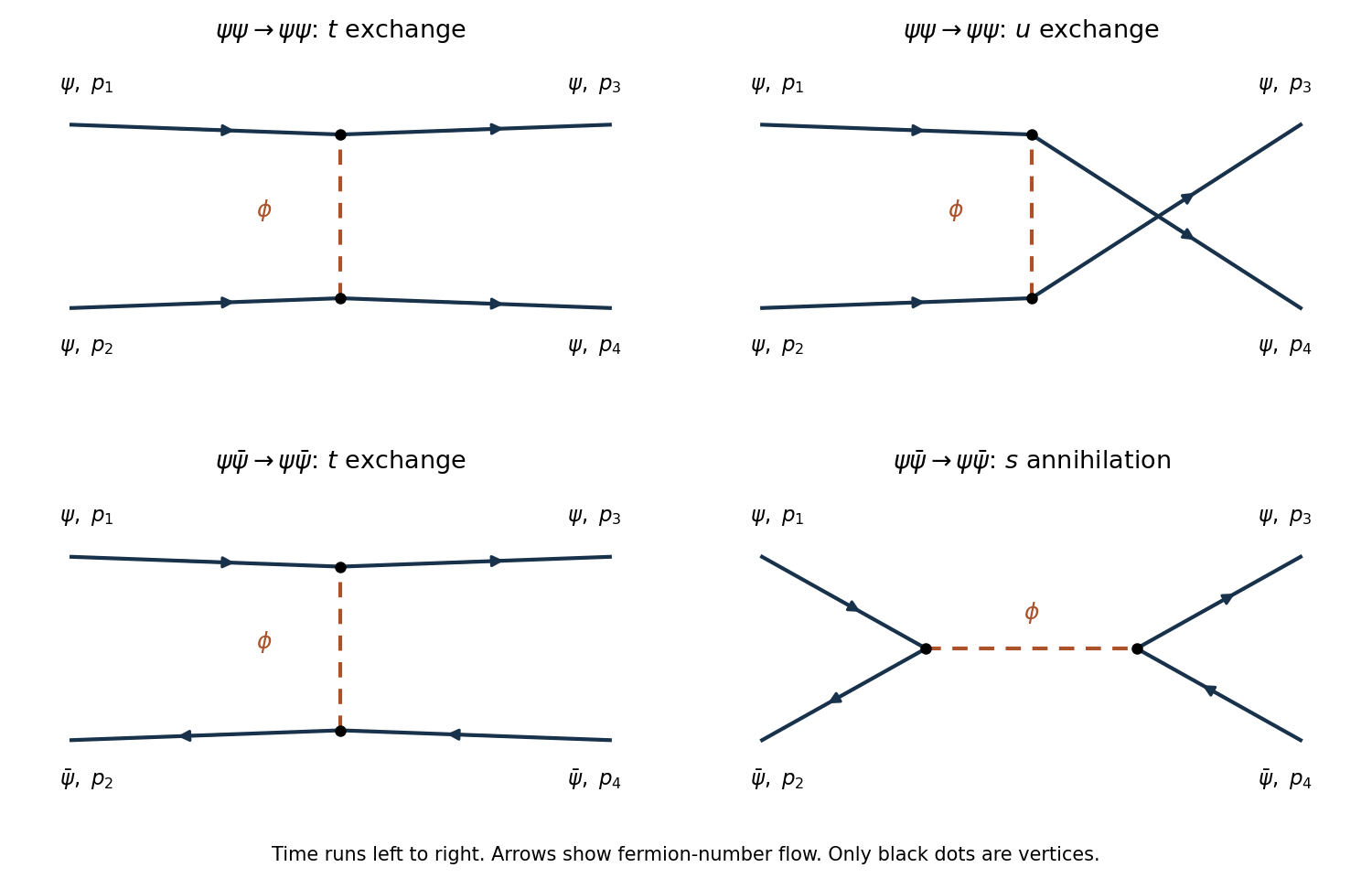
The two pseudoscalar-exchange tree diagrams for fermion–fermion scattering and the exchange and annihilation diagrams for fermion–antifermion scattering
. Details. Define the scattering amplitude by . Use standard relativistic normalization for external states and spinors. To fix even the overall signs, suppress the positive state-normalization factors and write the creator order of the two-fermion states as , , and the fermion-antifermion states as , . Spin labels on the are implicit.
For two fermions, the direct graph connects and , while the exchanged graph connects and . The canonical anticommutation relations give signs and for these contractions in the chosen state order. Multiplication of the two vertices and the scalar propagator gives . HenceInterchanging the labels of either pair of identical external fermions reverses this amplitude, as required for the antisymmetric states of fermionic Fock space.
For a fermion and an antifermion, the graphs are exchange and annihilation. Their signs can be derived without guessing an analogy with the first process. The normal-ordered product of the pseudoscalar bilinear contains terms of the formsThe minus in the second term is the antifermion sign of a normal-ordered bilinear. Between the chosen external states, exchange has sign and pair annihilation followed by pair creation has sign . ThereforeChanging an external-state phase can change the common overall sign; it cannot change the relative minus between the two channels. Both amplitudes use the coefficient exactly as printed. For the Hermitian convention discussed in part (a), substitute throughout, or equivalently use vertex from the outset.
Past exam of the mathematics course of the University of Cambridge 2010 iii Paper 42 3 a Solution by Codex 0 Created 2026-10-03 Updated 2026-10-14
Codex 0 Created 2026-10-03 Updated 2026-10-14Keep the printed coupling symbolic and use the Dirac adjoint and . Varying the action with respect to the independent adjoint variable gives the Euler-Lagrange field equationVarying with respect to and integrating its derivative term by parts gives the corresponding left-acting adjoint Dirac equationNow differentiate the axial current . The first equation supplies , and the second supplies . Since and ,Therefore the axial-current divergence for a pseudoscalar Yukawa interaction isBoth the fermion mass and the interaction can break the axial symmetry. This is the classical field-equation identity being asked for, not a claim that quantum composite operators need no renormalization.
There is a convention issue in the original PDF: its interaction is written without an explicit . The Hermiticity of a pseudoscalar Dirac bilinear follows directly fromFor real , the printed interaction is Hermitian if , rather than if is real. The PDF does not specify that is real, so a consistent physical convention is with real . Its interaction is , and the divergence becomes . If were instead required to be real, the printed action would be non-Hermitian; the variational formulas above would still be formal calculations, but the variational adjoint equation would not be its Hermitian-conjugate equation. No missing factor is silently inserted into the solution.
Past exam of the mathematics course of the University of Cambridge 2010 iii Paper 41 1 v Solution by Codex 0 Created 2026-10-03 Updated 2026-10-14
Codex 0 Created 2026-10-03 Updated 2026-10-14A tricritical point occurs at with : tuning changes a continuous transition into a first-order one. At , the equation of state is . It gives at , at , and a minimized free energy proportional to below the transition. The mean-field tricritical exponents areIn the three-dimensional parameter space , the zero-field disordered-to-ordered continuous line meets the first-order line at the tricritical point. The zero-field surface also contains coexistence of positive and negative ordered phases. For negative , tilting with produces two symmetric tricritical wings of first-order coexistence, each bounded by a line of ordinary critical endpoints. Those wings and their critical edges meet at the tricritical point. The upper critical dimension of tricritical sextic theory is three, so mean-field values can acquire logarithmic corrections there.
Past exam of the mathematics course of the University of Cambridge 2010 iii Paper 41 1 iv Solution by Codex 0 Created 2026-10-03 Updated 2026-10-14
Codex 0 Created 2026-10-03 Updated 2026-10-14Critical exponents describe singular behavior near a continuous phase transition. Define below , susceptibility , singular heat capacity , and critical isotherm . The ordinary quartic Landau free energy gives the equation of stateAt zero field its ordered minimum is proportional to . Differentiating the equation of state gives , proportional to on either side. At , , and the minimized free energy below the transition is proportional to . ThusHere denotes a finite heat-capacity jump, rather than a power divergence. Including gradients gives the Landau scalar correlation length and correlation-length exponent .
Past exam of the mathematics course of the University of Cambridge 2010 iii Paper 41 1 iii Solution by Codex 0 Created 2026-10-03 Updated 2026-10-14
Codex 0 Created 2026-10-03 Updated 2026-10-14At fixed average order parameter, a nonconvex local potential need not describe the equilibrium free energy. A mixture of two phases can lower it to the common-tangent convex envelope. If their magnetizations are , the coexistence field satisfiesEquivalently, , the equal-area Maxwell construction. An average between and is obtained by choosing their volume fractions according to the lever rule. The gradient term in Landau-Ginzburg theory gives a finite interfacial energy and smooth domain walls; in the thermodynamic limit the bulk gain dominates the interface cost. Domains are therefore especially natural under a constrained mean magnetization or suitable boundary conditions. Without such a constraint, one pure phase is also an equilibrium state at coexistence.
Past exam of the mathematics course of the University of Cambridge 2010 iii Paper 41 1 ii Solution by Codex 0 Created 2026-10-03 Updated 2026-10-14
Codex 0 Created 2026-10-03 Updated 2026-10-14For , the quartic Landau free energy at minimizes at for and at for . The order parameter changes continuously at , giving a continuous phase transition and a divergent response. The minimized potential is above the transition and below it, so its first temperature derivative is continuous while its second derivative jumps.
For , retain . A first-order phase transition occurs when the minimum and a nonzero minimum have equal free energy. Combining stationarity with equality of potential values givesThe order parameter jumps at a positive before the disordered minimum loses local stability. Generic temperature dependence then also produces a jump in entropy and a latent heat. Equality of global minima locates coexistence; the disappearance of a metastable minimum instead defines a spinodal point.
Past exam of the mathematics course of the University of Cambridge 2010 iii Paper 41 1 i Solution by Codex 0 Created 2026-10-03 Updated 2026-10-14
Codex 0 Created 2026-10-03 Updated 2026-10-14An order parameter distinguishes phases through a macroscopic observable, such as the mean spin of a ferromagnet. Its vanishing can reflect an unbroken symmetry, while choosing one of several nonzero equilibrium values gives spontaneous symmetry breaking. Landau-Ginzburg theory treats it as a slowly varying field and expands the free energy in terms allowed by symmetry:Here penalizes spatial variation, is the conjugate field, and the highest retained even coefficient must stabilize large . For a spin-flip-symmetric system, odd powers are forbidden at . Equilibrium in the Landau approximation minimizes this functional; near an ordinary continuous transition with and .
Past exam of the mathematics course of the University of Cambridge 2010 iii Paper 4 4 iv Solution by Codex 0 Created 2026-10-03 Updated 2026-10-14
Codex 0 Created 2026-10-03 Updated 2026-10-14The Grassmann graph is connected, and its distance can be determined directly. Put , , and . Choose vectors so thatThe vectors of a basis of , followed by all the and , are independent: a relation would identify a vector in the two chosen complements modulo , contradicting . For defineEach successive pair has an intersection of dimension . Thus and are joined by a path of length .
For the lower bound, if two vertices are adjacent, their common vector subspace has codimension one in each. Both and lie between and . Thus one edge can change the dimension of the intersection with by at most one. It must change from to along a path from to , requiring at least edges. Therefore
If two ordered pairs have equal distance, their intersections have equal dimension. Construct adapted bases for each pair as above and extend both to bases of the ambient vector space. The invertible linear map between them sends the first ordered pair to the second. It preserves intersection dimensions, so it is a graph automorphism. This proves that the Grassmann graph is distance-transitive, with the required simultaneous images. Its diameter is , because permits two disjoint -dimensional vector subspaces.
Past exam of the mathematics course of the University of Cambridge 2010 iii Paper 4 4 iii Solution by Codex 0 Created 2026-10-03 Updated 2026-10-14
Codex 0 Created 2026-10-03 Updated 2026-10-14Choose a complement to the fixed -dimensional vector subspace . With column vectors and the decomposition , its parabolic stabilizer of a subspace isThe arbitrary upper-right block forms a normal elementary abelian group. The block-diagonal matrices form a complement, acting on it by . ThusWith row vectors the off-diagonal block is transposed; the subgroup description is the same after the convention change.
The rank of a transitive permutation group is the number of orbits of a stabilizer subgroup, not the rank of a matrix. For , the invariant of its -orbit is . This invariant is complete. Choose a basis of , extend it to a basis of , then add a basis of a complement of in , and extend the resulting independent vectors to a basis of . For with the same intersection dimension , do the same. The map between these adapted bases preserves and sends to .
Past exam of the mathematics course of the University of Cambridge 2010 iii Paper 4 4 ii Solution by Codex 0 Created 2026-10-03 Updated 2026-10-14
Codex 0 Created 2026-10-03 Updated 2026-10-14Replace the determinant condition by preservation of a nondegenerate alternating bilinear form on . In a symplectic basis the symplectic group over a finite field isTo count symplectic bases, choose the first vector in ways, then choose with in ways. Their span is nondegenerate; its symplectic orthogonal complement has dimension and supplies the rest of the basis. The resulting recurrence gives the finite symplectic group order
The elementary replacements are symplectic transvectionsExpanding shows that the two cross terms cancel and the last term vanishes because . Thus these maps preserve ; their inverses are .
We need both generation and primitivity to use the argument from part (i). For nonzero vectors with , the symplectic transvection with direction and parameter sends to . When , choose nonorthogonal to both and use two such steps. Such exists because two proper hyperplanes cannot cover a vector space: if the two linear forms are independent prescribe both values to be one, and if dependent prescribe either a nonzero value. Hence symplectic transvections act transitively on nonzero vectors.
They generate the whole symplectic group over a finite field. Indeed first use them to make a given symplectic transformation fix . Its image of still satisfies . A symplectic transvection with direction fixes and sends to if the pairing is nonzero. If that pairing is zero, pass through for any : it has nonzero pairing with both partners, and both required directions lie in . We have now fixed the first hyperbolic pair, and induction applies in its nondegenerate orthogonal complement. The final two-dimensional case is exactly the elementary generation of proved in part (i).
For a fixed projective point , the symplectic transvections form an abelian subgroup normal in its stabilizer subgroup; conjugation scales by the square of the scalar multiplying . Their conjugates supply all symplectic transvections. A central element commutes with every symplectic transvection, so it preserves every direction line and must be scalar. Conversely scalars commute with the whole group. The kernel of the projective action consists of scalar matrices, and preservation of restricts the scalar to . Thus the center of a group has size and the projective symplectic group over a finite field acts faithfully.
For the stabilizer subgroup has precisely three orbits: its fixed point, the other points in , and the points outside . Transitivity on each follows by extending, respectively, an independent isotropic pair or a hyperbolic pair to a symplectic basis. WriteA nontrivial proper block through the fixed point would be a union of these stabilizer subgroup orbits, hence would have size either or . A block size divides . But , so cannot divide , and , excluding the other size. This proves primitivity. For the projective action is the two-transitive action of .
Here is a direct check of perfectness of finite symplectic groups, including the small fields where the diagonal group commutator needs replacement. If , every symplectic transvection lies in an embedded on a hyperbolic plane containing its direction, and that subgroup is perfect by part (i). Since the symplectic transvections generate, the whole symplectic group over a finite field is perfect.
For and , all are conjugate, so their common image generates the abelianization and satisfies . Choose independent perpendicular vectors . The four commuting symplectic transvections with directions and parameter one multiply to the identity: the sum of their rank-one matrices is zero in characteristic 3. Thus also , giving .
For and , use the seven nonzero vectors of a three-dimensional isotropic subspace of a symplectic vector space. Their symplectic transvections commute, and their product is the identity. To see this explicitly, write a vector in three isotropic basis coordinates: in the sum of the outer products each diagonal coefficient occurs four times and each off-diagonal coefficient twice, all zero in characteristic 2. The common abelianization image therefore satisfies . Again the group is perfect.
The simplicity argument from part (i) now applies to the projective symplectic group over a finite field. The remaining exceptional group besides and is . It is not simple: it is isomorphic to . One can verify this identification without assuming it. On setThese are all 16 quadratic forms with polar form ; the Arf invariant of a quadratic form gives . There are six with invariant one. The symplectic group over a finite field permutes these six forms. Differences of their parameter vectors span : writing for the symplectic basis, the six parameters areTheir pairwise differences include each of . An element fixing all six forms therefore fixes all linear forms , hence is the identity. This gives a faithful action on six objects; the group order is 720, so its image is all of . Consequently
Past exam of the mathematics course of the University of Cambridge 2010 iii Paper 4 4 i Solution by Codex 0 Created 2026-10-03 Updated 2026-10-14
Codex 0 Created 2026-10-03 Updated 2026-10-14Let . The general linear group over a finite field consists of all invertible linear maps , and the special linear group over a finite field is its determinant-one subgroup. Counting the ordered bases givesThe determinant map is onto , since has determinant . Its kernel is , so
For , commuting with all the elementary transvection matrices forces a matrix to be scalar. Therefore the center of a group of consists of with . The multiplicative group of a finite field is cyclic, so this center of a group has size . The projective special linear group over a finite field consequently has order
Here is a proof of simplicity which isolates all the required ingredients. First we prove the Iwasawa simplicity lemma in the form needed. Suppose a group acts faithfully and primitively, is a perfect group, and has an abelian subgroup normal in a stabilizer subgroup , whose conjugates generate . For a nontrivial normal subgroup , its orbits form a block system. Faithfulness prevents all these orbits from being singletons, so primitivity makes transitive. Thus . Modulo , each conjugate of has exactly the same image as , because we may write its conjugating element as with and . The quotient is generated by this one abelian image and hence is abelian. Since is a perfect group, . Thus every nontrivial normal subgroup is .
Apply this to the action on projective points, that is, one-dimensional vector subspaces of . Any ordered pair of distinct lines can be sent to any other by a linear map obtained by extending representatives to bases. Multiplying one target basis vector by a suitable nonzero scalar adjusts the determinant to one without changing either target line. Thus is two-transitive on these points. A linear map fixing every line is scalar: it is diagonal on a fixed basis, and fixing the lines spanned by makes all diagonal entries equal. The projective quotient therefore acts faithfully, two-transitively, and primitively.
For the line , useThese matrices multiply by addition of , so is abelian. Conjugating by a matrix preserving preserves , so it is normal in that stabilizer subgroup. Its conjugates include every elementary transvection matrix .
These elementary transvection matrices generate by row elimination. For completeness, row addition is elementary, signed row interchange is elementary, and compensating diagonal scalings are elementary because, in a two-dimensional coordinate block,Elimination using these operations reduces a determinant-one matrix to the identity.
It remains to show that these groups are perfect groups. In the following matrix identities use ; the alternative group commutator convention generates the same commutator subgroup. If , distinct indices give the group commutator identityEvery elementary generator is therefore a group commutator. For and , choose with , and let . ThenAs varies this supplies all upper elementary transvection matrices, and conjugation supplies the lower ones. Thus , and its projective quotient, are perfect in the asserted cases. The preceding simplicity argument now applies.
The two exceptions are genuine: the projective actions identify with and with , of orders 6 and 12 respectively. The first contains its normal subgroup of order 3; the second contains the normal Klein four group. We have proved
Past exam of the mathematics course of the University of Cambridge 2010 iii Paper 4 3 ii Solution by Codex 0 Created 2026-10-03 Updated 2026-10-14
Codex 0 Created 2026-10-03 Updated 2026-10-14The Fano plane has as points the seven nonzero vectors of , because every one-dimensional vector subspace has just one nonzero vector. Its lines are the seven two-dimensional vector subspaces. Every line has three points, every point lies on three lines, two points determine the line , and two lines meet in one point.
The two order-24 classes are therefore stabilizer subgroups of points and of lines. Each is isomorphic to : fixing a vector gives the block group , the full affine group on four points; inverse transpose gives the dual line stabilizer subgroup. Their distinct fixed-point behavior in part (i) distinguishes the two conjugacy classes.
For a point and line , stabilizes the ordered pair . There are incident pairs and nonincident pairs. A change of basis takes any pair to a fixed model of its type, so each type is a single orbit. Orbit-stabilizer theorem gives the Fano point-line stabilizer intersection:Both occur: take and choose or .
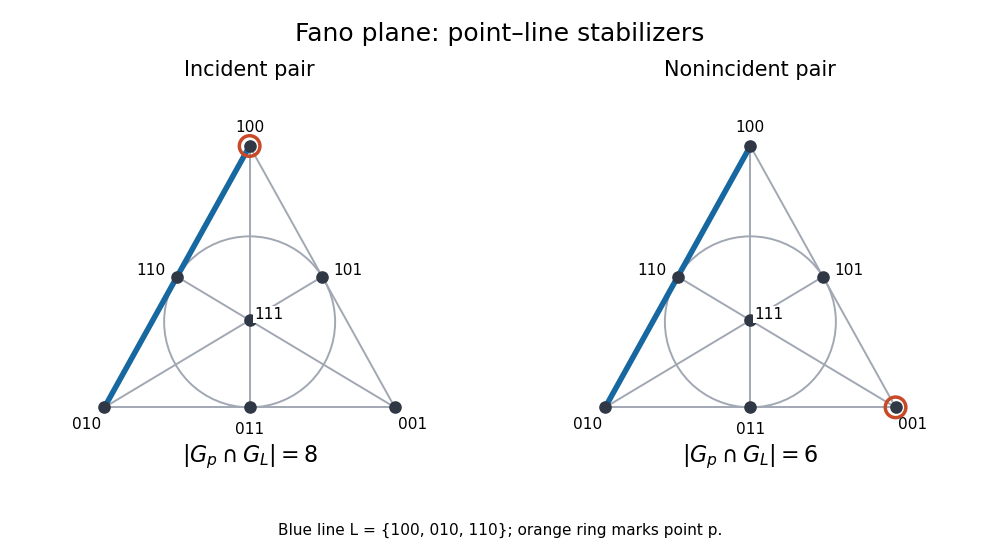
Fano plane with incident and nonincident point-line pairs
. Details. For the extension, identify vectors and covectors by the standard pairing. The inverse-transpose automorphism exchanges a point with its orthogonal plane and exchanges the two order-24 classes. Thus it is outer. The Fano plane duality group has order 336 and acts on points and lines, preserving incidence while allowing their types to be swapped.
The stabilizer subgroup of an unordered point-line pair has twice the corresponding ordered-pair stabilizer subgroup: some element outside swaps the pair, since duality produces a pair of the same incidence type and is transitive on such pairs. Hence these stabilizer subgroups have orders 16 and 12. Also every outside conjugate of a Sylow 7-subgroup can be moved back by an element of , giving
We prove these exhaust the maximal subgroups other than . Let be such a maximal subgroup and . Since is not contained in , is normal in and . If , part (i) gives a unique Sylow 7-subgroup of . It is characteristic in , hence normalized by . Therefore maximality forces .
Suppose and . The classification argument in part (i) says fixes a point or a line. Because is normal in , an element outside swaps its fixed-point and fixed-line sets, so it fixes at least one of each. WriteFixed lines are kernels of fixed nonzero covectors, since the only nonzero scalar is one. Duality gives , hence .
If , there is a unique fixed point and unique fixed line; preserves their unordered pair. If , put and . For every , contains the plane and lies in the line . Over there is only one nonzero linear map , so has order two. Invertibility forces : for one needs . Thus and are its unique image point and kernel line. These are canonically swapped by duality, so again preserves their unordered incident pair.
If , then has order two, generated by an involutory duality . For any point , the pair is preserved by . Hence lies in an order-12 or order-16 pair stabilizer subgroup and is not maximal. We have exhausted all cases.
The pair stabilizer subgroups are themselves maximal: a proper maximal overgroup is one of the just-listed types, and divisibility excludes orders 12 inside 16 or 42, and 16 inside 12 or 42. The order-42 normalizer is maximal by the unique-Sylow argument. Incidence types give one conjugacy class each; Sylow conjugacy gives one normalizer class. Thus, apart from the normal index-two subgroup ,
Past exam of the mathematics course of the University of Cambridge 2010 iii Paper 4 3 i Solution by Codex 0 Created 2026-10-03 Updated 2026-10-14
Codex 0 Created 2026-10-03 Updated 2026-10-14Work in the finite-group setting. If is maximal in a nonabelian simple , then : otherwise every nonidentity element would generate , forcing a cyclic group of prime order. Choose a minimal normal subgroup of . Every characteristic subgroup of is normal in , so minimality makes a characteristically simple group. Its normalizer contains . By maximality it is or , and the latter would make a nontrivial normal subgroup of the simple group , impossible because . This proves the maximal subgroup normalizer criterion:
For , stabilizer subgroups have order 12. Stabilizer subgroups of a two-element subset have order , and are isomorphic to ; for example . The normalizer of a Sylow 5-subgroup has order 10: its normalizer in has order , and exactly half its permutations are even, since a multiplier of order four on is an odd four-cycle. This gives a dihedral group of order 10.
To prove completeness, an intransitive subgroup either fixes a point, or its orbits on five letters have sizes two and three. It therefore lies in one of the first two types. A transitive proper subgroup has order divisible by 5. Its number of Sylow 5-subgroups is one or six, since has six and the count is modulo 5. A count of six would make , forcing an index-two subgroup and contradicting Simplicity of the alternating group A5. Therefore normalizes its unique Sylow 5-subgroup and lies in the order-ten normalizer.
Stabilizer subgroups are maximal because their index is prime. The order-ten group is transitive and cannot have a larger proper transitive overgroup by the preceding argument. The order-six group has no fixed point, cannot lie in a stabilizer subgroup, and cannot lie in the order-ten type because 3 does not divide 10. Thus all three types are maximal. is transitive on points and on unordered pairs, while Sylow conjugacy handles the normalizers. Consequently
Now let . Choosing independent columns gives . Its simplicity follows from the elementary projective-transvection proof in part 4(i), which does not use this subgroup classification.
A stabilizer subgroup and a plane stabilizer subgroup each have index seven and order 24. To construct the remaining type, identify with and take the Singer cycle of multiplications by nonzero field elements, of order seven. Any linear map commuting with a primitive multiplication commutes with all of , so its centralizer is precisely . A normalizer sends a primitive element to another root of its minimum polynomial, namely . The Frobenius map realizes those three choices. Hence
If for a proper , its Sylow count is one or eight. Eight would make , hence . Its index-three coset action would inject the simple group into : the kernel is normal and cannot be all of . This is impossible. Thus normalizes a unique Sylow 7-subgroup and lies in the order-21 normalizer.
If , its order divides 24. In its action on seven nonzero vectors, an odd orbit has size one or three. A one-point orbit gives a fixed point. If a three-point orbit is collinear, it is the set of nonzero vectors of an invariant plane. If its three vectors are independent, their nonzero sum is fixed by . Thus lies in a point or plane stabilizer subgroup.
The index-seven stabilizer subgroups are maximal, and any proper overgroup of the order-21 normalizer would again have a unique Sylow 7-subgroup and normalize that same subgroup, so the normalizer is maximal too. The point and plane stabilizer subgroups are not conjugate: a stabilizer subgroup fixes a point, whereas a plane stabilizer subgroup is transitive on its three internal points and its four external points, so fixes no point. Each type is one conjugacy class. We have proved maximal subgroups of GL3 over F2:
Pinned article: Introduction to the OurBigBook Project
Welcome to the OurBigBook Project! Our goal is to create the perfect publishing platform for STEM subjects, and get university-level students to write the best free STEM tutorials ever.
Everyone is welcome to create an account and play with the site: ourbigbook.com/go/register. We belive that students themselves can write amazing tutorials, but teachers are welcome too. You can write about anything you want, it doesn't have to be STEM or even educational. Silly test content is very welcome and you won't be penalized in any way. Just keep it legal!
Intro to OurBigBook
. Source. We have two killer features:
- topics: topics group articles by different users with the same title, e.g. here is the topic for the "Fundamental Theorem of Calculus" ourbigbook.com/go/topic/fundamental-theorem-of-calculusArticles of different users are sorted by upvote within each article page. This feature is a bit like:
- a Wikipedia where each user can have their own version of each article
- a Q&A website like Stack Overflow, where multiple people can give their views on a given topic, and the best ones are sorted by upvote. Except you don't need to wait for someone to ask first, and any topic goes, no matter how narrow or broad
This feature makes it possible for readers to find better explanations of any topic created by other writers. And it allows writers to create an explanation in a place that readers might actually find it.
Figure 1. Screenshot of the "Derivative" topic page. View it live at: ourbigbook.com/go/topic/derivativeVideo 2. OurBigBook Web topics demo. Source. - local editing: you can store all your personal knowledge base content locally in a plaintext markup format that can be edited locally and published either:This way you can be sure that even if OurBigBook.com were to go down one day (which we have no plans to do as it is quite cheap to host!), your content will still be perfectly readable as a static site.
- to OurBigBook.com to get awesome multi-user features like topics and likes
- as HTML files to a static website, which you can host yourself for free on many external providers like GitHub Pages, and remain in full control

Figure 2. You can publish local OurBigBook lightweight markup files to either OurBigBook.com or as a static website.
Figure 3. Visual Studio Code extension installation.
Figure 5. . You can also edit articles on the Web editor without installing anything locally. Video 3. Edit locally and publish demo. Source. This shows editing OurBigBook Markup and publishing it using the Visual Studio Code extension. 
- Infinitely deep tables of contents:




All our software is open source and hosted at: github.com/ourbigbook/ourbigbook
Further documentation can be found at: docs.ourbigbook.com
Feel free to reach our to us for any help or suggestions: docs.ourbigbook.com/#contact