
Critical Weierstrass modulus 2026-10-14
For , all frequencies satisfy . At , the increment is . If , the first terms have and contribute at least , while the remaining tail has magnitude at most . This proves a lower modulus of continuity bound of order for small . The inverse theorem for trigonometric approximation supplies the matching upper bound because the positive lacunary trigonometric series has .
The three nonzero half-period classes make the odd derivative of the Weierstrass elliptic function vanish. Their values are distinct: two equal values would force at least four zeros for a function with only one double pole. Thus they are three distinct roots of , whose monic discriminant gives the displayed factor. This lattice discriminant differs by from the normalized modular discriminant for the lattice .
Half-wave plate 2026-10-14
A half-wave plate reverses the relative sign of the two components. For initial linear polarization at angle to the fast axis, the outgoing line is at modulo . The input therefore rotates by .
Quarter-wave plate 2026-10-14
A quarter-wave plate gives a quarter-cycle phase retardation. Equal transmitted wave amplitudes initially in linear polarization at become circular polarization; unequal wave amplitudes generally give elliptical polarization. Reversing the sign reverses the traversal of the same circle.
Phase retardation 2026-10-14
For the overlapping monochromatic wave components, let be the thickness and the vacuum wavelength. Define using the slow and fast refractive indices. With complex amplitude convention , the accumulated slow-minus-fast phase difference isThis is the optical path difference expressed as a wave phase. It is a signed accumulation convention; with the opposite time convention the sign reverses. The outgoing polarization of an electromagnetic wave depends on modulo . Here the positive slow-minus-fast differs from the signed principal-index used in the parent birefringence entry when .
For an original worked example, stipulate at and a uniform thickness . These are design assumptions, not measured material data. The optical path difference is , soIt is a quarter-wave plate. At the same wavelength and refractive indices, doubling to gives , a half-wave plate. A thickness increase changes by , or ; retaining the same birefringence at would instead give for the plate. Real refractive indices also vary with wavelength, so this last calculation explicitly neglects optical dispersion.
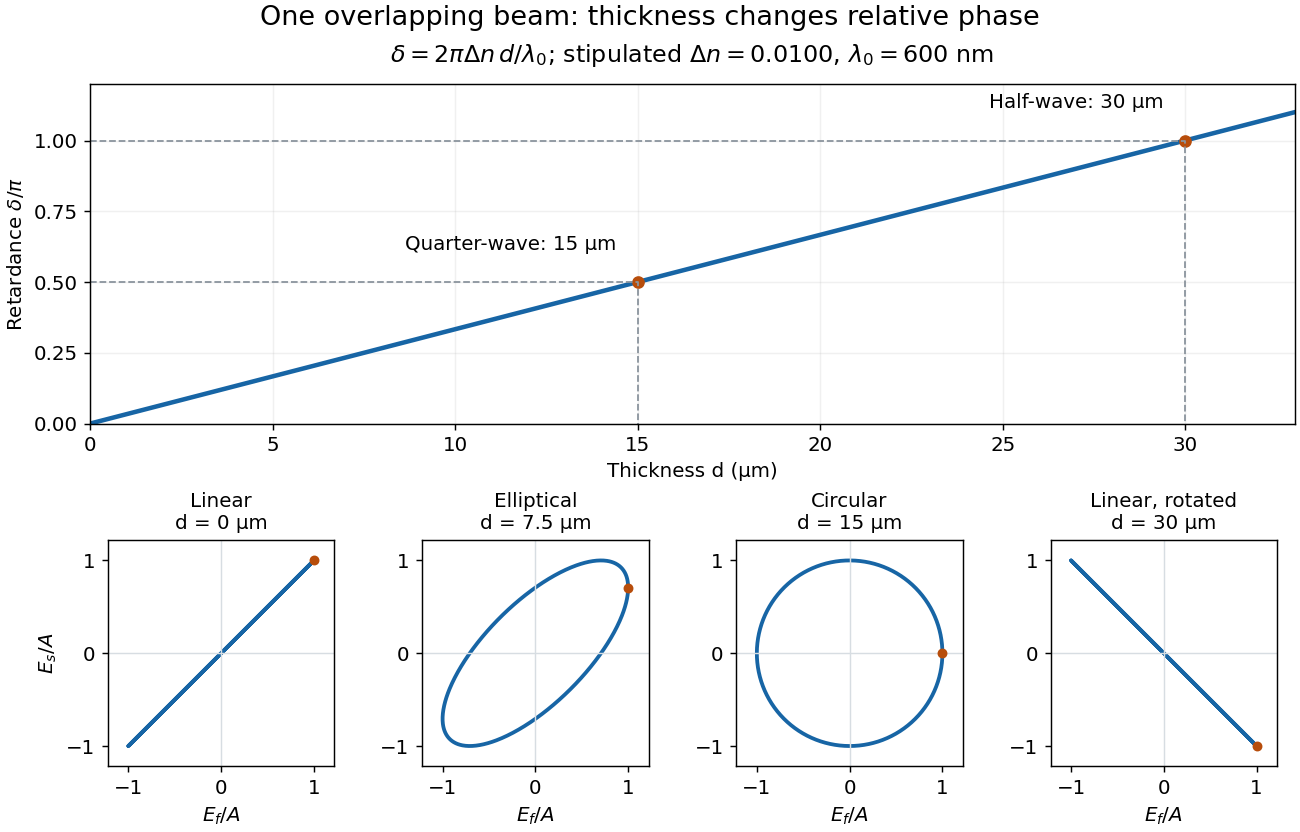
Phase retardation grows with thickness while overlapping components change polarization of an electromagnetic wave
. The stipulated , model gives quarter-wave and half-wave thicknesses of and . Insets trace the normalized electric field at a fixed point for equal fast/slow wave amplitudes, with and . The intermediate ellipse, circle and rotated line require no spatial beam separation. Details.
For these equal transmitted wave amplitudes, orthogonal projection onto a polarizer crossed with the initial linear polarization gives a simple independent readout. After removing a common wave phase, the component complex amplitudes are proportional to ; orthogonal projection onto gives . Squaring its modulus yields : zero at , one half at , and one at . This assumes ideal polarizers, negligible specular reflection and wave absorption, overlapping components and stable relative wave phase. It measures a periodic function of phase retardation, so one brightness measurement cannot determine the thickness uniquely.
Wavelet coefficient thresholding 2026-10-14
Hard thresholding keeps detail coefficients whose magnitude exceeds a prescribed threshold and sets the rest to zero, while retaining the coarse approximation coefficients. Soft thresholding instead uses . The simultaneous wavelet coefficient noise bound motivates thresholds of order in a normalized Gaussian regression model with at most order details. This is a nonlinear selection rule: coefficients can be removed individually rather than discarding an entire finest resolution.
Gaussian envelope in a Klein-Gordon medium 2026-10-14
For the stipulated Klein-Gordon packet velocities, take the original normalized spectral amplitudewith and . Here is the width of the spectral amplitude, not the standard deviation of its squared magnitude. Initially , a Gaussian function multiplying a carrier wave. Taking gives a real solution of the Klein-Gordon equation with the corresponding initial velocity. The tiny negative- tail is retained in this exact integral; the statement that it is mainly right-going is a narrow-spectrum approximation, not a claim of strictly positive wavenumbers.
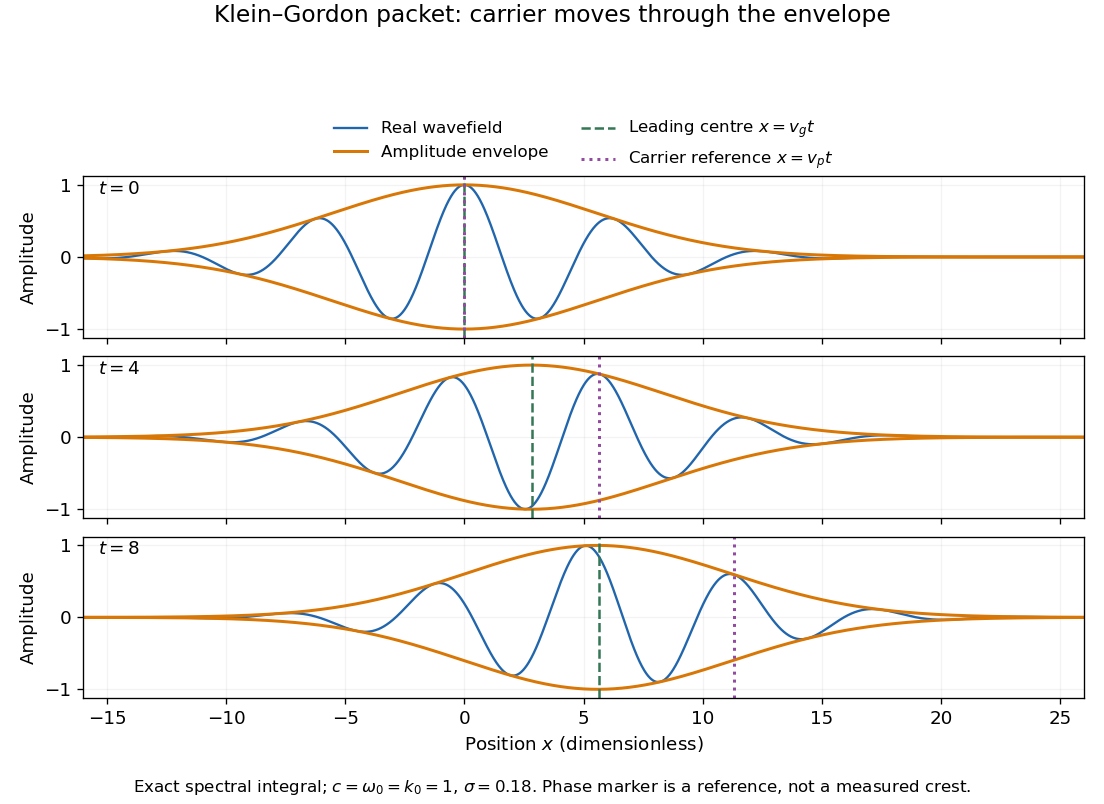
Original Klein-Gordon packet evolution: exact spectral integral, slower envelope and carrier phase reference
. Details. 
The dimensionless figure uses and at . Blue curves are , orange bounds are , and the marked carrier wave reference is ; it need not be a crest of the full wavefield. The dashed envelope-centre reference is a leading approximation. These are calculated curves, not experimental records. The exact dispersion relation makes the packet slightly asymmetric; a quadratic approximation predicts symmetric broadening about .
The first-order Taylor expansion translates the initial wave envelope without changing its shape. Retaining curvature instead givesThe distinction between translation and curvature-driven spreading is the same one exposed by the Gaussian pulse calculation in Pulse Propagation by Richard Fitzpatrick (equations 9.8–9.18). Its first-order approximation is not an assertion that a dispersive packet keeps its shape indefinitely.
Evaluating the quadratic Gaussian integral gives the original approximationand henceHere is the amplitude width: the standard deviation of the normalized intensity is . The peak falls as the packet widens, while stays constant. This conserved integral is not the complete physical wave energy of the Klein-Gordon equation.
Rigid translation requires . The quadratic approximation can allow that quantity to be order one, but still requires the accumulated neglected cubic wave phase to be small over the appreciable spectrum, for example . This sufficient check controls only the stated three-width spectral window; the Gaussian tails must also be negligible at the required accuracy. Higher derivatives or very long times require returning to the exact spectral integral. The width is therefore a controlled local approximation; it neither predicts front velocity nor establishes a universal identity between group velocity and information velocity.
Carrier wave 2026-10-14
A carrier wave is the rapid reference oscillation in a modulated wave. In the narrow-packet representation , choose near the centre of the frequency spectrum and on its dispersion relation. Its constant-wave phase reference moves at phase velocity . This reference need not coincide with a local maximum of the complete real wavefield when the wave envelope varies. Moving the reference shifts some slow wave phase into without changing .
Envelope (waves) 2026-10-14
A wave envelope is a slowly varying wave amplitude multiplying a rapidly oscillating carrier wave. For a complex wavefield , its nonnegative amplitude envelope is ; the complex can also encode a slowly varying wave phase. This choice distinguishes the amplitude envelope from a signed modulation factor, such as the cosine factor in a two-tone superposition. A slowly varying wave envelope is useful when the carrier's wavelength and period are short compared with its variation scales. Strong overlap between distinct packets or a broad frequency spectrum can spoil a unique carrier-envelope interpretation.
An ice-bearing plume at local liquidus equilibrium conserves excess enthalpy and salt relative to the ambient liquidus water. Eliminating its temperature and brine composition gives . To dilute-crystal order this fixes its advected ice volume, hence its leading buoyancy flux. A positive rising branch needs a positive source invariant.
Melting-driven saline wall plume 2026-10-14
A glacier supplies fresh meltwater at speed to a rising wall line plume whose buoyancy is dominated by salinity. With one entraining edge, entrainment coefficient , volume flux and negligible wall stress, and . Enthalpy and salt balances give and . If latent heat dominates and entrainment dominates the volume supply, integration from a virtual origin and power-law balance give the displayed width and speed. The temperature and salinity deficits are and , both proportional to . The approximation is a far-field plume solution, not a solution at the virtual origin.
In a nearest-neighbor voter model on the square lattice, any two ancestral coalescing random walks meet almost surely. For an invariant probability measure of a Markov process, the disagreement probability is constant in time but bounded by the vanishing probability of noncoalescence. Hence every pair of sites agrees almost surely. Countability concentrates the measure on the two constant configurations; both are absorbing state, so every mixture of their Dirac measures is invariant. Translation invariance need not be assumed.
If the initial one-spin set is finite on the square lattice, voter-model duality gives . The transition probabilities tend to zero on this infinite lattice; their Fourier transform also proves the limit of a sequence by dominated convergence. A union bound on any finite set of observation sites then proves weak convergence of probability measures to the all-zero point mass in the product topology.
Kaplansky density theorem 2026-10-14
For a unital star-subalgebra , its unit ball is dense in the unit ball of in the strong operator topology. The same holds for self-adjoint unit balls and for positive unit balls, and the full unit balls may be approximated strongly together with their adjoints. Passing first to the norm closure allows continuous functional calculus; resolvent identities prove strong continuity of continuous functions vanishing at infinity, even for unbounded approximating nets of self-adjoint operators. A cutoff function supplies the norm bound, and a two-by-two self-adjoint matrix removes the self-adjoint restriction.
Virasoro generator 2026-10-14
Virasoro generators are the contour modes of the holomorphic stress tensor in a two-dimensional conformal field theory. Their commutators are . A contour around an operator insertion extracts the corresponding coefficient of its stress-tensor operator product expansion. generates translations, measures holomorphic weight, and all positive generators annihilate a primary state. An independent antiholomorphic copy acts on the other weight.
Unitary Virasoro discrete series 2026-10-14
An irreducible unitary highest weight module of the Virasoro algebra with has integer , , , and the displayed weights. Labels and represent the same module. It is obtained from the Verma module by quotienting its zero-norm submodules; the two generating singular-vector levels are and . For this is the trivial module. For , the three weights are , , .
Sugawara construction 2026-10-14
For a restricted representation of an affine current algebra with and , the displayed normal ordering construction is defined when . Moving the currents past each other gives ; the additional in the denominator is the adjoint-Casimir reordering term. The resulting Virasoro algebra has central charge . On a compact unitary positive-energy module, .
Unitary highest-weight Virasoro module 2026-10-14
A unitary highest-weight Virasoro module is generated by a normalized vector satisfying the displayed relations, with a positive-definite inner product and . Its Virasoro descendants have eigenvalues for nonnegative integral levels . The commutator gives , so unitarity requires . Such a module is a quotient of a Virasoro Verma module; its Unitary Virasoro discrete series describes the cases with central charge below one.
Virasoro Verma module 2026-10-14
The Virasoro Verma module is the universal highest-weight representation with central charge and ground weight . The Poincaré-Birkhoff-Witt theorem gives a basis with . Its invariant Hermitian form is fixed by and the norm of the ground vector. Quotienting by its maximal proper submodule produces the irreducible highest-weight module; in the unitary cases this removes the null vectors.
Virasoro character 2026-10-14
A Virasoro character records the graded dimensions of a positive-energy Virasoro algebra module. A state of weight contributes , and its multiplicity is the dimension of that energy eigenspace. The shift accounts for the Casimir energy of a two-dimensional conformal field theory. For a Virasoro Verma module, the character is , by counting the ordered descendant basis.
There are unlisted articles, also show them or only show them.