
Topological quantum matter Created 2026-09-24 Updated 2026-10-18
Topological quantum matter has robust low-energy properties controlled by global topology rather than local order parameters.
The central question is which quantum states can be joined by a smooth change of a local Hamiltonian while keeping a nonzero bulk spectral gap. A Chern insulator makes this question concrete: two band insulators can have different integer Chern numbers, forcing a gap closure between them. The Haldane phase supplies a one-dimensional example in which a protecting symmetry matters. These are distinct from intrinsic topological order, with its anyons and topology-dependent ground-state degeneracy. The Berezinskii–Kosterlitz–Thouless transition concerns a separate mechanism involving vortices; topology organizes more than one kind of physical phenomenon.
Hadamard basis Created 2026-09-24 Updated 2026-11-05
The Hadamard basis is an orthonormal basis of one qubit consisting of the two eigenstates of the Pauli X gate.
The two states have the same computational-basis measurement probabilities, but opposite relative signs. A Hadamard gate maps them to and , so applying it before a computational-basis measurement distinguishes the states. Relative phase is therefore physically accessible even when one chosen measurement has identical outcome probabilities. [ref]
Qiskit quantum gate documentation by IBM. IBM Quantum, HGate: interchange of computational and plus/minus bases
Partial trace Created 2026-09-24 Updated 2026-11-05
The partial trace over is the linear operation characterized byApplied to a density operator, it produces a reduced density matrix.
Pure state Created 2026-09-24 Updated 2026-11-05
A pure quantum state is represented by a unit vector up to global phase, or equivalently by the rank-one density operator .
Quantum gravity Created 2026-09-24 Updated 2026-11-05
Quantum gravity seeks a consistent quantum description of gravitational dynamics, including regimes where treating spacetime geometry as a prescribed classical background is insufficient. The issue is not merely adding a gravitational potential to a nonrelativistic Schrödinger equation: the gravitational field itself can require quantum degrees of freedom and backreaction.
Weak-field perturbation theory describes a spin-two graviton, while string theory supplies a framework with a richer spectrum. A candidate theory must reproduce established classical gravity in its appropriate limit and make quantum predictions with a controlled domain of validity. Semiclassical gravity instead sources a classical field by a quantum expectation value; it is a distinct approximation whose success for some observables does not establish a full quantum theory of geometry.
Foundations of quantum mechanics Created 2026-09-24 Updated 2026-11-05
The foundations of quantum mechanics study the physical meaning and consistency of quantum states, quantum measurement, unitary time evolution and correlations between systems. The aim is to connect precise mathematical rules with claims about preparation, observation and physical reality.
The measurement problem can be seen in a simple model. An initial quantum superposition interacting unitarily with a record givesIf the record states are orthogonal, the system's reduced density matrix is diagonal with weights . This explains suppression of observable interference, while the relation between the joint state and an individual recorded outcome remains a foundational question. Quantum decoherence, the many-worlds interpretation and de Broglie-Bohm theory address different parts of this problem.
John Stewart Bell made a separate question experimentally sharp. In his singlet-pair model, local hidden-variable response functions cannot reproduce all the quantum spin correlations. A Bell test compares measured correlations across analyzer settings with the appropriate Bell inequality. [ref]
On the Einstein Podolsky Rosen paradox by John Stewart Bell. Sections II–IV, spin-singlet setup, local response functions and contradiction
Interpreting such a test requires attention to measurement independence and sampling assumptions. Quantum nonlocality concerns these joint probabilities and is compatible with quantum no-signalling. Quantum decoherence Created 2026-09-24 Updated 2026-11-05
Quantum decoherence is the suppression of observable quantum phase relations through interaction with unobserved degrees of freedom. A simple model starts with and correlates the alternatives with environmental states:Taking the partial trace multiplies the off-diagonal entry of the reduced density matrix by . If the environmental records become nearly orthogonal, interference between the two alternatives becomes locally inaccessible even though the joint state can remain pure.
Preserving diagonal populations is a property of dephasing, not a general requirement for quantum decoherence. An amplitude damping channel, for example, changes an excited-state population as while suppressing coherence as . Thus energy relaxation and quantum decoherence can occur together, with different rates. Pure dephasing instead preserves populations in its selected pointer basis.[ref]
Quantum information theory Created 2026-09-24 Updated 2026-10-13
Quantum information theory asks what can be stored, learned, transmitted, and protected when information is carried by quantum states. Its basic objects are density operators, measurement in quantum measurements, and quantum channels; its resources include qubits, entanglement, and classical communication. Specifying the task matters: preserving an unknown quantum state, recovering a classical bit, and estimating a probability amplitude are different demands on the same physical system.
A particularly beautiful feature is that knowing the whole need not mean knowing its parts. A Bell state is a completely specified pure state, yet either qubit alone has a maximally uncertain reduced density matrix. Conversely, two systems can share perfectly matching measurement records without entanglement. The worked Bell correlations versus a classical mixture comparison separates these possibilities using only two choices of Pauli measurement.
This viewpoint makes limitations useful design rules. Schumacher compression asks how much quantum memory a source needs; Holevo's theorem limits the classical information extractable from an encoding; quantum error correction protects states against noise. Quantum teleportation uses shared entanglement and classical communication to transfer an unknown state. Its resource accounting respects both quantum no-signalling and the no-cloning theorem.
Maximally entangled state Created 2026-09-24 Updated 2026-11-05
A bipartite pure state is maximally entangled when its Schmidt coefficients are all equal across the smaller subsystem dimension. For equal local dimensions , a standard example isBoth reduced density operators are and the entanglement entropy is . Local unitary transformations give other states with the same entanglement.
When subsystem dimensions differ, only the smaller subsystem can have a full-space maximally mixed reduction. The larger reduction has equal nonzero eigenvalues on its Schmidt support and additional zeros. Thus “either reduction is maximally mixed” requires an equal-dimension or support qualification. A Bell state is the two-qubit case and supplies a standard resource for teleportation.
Born rule for a product-basis measurement Created 2026-09-24 Updated 2026-11-05
Measurement of a Pauli observable Created 2026-09-24 Updated 2026-11-05
The expectation of a Hermitian Pauli string can be obtained by basis rotation and measurement, or by a Hadamard test with the Pauli string as its controlled unitary.
Parallel quantum gates Created 2026-09-24 Updated 2026-09-24
Controlled unitary gate Created 2026-09-24 Updated 2026-11-05
A controlled unitary gate applies a unitary operator to a target system when a control qubit is , and leaves the target unchanged when the control is :For a coherent control, linearity givesThe control has not been measured; the output may be entangled. The controlled-unitary entangling criterion states exactly when some product input becomes entangled.
The global phase of a controlled quantum gate matters: if , then acts as a phase gate on the control. A phase invisible on the isolated target is a relative phase between control branches. [ref]
Qiskit quantum gate documentation by IBM. ControlledGate, conditional base operation and control labels; the coherent-state formula follows by linearity
Inverse quantum circuit Created 2026-09-24 Updated 2026-09-24
The inverse of a quantum circuit applies the adjoints of its gates in reverse temporal order. The Hadamard gate, Pauli Z gate, and controlled-NOT gate are each self-inverse.
Pauli X gate Created 2026-09-24 Updated 2026-11-05
The Pauli gate interchanges and .
Pauli Z gate Created 2026-09-24 Updated 2026-11-05
Hadamard gate Created 2026-09-24 Updated 2026-10-20
The Hadamard gate is the unitary operatorwhere is the identity operator. It maps the computational basis to the Hadamard basis:
These outputs have equal computational-basis measurement probabilities, but their relative quantum phase differs. Applying another Hadamard gate sends them to different definite outputs. Calling this gate a classical coin toss would discard precisely the information that makes this possible. [ref]
https://quantum.cloud.ibm.com/learning/en/courses/basics-of-quantum-information/single-systems/quantum-information. Watrous, IBM Quantum Learning, unitary operations on qubits
.Starting from , compare two quantum circuits, reading matrix products from right to left:Here is the Pauli Z gate. After the first Hadamard gate, the probability amplitudes are . Inserting changes them to without changing their squared magnitudes. At the final gate, the contributions to output zero cancel and those to output one add. Without , cancellation occurs at output one instead. This is controlled interference, with the quantum phase determining which answer emerges.
The same calculation works for any phase gate :For example, gives , while gives . The output-one amplitude at is : its two complex contributions add before the Born rule is applied. A phase gate alone leaves the populations unchanged; recombination converts its relative quantum phase into observable probabilities.
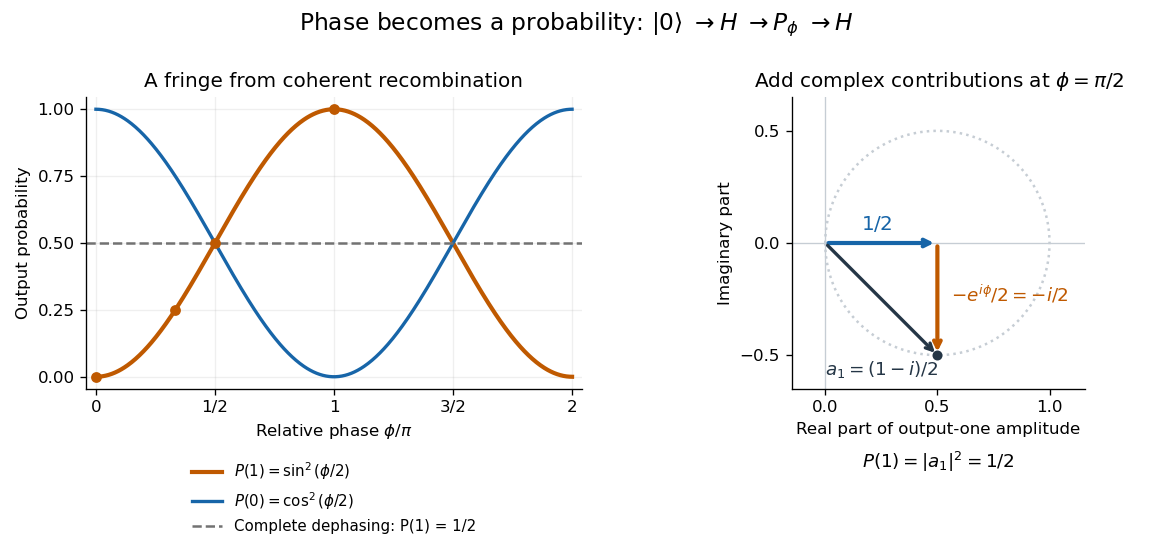
Hadamard interference: a relative phase changes output probabilities through complex amplitude addition; the dotted circle traces the output-one amplitude as the phase varies
. Details. 
If quantum decoherence completely removes the computational basis coherence between the gates, the intermediate density matrix becomes . Both the phase gate and final Hadamard gate leave unchanged, so for every . The disappearing fringe explains why preserving quantum coherence matters: it enables the gate sequence to carry phase information into the final measurement.
Landau level Created 2026-09-24 Updated 2026-11-05
A Landau level is a quantized cyclotron-energy level of a charged particle in a uniform magnetic field. For a nonrelativistic particle with charge and mass , the transverse orbital energies areDifferent guiding-center positions share the same orbital energy. Their bulk degeneracy per unit perpendicular area is before separate spin counting.
In three dimensions, free motion along the field adds a longitudinal kinetic energy, while spin and material band structure can modify the spectrum. Sweeping field changes both spacing and degeneracy, moving levels through the Fermi energy and producing quantum oscillations. Disorder broadening and localization distinguish ideal sharp levels from the measured transport features in a real sample.
Variational method Created 2026-09-24 Updated 2026-10-13
The variational method estimates the lowest energy of a Quantum Hamiltonian by choosing a trial wavefunction, evaluating its energy, and optimizing the trial parameters. It uses the quantum variational principle, the Rayleigh-Ritz variational principle expressed for quantum states. Let be a self-adjoint operator bounded below, and define , the bottom of its spectrum. Every normalized admissible trial quantum state satisfiesWhen is an energy eigenvalue, it is the ground-state energy; equality holds precisely for a quantum state in the ground-state subspace. Otherwise the bottom of the spectrum need not be attained by any normalizable wavefunction.
Admissible means finite form energy. Choose a real and use the shifted quadratic form of a positive quantum Hamiltonian:The form domain is independent of this choice of and can be larger than the operator domain . For , is the usual expectation value; for nonzero unnormalized trials, divide by to get the form version of the Rayleigh quotient. See the quantum variational principle for the general domain justification.
Thus each trial energy is an upper bound on , and minimizing within a trial family improves that upper bound. It is not a lower bound on . The Gaussian variational energy for the harmonic oscillator reaches because its family contains an exact ground state. The exact variational solution in a two-level system makes the equality condition visible as vanishing excited-state probability amplitude.
The method is useful when solving the Schrödinger equation exactly is difficult but integrals of a trial wavefunction are tractable. Enlarging a trial family cannot increase its optimal energy, although an optimum need not be attained. The beauty is that even an imperfect trial gives a rigorous bound, provided its form energy is computed exactly: numerical integration errors require separate control. The Gaussian variational estimate for a solvable sextic potential provides an existing example beyond a quantum harmonic oscillator.
A short proof explains the direction. With a complete orthonormal eigenbasis of energy eigenstates, write , where and . ThenThis is a weighted mean of nonnegative energy differences; equality requires every occupied energy eigenstate to have energy . [ref]
https://ocw.mit.edu/courses/8-05-quantum-physics-ii-fall-2013/61bc31b8d8bf0680c322733910a71aa0_MIT8_05F13_Chap_01.pdf. Barton Zwiebach, Wave Mechanics, MIT 8.05, 2013, §5, pp. 18–20
. For continuous spectrum, the spectral theorem replaces the sum by an integral against the scalar spectral measure of , with the same nonnegative integrand. This proves the bound without assuming an orthonormal eigenbasis exists.The historical setting predates quantum mechanics: Rayleigh's The Theory of Sound, volume I, appeared in 1877, and Ritz's paper on solving variational problems of mathematical physics appeared in volume 135 of Crelle's journal, catalogued by its publisher as 1909, pp. 1–61. These are original works associated with the Rayleigh-Ritz method; the dates here identify the publications rather than assert priority. [ref]
https://archive.org/details/theorysound06raylgoog. Lord Rayleigh, The Theory of Sound, volume I, 1877
; [ref]https://doi.org/10.1515/crll.1909.135.1. Walter Ritz, Über eine neue Methode zur Lösung gewisser Variationsprobleme der mathematischen Physik, original article and publisher metadata
. Bell state Created 2026-09-24 Updated 2026-11-05
A Bell state is one of four maximally entangled states forming an orthonormal basis for two qubits:Each qubit alone has reduced density matrix , giving equal probabilities for outcomes in any orthonormal measurement basis. The joint state nevertheless has definite correlations; for , computational-basis outcomes always agree.
A separable quantum state can imitate those same computational-basis correlations. The distinction appears in complementary measurements: the coherent relative phase between and controls correlations in the Hadamard basis. Bell states are therefore resources for quantum teleportation and useful tests of quantum entanglement, rather than merely pairs with correlated classical bits.
There are unlisted articles, also show them or only show them.