
Degenerate perturbation theory Created 2026-09-24 Updated 2026-11-05
Degenerate perturbation theory treats a perturbation of an energy eigenvalue shared by several independent quantum states. Ordinary nondegenerate formulas contain vanishing energy denominators in this situation. Instead, for the orthogonal projection onto that eigenspace, diagonalize within the eigenspace before treating coupling to other levels.
Its eigenvalues are the first-order energy shifts, and its eigenvectors choose combinations with a well-defined leading response. For a two-state block , the shifts are : zero diagonal entries in the original basis do not imply zero shifts. Coupling to states outside the block enters at higher order when their energy separations remain large compared with the perturbation. This method explains how a weak field or broken symmetry splits a degenerate energy level.
Time-independent perturbation theory Created 2026-09-24 Updated 2026-11-05
Time-independent perturbation theory expands the eigenvalues and eigenstates of in powers of a small perturbation .
This is the stationary branch of perturbation theory.
Time-dependent perturbation theory Created 2026-09-24 Updated 2026-11-05
Expanding a state in unperturbed energy eigenstates with their free phases converts the time-dependent Schrodinger equation into coupled equations for slowly varying amplitudes. To first order, the perturbation on the right-hand side acts on the initial unperturbed state.
This is the time-dependent branch of perturbation theory; its corrections describe transition amplitudes.
Tensor product of quantum systems Created 2026-09-24 Updated 2026-11-05
Two specified quantum subsystems have a joint Hilbert space . A local observable acts as or , while product vectors describe independent pure preparations.
A general joint state need not be a product. The Bell state has perfectly correlated computational-basis measurements and mixed reduced states, illustrating quantum entanglement. Interaction terms can couple the factors, so a tensor-product kinematic description does not imply a decoupled Hamiltonian. For noninteracting subsystems, the special form gives additive energies and product time evolution. Identical-particle descriptions additionally impose the appropriate exchange symmetry on the full state.
Fermi oscillator Created 2026-09-24 Updated 2026-11-05
A Fermi oscillator has nilpotent lowering operator , anticommutator , and occupation Hamiltonian with levels zero and one.
Two-dimensional isotropic harmonic oscillator Created 2026-09-24 Updated 2026-11-05
Three-dimensional isotropic harmonic oscillator Created 2026-09-24 Updated 2026-11-05
The three-dimensional isotropic harmonic oscillator has the same oscillator angular frequency in all three directions:The three independent quantum harmonic oscillators give energy eigenvalues , where and the three occupation numbers are nonnegative integers. The zero-point energy is the sum of the three one-dimensional contributions.
For fixed , choosing all triples gives energy-level degeneracy . For example, has the three excitations , and . Anisotropic oscillator frequencies generally split this degeneracy. The model is useful near a rotationally symmetric minimum of a smooth three-dimensional potential energy.
Quantum harmonic oscillator Created 2026-09-24 Updated 2026-10-13
The quantum harmonic oscillator describes a particle of mass in a quadratic potential energy with angular frequency . In the position representation its Quantum Hamiltonian isThe model is useful far beyond a literal spring: a Taylor series about a stable equilibrium with positive potential curvature has this quadratic term as its leading nonconstant approximation. The pure quartic oscillator has zero curvature at its minimum, so that particular approximation does not apply. [ref].
In units with , creation and annihilation operators giveHere is the number operator. Restoring the reduced Planck constant, the energy eigenvalues are for : neighboring levels are separated by , and the ground-state energy is the zero-point energy .
With length scale and dimensionless coordinate , the ground state is the normalized Gaussian wave packetFor , this is precisely the trial wavefunction in the quantum variational principle. The balance of kinetic energy and potential energy therefore recovers the exact ground-state energy using only Gaussian integrals.
Orbital angular momentum Created 2026-09-24 Updated 2026-11-05
Orbital angular momentum is the quantum counterpart of . In the position representation in quantum mechanics,Its components generate rotations of the spatial wavefunction. For a three-dimensional scalar wavefunction, simultaneous eigenstates of and have eigenvalues and , with integer and .
For a central potential energy, the angular factors are spherical harmonics, and orbital angular momentum organizes the energy eigenstates into rotational multiplets. It differs from spin, which is an intrinsic degree of freedom rather than angular dependence of a scalar spatial wavefunction. The angular momentum operators obey the same rotation algebra in both cases.
Infinite square well Created 2026-09-24 Updated 2026-10-20
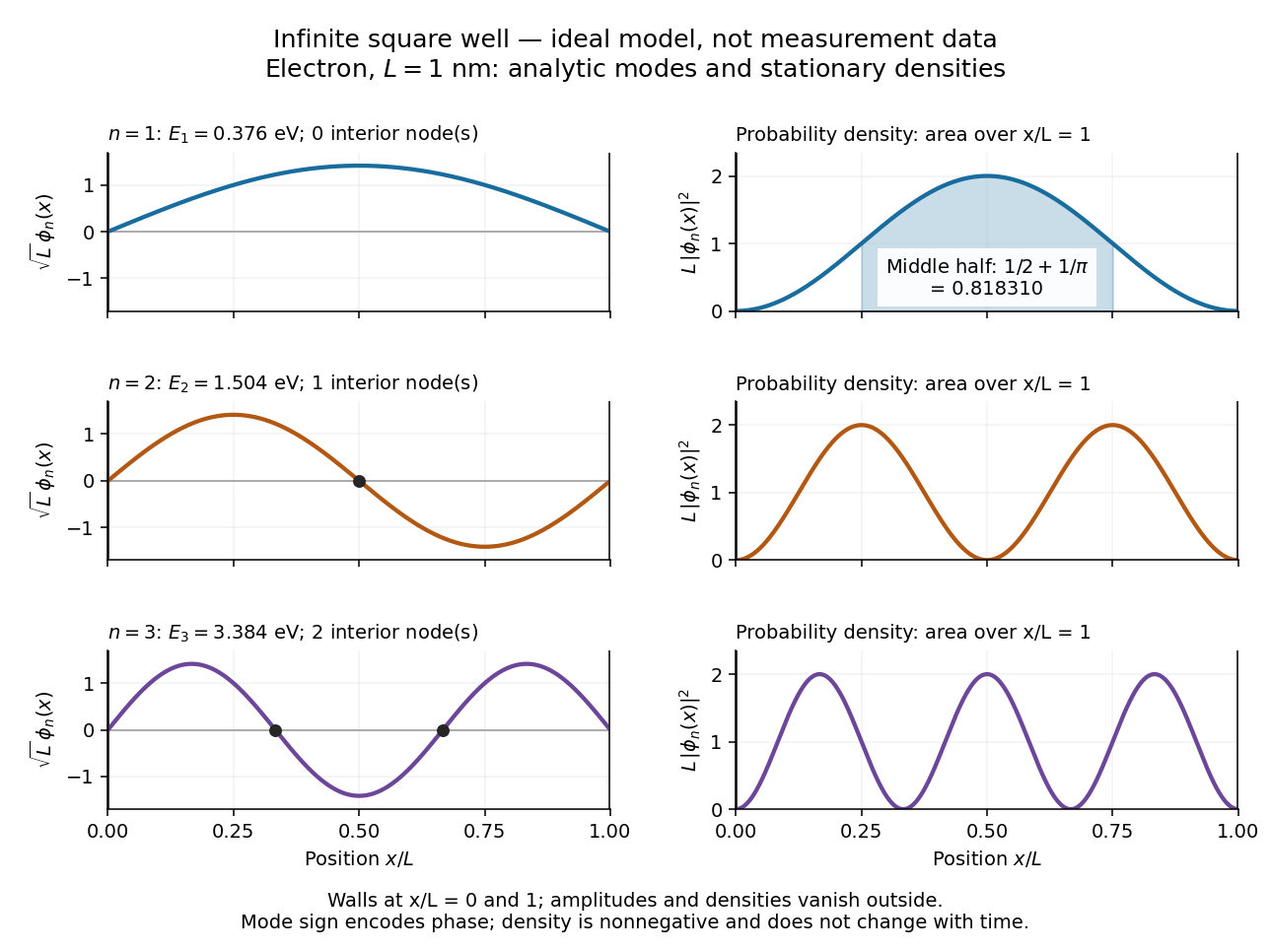
The infinite square well is an ideal confinement model with potential energy for and infinite walls outside. The walls impose Dirichlet boundary conditions and a vanishing exterior wavefunction. Inside, the time-independent Schrödinger equation isThe first wall removes the cosine term; the second requires , hence . The solution is identically zero and cannot satisfy wavefunction normalization. Each energy eigenstate has interior nodes of a standing wave, at for . More curvature costs more kinetic energy, explaining the growth. The positive ground-state energy is a confinement effect: a constant zero-energy wavefunction cannot satisfy both walls and remain normalized.
For an electron with mass in a box of length , use and . These constants are from the 2022 CODATA adjustment. [ref]. Substitution givesDoubling quarters every energy eigenvalue; doubling halves them. This scaling makes the particle in a box useful for estimating confinement energies before attempting a more realistic calculation. A finite square well permits exterior tails for bound states and has only finitely many bound energy eigenstates. For an electron, the scalar box calculation assumes fixed spin and no spin-dependent interactions.
For the ground state, the probability of finding the particle in the middle half of the box is fully computable:Thus half the available length contains about of the probability. The figure contrasts the signed wavefunctions with their nonnegative probability densities: a negative lobe is an amplitude with opposite quantum phase, not negative probability.
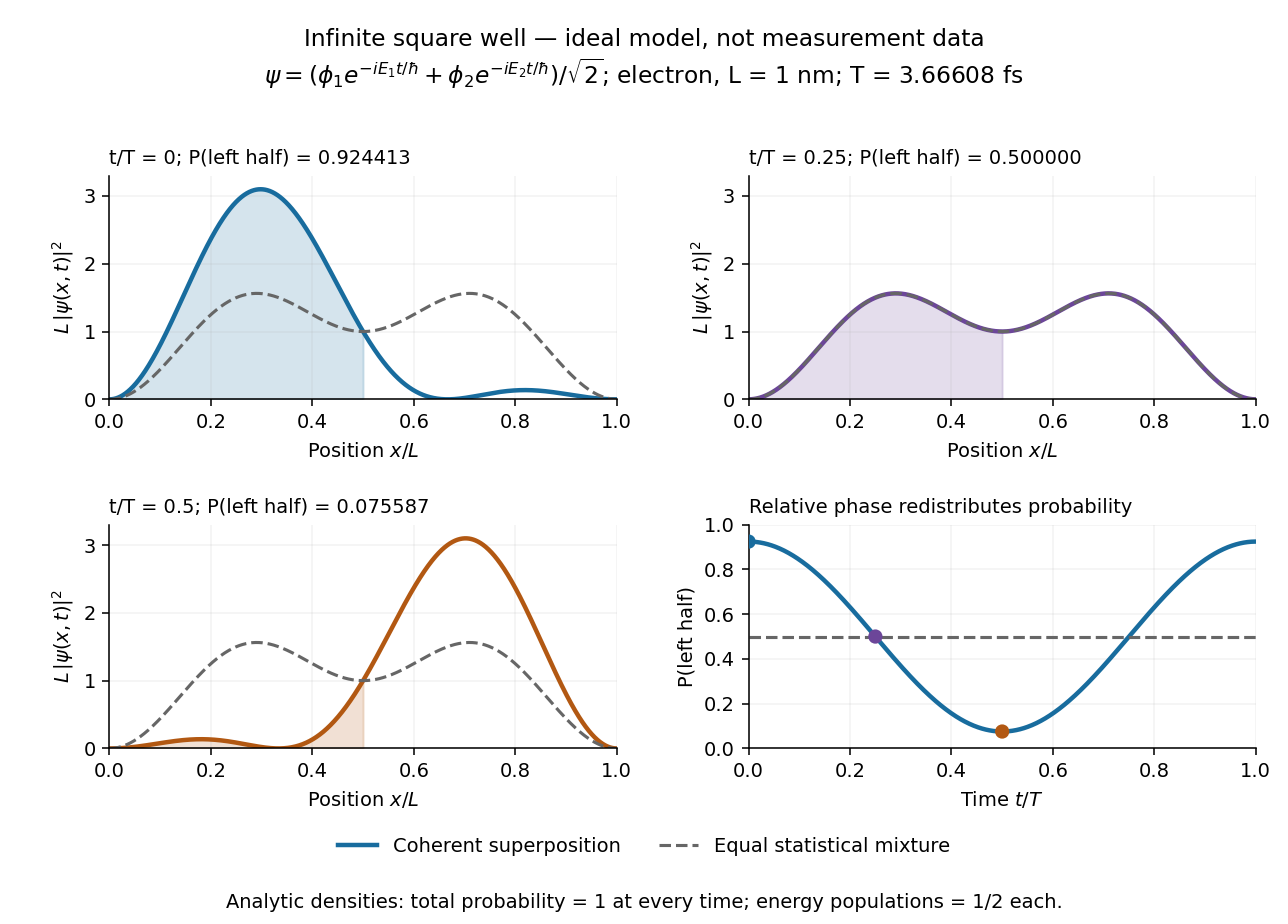
An equal quantum superposition of the first two energy eigenstates gives a simple example of moving density:Its density period is for the electron box above. At the cross term enhances the left side; at it vanishes; at it enhances the right side. More quantitatively,which takes the values , , and at those times. Orthogonality keeps the total probability one throughout. An energy measurement still returns or with equal probabilities: changing position density arises from relative quantum phase, not changing populations. A mixed state describing a statistical mixture with those populations has the constant probability density ; it lacks this matter-wave interference term.


Angular momentum operator Created 2026-09-24 Updated 2026-11-05
An angular momentum operator generates rotations of a quantum state. Its three components satisfyand cyclic permutations. Since distinct components do not commute, a state generally cannot have definite values of all three at once. The total commutes with every component, allowing simultaneous eigenstates of and one chosen projection.
Their eigenvalues are and , where . The quantization axis fixes which projection is labeled. Orbital angular momentum has integer for a scalar spatial wavefunction, while spin can have half-integer . Combining electronic and nuclear angular momenta explains hyperfine structure; a Stern-Gerlach experiment makes discrete magnetic projections visible by spatially separating different responses to a field gradient.
Ehrenfest theorem Created 2026-09-24 Updated 2026-11-05
Ehrenfest’s theorem makes expectation values obey Hamiltonian commutator equations analogous to classical motion.
Momentum operator Created 2026-09-24 Updated 2026-11-05
The momentum operator generates spatial translations. In a one-dimensional position representation in quantum mechanics, it acts asApplying it to a plane wave gives momentum eigenvalue , connecting momentum with the de Broglie wavelength. A localized wave packet generally contains several such momenta.
A differential expression alone does not define a self-adjoint operator: its domain and boundary conditions matter. On a periodic interval, the allowed momentum eigenvalues are discrete; on the whole real line they form a continuous spectrum. In a magnetic field, this operator is the canonical momentum. The mechanical momentum entering the kinetic energy is instead in SI units, where is the vector potential.
Position operator Created 2026-09-24 Updated 2026-11-05
The position operator represents a position measurement. In the position representation in quantum mechanics, its one-dimensional action is multiplication, . The Born rule associates an interval with the integral of over that interval, rather than assigning a finite probability to a single point of a continuous distribution.
The expectation value is when that integral exists. Its domain in the Hilbert space of square-integrable wavefunctions requires to be square integrable; a normalized state need not belong to this domain. Together with the momentum operator, the position operator obeys the canonical commutation relation on a suitable common domain, leading to the Heisenberg uncertainty principle.
Reflectionless potential Created 2026-09-24 Updated 2026-11-05
In one-dimensional inverse scattering, its continuous reflection coefficient vanishes and its remaining discrete scattering data reconstruct multisoliton potentials.
Supersymmetric quantum mechanics Created 2026-09-24 Updated 2026-11-05
Supersymmetric quantum mechanics organizes two sectors through an operator and its adjoint operator, with partner Hamiltonians and . An off-diagonal supercharge maps between the sectors, and its anticommutator with its adjoint gives the block Hamiltonian. This makes both partner energies nonnegative.
For a one-dimensional example, in suitable dimensionless units gives partner potentials proportional to and . A positive-energy state of one partner maps to a state of the other with the same energy. Zero modes need not pair, because or can annihilate them; supersymmetric factorization and zero-mode normalizability determines which candidates are actual states.
The method relates apparently different potential problems and isolates the role of boundary conditions. In a geometric realization, differential forms provide the graded Hilbert space and the exterior derivative and its adjoint play the role of supercharges.
Quantum scattering Created 2026-09-24 Updated 2026-11-05
Quantum scattering relates incoming and outgoing states of an interaction problem. For a short-range potential in three dimensions, a stationary asymptotic solution is often written : the incident plane wave and outgoing spherical wave define the scattering amplitude .
For equal incoming/outgoing speeds and the stated normalization, connects that amplitude to detector counts. Phases matter because alternative contributions interfere before their probabilities are formed. A normalizable wave packet supplies a physical incident preparation, while ideal stationary states simplify the asymptotic calculation. Long-range Coulomb interactions require modified asymptotic treatment, and internal excitations create additional channels. Partial-wave scattering uses angular momentum to organize a central-potential problem into simpler radial channels.
Delta potential Created 2026-09-24 Updated 2026-11-05
A one-dimensional delta potential is the point interaction , where has energy times length units. Rather than multiplying ordinary functions at a singular point, one can define it by matching a continuous wavefunction with a derivative jump:Integrating the Schrödinger equation across the origin gives this condition. It provides an exactly solvable model of a very narrow potential barrier for , or a narrow attractive well for . Scattering states are plane waves away from the origin, while the attractive interaction has a single bound state. The formula is specific to one dimension; a naive higher-dimensional Dirac delta function interaction needs additional care.
Finite square well Created 2026-09-24 Updated 2026-11-05
A finite square well has a constant lower potential energy over a finite interval and a higher constant potential outside. For a symmetric well on and outside, a bound state has : the wavefunction oscillates inside and decays exponentially outside.
Continuity of the wavefunction and its derivative at gives for even parity and for odd parity, where and . These conditions select finitely many bound state energies. Unlike an infinite square well, the finite well allows penetration beyond the edges; a shallow one-dimensional attractive well still has an even ground state. Positive-energy scattering states lie above the outside potential.
Second moments of a complex Gaussian wave packet Created 2026-09-24 Updated 2026-11-05
There are unlisted articles, also show them or only show them.