For the ground-state convention gp=1, gH=2, the statistical prefactor 2gp/gH is one. At fixed volumen0 is constant, whereas an isobaric heating process would not have a constant A.
The observed 90∘+30∘ substeps sum to 120∘, consistent with three catalytic cycles per revolution of F1-ATPase. Surface attachment fixes the β-subunit frame while the gold-labelled γ shaft reports relative rotation. A finite dwell before the smaller step indicates hidden chemical transitions rather than a completely smooth motor.
Suppose two irreversible independent first-order transitions, with rates ka and kb, must occur sequentially before the 30∘ step. Their waiting times Xa and Xb have exponential distributions, and τ=Xa+Xb. Convolution gives
This probability density integrates to one and has ⟨τ⟩=ka−1+kb−1. For equal rates its continuous limit is P(τ)=k2τe−kτ, not asingular distribution. In particular P(0)=0 distinguishes two resolved sequential waits from a single exponential wait. Hydrolysis and product release are plausible underlying chemical events, but the waiting-time fit alone neither assigns their order nor uniquely identifies which biochemical eventcauses each substep. Concentration dependence or independent labelling would be needed for that assignment.
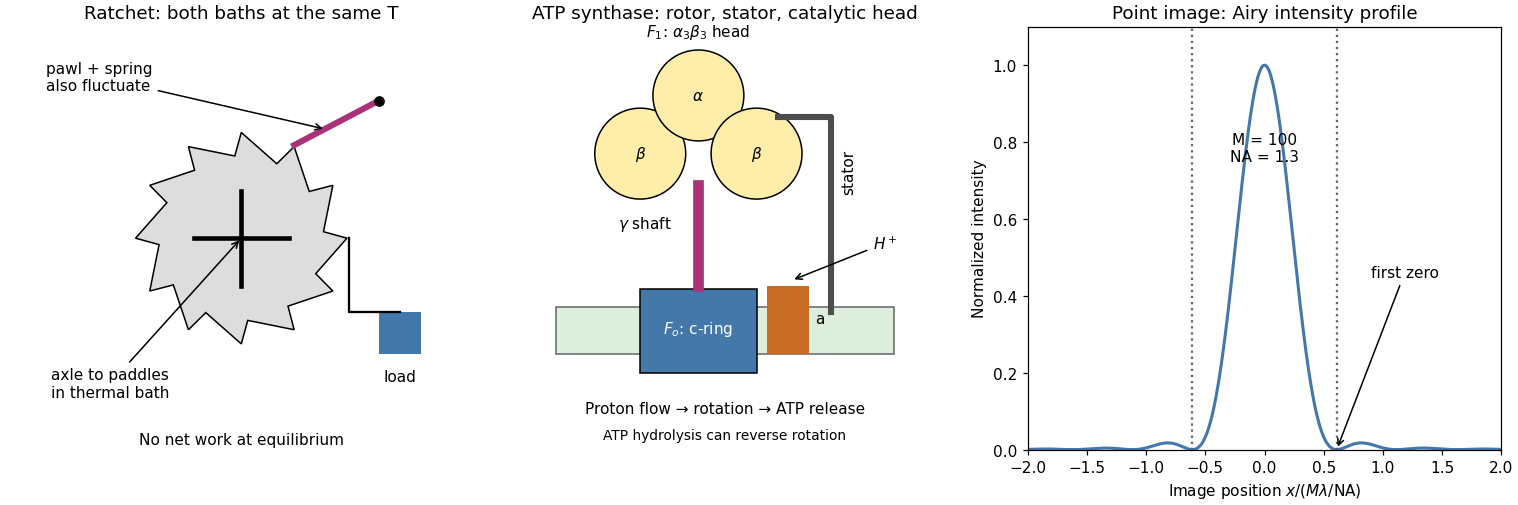
ATP synthasehas a membrane-embedded Fo sector, a catalytic F1 head and mechanical connections between them. The Fo sector contains an ion-conducting subunit a adjoining a rotating ring of c subunits. A central shaft including the γ subunit connects that ring to F1. Aperipheral stator holds the head fixed relative to the membrane. The F1 head has three catalytic β subunits alternating with three α subunits, surrounding the asymmetric central shaft; the middle panel of solution labels these relationships.
The left panel below shows paddles in a bath connected by an axle to an asymmetric toothed wheel, aspring-loaded pawl and a load. A naive argument lets random paddle kicks turn the wheel in one direction while the pawl blocks reverse motion, apparently extracting work from a single bath. The missing ingredient is the pawl's own thermal fluctuations. At the same temperature, it sometimes lifts and allows reverse slips. Correct forward and reverse transition rates obey detailed balance, so no sustained directed rotation can do work at single-bath thermal equilibrium. The device illustrates, rather than disproves, the Second law of thermodynamics.
A macroscopic shaken ratchet is driven far from thermal equilibrium: imposed shaking supplies organized mechanical energy, and friction or inelastic collisions dissipate it. Its kilogram-scale parts are not moved appreciably by molecular thermal fluctuations. Rectification requires broken spatial symmetry from the teeth or pawl and appropriate dynamical coupling: the shaking must sometimes disengage or drive the pawl over atooth while contact and dissipation prevent equal reverse motion. The load must remain below the available meandriving torque. Isotropic, aperiodic shaking can satisfy these conditions because the asymmetric mechanism breaks directional symmetry; without the external energy supply, a working rectifier and dissipation, there is no guaranteed directed motion.
At thermal equilibrium, J=0 and the Boltzmann distribution is p(x)=Z−1e−kx2/(2kBT), with p′/p=−kx/(kBT). Inserting this into the zero-current condition gives
Both arms need expert contemporary planning and comparable quality assurance. Centre experience, changing delivery technology and an obsolete comparison arm can distort results. The chosen endpoint must match the proposed benefit: equal tumour control with lower late toxicity may be valuable even without a survival difference. Statistical power, competing mortality, multiple comparisons and long follow-up are crucial for rare late effects, particularly secondcancers. Blinding of treatment delivery is difficult, so independent endpoint adjudication and predefined analyses help. Economic analyses must state their perspective and include access and follow-up costs.
The optional δ and C/Z represent density and shell corrections. For a very heavy projectile Tmax≃2mec2β2Γ2, and the bracket reduces to ln(2mec2β2Γ2/I)−β2 when those corrections are neglected. If T denotes remaining projectile kinetic energy, the printed dT/(ρdx) is negative; the conventional positive stopping power has the minus sign above.[ref]
Shrink the positive outer contour to the branch cut[−1,1]. On its upper bank the chosen branch of a multivalued function has x2−1=i1−x2 and on the lower bank it has the negative of this value. The upper bank runs from 1 to −1, and the lower bank runs from −1 to 1. The endpoint circles contribute O(ϵ) and vanish. Hence