A uniform-densitymodel gives 3GM2/(10RL)≃9.4×106yr. The given bound fixes a scale, rather than an exact contraction history; both estimates are far shorter than the Sun's main-sequence lifetime.
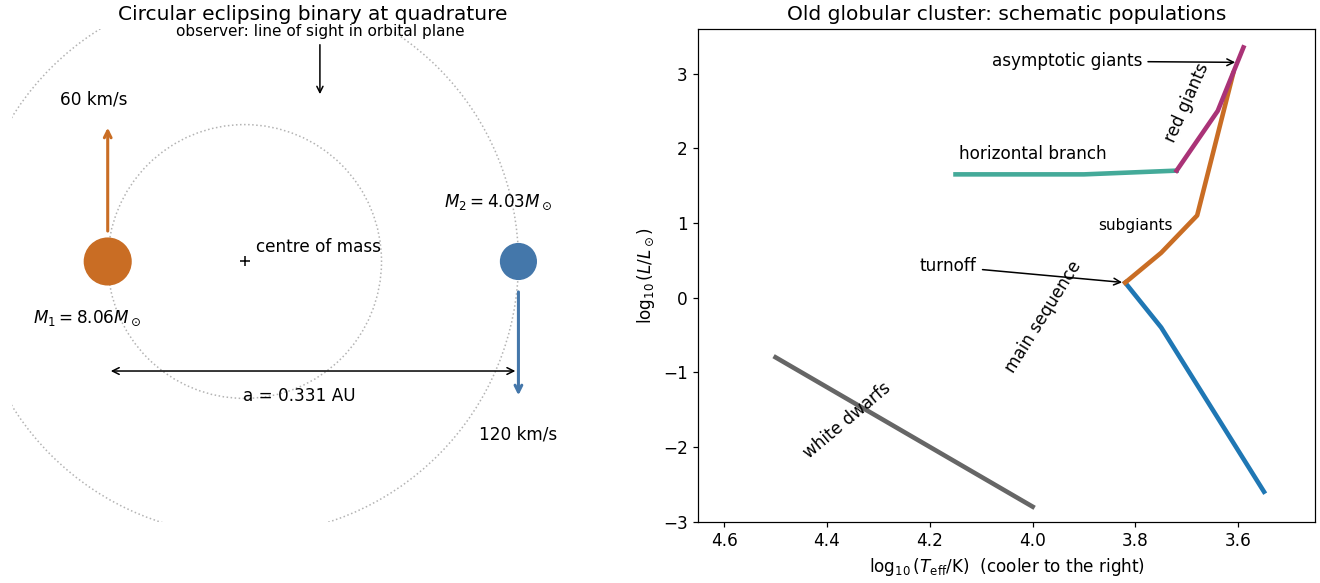
The orbital plane contains the observer'sline of sight; at quadrature the two velocities point towards and away from that observer, as labelled in the original schematic below. For an elliptic orbit, the measured amplitudes instead give asini=P(K1+K2)1−e2/(2π); the numerical answer requires the circular assumption.
This uses exactly the coefficient specified by the paper and neglects reflection and changing plasma conditions. With ν=1/τei instead, the corresponding thickness is 2.14mm, illustrating the convention dependence discussed in part (c).
Convention qualification:a 90∘ deflection time does not by itself specify amomentum-relaxation rate without acollisionmodel. If instead τei is defined by ν=1/τei, the intensity absorption coefficient is twice the printed one. Amplitude and intensity damping also differ by two. The result above states the extra convention needed rather than silently identifying these quantities. It assumes ω>ωp, ν≪ω and sufficiently weak damping away from the cutoff; the apparent divergence near cutoff is outside that approximation.
Some authors omit 4π/3 in this definition. Mobile ions alter the total screening length by contributing their own susceptibility; the electron-only convention is used consistently here.
Assume acold, unmagnetized, weakly collisional plasma, a small fractional bandwidth and ω≫ωp. The dispersion relation is ω2=c2k2+ωp2, with ωp2=nee2/(ϵ0me). The group velocity and propagation time are
With collisions and spontaneous decay both retained, N2/N1=neC12/(A21+neC21). A Boltzmann distribution, N2/N1→2e−ΔE/(kBT)≃1.97, requires ne≫ncrit, not merely equality. For example ne≳3×10⁸m−3 brings the ratio within about ten per cent of that limit.
This uses 2gp/gH=1as specified in part (a); a different internal-state convention must be carried consistently into the numerical electron density. The original nuclei density is n0=2ne≃1021m−3.
At low temperatureζ→0 and CV→3R/2. At high nonrelativistic temperature the gas is fully ionized, ζ→1, and CV→3R. The large intermediate excess reflects energy spent increasing ionization, as well as heating and creating additional translational particles. “Very high” here remains below regimes where relativistic, radiative or pair-creation contributions invalidate the model.