
A parabolic wave equation driven by longitudinal Gaussian white noise with transverse covariance kernel has the displayed closed mutual coherence equation. The noise is the derivative of a longitudinal Brownian field with transverse covariance; the physical smooth-noise limit uses the Stratonovich integral. Conversion to the Itô integral supplies the attenuation drift and the cross variation supplies the term. For unit plane-wave incidence and transverse statistical homogeneity, . General Gaussian colored media do not have this local closure.
The free parabolic wave equation multiplies each transverse Fourier mode by , of unit modulus. A statistically stationary input therefore keeps its uncentered spectral measure and mean intensity. A pure phase screen of unit incident amplitude has total mean intensity one even when its coherent intensity is smaller. This statement does not require a Gaussian joint phase distribution; second-order stationarity and free paraxial propagation suffice.
Parabolic disk for z minus z squared 2026-10-14
For , the disc corresponds under to . The transformed map is , so . Thus and there. The Fatou component containing the disc has locally uniformly by normality and the identity theorem. It is forward invariant. The point in the disc has the entire fiber , so the Fatou component containing an entire fiber is completely invariant criterion gives . Zero itself is a Julia point: a normal subsequential limit near zero would be zero by the disc limit, but every iterate has derivative one at zero, contradicting derivative convergence.
Panjer recursion 2026-10-14
For positive integer severities with probability mass function and independent count in the Panjer claim-count class, the aggregate probability mass function starts at and satisfies the displayed recurrence. If are the count, severity and aggregate probability generating functions, respectively, then and . Equating the coefficient of gives . The positivity assumption excludes zero severities; otherwise the initial value and recursion denominator change.
Let be independent fair bits, and let be their exclusive or: precisely when . The four possible triples are , each with probability . Each coordinate is a fair bit. Writing out all eight patterns givesEvery pair has all four cells with probability :For , the four allowed triples project to ; for they project to . Each projection lists each pair exactly once, proving pairwise independence. But differs from the product , so the three are not independent random variables. Indeed, any two determine the third. A single coordinate reveals nothing about another, while two coordinates together reveal it completely.
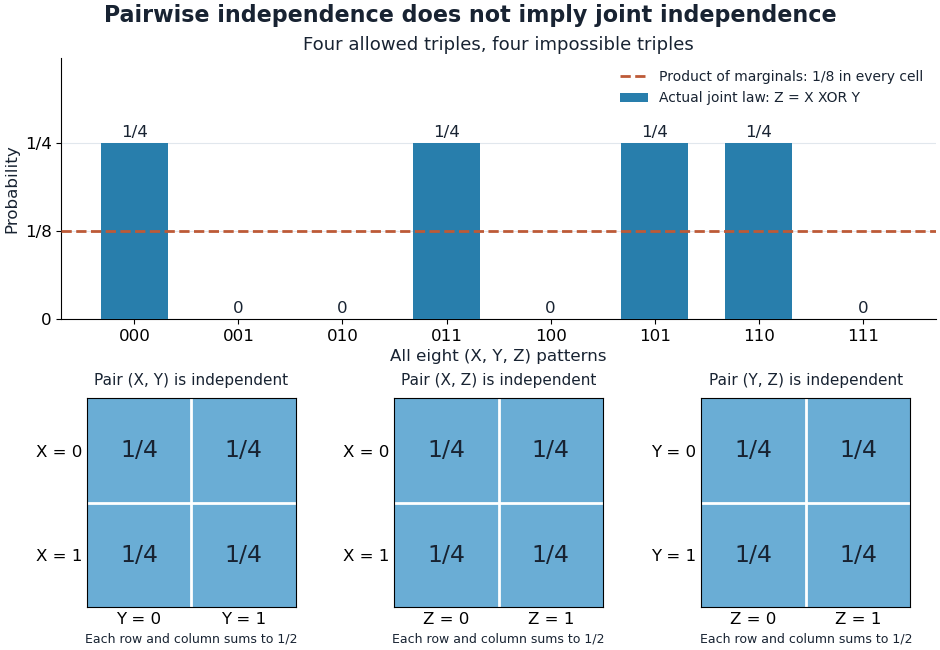
The XOR example hides joint dependence from every pairwise probability table
. The bars show all eight triple patterns against the reference for three independent fair bits. Below, all three pairwise joint probability mass functions have four equal cells of . Details.
The exclusive or example is the complementary-bit version of the two-toss exercise in Grinstead and Snell, Introduction to Probability, section 4.1, exercise 7, printed page 151. It is a compact reason to check the full product rule whenever a calculation uses three-way or higher events.
Hyperbolic Y-piece 2026-10-14
A Y-piece is a compact curvature- hyperbolic surface homeomorphic to a pair of pants, with three geodesic boundary curves. Its labelled boundary lengths determine it up to isometry. Cutting along the three mutually perpendicular seams produces two congruent right-angled hyperbolic hexagons with alternating sides . Conversely, doubling the hexagon along its other three sides constructs the Y-piece for arbitrary positive lengths.
For a steady accretion disk with arbitrary rotation law and a zero-torque inner boundary condition at , the outward viscous torque in an accretion disk is . The dissipation per unit planar area summed over both disk faces is . Integrating gives in the Paczyński-Wiita potential. The radiative flux from one face is , preventing a factor-of-two error in the luminosity.
Paczyński-Wiita ballistic plunge 2026-10-14
The limiting inward departure from the marginal Paczyński-Wiita circular orbit at conserves the displayed specific angular momentum and specific orbital energy. In the Paczyński-Wiita potential, its inward speed satisfies . The exactly marginal circular orbit does not depart without a perturbation; the formula describes the separatrix limit of inward releases.
Reflection of a P-wave from a rigid plane 2026-10-14
For a stable isotropic solid in , use , . An incident P wave with frequency , tangential wavenumber and upward normal wavenumber reflects into a P potential and an SV potential , where . Vanishing of both displacements at the rigid plane gives , . Hence and . Because and , and the converted S wave propagates rather than being evanescent.
P-wavefront discontinuity transport 2026-10-14
Let be a smooth wavefront and suppose the first jump in time derivatives of displacement field is , with . Substitution of into the elastic equation first gives the eikonal equation and longitudinal polarization . Projecting the next-order compatibility condition onto gives , hence the displayed conservation law. Coefficients and wavefront must be sufficiently differentiable for this classical transport equation; its local form fails at a caustic.
p-radical subgroup 2026-10-14
A p-subgroup is p-radical if it equals the p-core of its normalizer. Every defect group of a block is p-radical by defect groups are centralizer-conjugate Sylow intersections. Being an intersection of arbitrary Sylow subgroups alone is weaker than the centralizer-conjugate statement used in that argument.
The integer divides . The group is p-nilpotent exactly when . To see this, let . Invariant p-prime-degree characters of extend, and each has exactly extensions of p-prime degree. Conjugation by the p-group then gives . Thus the quotient is prime to precisely when is a normal p-complement.
If a prime divides the degree of every nonlinear irreducible character of a finite group, the group has a normal p-complement. Indeed, the p-prime-degree characters are exactly the linear characters. Their squared-degree sum is , whose p-part is ; Isaacs' character-degree criterion for p-nilpotency applies.
p-constrained group 2026-10-14
Put using the p-prime core of a finite group. A finite group is p-constrained if . If , the p-core of a finite group has its centralizer contained in itself. Then block idempotents centralize a normal p-subgroup places every block idempotent in , a local ring, so has only the principal block.
Convolution of p-adic measures 2026-10-14
On a profinite group, convolution is first defined for functions on a finite quotient by summing products of the two measures' coset coefficients, then extended by uniform approximation. Finite-quotient associativity proves associativity. For an abelian group it is commutative; the Dirac measure at the identity is the identity element. Under the measure realization of an Iwasawa algebra, it becomes group-algebra multiplication.
Amice transform 2026-10-14
The coefficient of is . The Mahler expansion of continuous p-adic functions identifies -valued p-adic measures on with . If , then . A measure supported on has , because the sum of is zero for .
Let be a complete discrete valuation ring with a continuous -algebra structure. Every continuous function on with values in has a unique uniformly convergent expansion in the binomial polynomials, with . This is the coefficient-ring version of the Mahler theorem. To see that , approximate the function modulo any power of the maximal ideal by a function of period . In the expansion of , all intermediate binomial coefficients are divisible by , while kills the periodic function. Iterating makes its differences vanish modulo the prescribed ideal power. Finite differences do not increase the uniform norm, so the same conclusion holds for the original function. Binomial inversion gives agreement at the nonnegative integers, and their density in the p-adic integers gives the expansion everywhere. This gives the dual description of p-adic measures by arbitrary bounded sequences of binomial moments, and hence the Amice transform.
Growing-clique overlap bound 2026-10-14
Write and . The first mean condition implies eventually. For , this yields , and each fixed- term tends to zero when . The second mean condition implies eventually. Writing gives for , and . Both bounding series are summable. The overlap formula for the variance of a clique count therefore gives relative variance tending to zero; the second moment method proves an -clique exists with high probability.
Underfitting 2026-10-14
Underfitting occurs when a prediction rule fails to capture useful structure in the target relation. A straight-line polynomial regression fitted to a genuinely quadratic noiseless target illustrates a representational limitation. Poor prediction alone does not identify the cause: compare candidate rules using cross-validation or a validation set, while keeping the final test set reserved for assessment.
There are unlisted articles, also show them or only show them.