
The Poisson equation for differential forms on a closed oriented Riemannian manifold is solvable exactly when its source is -orthogonal to every harmonic differential form of the same degree. Necessity follows from the formal adjoint identity . For sufficiency, the Green operator of the Hodge Laplacian gives , since .
Poisson size-bias identity 2026-10-14
For with Poisson distribution of mean , the equality proves the identity by summation. For an independent random sum of independent claims with this count, exchangeability of the summands gives , where on the right is independent of and has the severity law. These identities hold for nonnegative measurable functions, and for integrable signed functions. They obtain moments without assuming that a positive exponential moment exists.
Stein-Chen method 2026-10-14
The Stein-Chen method compares an integer-valued count with a Poisson distribution by solving the Poisson Stein equation and estimating its expectation at the count. For sums of indicator random variables, dependency neighborhoods expose local overlap errors. This gives total variation distance bounds without having to compute the entire count distribution.
Poisson entropy monotonicity 2026-10-14
The information entropy of a Poisson distribution is strictly increasing for . Given , take independent and . Their sum has Poisson distribution with mean , so entropy monotonicity under independent addition gives . All these information entropies are finite, and excludes equality.
// Target: probability-and-statistics.bigb
Mixed Poisson distribution 2026-10-14
A mixture of Poisson distributions over a nonnegative random intensity. With exposure and prior density , its probability mass function is . A gamma mixing distribution gives a negative binomial distribution. Counts sharing the same latent intensity are conditionally independent, but generally dependent after mixing.
Skellam distribution 2026-10-14
The distribution of for independent Poisson random variables with means is the Skellam distribution. Its characteristic function is , its mean is and its variance is . For equal means ,This is the fixed-time law of a symmetric Poisson difference process.
// Target: markov-process.bigb
One-sided fluid-loaded membrane radiation 2026-10-14
For one acoustic half-space and vacuum on the other side, a harmonic point force gives displacement amplitude and fluid acoustic velocity potential amplitude . For time dependence , the outgoing acoustic square-root branch has for and for . The causal limit places the positive guided-mode pole above the inversion contour and the negative pole below. The saddle point generates cylindrical radiation, whereas guided residues decay normally to the membrane.
For the Boussinesq top-hat plume in a stratified ambient with , the exact pure-power solution has the displayed radius and velocity, and . With positive entrainment, radius, upward speed and reduced gravity, stable requires , whereas unstable requires . The stable branch has divergent buoyancy flux at zero height, so it is not a finite-flux point-source solution. The unstable branch has zero limiting source buoyancy flux and extracts buoyancy from its maintained unstable ambient. The cases are singular at nonzero ; instead admits the ordinary Boussinesq point-source plume.
For prescribed , the steady Boussinesq top-hat plume in a stratified ambient has kinematic fluxes , , and . Balancing powers in , , and gives exponents and these positive amplitudes. The ambient's static instability is prescribed without allowing it to drive ambient motion; the Boussinesq approximation additionally requires small density differences over the modeled height range.
Line-plane incidence in Plücker coordinates 2026-10-14
The intersection of a line in Plücker coordinates with a plane covector is the first displayed homogeneous vector: it lies in the span of the defining points and its contraction with is zero by antisymmetry. A zero vector means the whole line is contained in the plane. Dually, the plane through the line and a point or ideal direction is given by the second formula; it vanishes if is already on the line. These operations require no Euclidean lengths or angles.
Oblate-quadrupole epicyclic precession 2026-10-14
For , a nearly circular equatorial orbit has and azimuthal frequency . The radial epicyclic frequency is , and the vertical epicyclic frequency is . Radial stability requires . The nodal precession rate is negative and the apsidal precession rate positive. These sign statements concern small eccentricity and inclination. For an arbitrary inclined orbit, the averaged argument of periapsis instead evolves as and can regress.
For a sharp thermal front moving at fraction of the Darcy velocity , a cold fluid of viscosity displacing its hot counterpart of viscosity has the displayed growth rate in the local, unbounded planar approximation without thermal conduction. The harmonic pressure perturbations decay on either side. Pressure continuity and continuity of perturbed Darcy flux give the velocity response ; the thermal front's kinematic law is . The prefactor is the thermal-front speed, not the material pore velocity. Increasing viscosity with heating therefore makes the trailing thermal interface unstable even when the leading displacement of the original fluid is stable.
Nonplanarity by edge counts 2026-10-14
The complete graph has and , exceeding the planar graph edge bound . Therefore it is not a planar graph. The complete bipartite graph has and . The general bound allows twelve edges, but the bipartite planar graph edge bound allows only eight, proving nonplanarity.
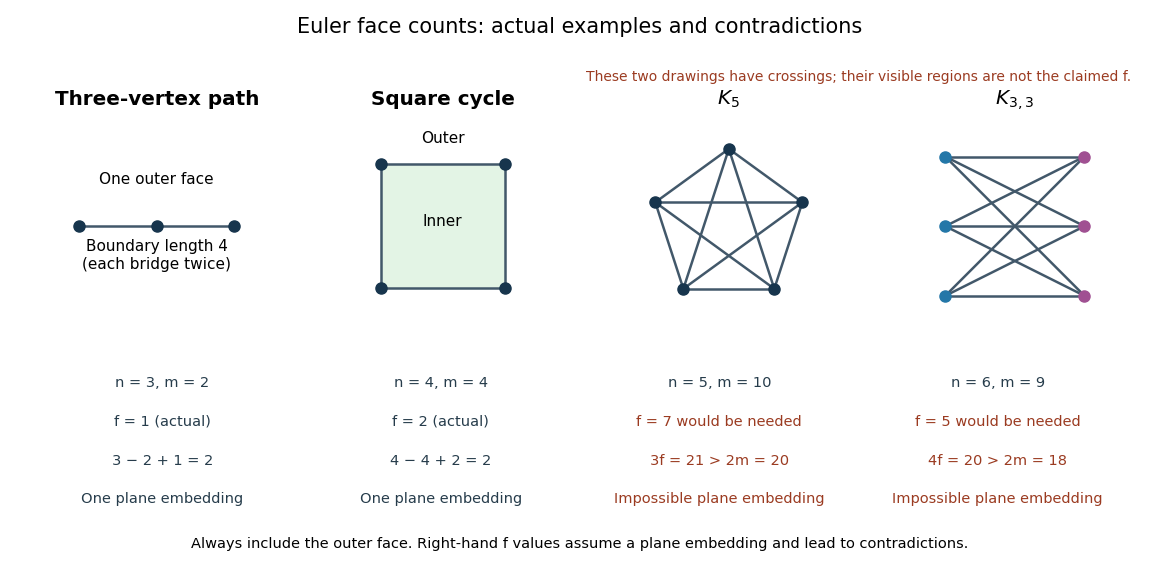
Actual plane-graph face counts compared with impossible face counts for the two complete-graph obstructions
. Details. 
These are necessary bounds, not a complete planarity test. For an original counterexample, subdivide every edge of once. The resulting simple graph is a connected graph with , , and is bipartite: put all original vertices in one part and all nine new vertices in the other. Both inequalities hold, and . Nevertheless, a crossing-free graph drawing would let us trace each two-edge graph path as one curve, producing an impossible embedding of . The graph subdivision preserves this obstruction. Kuratowski's theorem supplies a stronger characterization than these counts.
Bipartite planar graph edge bound 2026-10-14
If a finite simple graph is a connected graph, a bipartite graph, and a planar graph, with vertices, then . Every facial boundary walk has even length and length at least three, hence at least four. Thus ; substitute the Euler formula for a connected planar graph.[ref]
Mathematics for Computer Science by Eric Lehman and others. Mathematics for Computer Science, §12.5, Lemma 12.5.2 and Theorem 12.5.3, printed pp. 486–487
The square cycle graph attains equality: . The three-vertex graph path also attains equality: . Its repeated bridges in a graph illustrate why counting facial boundary walk length correctly matters. Neither bound applies unchanged to a multigraph: two vertices may support arbitrarily many parallel edges in a plane graph.
Area of a planar Brownian path 2026-10-14
A planar Brownian motion range has zero two-dimensional Lebesgue measure almost surely. Assuming finite expected area, Brownian scaling gives half that expected area for each half-time range. Inclusion-exclusion then makes their expected overlap zero. Translate their ranges by the midpoint position; the independent Brownian arms at a deterministic time make the expected overlap the integral of the squared point-hitting probabilities for a half-time range. Those probabilities vanish almost everywhere, so the half-time expected area, and hence the full-time expected area, vanish. This argument does not assert zero hitting probability for every individual point solely from an almost-everywhere integral conclusion.
Omitted value 2026-10-14
An omitted value of a function is a point outside its image: the equation has no solution in . Both and matter. The complex exponential function on the complex plane has one omitted value in , namely zero, and two omitted values when regarded as a map into the Riemann sphere, namely zero and infinity. Restricting can create additional omitted values.
Pi-element 2026-10-14
Proof that π is irrational 2026-10-14
Assuming and integrating a suitably normalized polynomial times produces a positive integer that tends to zero as the polynomial degree grows. This contradiction proves that is an irrational number.
Wallis product 2026-10-14
The Wallis product isIts finite product is . The Wallis integrals give , proving both convergence of the product and its value. The strict integral bounds also give .
For a Reissner-Nordstrom black hole with , the outer unstable circular null geodesic has radius . Maximizing for gives the critical impact parameter . The geometrical optics capture cross-section is , reducing to in Schwarzschild spacetime and in the extremal charged case. Finite-wavelength absorption need not equal this geometric limit.
// Target: general-relativity.bigb
There are unlisted articles, also show them or only show them.