
Past exam of the theoretical physics I course of the University of Cambridge 2022 3 b Solution 2026-10-18
The square lattice has coordination number of a lattice . The mean-field decoupling isAccounting for the factor in the directed-neighbour sum gives the Hamiltonian in the mean-field approximation:The constant term is necessary to correct the double counting of the interaction. Let . The one-site partition function isso . The Helmholtz free energy is thereforeThe equilibrium mean-field approximation is obtained by minimizing this expression over the allowed . The state supplies the extra in ; omitting it would instead describe the two-state Ising model. This is the Blume-Capel mean-field transition at zero single-ion anisotropy.
Past exam of the theoretical physics I course of the University of Cambridge 2022 3 a Solution 2026-10-18
The mean-field approximation replaces the fluctuating environment of each microscopic variable by a uniform average field. For spins, write and drop products between different sites. The resulting single-site problem can be solved independently, and its average spin must reproduce the assumed order parameter : this is the self-consistency equation.
It is reliable when correlated thermal fluctuations about the mean are small, for example with many interacting neighbours, long-range interactions or high spatial dimension. Near a thermodynamic critical point the quantitative test is the Ginzburg criterion. For short-range scalar ordering the upper critical dimension is four, with logarithmic qualifications at four; a two-dimensional nearest-neighbour lattice is below this and its asymptotic critical region of a phase transition is not described accurately by simple mean-field theory.[ref]
Statistical Field Theory by David Tong. §2.2.4, The Upper Critical Dimension: correlation-volume fluctuations and the Ginzburg criterion
Past exam of the theoretical physics I course of the University of Cambridge 2022 2 e Solution 2026-10-18
The dispersion relation shows that an infinite rod has unstable long-wave modes. A finite rod excludes sufficiently long wavelengths, so stability depends on its length and the precise end conditions. The fourth spatial derivative requires two conditions at each end; fixing transverse positions alone does not specify whether slopes are constrained.
First take displacement-fixed ends with free rotation. Setting leaves slope variations free; the bending boundary term in the first variation then gives the corresponding natural boundary conditions on the slope, . The spatial normal modes are , andThe first mode destabilizes first. ConsequentlyAt equality, the first mode has zero restoring force and is marginal, with a static component and a possible linear-in-time component in the linear theory. Every integer gives an exponentially growing mode.
If "fixed" instead means clamped, the clamped boundary condition is at both ends. The critical compression is thenFor example, the static critical shape obeys the four clamp conditions and the zero-frequency equation at this load. To establish that it is the first threshold, write : it has zero endpoints and zero mean, and periodic extension gives by the zero-mean periodic Poincaré inequality, with equality at . This proves the critical Rayleigh quotient. Both cases are instances of the compressed Euler-Bernoulli beam and its endpoint-dependent buckling threshold. The source does not specify the endpoint rotation, so both interpretations are stated explicitly.
Past exam of the theoretical physics I course of the University of Cambridge 2022 2 d Solution 2026-10-18
For this density the Euler-Lagrange field equation with second derivatives givesInsert a plane wave . The second and fourth spatial derivatives give and , respectively, soFor propagating modes, and the phase velocity has magnitude , which depends on the wave number. Thus the waves are dispersive. For , the squared frequency is negative: the corresponding solutions grow or decay exponentially rather than propagate with a real frequency. The uniform displacement is a zero-frequency shift mode.
Past exam of the theoretical physics I course of the University of Cambridge 2022 2 c Solution 2026-10-18
A constant shift leaves every derivative unchanged, and the density has no undifferentiated . Thus it is exactly invariant under this scalar-field shift symmetry. Localize the shift parameter temporarily to :Integrating the last term by parts once identifies the Noether current for a constant shift with second derivatives:The Euler-Lagrange field equation is , precisely the continuity equation . Therefore the conserved quantity, when the endpoint current vanishes or the field has suitable periodic/decaying conditions, isthe total transverse momentum. More explicitly . The fixed endpoints introduced later can exert transverse forces and break the global shift symmetry of the boundary problem, so vanishing endpoint current must not be inferred merely from fixed displacement.
Past exam of the theoretical physics I course of the University of Cambridge 2022 2 b Solution 2026-10-18
Interpret as the small transverse displacement of the elastic beam. The first term is the positive kinetic energy density , with the mass per unit length. The Lagrangian density is kinetic minus potential energy, so the potential density encoded by the other two terms isFor a compressed rod, transverse deflection releases compression energy: the small-slope geometric change in length is proportional to , so the applied compressive load lowers the potential by . This explains the positive sign of the term in the Lagrangian. Tension would give the opposite sign and a restoring gradient term.
Bending costs elastic energy. At small slopes the curvature is , so positive bending stiffness gives potential , and hence a negative term in the Lagrangian. For a uniform slender beam is its flexural rigidity. The competition between destabilizing compression and stabilizing bending is responsible for Euler buckling of an elastic filament.
Past exam of the theoretical physics I course of the University of Cambridge 2022 2 a Solution 2026-10-18
Vary the action with compactly supported , or impose vanishing and its first derivatives on the spacetime boundary. The first variation isOne integration by parts on the first-derivative term and two on the second-derivative term remove all derivatives from . The boundary terms vanish, leavingThe fundamental lemma of the calculus of variations gives the Euler-Lagrange field equation with second derivatives:Repeated indices run over time and space. The coefficient of the symmetric second derivative is defined by the displayed variation; if is instead treated as a single independent mixed derivative variable, it is counted once rather than twice.
Past exam of the theoretical physics I course of the University of Cambridge 2022 1 f Solution 2026-10-18
A common rotation changes neither the separation nor the spring energy. Its infinitesimal direction is , exactly the zero-frequency normal mode. Thus the continuum of rotated equilibrium points requires that zero mode; a nonzero restoring frequency in that direction would contradict rotational symmetry.
The second mode has , so it changes the relative angle while leaving the inertia-weighted common angle unchanged. It therefore carries zero perturbation in the conserved angular momentum associated with common motion. Indeed the coordinatesseparate the Lagrangian exactly:The cyclic coordinate is free, while has restoring or inverted curvature. This also explains why all members of either equilibrium family have the same frequencies. Reflection symmetry makes the potential even in , and the stable oscillatory mode is consistent with time reversal in classical mechanics through its two opposite frequency signs.
Past exam of the theoretical physics I course of the University of Cambridge 2022 1 e Solution 2026-10-18
Let be or , and write the angular displacements as . To quadratic order the restoring potential energy is . The linearized normal mode equation isThe determinant gives . Thus the normal modes of two spring-coupled coaxial rotors areFor the aligned family, the relative mode oscillates with positive frequencyFor the antipodal family, , so that displacement has solutions and the equilibrium is unstable.
The common zero mode has . It describes a neutral displacement or uniform common rotation, not a restoring oscillation. Thus the aligned family is stable with respect to relative motion and has orbital stability modulo common rotations. A particular static point is not strictly Lyapunov stable against unrestricted small velocity perturbations: arbitrarily small nonzero eventually moves the common angle far from that point. With , the common angle is fixed and the aligned relative equilibrium point is stable. This distinguishes the symmetry-induced drift from the exponential instability of the antipodal family.
Past exam of the theoretical physics I course of the University of Cambridge 2022 1 d Solution Created 2026-10-18 Updated 2026-11-05
The angular Euler-Lagrange equations areA static equilibrium point has both angular velocities zero and . Hence the complete equilibrium families, with angles taken modulo , areThe first family is aligned in azimuth and minimizes the spring length; the second is antipodal and maximizes it. Their potentials are and , respectively. Common rotations generate a whole family rather than isolated equilibria.
Past exam of the theoretical physics I course of the University of Cambridge 2022 1 c Solution 2026-10-18
The two continuous, time-independent symmetries are time translation and a common rotation of both angles. Their Noether charges are respectively the total energy and vertical angular momentum:For the second symmetry, and , so the Noether theorem gives the sum of their conjugate momenta. Independent rotations are not symmetries of the spring coupling.
There are also discrete symmetries: simultaneous reflection , and time reversal in classical mechanics, which reverses both angular velocities. These leave the dynamics invariant but provide no additional infinitesimal Noether charges. Combined with common rotations, the reflections give the full planar orthogonal symmetry of the angular geometry. If , interchange of the two angular coordinates is an additional discrete symmetry of the reduced dynamics.
There is a further useful time-dependent symmetry, up to a total derivative, on a continuous lift of the angles: adding the same constant angular velocity, . It changes byIts conserved quantity is . It is the integration constant for free common rotation, rather than a new globally single-valued angle charge on the configuration torus. The globally defined continuous charges are and above.
Past exam of the theoretical physics I course of the University of Cambridge 2022 1 b Solution 2026-10-18
Let and be the lower and upper azimuthal angles, measured from a common fixed direction. The squared spring length isBy Hooke's law, a spring with zero natural length has potential energy . ThereforeConstant gravitational energies can be omitted. It is useful to define the moments of inertia , and the angular coupling . The part of the potential that affects motion is simply . In particular, changes the constant spring energy but not the angular equations, because the spring has zero natural length.
Past exam of the theoretical physics I course of the University of Cambridge 2022 1 a Solution 2026-10-18
Use the angular coordinate for the position on the ring. The kinetic energy is . The gravitational potential energy is constant because the ring is horizontal, and the ideal constraint force has no tangential component. Thus the Lagrangian has no dependence on itself: it is a cyclic coordinate.
The Euler-Lagrange equation givesEquivalently, the conserved conjugate momentum is the vertical angular momentum, as required by rotational symmetry.
Past exam of the theoretical physics I course of the University of Cambridge 2019 4 e Solution 2026-10-18
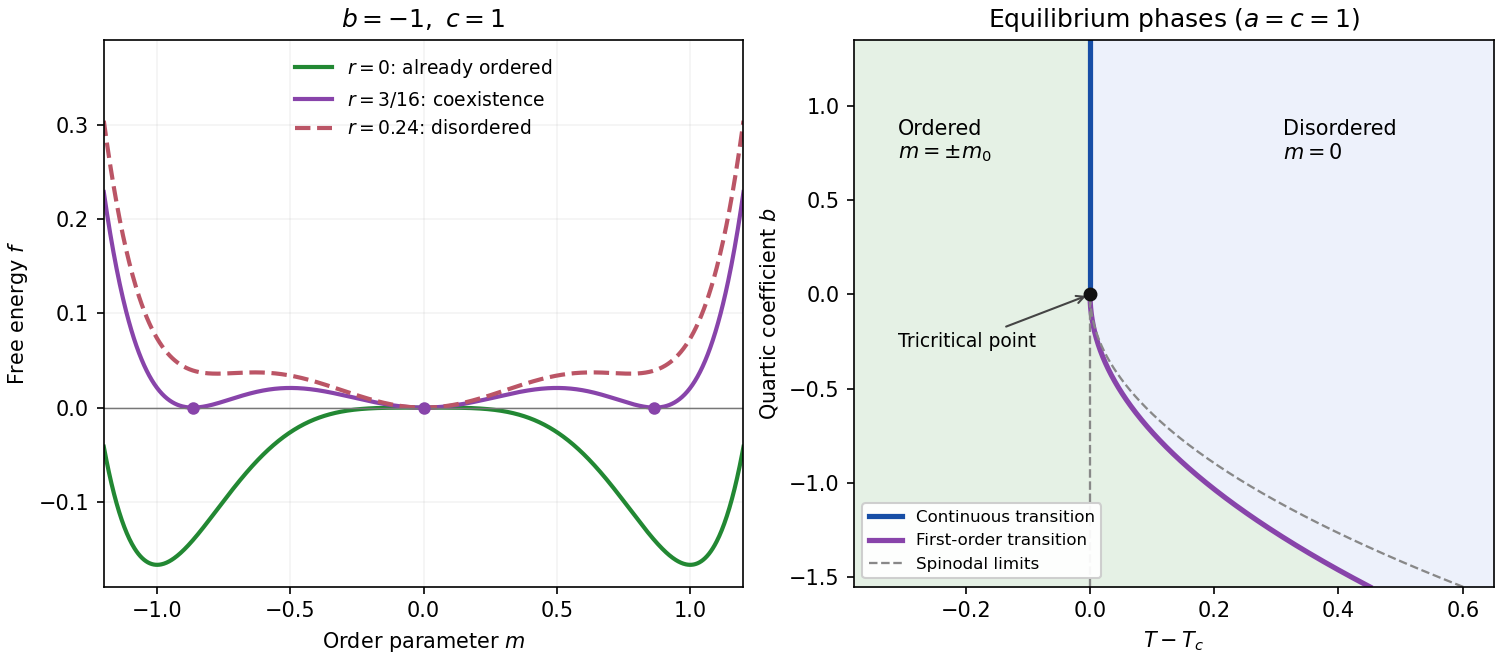
Let , with fixed. The equilibrium phase diagram has boundariesFor either branch, larger is disordered and smaller is ordered. Both signs of the ordered magnetization are symmetry-related global minima throughout the ordered region, rather than separate regions selected by temperature and .
The branches meet at the tricritical point . Directly on , minimizing givesThe transition there remains continuous, with a different mean-field critical exponent. For , the metastability boundaries are for the disordered state and for the ordered state. The first-order phase transition curve lies strictly between them, as shown in the figure. These spinodal curves describe possible hysteretic continuation of local minima, not equilibrium phase boundaries.
Past exam of the theoretical physics I course of the University of Cambridge 2019 4 d Solution 2026-10-18
At phase coexistence, the finite ordered global minimum has the same free energy as . With and , stationarity and equal values giveSubtracting eliminates :Substitute back to get , soThe three degenerate equilibrium values at this temperature are and . A useful global check, avoiding confusion with a spinodal point, is the exact factorizationAll three zeros are therefore global minima. Their curvatures are positive: and .
The ordered local minimum first appears on cooling at , where the nonzero stationary roots merge. It becomes globally stable only at ; the disordered minimum remains metastable down to . These different temperatures distinguish phase coexistence from loss of local stability.
Past exam of the theoretical physics I course of the University of Cambridge 2019 4 c Solution 2026-10-18
For at , the quartic term lowers the free energy near , while the positive sextic term stabilizes it at larger . The nonzero stationary points haveThey are global minima. The stationary point has zero quadratic curvature but is a flat local maximum because its leading nonzero term is negative. Thus the system is already ordered at , with a finite magnetization.
More explicitly, a continuous onset from could occur only where vanishes, namely at . But the global minima there are the finite values above. For sufficiently large positive , only is stable. Therefore the equilibrium minimum must change at some positive by crossing between a zero and a finite nonzero order parameter. This is a first-order phase transition. Its actual temperature lies above and is calculated next; itself is the disordered spinodal point, not the coexistence temperature.
Past exam of the theoretical physics I course of the University of Cambridge 2019 4 b Solution 2026-10-18
The stationary points of the Landau free energy obeyFor , makes every term of nonnegative, so is the unique global minimum. For , its curvature is negative. Setting gives , whose unique positive root isAt a nonzero stationary point,Thus both are stable and have lower free energy than . The equilibrium magnetization isFor fixed and , expand the square root:It tends continuously to zero. Hence the continuous phase transition has the order-parameter critical exponentThis is the mean-field critical exponent; fluctuation corrections beyond Landau theory are not included.
Past exam of the theoretical physics I course of the University of Cambridge 2019 4 a Solution 2026-10-18
A Landau free energy is a coarse-grained thermodynamic potential expressed as a function of a proposed macroscopic order parameter. Its coefficients include microscopic and thermal effects already averaged over. At fixed external thermodynamic conditions, equilibrium selects its global minimum; other local minima can represent metastable states. It is not the internal energy of a single microscopic magnetic configuration. Here the real scalar represents a selected component of magnetization: zero describes the disordered state, while nonzero values distinguish two oppositely ordered states.
Every power is even, so the internal discrete symmetry isFor a magnetic order parameter, this represents reversal of the magnetization, as under time reversal in zero applied magnetic field. A nonzero field would generally add an odd term and break this symmetry explicitly. This scalar model has no continuous internal rotation symmetry; physical rotational symmetry of a vector magnet is not implied by treating one real component. The condition makes the polynomial bounded below at large .
For the requested ordered phase on cooling, take the usual implicit assumption , and write . If the temperature directions reverse; if this expansion has no temperature-driven transition. The source explicitly states only .
Past exam of the theoretical physics I course of the University of Cambridge 2019 3 e Solution 2026-10-18
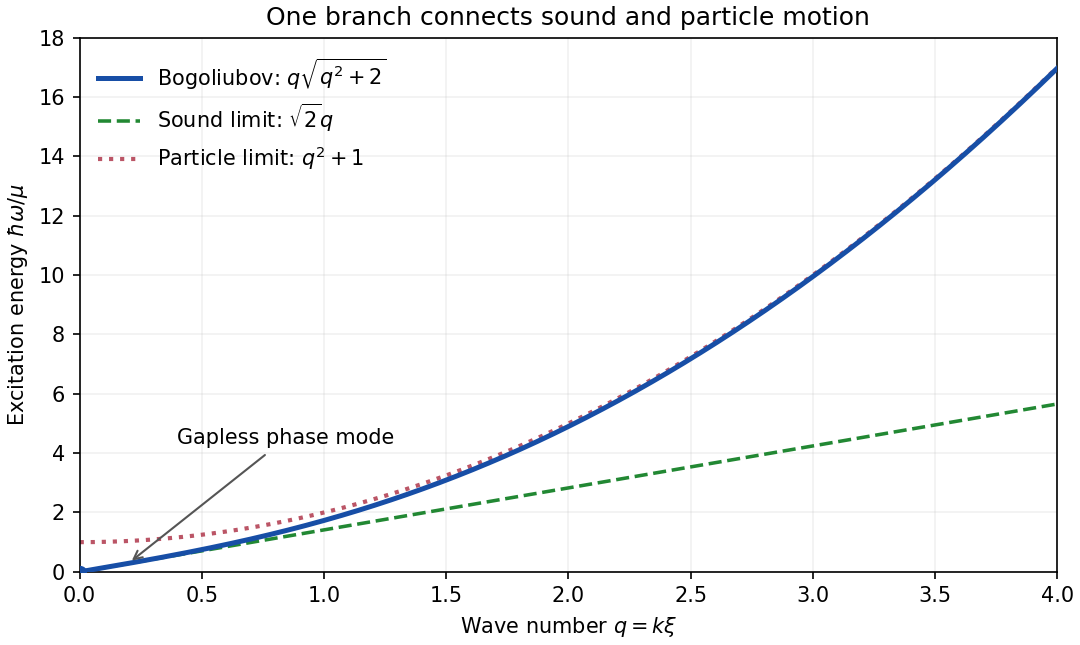
At long wavelength,This is the sound-like Goldstone mode of the broken global continuous symmetry. A spatially uniform infinitesimal phase change is , entirely in the direction, and costs no potential energy. Slow spatial variations acquire gradient energy and propagate as sound. Thus the dispersion relation realizes Goldstone's theorem through a gapless excitation; it is not a massive phase oscillation.
The amplitude and phase are canonically paired by the first-order time derivative in the quadratic condensate fluctuation Lagrangian. There is one positive-frequency branch, rather than an additional independent amplitude branch of a relativistic second-order-time theory. At high momentum,so the same branch becomes particle-like. The healing length sets the crossover scale.


Past exam of the theoretical physics I course of the University of Cambridge 2019 3 d Solution 2026-10-18
For independent , the derivatives needed in the Euler-Lagrange field equation areConsequently the two conjugate field equations areWrite with real components, and put . Separating real and imaginary parts givesFor each real field take the real part of a complex plane wave amplitude, . With the two equations becomeA nonzero normal mode requires their determinant to vanish, soThe positive-frequency Bogoliubov quasiparticle dispersion is thereforeThere is also the negative-frequency conjugate solution, as required for real component fields. Since , , consistent with the stability of the chosen uniform ground state.
There are unlisted articles, also show them or only show them.