
Past exam of the theoretical physics II course of the University of Cambridge 2019 4 a Solution 2026-10-18
A quantum state ensemble of normalized states , with probabilities and , has density operatorIt is a positive semidefinite Hermitian operator with trace one, and the Born rule assigns a measurement outcome with projector the probability .
A pure state has , hence and purity of a density operator . Its only nonzero eigenvalue is one. A mixed state has at least two nonzero eigenvalues and . The spectral theorem proves the converse criteria, since the nonnegative eigenvalues sum to one. Different quantum state ensembles may give the same density operator; the mere presence of several terms in a preparation list does not make the state mixed if all positive-weight terms represent the same quantum state ray.
Past exam of the theoretical physics II course of the University of Cambridge 2019 3 d Solution 2026-10-18
Using the consistently normalized Jordan–Wigner transformation from part (c), write . Since and , the parity string givesThereforeThe orthogonal transformation , preserves the canonical anticommutation relations and diagonalizes this bilinear Hamiltonian:The Fock vacuum is , with energy . Occupying alone gives the symmetric opposite-spin state with energy ; occupying alone gives the antisymmetric state with energy ; occupying both gives , up to a global phase, with energy . This reproduces the entire spectrum in part (b).
Past exam of the theoretical physics II course of the University of Cambridge 2019 3 c Solution 2026-10-18
There is a normalization mismatch in the printed definitions: have nonzero entries of magnitude two, whereas a single fermionic creation or annihilation operator has magnitude one. To obtain the intended Jordan–Wigner transformation, use normalized spin ladders . The given fermion expressions represent these . The two-site Jordan-Wigner normalization and signs then fix every factor unambiguously.
Put and . The canonical anticommutation relations give , , and . HenceandThese are the spin commutation relations, with distinct sites commuting. If one retains the unscaled symbols , the first and last displayed commutators instead equal ; the off-site commutators remain zero. Setting the unscaled equal to would contradict the original Pauli matrices.
Past exam of the theoretical physics II course of the University of Cambridge 2019 3 b Solution 2026-10-18
In the ordered product basis , the two-spin XY Hamiltonian isThe transverse term exchanges opposite spins and leaves parallel spins unchanged. Diagonalizing its two-dimensional block gives the complete orthonormal eigenbasisThe antisymmetric state is the singlet state; the other three are triplet states. Accidental equality of energies does not invalidate this eigenbasis.
Past exam of the theoretical physics II course of the University of Cambridge 2019 3 a Solution 2026-10-18
For bosonic creation operators and bosonic annihilation operators, the canonical commutation relations areFor fermionic annihilation operators and their adjoints, the canonical anticommutation relations areThe respective number operators are and . Their allowed eigenvalues are . In the fermionic case , so its eigenvalues must satisfy ; this is the single-mode Pauli exclusion principle.
Past exam of the theoretical physics II course of the University of Cambridge 2019 2 d Solution 2026-10-18
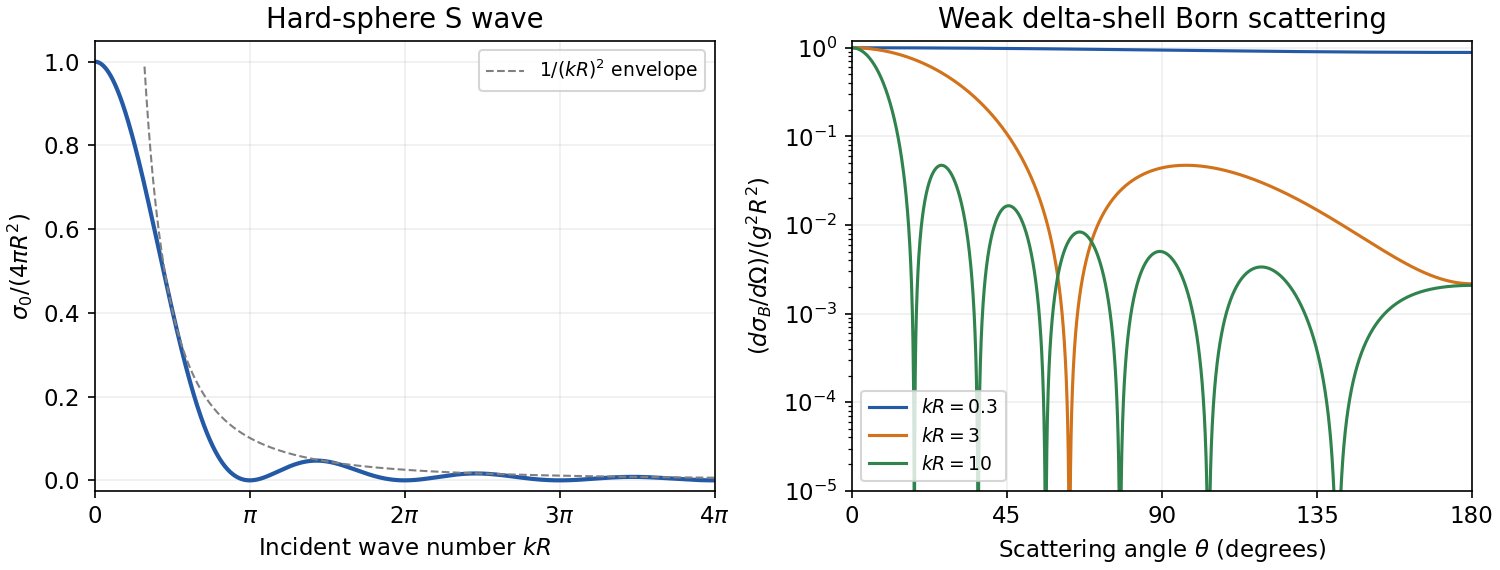
In the first Born approximation, let be the transferred wave number. The angular integral in the three-dimensional Fourier transform is , soWriting and , with value one at zero, the delta-shell Born amplitude givesFor the scattering is approximately isotropic, with total cross section . For it has a forward lobe of angular width of order and oscillatory zeros where . At a fixed nonzero scattering angle, its envelope decreases as . The right-hand panel of the figure shows this angular dependence.
For real the first-order scattering amplitude is real, so inserting it literally in the optical theorem would predict zero total cross section, contrary to its nonzero squared modulus. The first Born amplitude alone does not satisfy the optical theorem at order . This is an order-of-approximation issue: the squared first-order amplitude is already second order, and the second Born term supplies the required second-order imaginary forward amplitude. At first order both sides vanish. A weak-shell regime is needed for the Born truncation itself to be accurate.
Past exam of the theoretical physics II course of the University of Cambridge 2019 2 c Solution 2026-10-18
The radial S wave vanishes at the hard surface, so outside the sphere . Comparison with givesThe hard-sphere S-wave scattering amplitude and cross section are thereforeThe three prominent features are the finite low-energy limit , the oscillations with exact zeros at for positive integers , and the decreasing envelope . The zero-energy value is four times the geometric area . Near zero the normalized cross section is . The large- fall here concerns the S wave alone; summing all partial waves gives a different high-energy total.

Past exam of the theoretical physics II course of the University of Cambridge 2019 2 b Solution 2026-10-18
Integrate the squared partial-wave expansion of a scattering amplitude over the solid angle. Legendre polynomial orthogonality eliminates terms with unequal angular-momentum indices, givingAt zero scattering angle, and . ConsequentlyThis is the optical theorem. In the present elastic problem the total and elastic cross sections coincide. For an absorptive interaction the inclusive total still obeys the optical theorem, but need not equal the integral of the elastic differential cross section.
Past exam of the theoretical physics II course of the University of Cambridge 2019 2 a Solution 2026-10-18
Assume a real, central, short-range potential and elastic quantum scattering. At large radius, normalize the stationary wavefunction aswhere and is the scattering angle. Equal incoming and outgoing speeds give the differential scattering cross-section .
The partial-wave scattering expansion separates the spherical harmonics. The incident plane wave has expansion , with Spherical Bessel functions and Legendre polynomials . The regular radial solution outside the potential has asymptotic form . Its real scattering phase shift changes the ratio of outgoing to incoming waves to the Partial-wave S-matrix . Matching outgoing coefficients yieldsHere labels the orbital angular momentum, with squared magnitude . The assumption of purely elastic scattering is what makes every have unit modulus.
Past exam of the theoretical physics II course of the University of Cambridge 2019 1 d Solution 2026-10-18
Put and . The Pauli matrix multiplication law gives the pulse-and-precession spin one-half mapBecause , a suitable angle and unit vector for the rotation areIf the denominator vanishes, and the axis is arbitrary. The Bloch vector rotates through about per period; after periods the angle is . The eigenphases equivalently give quasienergies modulo .
In the two-orbital subspace the position operator is . The Heisenberg equation of motion between pulses gives , henceThus two components of the Bloch vector directly describe the mean position and momentum; its third gives the orbital population imbalance. The electric kick rotates about the position axis, leaving unchanged at the kick, while free evolution mixes the position and momentum components. Starting in , one complete period giveswhich exhibits the induced motion explicitly. These are projected two-orbital observables.
Past exam of the theoretical physics II course of the University of Cambridge 2019 1 c Solution 2026-10-18
Use the ordered orthonormal basis . The projected Hamiltonian between pulses is , so its free time-evolution operator through a period isAcross one instantaneous pulse, integrating the Schrödinger equation givesusing the exponential of a Pauli vector. The finite free Hamiltonian contributes vanishing evolution during the zero-duration kick. A period measured immediately before successive pulses therefore consists of the kick followed by free evolution. Composition givesThis is the Floquet operator at the specified phase of the pulse train. Actual hydrogenic energy levels are not opposite numbers: the displayed convention subtracts their midpoint, with . Restoring that midpoint multiplies the result by an unobservable global phase. Likewise in the given Hamiltonian denotes the electric coupling per unit length; if it is instead a physical electric-field strength, its charge factor must be included in .
Past exam of the theoretical physics II course of the University of Cambridge 2019 1 b Solution 2026-10-18
Here the dimensionless spin one-half operator is . Since the Pauli matrix obeys , the even and odd terms of the matrix exponential giveThis is the exponential of a Pauli vector for an -axis rotation. With a physical spin angular momentum , the exponent is .
Past exam of the theoretical physics II course of the University of Cambridge 2019 1 a Solution 2026-10-18
The Heisenberg equation of motion and the spin commutation relations give, componentwise,Thus . For constant magnetic field this is Larmor precession: the component along is conserved and the transverse components rotate. In particular, for ,The signed angular velocity is ; the positive precession rate is .
Past exam of the theoretical physics II course of the University of Cambridge 2018 4 d Solution 2026-10-18
The annihilation operator associated with the new coordinate isAs the initial state is the old vacuum,Equivalently, applying to the number-state expansion in part (c) and shifting its summation index returns times the same state. It is therefore a coherent state of the displaced oscillator.
The new Hamiltonian is . In the Schrödinger picture its evolution givesConsequentlyThe displayed prefactor is only a global phase. Equivalently, in the Heisenberg picture . The mean occupation is constant, and reproduces the energy above the new minimum found in part (b). Its mean position and momentum likewise reproduce that part's oscillating wavepacket centre.
Past exam of the theoretical physics II course of the University of Cambridge 2018 4 c Solution 2026-10-18
Define the signed dimensionless displacementThe spatial translation operator is , and the phases of the new energy eigenstates are fixed by . Their expansion coefficients are thereforeSince ,Set and . Their commutator is , which commutes with both operators. Thus the stated special case of the Baker--Campbell--Hausdorff formula is applicable and givesBecause ,Taking the overlaps with therefore provesThis is the coherent state after shifting an oscillator equilibrium. Its normalization follows from .
There is a sign qualification in the printed expansion: agrees with when , equivalently . For a general signed displacement , the odd coefficients have the opposite sign in the specified translated basis. The squared displacement alone fixes the occupation probabilities, not these coherent relative phases. The two-exponential identity also requires the central-commutator condition used above; it is not valid in that simple form for arbitrary operators.
Past exam of the theoretical physics II course of the University of Cambridge 2018 4 b Solution 2026-10-18
Complete the square, keeping the equilibrium displacement signed:Write for position relative to the new minimum. By the sudden approximation, the state immediately after the quantum quench is still the old vacuum. Its initial means areThe old ground state has and . Thus , but the energy measured above the new potential minimum isThe extra term is the excitation energy above the new ground state; the zero-point term remains part of the energy above the potential minimum.
Past exam of the theoretical physics II course of the University of Cambridge 2018 4 a Solution 2026-10-18
Using , the Heisenberg picture equations for the quantum harmonic oscillator areSolving these coupled linear equations givesThe oscillator annihilation operator and creation operator areThey obey and . Substitution of the position and momentum solutions, or the corresponding commutators with , yields
Past exam of the theoretical physics II course of the University of Cambridge 2018 3 c Solution 2026-10-18
Fix the mode ordering with the operator before the operator, as in the given state. In the sector with one fermion in each subsystem, use the ordered basisThe state vector is , whose squared norm is one. Thus the global density matrix is the rank-one projectorIt has trace one and satisfies , so the global state is pure.
Take the partial trace over . The conditional vectors in are for and for . Therefore the reduced density matrix isIts determinant is , giving eigenvaluesBoth are positive; in particular, , so the reduced state is mixed despite global purity. The entanglement entropy is obtained by diagonalizing this reduced matrix and evaluatingFor a globally pure bipartite state this equals the entropy of either reduced subsystem. No numerical evaluation is needed.
Past exam of the theoretical physics II course of the University of Cambridge 2018 3 b Solution 2026-10-18
The fixed-particle-number sector is spanned by and . In this basis,The relevant quantum Gibbs state is normalized within this two-dimensional sector, not over all particle numbers. With and , the exponential of a Pauli vector givesThereforeIts eigenstates are , with energies and probabilities . These are nonnegative and sum to one, so the matrix is Hermitian and has trace one. Its purity of a density operator isFor , the zero-temperature limit is the pure ground-state projector,with purity one. As , and , with purity . At every strictly positive finite temperature and finite , both eigenvalues are nonzero, so the state is mixed. If , the two levels are degenerate and the Gibbs state is at all temperatures, including its zero-temperature limit.
Using dimensionless Von Neumann entropy, , givesFor nonzero , as , while as . More precisely, the high-temperature expansion is , and the low-temperature form is . The thermodynamic entropy includes an overall factor .
Past exam of the theoretical physics II course of the University of Cambridge 2018 3 a Solution 2026-10-18
An ensemble with normalized quantum states and probabilities , , has density matrixEach rank-one projector is Hermitian, so . Taking the trace in any orthonormal basis givesIt is also positive: . Its eigenvalues are therefore nonnegative and sum to one. Hencewith equality exactly when one eigenvalue is one and the others are zero. Thus the purity of a density operator distinguishesEquivalently, a pure state has and rank one. In a -dimensional Hilbert space, purity is at least , attained by the maximally mixed state .
There are unlisted articles, also show them or only show them.