
Past exam of the theoretical physics I course of the University of Cambridge 2019 3 c Solution 2026-10-18
Choose the real representative . For ,and the fourth power through quadratic order isIn , the linear terms and the terms cancel because . The remaining potential contribution is .
The time-derivative contribution isIts first term is a total derivative and contributes only a temporal boundary term for fixed endpoint fields. Since is uniform, the gradient contribution is simply . Dropping that boundary term and the constant, the quadratic condensate fluctuation Lagrangian isThe omitted cubic and quartic interactions describe scattering between these small fluctuations; they do not enter the linear normal mode calculation.
Past exam of the theoretical physics I course of the University of Cambridge 2019 3 b Solution 2026-10-18
Treat independently in the Legendre transform in mechanics. Their canonical momenta areThe time-derivative terms cancel in , giving the Hamiltonian densityThe first-order time dependence makes the momenta constrained; this direct calculation still gives the canonical density. In physical terms this is the grand-canonical Hamiltonian of a Bose field, . The physical energy density is obtained by adding back. A stationary field in this chemical-potential frame has the usual factor in the physical frame.
Complete the square:For uniform or periodic boundary conditions, or in the homogeneous bulk, both nonconstant terms are nonnegative and vanish simultaneously atThe ground states form a circle. A particular nonzero is changed by every nontrivial phase rotation, although the full family is invariant. Selecting one such mean-field theory state therefore exhibits spontaneous symmetry breaking of . This describes phase selection in the thermodynamic limit; an exact finite-system particle-number eigenstate need not itself have a nonzero field expectation.
Past exam of the theoretical physics I course of the University of Cambridge 2019 3 a Solution 2026-10-18
Under with constant real , the field and its complex conjugate acquire opposite phases. These cancel in , , , and . The Lagrangian density therefore has the particle-number phase symmetry, a global circle group .
For a spacetime-dependent real ,Writing , the change in the Lagrangian density isThis is not generally zero or a boundary term. Thus the symmetry is global, with no arbitrary local phase symmetry. A compensating gauge field and gauge-covariant derivative of a charged scalar field would be required to promote it to a local redundancy.
Past exam of the theoretical physics I course of the University of Cambridge 2019 1 e Solution 2026-10-18
The constants specify isotropic, nondispersive linear response: controls electric polarization, and controls magnetization. Their numerical relation to conventional electric susceptibility and magnetic susceptibility depends on the signs and field normalization in the action. In the rationalized units used here, the printed action gives the constitutive relationsThus its relative permittivity and magnetic permeability areHere conventional is defined by , not by . With the alternative repaired action that yields the PDF's target equation, is unchanged but and . In particular, a positive conventional electric susceptibility corresponds to negative in the printed conventions; the problem does not specify signs for these constants.
Past exam of the theoretical physics I course of the University of Cambridge 2019 1 d Solution 2026-10-18
In the rest frame and . The two material contractions in the printed action become and . Consequently its material Lagrangian density isThe Euler-Lagrange field equations are algebraic, since no derivatives of the material variables occur. They giveThese also follow from the and components of the corrected equation in part (b). If instead the intended starting point was the PDF's displayed equation in part (b), its predictions would beThe two magnetic answers express the documented sign error, rather than different choices of frame. Here the inverse coefficients in the action require nonzero ; zero response is obtained as a limiting constitutive law.
Past exam of the theoretical physics I course of the University of Cambridge 2019 1 c Solution 2026-10-18
Choose , so that and , with . The definitions of the polarization-magnetization tensor imply and . Separating temporal and spatial indices,The Levi-Civita symbol contraction equals , givingThus is the electric dipole moment per volume, or electric polarization, and is the magnetic dipole moment per volume, or magnetization. The signs are those of dipole interactions in a Lagrangian; the associated fixed-dipole potential energies have the opposite signs. Consistently, the equation in part (a) has componentsso and are the bound charge and bound current.
Past exam of the theoretical physics I course of the University of Cambridge 2019 1 b Solution 2026-10-18
There is a sign inconsistency in the original PDF: varying its action gives a plus sign for the spatially projected magnetic term, whereas its displayed target equation has a minus sign. The following Lagrange multiplier for antisymmetry calculation derives the result of the action as printed.
Temporarily vary all sixteen entries independently and addVariation of the symmetric Lagrange multiplier imposes . DefineOn this constraint surface, . Differentiating the original contractions before imposing the constraint givesandIn particular, the reversed order in the last factor of the action matters. The unrestricted Euler-Lagrange field equation, evaluated on the antisymmetry constraint, isSubtract its index-transposed equation to eliminate the symmetric multiplier:A direct check is to restrict the action to a rest-frame magnetic component , : its quadratic contribution is , whose derivative has a positive sign. To obtain the PDF's target equation instead, one must reverse the sign of that quadratic term in the action, or replace its last by . These are alternative repairs; changing conventions cannot make the printed action and printed equation agree.
Past exam of the theoretical physics I course of the University of Cambridge 2019 1 a Solution 2026-10-18
Use Minkowski metric and units with the speed of light equal to one. Thus , and is the spatial projector of a timelike congruence. Keep the medium velocity fixed when varying the electromagnetic four-potential. Since the electromagnetic field tensor is , its variation givesBoth tensors are antisymmetric. Integration by parts, with variations vanishing at the boundary, therefore givesThe Euler-Lagrange field equation is . Renaming the free index and using antisymmetry givesThese are the inhomogeneous Maxwell equations with the bound charge and bound current encoded by the polarization-magnetization tensor.
Past exam of the theoretical physics I course of the University of Cambridge 2018 4 d Solution 2026-10-18
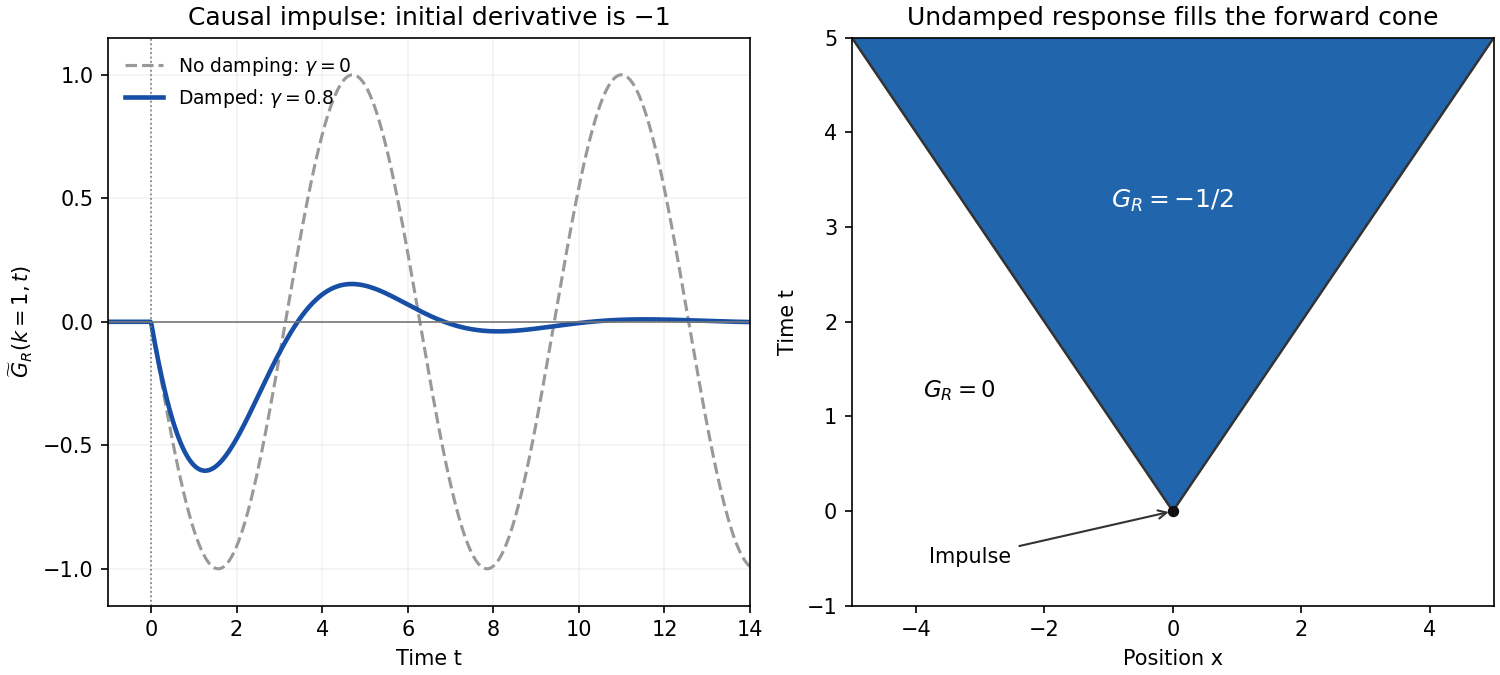
For , defineThe simple poles are . In the inverse transform , close the contour below for . Its clockwise orientation gives times the sum of residues. That sum isFor , close above; there are no poles. The residue theorem therefore givesHere is the Heaviside step function. At the continuous retarded limit is . At critical damping, likewise replaces by ; beyond the stated oscillatory range an imaginary converts it to a hyperbolic sine. These continuations retain decaying temporal exponents.
For each fixed , taking givesFor , invert in space and set :The correctly normalized sinc function transform isFor instance, , and Fourier inversion immediately gives the factor . The PDF's prefactor is inconsistent with its top hat of unit height; it would give height . Using the normalized identity yieldsas a distribution. The values assigned precisely at a wave front do not change that distribution. This is the negative of the standard one-dimensional retarded wave Green function, because the PDF's differential operator is .
The sign and initial data can be checked without any contour calculation. Integrating the spatial-Fourier equation through the impulse givesIn real space these are and . In particular,for a smooth test function , confirming the negative delta-function initial velocity. Before the impulse the displacement and velocity are zero. The disturbance fills the forward causal cone for the constant-speed wave equation, whose fronts move at unit speed, consistent with . The final question's printed is interpreted as , referring to the elastic constant, not to the Fourier wavevector. No initial conditions were otherwise specified, so the causal choice has been made explicitly.
Past exam of the theoretical physics I course of the University of Cambridge 2018 4 c Solution 2026-10-18
With the PDF's inverse Fourier transform convention, the derivatives act asso its forced differential operator becomes . ThusFor the physical impulse response choose the retarded fundamental solution, vanishing before . For and , its poles lie in the lower half-plane. The retarded Fourier pole prescription specifies the zero mode and the zero-damping limit as well; a Green function without a temporal or boundary prescription would otherwise permit homogeneous additions.
This is the Kelvin-Voigt rod Green function. Multiplying the homogeneous real-space equation by givesA spatial Fourier mode therefore satisfies : positive really damps the motion. For sufficiently decaying fields its energy satisfiesThis checks the sign of the imaginary term in independently of the transform calculation.
Past exam of the theoretical physics I course of the University of Cambridge 2018 4 b Solution 2026-10-18
Use and Minkowski metric , with the wave speed equal to one. Regarding as a scalar field, the symmetric canonical stress-energy tensor isIt obeys on the wave equation. For a scalar field the intrinsic spin current vanishes. The total orbital Lorentz current and its integrated angular-momentum tensor areBecause there is only one spatial dimension, its only independent possibly nonzero component iswhere . The corresponding flux is . Symmetry and conservation of giveThus is conserved provided the boundary flux vanishes and the integrals exist. For example, localized wave packets on an infinite line have this property. One can also check directly that , so the two terms in have cancelling derivatives.
The significance is the boost charge of a one-dimensional scalar field. There is no independent spatial rotation or ordinary spatial angular-momentum component in one dimension. Instead, the action has the mathematical Lorentz invariance of a massless wave field with invariant speed , and generates its boost. Its conservation says that the center of energy moves uniformly. This is a symmetry of the ideal wave-field model, rather than an assertion of fundamental vacuum Lorentz symmetry for a material rod. Fixed boundaries can break it, and a general solution with nonvanishing boundary flux need not conserve the integrated charge.
Past exam of the theoretical physics I course of the University of Cambridge 2018 4 a Solution 2026-10-18
The derivatives of the Lagrangian density are , , and . The Euler-Lagrange field equation is thereforeThis is the one-dimensional wave equation with wave speed . Both signs of propagation are allowed: for sufficiently regular profiles.
Past exam of the theoretical physics I course of the University of Cambridge 2018 3 d Solution 2026-10-18
With constant , the bulk action is invariant under time translations, translations in the two spatial coordinates, and rotations or reflections within the substrate plane. The Laplacian has no preferred direction, giving the planar symmetry. It also has scalar-field shift symmetry , expressing the arbitrary origin of height, and the discrete symmetry because its residual is squared.
There is an additional exact tilt symmetry : the added slope is time independent and has zero Laplacian. More generally, adding any function satisfying leaves the residual unchanged. Such bulk transformations need not preserve prescribed boundary conditions or a restricted physical interpretation of the height.
In two spatial dimensions the action also has the anisotropic scale invarianceThe spacetime measure scales as and the squared residual as . The time and length scales are therefore related diffusively, rather than by a Lorentz transformation.
Ordinary time reversal needs a boundary qualification. The identityshows that the density is time-reversal invariant up to a total divergence. Thus the bulk stationary equation is invariant under , although the printed density is not pointwise unchanged. The time reversal of the squared diffusion-residual action exchanges the growing and decaying branches; the selected first-order diffusion equation alone is not time-reversal invariant at fixed positive .
Past exam of the theoretical physics I course of the University of Cambridge 2018 3 c Solution 2026-10-18
Put , where the diffusion coefficient is constant. ThenOne temporal and two spatial integrations by parts givewith compactly supported variations. HenceHere is the biharmonic operator. The cross terms cancel because is constant and spatial and temporal derivatives commute. Equivalently, and in part (b), producing .
This squared diffusion-residual action does not have only the first-order diffusion equation as its stationary equation. The zero-residual paths have and are certainly solutions, but the variational equation is the higher-order one above. For a spatial Fourier mode with nonzero wavevector , it givesBoundary data or an additional physical selection principle are needed to retain only the decaying diffusion branch. The spatially uniform mode instead has in the stationary equation.
Past exam of the theoretical physics I course of the University of Cambridge 2018 3 b Solution 2026-10-18
Let and . Define the second coefficient with ordered repeated indices and , so thatThis convention avoids double-counting a mixed derivative such as . The first derivative term needs one integration by parts. The second derivative term needs two:Combining the terms givesFor compactly supported variations, or fixed and its first derivatives at the boundary, the last integral vanishes. The fundamental lemma of the calculus of variations then yields the Euler-Lagrange field equation with second derivatives:The plus sign of the final term comes from the two integrations by parts. In general this gives fourth-order equations, although the order in a particular coordinate depends on which second derivatives occur in the density.
Past exam of the theoretical physics I course of the University of Cambridge 2018 3 a Solution Created 2026-10-18 Updated 2026-11-05
If , the action changes by an endpoint term:In the principle of stationary action with fixed endpoints, and the endpoint times are fixed. Therefore , and the two actions give the same bulk Euler-Lagrange equations.
For a Lagrangian density, adding changes the action by , by the divergence theorem. Its variation vanishes for compactly supported field variations, or when the appropriate boundary data are held fixed. These total divergences in a variational principle can therefore be discarded when deriving bulk equations under those conditions.
The qualification about boundaries matters: if depends on field derivatives, their variations on the boundary must also be controlled. A total derivative can change the canonical momenta or the chosen representative of a Noether current, even while leaving the bulk dynamics unchanged.
Past exam of the theoretical physics I course of the University of Cambridge 2018 2 c Solution 2026-10-18
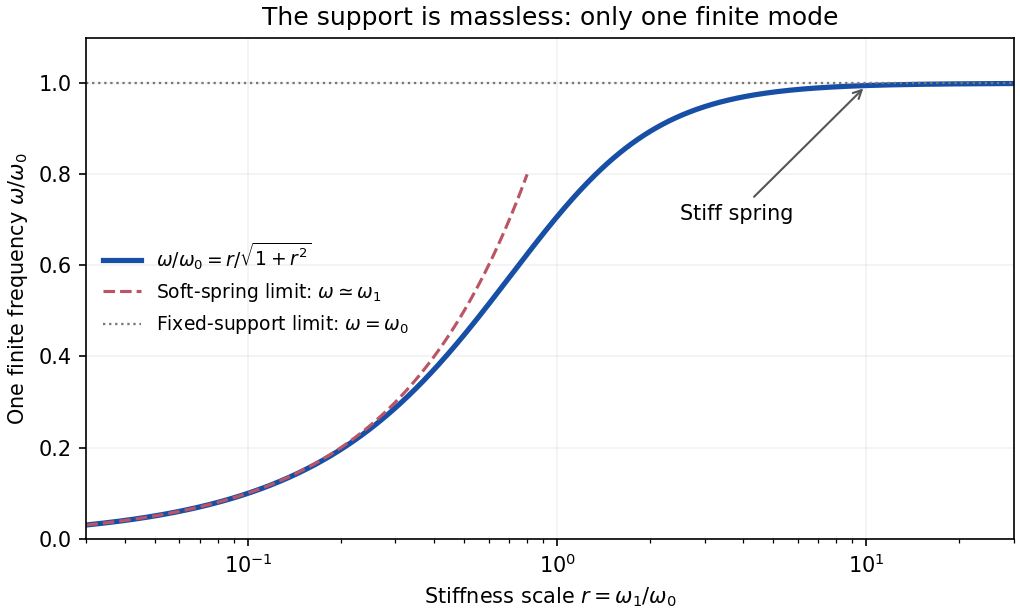
Subtracting the two linearized equations eliminates their acceleration terms:For , the assumed nontrivial simple harmonic motion therefore hasThe support displacement and pendulum angle oscillate in phase. Inserting this relation into either Euler-Lagrange equation yieldsso the one positive finite angular frequency isThe negative frequency describes the same real oscillation after a phase change. For a general phase, replace the sine in both coordinates by .
There is no missing second finite branch. The quadratic Lagrangian iswhose kinetic matrix is and has rank one. Its characteristic determinant is , not a quadratic polynomial in . This singular kinetic matrix in small oscillations results from taking the support mass to be exactly zero. Adding a small support mass restores a second mode that runs to infinite frequency as that mass vanishes.
For a stiff spring,The hinge becomes fixed, recovering the simple pendulum frequency, as expected for the pendulum with a massless spring-mounted support. At finite , horizontal support motion makes the frequency smaller.


Past exam of the theoretical physics I course of the University of Cambridge 2018 2 b Solution 2026-10-18
For the horizontal generalized coordinate ,The corresponding Euler-Lagrange equation isFor , the terms proportional to cancel between and . Hence the other exact equation isKeeping only terms linear in small coordinates and their derivatives givesThe equilibrium is . These characteristic frequencies label gravitational and spring restoring scales; they are not two independent normal mode frequencies of this massless-support system.
Past exam of the theoretical physics I course of the University of Cambridge 2018 2 a Solution 2026-10-18
Use the downward direction of the PDF diagram. The bob's Cartesian coordinates areThusThe hinge and rod are massless, so only the bob contributes kinetic energy:Because gravity points along positive , its gravitational potential energy is . The zero-rest-length spring has elastic potential energy . Put and divide by the positive constant . The equivalent Lagrangian isMultiplying the action by a nonzero constant leaves its stationary paths unchanged. This derivation is a direct use of kinetic energy from Cartesian position vectors; no independent kinetic term should be assigned to the massless support.
Past exam of the theoretical physics I course of the University of Cambridge 2018 1 e Solution 2026-10-18
Let for a nonzero constant magnetic field. Since is constant, the relativistic Lorentz force reduces toThe projection along is constant. In the perpendicular plane define the signed cyclotron frequency ; thenThe explicit rotating velocity isThis is the relativistic cyclotron orbit frequency in laboratory time, reduced from the nonrelativistic frequency by . With nonzero parallel velocity, the trajectory is a helix. If , that perpendicular vector stays zero and has no nontrivial fundamental period; the displayed is the period of a nonzero transverse orbit.
There are unlisted articles, also show them or only show them.