
Robin Hill (biochemist) Created 2026-10-18 Updated 2026-11-05
Robin Hill reported oxygen evolution by isolated chloroplasts. Studying the organelle separately from the whole plant connects a component of photosynthesis with a defined subcellular preparation.
The experiment asks whether the light-driven oxygen-producing machinery can remain functional after isolation. It helped make photosynthesis accessible to direct biochemical analysis.[ref]
Oxygen Evolved by Isolated Chloroplasts by Robin Hill. 1937, public opening paragraph
Institutional biographical record: specialcollections-blog.lib.cam.ac.uk/?p=27166
Frederick Sanger Created 2026-10-18 Updated 2026-11-05
Frederick Sanger coauthored DNA sequencing by chain termination. Incorporation of a chain-terminating nucleotide creates fragments whose lengths report the positions of a particular base.
Resolving fragments by length converts a biochemical copying reaction into sequence information. The key chemical distinction is that a terminating nucleotide lacks the group required for continued chain extension.[ref]
DNA sequencing with chain-terminating inhibitors by Frederick Sanger and others. Primary publication: scientific topic and stated experimental result

Colin Dingwall Created 2026-10-18 Updated 2026-11-05
Colin Dingwall coauthored experiments identifying a protein domain that directs nucleoplasmin into the cell nucleus. Comparing fragments and injection locations separates nuclear import from simple retention after entry.
A domain can provide localization information without being the whole protein. Testing both cytoplasmic and nuclear placement helps distinguish a targeting signal from a feature that merely prevents export.[ref]
A polypeptide domain that specifies migration of nucleoplasmin into the nucleus by Colin Dingwall and others. Figures 2–3, 5, and 7: import and retention comparisons
G. R. Williams Created 2026-10-18 Updated 2026-11-05
G. R. Williams coauthored kinetic measurements of oxygen utilization with Britton Chance. The work relates the time course of mitochondrial respiration to the conditions controlling oxidative phosphorylation.
A bulk oxygen concentration records the balance of consumption and exchange with the environment. Interpreting its slope therefore requires both biochemical and instrumental controls.[ref]
Publication record: pubmed.ncbi.nlm.nih.gov/13271402/
Britton Chance Created 2026-10-18 Updated 2026-11-05
Britton Chance coauthored measurements of oxygen utilization during oxidative phosphorylation. Time-dependent oxygen signals reveal how respiration responds to changes in the available substrates and phosphorylation conditions.
The apparatus must separate genuine oxygen consumption from oxygen ingress and instrumental response. Such controls connect a measured signal slope with a physiological flux.[ref]
respiratory enzymes in oxidative phosphorylation. I. Kinetics of oxygen utilization by Britton Chance and G. R. Williams. Methods, Figures 1–2, and oxygen-ingress cautions

Portrait of Britton Chance
. Ron Kroon / Anefo, Nationaal Archief; existing extraction uploaded by Jan Arkesteijn. CC0 1.0 Universal Public Domain Dedication (current File Licensing section). Source usage terms, via Wikimedia Commons. Source.
J. Heinrich Matthaei Created 2026-10-18 Updated 2026-11-05
J. Heinrich Matthaei coauthored experiments with Marshall Warren Nirenberg using cell-free protein synthesis and synthetic polyribonucleotides to investigate the genetic code.
Supplying a simple RNA template and measuring amino-acid incorporation connects nucleotide sequence with protein composition. The experiment separates the informational role of the template from the catalytic machinery already present in the extract.[ref]
The dependence of cell-free protein synthesis in E. coli upon naturally occurring or synthetic polyribonucleotides by Marshall Warren Nirenberg and J. Heinrich Matthaei. Primary publication: scientific topic and stated experimental result

Portrait of J. Heinrich Matthaei
. Externally hosted portrait identified at commons.wikimedia.org/wiki/File:J._Heinreich_Matthaei_and_Marshall_Nirenberg_(29819142523)_(cropped).jpg. Source.

Marshall Warren Nirenberg Created 2026-10-18 Updated 2026-11-05
Marshall Warren Nirenberg coauthored cell-free experiments connecting synthetic RNA with amino-acid incorporation into proteins. With J. Heinrich Matthaei, he used the response to defined polyribonucleotides to investigate the genetic code.
A defined template changes one component of a complex extract while the other biochemical machinery remains available. This makes the observed incorporation informative about the template's coding role.[ref]
The dependence of cell-free protein synthesis in E. coli upon naturally occurring or synthetic polyribonucleotides by Marshall Warren Nirenberg and J. Heinrich Matthaei. Primary publication: scientific topic and stated experimental result
Additional identity: www.history.nih.gov/illustrated-histories/nih-biographies-plus/nirenberg-marshall-w-1927-2010

Portrait of Marshall Warren Nirenberg
. Externally hosted portrait identified at commons.wikimedia.org/wiki/File:Marshall_Nirenberg.jpg. Source.

Rodney Robert Porter Created 2026-10-18 Updated 2026-11-05
Rodney Robert Porter used proteolytic fragmentation to study antibody structure and binding. His 1958 report describes fractions that retained antigen interaction despite losing the ability to produce the same precipitation behaviour as intact antibody.
Binding and crosslinking are different functions. Separating them chemically helped connect antibody architecture with the different experimental readouts.[ref]
Separation and Isolation of Fractions of Rabbit Gamma-Globulin containing the Antibody and Antigenic Combining Sites by Rodney Robert Porter. Public opening paragraph: digestion, precipitation, and specific inhibition

Portrait of Rodney Robert Porter
. Source. 
Saurabh Upadhyay Created 2026-10-18 Updated 2026-11-05
Saurabh Upadhyay authored an enzyme-coupled spectrophotometric method for measuring pyruvate kinase kinetics. A coupled reaction converts product formation into a change in an optical reporter.
The reporter measures the intended enzyme rate only when coupling is sufficiently rapid and the signal is converted with an appropriate optical path length. This separates an observed absorbance slope from an absolute chemical rate.[ref]
An Optimized Enzyme-Coupled Spectrophotometric Method for Measuring Pyruvate Kinase Kinetics by Saurabh Upadhyay. Graphical overview and Data analysis section 3
Identity source: pubmed.ncbi.nlm.nih.gov/40873479/
Nancy Hall Created 2026-10-18 Updated 2026-11-05
Nancy Hall is an aerospace engineer whose NASA biography describes work on fluid mechanics in microgravity. She moved to the Fluid Physics Branch in 1994 and helped researchers use facilities such as a drop tower and reduced-gravity aircraft, as well as prepare proposed flight experiments.[ref]
In such work, understanding the scientific question and the apparatus are closely connected. A microgravity environment changes the relative importance of gravity compared with other forces acting on a fluid; an experiment must specify the conditions it actually achieves. Her described role linked principal investigators with engineering teams and ground-based facilities, helping translate a proposed measurement into an experiment. The institutional biography provides a historical account of this work rather than a statement of her current assignment.[ref]
Biography of Nancy Hall. Fluid Physics Branch, ground-based facilities and flight-definition experiments

Portrait of Nancy Hall
. Tom Benson Created 2026-10-18 Updated 2026-11-05
Tom Benson is an aerospace engineer whose NASA work connects computational fluid dynamics, wind tunnel measurements and scientific education. In his institutional autobiography, he describes computing three-dimensional supersonic flow through aircraft inlets and studying the movement of fluids in microgravity.[ref]
His educational work developed interactive simulations that behave like small virtual wind tunnels: a student changes inputs, the program calculates a new result, and computer graphics display the response. The accompanying Beginner's Guide to Aeronautics connects those simulations with the underlying equations. This makes the relation between a mathematical model, an adjustable input and an observable prediction part of the explanation itself.[ref]

Portrait of Tom Benson
. Raymond S. Castner Created 2026-10-18 Updated 2026-11-05
Raymond S. Castner is an aerospace engineer whose NASA work includes the interaction between exhaust plumes and shock waves in supersonic flow. His 2010 report describes a wind tunnel model designed to study how an exhaust nozzle changes the near-field pressure pattern associated with a sonic boom.[ref]
Wind Tunnel Model Design for the Study of Plume Effects on Sonic Boom for Isolated Exhaust Nozzles by Raymond S. Castner. NASA/TM-2010-216259, abstract and sections II–III
The apparatus places an isolated nozzle between transparent tunnel walls, allowing Schlieren photography alongside pressure measurements and comparison with computational fluid dynamics. Its geometry was chosen to leave a useful observation region before shock waves reflected from the tunnel walls reached the model centreline. This is an example of experimental design in which the measuring environment itself creates disturbances that must be separated from the physical effect under study.[ref]
Work by Lise Meitner 2026-10-18
Ignore nuclear pairing and use the continuous proportional-fragment model of liquid-drop fission energy. Put , and . As runs from zero to , rises from to . The identity with and givesThe derivative changes sign at most once, from negative to positive. Thus the global maximum on the closed continuous interval occurs at either the no-split endpoint or the symmetric split. If positive fission energy is available, the symmetric value is the global maximum. This qualification matters: symmetry alone makes stationary but does not make it a maximum for all parameters. In fact, requires ; below that value the symmetric split is a local minimum. Real discrete fragments and nuclear-shell corrections are outside this continuous smooth model.
Finite-layer model of Lippmann reflection 2026-10-18
To isolate the readout mechanism, replace the processed photographic emulsion by equally spaced, identical weak scattering planes, with separation . Take the readout refractive index to be real and independent of wavelength, and let be the internal angle from the plane normal. Adjacent specularly backscattered contributions differ in wave phase by . Their geometric series givesHere is a small plane reflection wave amplitude, assumed constant in this illustrative band; at by continuity. Since incident and reflected waves occupy the same external medium, is the model reflectance when transmission factors are absorbed into . Require for the weak-scattering sum to remain self-consistent. Normalizing to discards absolute brightness; it does not predict a highly reflecting historical plate.
The first-order peak obeysThis is Bragg's law with an angle measured from the normal, rather than the glancing Bragg angle. For external viewing angle in air approximated by refractive index one, Snell's law gives , henceThe expression describes specular readout: illumination must supply the matching incident direction. Tilting a plate under fixed narrow illumination can make the signal disappear as well as change its selected colour.
For the chosen and , calculated peaks are at , at , and at . Greater obliquity selects a shorter wavelength. Uniform shrinkage to , with unchanged , multiplies every peak wavelength by : a chosen moves the normal peak to . More generally, at normal incidence. A change of thickness alone is insufficient if processing also changes the refractive index.
Finite gives a finite spectral response. The nearest zeros satisfy , giving . At the normal peak, gives neighbouring zeros at approximately and ; gives and . Thus greater sampled depth narrows the central band in this model. The small-detuning distance from peak to a nearest zero is approximately ; it is not the full width at half maximum.
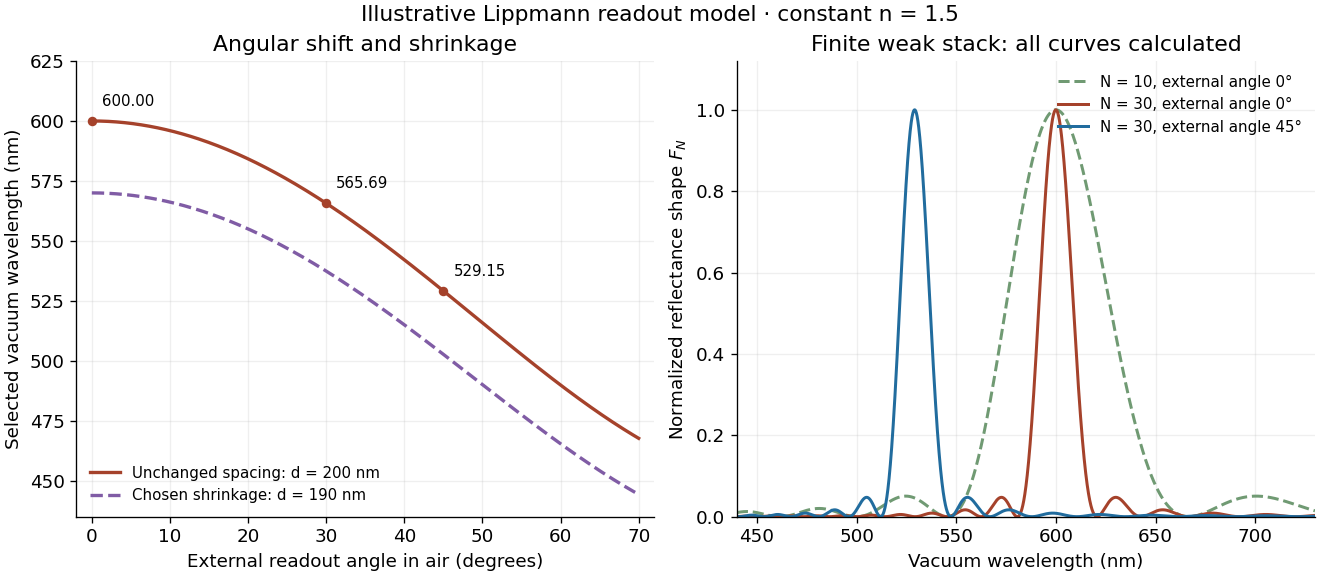
Calculated angular colour shift and finite-stack reflectance shape
. Original weak-scattering finite-grating model with chosen and . Left: predicted first-order peak versus external angle, with a separate illustrative 5 percent shrinkage calculation at unchanged refractive index. Right: normalized , comparing and at normal readout and at external readout. Every curve is calculated; none is a measured spectrum. Source. Details.
Real processed photographic emulsions have a continuous, irregular depth response rather than identical planes. Absorption, wavelength-dependent refractive index, unequal scattering strengths, a nonideal exposure reflector, changes during photographic processing and multiple scattering of light can alter both peak positions and shapes. A transfer calculation with measured material parameters would be needed for quantitative reflectance. The present model explains the phase-selection mechanism and the tradeoff between depth and spectral width; it cannot establish faithful reproduction of an arbitrary incident optical spectrum. Its useful lesson is that a photograph can record colour through sub-wavelength structure, while its eventual appearance still depends on illumination, viewing geometry and processing.
Lippmann fringe spacing 2026-10-18
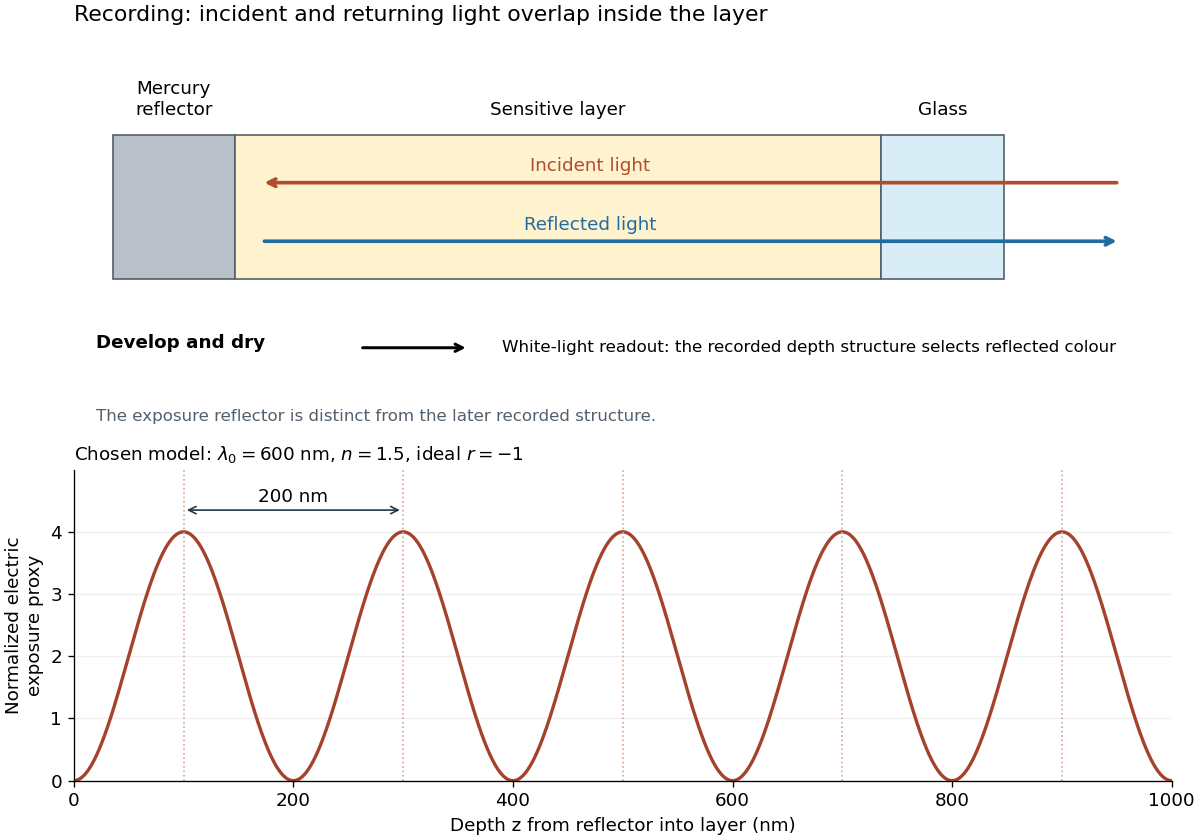
At normal incidence, let measure distance from the reflector into a uniform transparent layer with refractive index . For a monochromatic wave of vacuum wavelength , the layer wavenumber is . Represent the incident and returning electric fields by complex wave amplitudes with time factor suppressed:The time-averaged squared electric field, normalized to the incident contribution, isThis electric exposure pattern has maxima separated byThe wave phase of the reflector shifts the maxima's positions but leaves their spacing unchanged in this uniform-layer model. The electric pattern, rather than the zero net energy flux of an ideal standing wave, is the relevant exposure proxy. An imperfect mirror reduces its contrast: , where denotes this exposure proxy.
Choose and . Then the medium wavelength is and . For an ideal phase-reversing reflector, and the normalized pattern is : its first two maxima are at and . These are chosen calculations, not measured properties of a historical photographic emulsion or the optical response of Mercury.

For multiple mutually incoherent wavelengths, time averaging adds exposure contributions rather than their instantaneous electric fields. In a linearized recording model,Here is incident spectral exposure density, a wavelength-dependent recording sensitivity and a model exposure response. An optical spectrum therefore writes overlapping depth oscillations, not necessarily visibly separated sheets. This is a useful connection to the Fourier transform: approximately, depth is paired with optical spatial frequency . Finite recording depth, varying sensitivity and nonlinear photographic processing prevent treating this expression as an exact inversion rule for an actual plate.
Lippmann colour-recording experiment 2026-10-18
In his 14 December 1908 Nobel lecture, Gabriel Lippmann described a photographic plate bearing a transparent, even, extremely fine sensitive layer. A holder put Mercury against that layer as a mirror during exposure. Incident and reflected light formed a standing wave within the photographic emulsion; after photographic processing and drying, white light revealed colour by selective reflection. The reflector served during recording; the developed structure supplied the later colour selection.[ref]
Colour Photography by Gabriel Lippmann. Colour photography, PDF p. 1, paragraphs beginning The method is very simple and This result is due: apparatus, exposure, development and reflected readout
The lecture's control was to project a spectrum photograph, wet it, and project it again. Its colours disappeared as the gelatin swelled, then returned during drying, red before the shorter wavelengths. This tested a spacing-dependent explanation. Lippmann also reported roughly one-minute sunlight exposures and identified portrait exposure time as a limitation.[ref]
A reversible colour change supports a structural explanation, but does not independently measure every fringe spacing or the refractive index. For a conceptual comparison, record a narrow band and compare reflected optical spectra at fixed illumination and viewing angles; an unexposed processed plate tests background. A second comparison changes only viewing geometry. A third compares the dry state before and after a reversible spacing change. These are proposed discriminating controls, not additional experiments attributed to Lippmann. Background surface reflection must be separated from the selective signal. A photograph's appearance also depends on the illuminating optical spectrum; viewing under an arbitrary lamp is not a calibrated spectral measurement.
Uniqueness of the packed spherical bilayer radius Created 2026-10-18 Updated 2026-11-05
In an incompressible, noninterdigitating lipid bilayer with negligible head-group thickness, let the inner radius be , molecular tail volume and head-group area . Counting heads on both membrane leaflets and conserving tail volume gives . For , the function has derivative , starts at zero and tends to infinity. Thus exactly one candidate outer radius exists in this geometric model. A maximum tail length additionally requires and , where . Uniqueness does not establish compatibility with arbitrary molecular lengths.
Linearly graded junction depletion width 2026-10-18
Integrating the electric field across a linearly graded p-n junction gives , where positive means forward bias. Thus the depletion region width depends on the cube root of the remaining barrier voltage. Both the space-charge density and integration range grow with width; this differs from the square-root width law of an abrupt uniformly doped junction.
Linearly graded junction capacitance 2026-10-18
For a linearly graded p-n junction, the signed p-side depletion charge per area is . Differentiating with respect to positive p-side voltage , using the linearly graded junction depletion width, gives the positive differential junction capacitance per areaThus is linear in . If stored charge denotes the positive n-side magnitude , its derivative with respect to is negative; the positive capacitance is instead for reverse-voltage magnitude . Neither definition uses the zero net charge of the whole depletion layer.
There are unlisted articles, also show them or only show them.