
Synaptic normalization Created 2026-10-14 Updated 2026-11-05
A learning rule can constrain the sum or norm of incoming synaptic weights to prevent unbounded Hebbian learning. For , subtracting the mean unconstrained update from each update preserves the sum. Bounds and renormalization may also be needed to keep excitatory weights nonnegative. Normalization of learning weights is distinct from divisive gain control in instantaneous neural responses.
Non-squeezing theorem 2026-10-14
If there is a symplectic embeddingthen . Symplectic volume alone does not imply this radius obstruction.
Pseudoholomorphic curve 2026-10-14
Symplectic group over a field 2026-10-14
For a finite-dimensional vector space over any field with a nondegenerate alternating bilinear form , the symplectic group over a field consists of invertible linear maps preserving . In a symplectic basis its matrices satisfy . Matching two symplectic bases gives a unique such linear map, and a symplectic basis exists by successively splitting off paired vectors. This includes arbitrary-characteristic and infinite-field versions, beyond the real Lie group and the symplectic group over a finite field.
Capacity preservation under uniform limits 2026-10-14
Suppose diffeomorphisms preserving capacities of solid ellipsoids converge uniformly on compact sets to a diffeomorphism . For , uniform closeness and degree of a continuous mapping give . The capacity axioms squeeze between and . Letting tend to one proves equality. Rescaling a smooth near a point and repeating the argument also proves capacity preservation by its derivative.
Linear capacity rigidity 2026-10-14
An invertible real linear map preserving symplectic capacities of all solid ellipsoids is symplectic or anti-symplectic. For a pair with , if , complete this pair and its normalized transformed pair to symplectic bases. The resulting transpose matrix sends a unit ball into a symplectic cylinder of radius less than one, contradicting the capacity axioms after iterating the resulting linear map: its first coordinate pair contracts geometrically, while the image ellipsoid retains positive capacity. Perturbation handles a zero pairing; using handles absolute value greater than one. Thus the absolute bilinear pairings agree. Their squares agree as polynomials, and the polynomial ring being an integral domain forces one global sign.
Eliashberg–Gromov rigidity theorem 2026-10-14
A locally uniform limit of symplectomorphisms that is a smooth diffeomorphism is symplectic. By capacity preservation under uniform limits and linear capacity rigidity, its derivative is symplectic or anti-symplectic. Repeat this argument after taking the product of every map with the identity on a symplectic plane. An anti-symplectic derivative on the original factor and a symplectic derivative on the added factor would give neither sign on the product, a contradiction. The argument uses symplectic capacities in the original and stabilized dimensions.
Normalized symplectic capacity 2026-10-14
A normalized symplectic capacity has the displayed unit-ball and unit-cylinder values. Dilation gives for both radius- domains. Monotonicity then implies the sharp Gromov non-squeezing theorem.
An opposite-vertex line in the full octahedral symmetry group is an unoriented coordinate axis. Its stabilizer subgroup has the block form , where is a signed two-dimensional permutation matrix and . The eight possibilities for form the dihedral group of a square, of order eight; the independent axial sign gives a cyclic group of order two. Thus the stabilizer is their direct product, of order sixteen. It is larger than the stabilizer of an individual vertex, because exchanging the two endpoints still fixes the line.
The full symmetry group of a cube acts as all signed permutation matrices. The stabilizer subgroups of , and have orders eight, four and six, respectively, and their fixed-point subspaces of a group action are the lines through those vectors. The three group orbits have sizes six, twelve and eight. They therefore give distinct axial types for the equivariant branching lemma. More generally the fixed-space dimension of a vector stabilizer subgroup equals the number of distinct nonzero absolute coordinate values, so these are precisely its one-dimensional types.
// Destination: dynamical-systems.bigb
Body-diagonal stabilizer in the cube symmetry group Created 2026-10-14 Updated 2026-11-05
For vertices , the symmetry group of a cube consists of signed permutation matrices. A matrix preserving the unoriented line through must have all three signs equal, so it has the form , where is a permutation matrix and . Central inversion commutes with every and is not itself a permutation matrix. Consequently identifies this twelve-element stabilizer subgroup with the direct product of groups . A body diagonal is different from a face-normal coordinate axis, whose line stabilizer has order sixteen.
Colour-preserving symmetry group 2026-10-14
Let a group action of on a set be given, and let a function attach a colour label to each point. The colour-preserving subgroup of isIt is a subgroup: the identity map preserves all labels, compositions of two preserving maps preserve them, and replacing by shows that inverse maps preserve them too. Extra object data restrict the allowable transformations; the labels are now part of the object rather than bookkeeping for a drawing.
For a geometric square, take , of group order eight. If all four vertices have the same colour, all eight maps remain. If two adjacent vertices are red and the others blue, only the identity and one reflection remain. Putting the two red vertices opposite one another instead leaves four maps: the identity, a half-turn rotation, and the two diagonal reflections. Giving all four vertices distinct colours leaves only the identity.
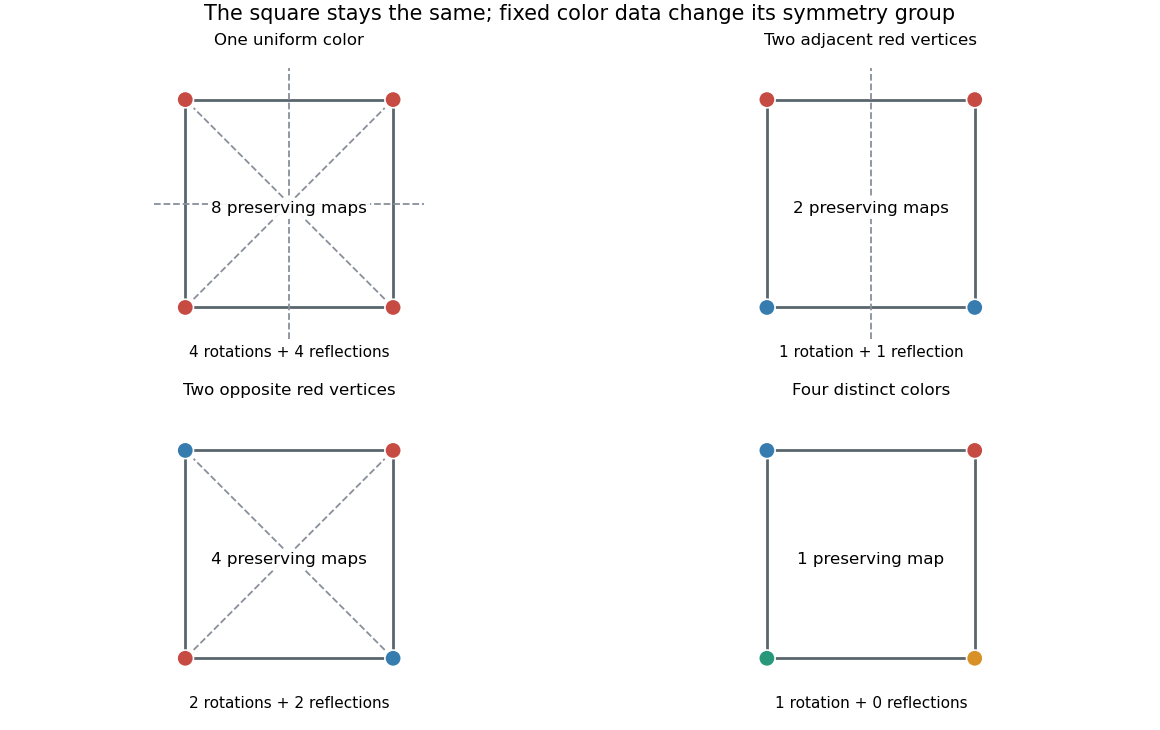
Fixed vertex colours restrict the geometric symmetry group
. Original computed examples. Counts refer to Euclidean motions of the square that preserve each vertex colour. Two adjacent red vertices and two opposite red vertices have the same colour counts but different symmetry groups. Dashed lines show surviving reflection axes; the rotation labels count surviving rotations including the identity. Details.
The count alone does not specify the pattern. Both two-red examples have the same number of red and blue vertices, but their stabilizer subgroups differ. For a single red vertex, the orbit-stabilizer theorem gives a group orbit of size four and a stabilizer subgroup of group order two, agreeing with the existing group action illustration. Such counts identify equivalent placements without treating each placement as a new geometric case.
Symmetry depends on preserved structure 2026-10-14
Take the four-point setthe vertices of a polygon of a rectangle whose side lengths are four and two. Three choices of structure give three different symmetry groups on these same points.
As an unstructured set, has all permutations as symmetries, forming the symmetric group . If Euclidean distance is part of the data, the allowed maps are only the identity, a half-turn rotation, and the reflections across the two coordinate axes. They form a Klein four-group of group order four. To see that nothing is missing, fix the image of one vertex of a polygon: its three other distances, , , and , are distinct, so they uniquely determine the images of the remaining vertices.
Preserving affine structure permits more. The affine mapcycles all four points of . It sends a horizontal side of length four to a vertical side of length two, so it is not an isometry. Yet it preserves the rectangle's vertex set and all affine combinations among those points.
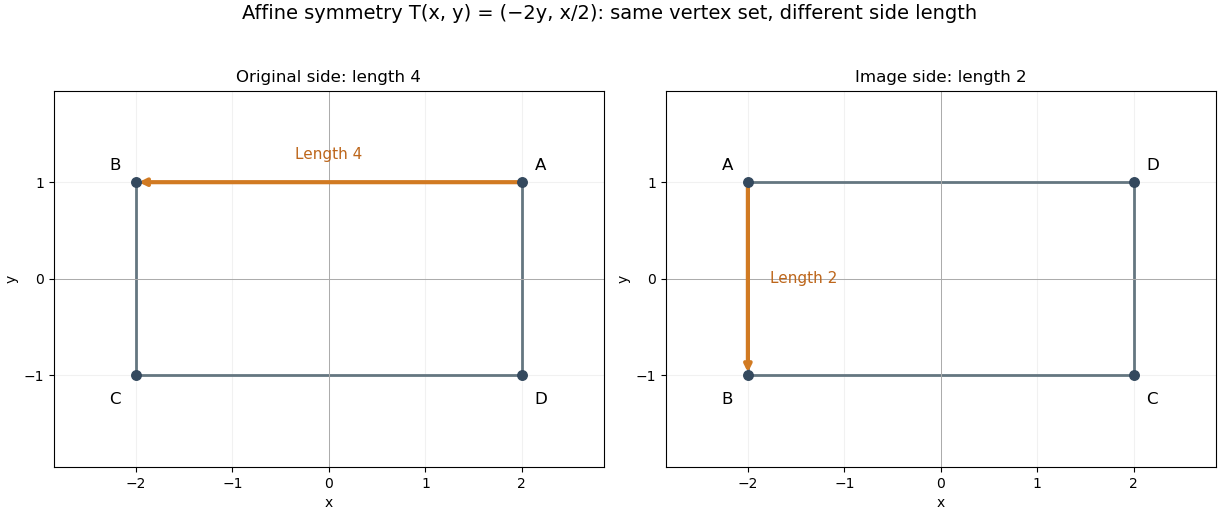

Let and let be the square's quarter-turn rotation. ThenConjugating every square symmetry by gives eight affine maps preserving . This group isomorphism makes the affine symmetry group a dihedral group, although some of its maps do not preserve the original Euclidean distances. There are no further affine symmetries: an affine map preserves the common midpoint of the diagonals, so it must preserve opposite pairs. The image of one vertex has four choices and the image of an adjacent vertex has two; those choices determine the map through three noncollinear points.
ThusAn arbitrary permutation need not be an affine map. For example, exchanging the two top vertices while fixing the two bottom vertices sends the common diagonal midpoint to two different points, which no single affine map can do. The phrase "the symmetry of these points" becomes unambiguous only after stating which structure matters.
Symmetry transformation 2026-10-14
A symmetry transformation is a bijection preserving the data that define the object's symmetry group. Its individual group elements are symmetry transformations; the group operation combines them by function composition.
For indentation , the common layer displacement is . The boundary layer stream function gives velocity and pressure . Substitution into the Prandtl boundary-layer equation yields the displayed equation, with and . This is a conditional similarity construction: the constant must permit a solution of the boundary value problem.
Symmetric closure 2026-10-14
The symmetric closure of a binary relation is , where means . Every symmetric relation containing contains all these reversed pairs, proving minimality.
Signed gluing-map reduction Created 2026-10-14 Updated 2026-11-05
Consider the branch return mapwith , , and nonzero return coordinates. After one iterate, . On these two sign sheets, define . Then and , givingThis scalar equation describes the signed gluing-map reduction.
A negative scalar fixed point has , so and the next is unchanged. The two sign choices therefore lift it to two symmetry-related fixed points of the original return map. A positive scalar fixed point instead has ; both and change sign on each step, giving one period-two orbit.
The value zero needs separate interpretation. In the underlying homoclinic orbit model it is the separatrix limit, where the flow's return time diverges. A formal continuous extension of the scalar formula at zero does not supply an ordinary finite-period periodic orbit. All branch iterations used to model finite flow returns must remain in the valid nonzero local domain.
Lorenz power return map 2026-10-14
For a symmetric real saddle with one unstable direction and a strongly contracting transverse direction, composing the power-law local passage with a smooth global return gives this leading Poincaré return map, with and saddle index . It is undefined at the stable-manifold crossing . For , small fixed points on each branch are attracting for ; for an attracting alternating-sign period-two orbit satisfies , giving gluing of two one-lobe flow cycles into one two-lobe cycle. For and small , on , , the inverse branchesmap into and contract. Infinite branch choices define an invariant Cantor set with full two-symbol dynamics. In the two-dimensional return, transverse contraction turns this mechanism into a Smale horseshoe. An attracting Lorenz set additionally requires appropriate trapping and global-return properties.
Permutation group Created 2026-10-14 Updated 2026-11-05
A subgroup of the symmetric group of a set, acting faithfully by permutations. A finite permutation group specified by generators can be enumerated by repeatedly multiplying the elements already found by those generators until no new element appears. Its orbits and conjugacy classes can then be computed directly.
Automorphisms of the symmetric group Created 2026-10-14 Updated 2026-11-05
An automorphism preserving the transposition class is inner: commuting relations recover the vertex stars of the complete graph, with a small-case adjustment in degrees three and four. An involution class has the same size as the transposition class only in degree six, when triple transpositions also have size fifteen. Hence outer automorphism groups of symmetric groups are trivial outside degree six and have size at most two in degree six.
// Target: combinatorics.bigb
There are unlisted articles, also show them or only show them.