
Isobaric conductive cooling in mass coordinates Created 2026-10-14 Updated 2026-11-05
With fixed pressure , let , so . A material mass coordinate has and the material time derivative becomes . The energy and continuity equations then give the displayed equation with and . A mass integral from a fixed origin is material only when the mass flux there vanishes; otherwise subtract its time-integrated flux to label parcels. Uniform pressure is a low-Mach approximation when sound crossing is faster than thermal evolution.
Temperature dipole around an insulating sphere Created 2026-10-14 Updated 2026-11-05
In the absence of heat advection, an insulating sphere of radius in a uniform remote temperature gradient has the displayed exterior harmonic function as its temperature field. The reflected dipole term makes at . The surface temperature is , so the tangential gradient is amplified by . If the sphere has thermal conductivity ratio relative to its surroundings, temperature and heat-flux continuity instead give surface gradient factor .
Thermal resistance Created 2026-10-14 Updated 2026-10-18
Thermal resistance measures the temperature drop required to drive a given rate of heat transfer. For the steady one-dimensional bar model in thermal conduction,Here relates the temperature drop to heat flux, while relates it to the rate of heat transfer. The single bar above has and , so its drop drives .
To see why series thermal resistances add, apply Fourier's law in each layer to obtain . With no accumulation or side losses the rate of heat transfer is the same through both, so adding the drops gives . This lets us size layered walls without solving a new differential equation for every layer. The structure matches Ohm's law: temperature difference plays the role of electric potential difference, the rate of heat transfer plays the role of electric current, and thermal resistance plays the role of electrical resistance. [ref]
https://web.mit.edu/16.unified/www/FALL/thermodynamics/notes/node118.html. E. M. Greitzer, Z. S. Spakovszky and I. A. Waitz, MIT Thermodynamics and Propulsion, section 16.4: series thermal resistances and the electrical analogy
Regular tetrahedron 2026-10-14
Circumcenter of a tetrahedron 2026-10-14
For independent edge vectors , , , the displacement solves , , . The reciprocal cross-product basis gives the displayed formula. Its squared distances to all four vertices are equal. It need not lie inside the tetrahedron.
Incenter of a tetrahedron 2026-10-14
The center of the sphere tangent to all four faces is the positive face-area-weighted combination of the opposite vertices. If is the volume and the total face area, its distance from each face is . Indeed its weight for vertex is and the corresponding altitude is , so their product is the common distance. Positive weights place it inside the tetrahedron.
Tetrahedron centroid-to-midpoint sum of squares Created 2026-10-14 Updated 2026-10-18
Place the centroid of a tetrahedron at the origin, so its four vertex vectors satisfy . Midpoints of opposite edges have opposite vectors, hence equal distances from the centroid. For the three opposite-edge pairs, choose midpoint vectors , . Expanding their squared lengths and using givesThe argument uses no regularity or equal-edge assumption on the tetrahedron.
For the tetracode length-isospectral lattice construction , choose the first coordinate divisible by three and reverse its sign. Such a coordinate always exists because each nonzero tetracode word has one zero coordinate. The reflection preserves the reduction modulo three and switches the two lattice membership conditions modulo four. It is an involution between and preserving every absolute coordinate, so arbitrary positive diagonal weights preserve equality of their vector-length multisets.
Add respectively the conditions and to the displayed common conditions. These define the two integer Euclidean lattices underlying the tetracode length-isospectral lattice construction. They coincide on their all-even vectors and differ on all-odd vectors. Reflecting a coordinate divisible by three preserves the code condition; on odd vectors it changes the coordinate sum by two modulo four, while on even vectors both conditions remain satisfied. This yields the coordinate reflection bijection for tetracode lattices.
Choose positive axis weights linearly independent over the rationals, and suppose both integer Euclidean lattices contain for some positive integer . A length-preserving linear map sends each to an integer vector with exactly that absolute-coordinate pattern, by the displayed implication. Thus the map must be a diagonal sign change. For the four-coordinate tetracode, preserving the code forces all four signs to agree, because each of its four nonzero projective words has support on a different triple of coordinates. A global sign cannot exchange the two odd-vector parity conditions, proving nonisometry for these weights.
Terminal velocity under linear drag 2026-10-14
Consider a point mass of fixed mass released from rest in a stationary medium. Choose downward as positive, assume constant gravitational acceleration , neglect buoyancy, and impose linear drag with constant linear friction coefficient . Here is the signed downward velocity component; it equals speed during this descent. Newton's second law becomesThe terminal velocity balances the two forces, and the time constant controls how quickly that balance is approached:For the illustrative parameters , and , the time constant is and the terminal velocity is downward. At , the downward velocity is and the downward acceleration is . This is a toy linear drag model, not a claim that every falling object has this resistance law.
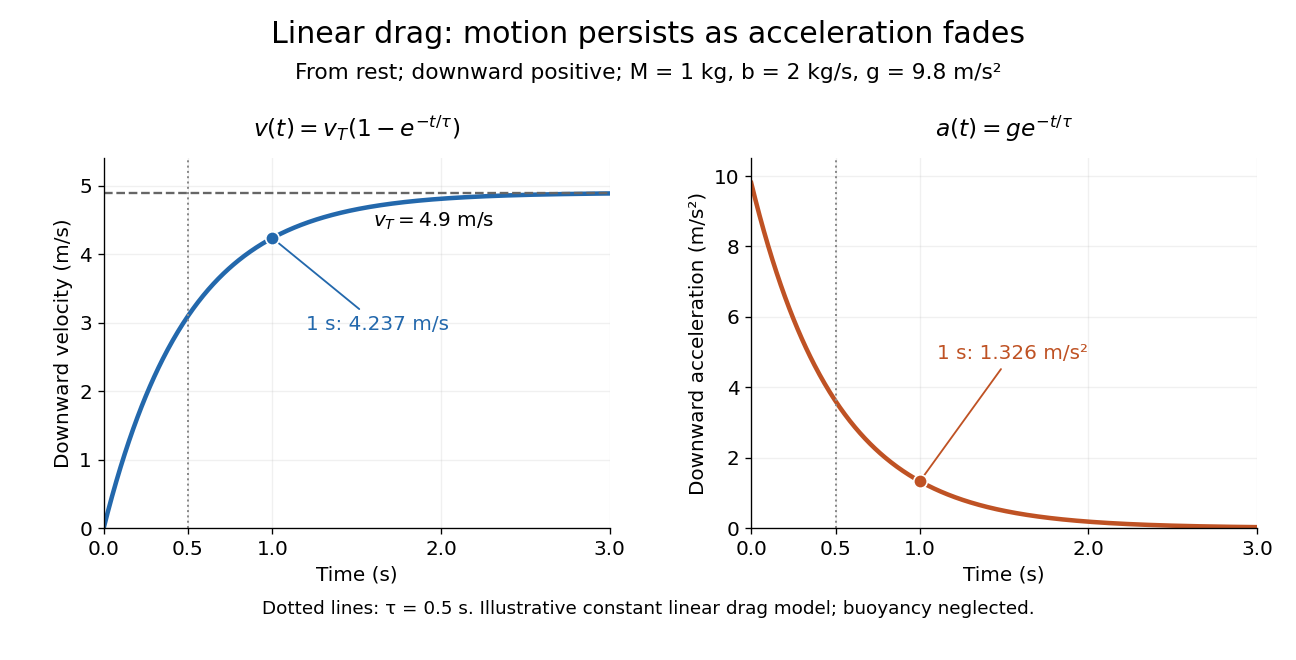
Exponential approach to terminal velocity and decay of acceleration in an illustrative linear drag model
. Details. 
For a proof outline, subtract the equilibrium value: obeys . The exponential decay solution and the initial condition give ; one derivative gives the acceleration. Every time constant multiplies the remaining gap by . The exact limit is reached only as . This makes the model useful for estimating a settling duration without mistaking vanishing acceleration for vanishing velocity.
Newton already analyzed vertical motion under uniform gravity and resistance proportional to velocity in Book II, Section I, Proposition III of the Principia. His geometric construction includes a greatest downward velocity, illustrating that a limiting rate can emerge from balancing a driving force and resistance. [ref]
https://en.wikisource.org/wiki/The_Mathematical_Principles_of_Natural_Philosophy_(1729)/Book_2/Section_1. Newton, Principia, Book II, Proposition III; Motte's 1729 translation
For , the interval is invariant under the second iterate of the tent map. The affine coordinate conjugates that restriction to the tent map with parameter . Its two linear pieces give the identity directly. This turns the two-iterate horseshoe threshold into a four-iterate threshold and explains why chaotic invariant sets need not have periodic points near the original nonzero fixed point.
Core interval of an expanding tent map Created 2026-10-14 Updated 2026-11-05
Restrict to , with . Its image is the closed intervalBecause and , its next image is again . Every state in therefore enters this invariant core after at most one iterate and remains there. This is the core used in interval exactness of a tent-map core.
Right exactness of the tensor product 2026-10-14
For a short exact sequence and any module , the sequence is exact. The last map is surjective since every pure tensor can be lifted using a preimage of . Put . There is a well-defined balanced map , sending to the class of : replacing by changes it by an element of the discarded image. This induces , inverse to the map induced by . Thus the kernel of is exactly the image of . Consequently a module is flat exactly when tensoring with it also preserves injections.
Fundamental-antifundamental decomposition for SU(N) Created 2026-10-14 Updated 2026-11-05
Identify the product with endomorphisms of the defining space. Special unitary group conjugation fixes scalar matrices and preserves the complementary traceless subspace. For , the latter is the complex Adjoint representation of a Lie algebra, which is irreducible because is simple. With fundamental Dynkin index , the trace-Casimir identity gives ; the tensor-product Casimir trace identity then gives .
External tensor product of group representations Created 2026-10-14 Updated 2026-11-05
For a -representation and an -representation over the same field, is the representation of on given by . Its character is . For finite groups , over a splitting field for finite group representations in characteristic zero the external products of irreducible representations form all irreducible representations of : character orthogonality gives irreducibility, and their squared degrees sum to , proving exhaustion. Unlike the tensor product of two representations of one group, the two factors here act independently.
Two-factor tensor rank 2026-10-14
The two-factor tensor rank is the smallest number of pure tensors whose sum equals , with zero allowed as the empty sum. For two finite-dimensional vector spaces over the same field, it equals the matrix rank of the tensor-product coefficient matrix. A sum of outer products has column space contained in the span of their first factors, so its matrix rank is at most . Conversely, choose a basis for the column space, express each column in that basis, and collect the coefficients into row vectors . This yields , hence a sum of pure tensors.
The pure tensor therefore has two-factor tensor rank one, whereas has two-factor tensor rank two. Both have two factors: the number of factors and the minimum number of product summands are different counts. Over the real numbers, the singular value decomposition supplies a useful decomposition , with one nonzero term per matrix rank. The two-factor rank equality does not extend to three or more factors by merely choosing one matrix layout.
Separability of a tensor 2026-10-14
In a two-factor tensor product over a field, a pure tensor is also called a separable or decomposable tensor: it can be expressed as one product . Every tensor is a finite sum of pure tensors, but a sum need not itself be a pure tensor.[ref]
Tensor Products I by Keith Conrad. §3, printed p. 9: elementary, simple, decomposable, and pure tensors; Example 2.1, printed pp. 4–5: outer products do not fill the matrix space
For finite-dimensional vector spaces, the tensor-product coefficient matrix gives a decisive test: a nonzero tensor is a pure tensor exactly when its matrix rank is one. Indeed, every column of is a scalar multiple of . Conversely, if all columns of a nonzero matrix are multiples of one nonzero column , collect their multipliers in to obtain . The zero tensor is also a pure tensor, for example , but its matrix rank is zero.
In , the tensoris nonseparable: its matrix rank is two and its determinant is one, whereas . Directly, trying requires and . The first two equations force all four scalars nonzero, contradicting the others. In contrast, products sharing a factor do combine: . Thus being written as two summands alone does not establish nonseparability.
Antisymmetric tensor 2026-10-14
An antisymmetric tensor changes sign under exchange of two indices in a specified subset of its indices. A totally antisymmetric tensor has this property for every pair of indices.
Tensor index symmetrization 2026-10-14
Symmetrization over selected tensor indices is the average over all permutations, with every sign positive. Parentheses denote this operation, for example . It is a projection onto the symmetric part and commutes with a covariant derivative acting on indices outside the parentheses.
There are unlisted articles, also show them or only show them.