
Stephen C. Tovey Created 2026-10-14 Updated 2026-11-05
A researcher who coauthored an account of IP3 receptor activation, relating receptor structure, ligand action and cytosolic calcium regulation. The work distinguishes a channel’s capacity to open from the interacting signals that determine its behavior in a cell.[ref]
Publication record: pubmed.ncbi.nlm.nih.gov/20980441/
Colin W. Taylor Created 2026-10-14 Updated 2026-11-05
A researcher who coauthored an account of IP3 receptor activation, relating receptor structure, ligand action and cytosolic calcium regulation. The work distinguishes a channel’s capacity to open from the interacting signals that determine its behavior in a cell.[ref]
Homepage: www.phar.cam.ac.uk/research/taylor
Thomas J. Fellers Created 2026-10-14 Updated 2026-11-05
Thomas J. Fellers is credited with Michael W. Davidson as an author of Linear Measurements (Micrometry) by Thomas J. Fellers and Michael W. Davidson, an educational account of quantitative optical microscopy. Its byline associates the authors with the National High Magnetic field Laboratory at Florida State University. [ref]
Linear Measurements (Micrometry) by Thomas J. Fellers and Michael W. Davidson. Contributing Authors byline
The account explains how a stage micrometer calibrates an eyepiece reticle. Matching a known specimen-plane length to reticle divisions converts an arbitrary scale into a physical measurement. Changing the objective lens changes that calibration, so magnification alone is insufficient for reliable microscopy. The article also discusses optical resolution and errors in locating scale edges. [ref]
Linear Measurements (Micrometry) by Thomas J. Fellers and Michael W. Davidson. Eyepiece Reticle Calibration, Figure 4; Conclusions
Supercritical fluid Created 2026-10-14 Updated 2026-11-05
A supercritical fluid is a fluid at temperature and pressure above its liquid-gas critical point. There is then no liquid–vapor coexistence boundary separating distinct bulk liquid and gas states. Density can change continuously from relatively gas-like to relatively liquid-like values along a suitable path.
This continuity does not mean that all supercritical states have identical properties. Density, compressibility, viscosity and solvent behavior can vary strongly, particularly near the critical region. Pressure can therefore tune a supercritical solvent's ability to dissolve material without crossing a boiling boundary. The absence of a liquid–vapor boundary applies to that transition; freezing or other transitions can still occur elsewhere in the phase diagram.
Weighted three-vector matroid 2026-10-14
Take labels and vectors in the real vector space :Here is the complete independence check for all eight subsets. The empty set is independent. Each of is independent because its vector is nonzero. Every pair is independent: the determinants of the two-column matrices , , and are respectively , , and . The triple is dependent because . ThereforeDeleting elements from any listed subset stays in this list, verifying heredity. Every exchange comparison has sizes , , or . From the empty set, any element of the larger matroid independent set works: this covers three singleton targets and three pair targets. From any singleton to any pair, every element of the pair outside the singleton works, since every resulting pair is independent. This covers all nine singleton-pair comparisons, including disjoint ones. There are no other comparisons: all fifteen ordered size-increasing pairs satisfy exchange.
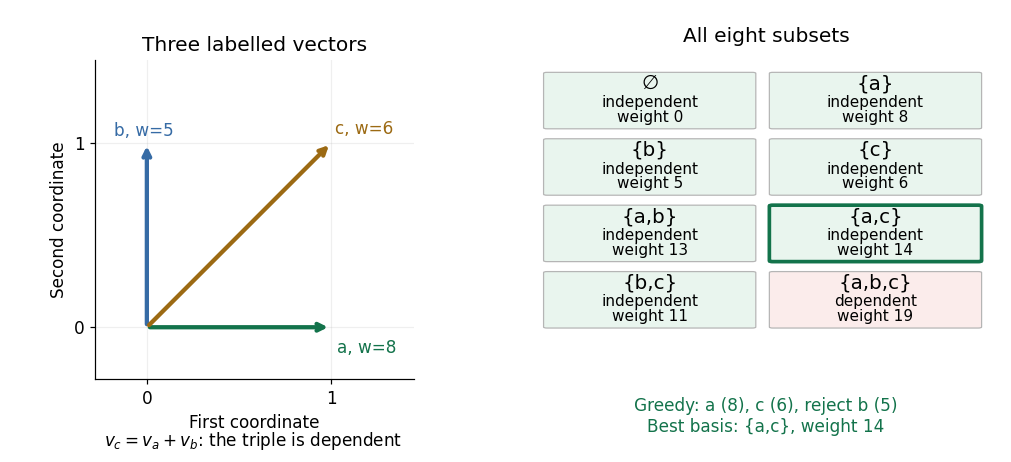
Three vectors have three independent pairs and one dependent triple; the heaviest matroid basis is with weight
. Details. 
The three matroid bases are , , and , all of cardinality two, with weights , , and . The matroid greedy algorithm considers , then , then : it admits , admits because their determinant is nonzero, and rejects because the triple is dependent. The resulting matroid basis has weight , the largest of the three totals. Every singleton can grow, so none is maximal; the three pairs are both maximal and maximum in cardinality.
Meridional ray 2026-10-14
A light ray whose path remains in a plane containing the optical axis. In a straight step-index optical fiber, this geometry gives the complementary axis and interface-normal angles used to derive the optical fiber acceptance angle.
Thick lens 2026-10-14
A thick lens retains the separation of its refracting surfaces when predicting image formation. In the paraxial approximation with air on both sides, object and image distances measured from the respective principal planes satisfy the familiar imaging equation. Measuring instead from one mechanical centre generally introduces an error.[ref]
Refracting systems (details), University of Tennessee physics teaching resource. University of Tennessee physics teaching resource, Refracting systems (details), final paragraph: object and image distances must refer to the principal planes
Work by Lawrence H. Pinto 2026-10-14
Work by Kazuaki Yamazawa 2026-10-14
Work by Kary Mullis 2026-10-14
Work by Joshua A. Hadler 2026-10-14
Work by Joseph S. Takahashi 2026-10-14
Work by Jonathan Pearce 2026-10-14
Work by Jon M. Kornhauser 2026-10-14
Work by John P. Perkins 2026-10-14
Work by John N. Fain 2026-10-14
Work by John H. Lehman 2026-10-14
Work by James Taylor (metrologist) 2026-10-14
Work by J. K. Northup 2026-10-14
Work by J. Adolfo García-Saínz 2026-10-14
There are unlisted articles, also show them or only show them.