
Coherent preparation and incoherent mixing 2026-10-14
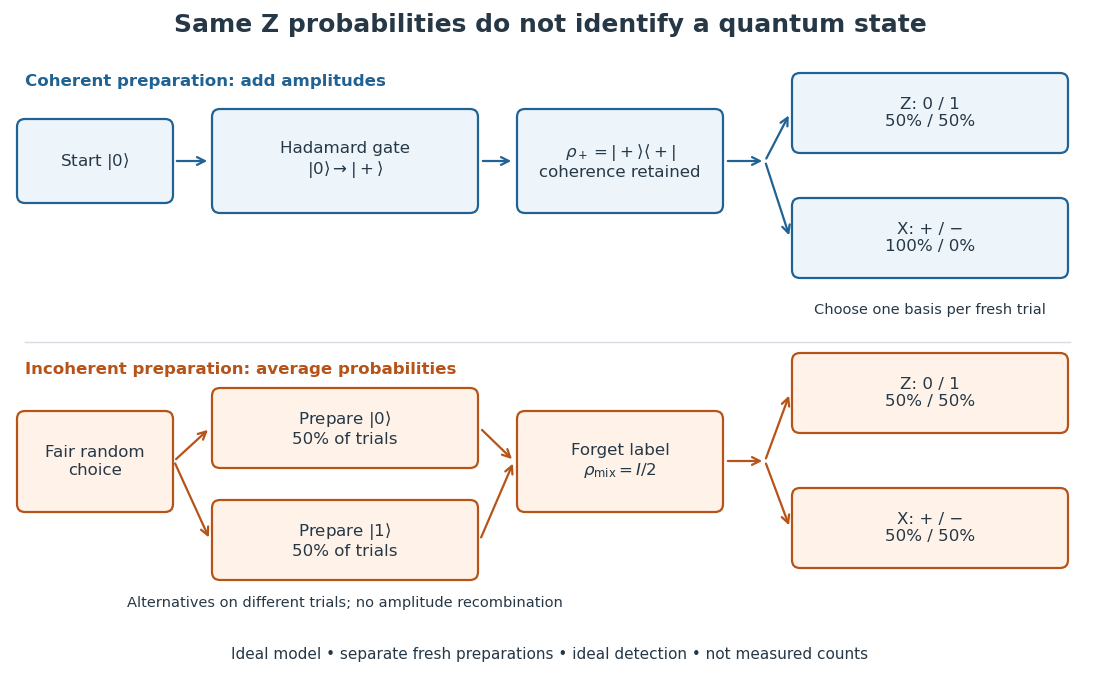
Choose the qubit computational basis , also called the basis, and the Hadamard basis , also called the basis. Compare a coherent preparation of with choosing or at random with equal probabilities and discarding that label:These are original ideal preparation models. Their -basis probabilities are both , because their quantum state populations agree. Their -basis probabilities are respectively and . Indeed , whereas . The missing off-diagonal quantum coherence therefore changes a prediction that the common populations cannot determine.
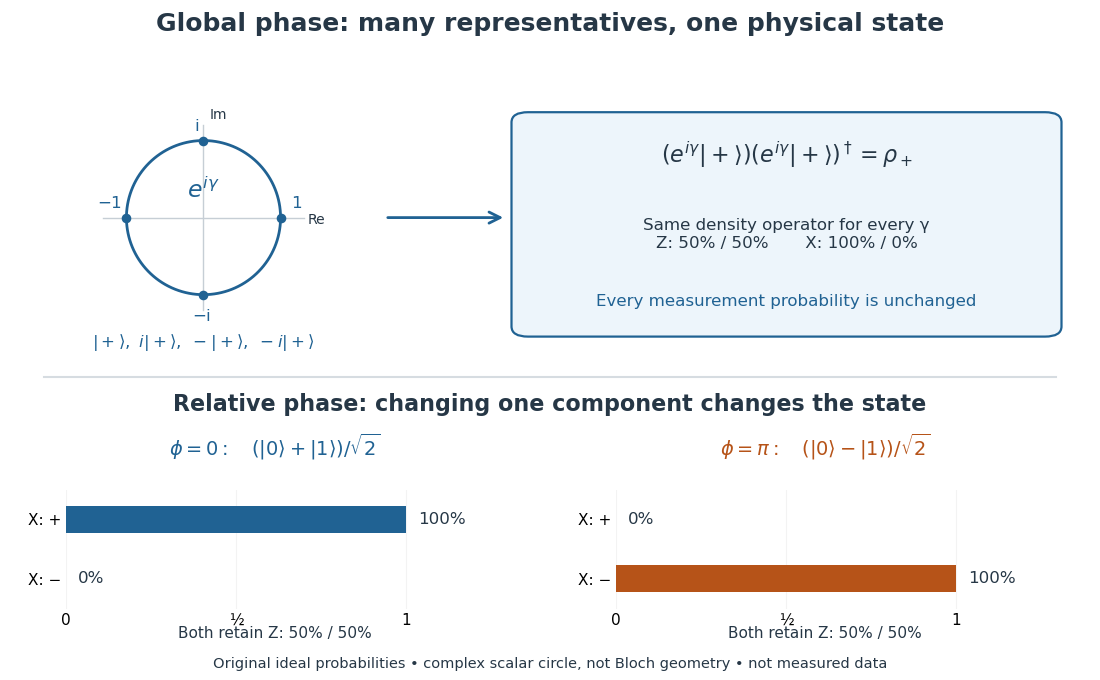
For a relative quantum phase , the coherent family instead hasThe last formula follows by adding or subtracting the two probability amplitudes before taking the squared modulus. At , the state is and the outcomes switch to , while the outcomes remain . In contrast, changes both components by the same global phase and retains the outcomes . In photon polarization, the identification , makes and the two orthogonal diagonal linear polarizations; these labels describe measurement bases, not spatial axes for photon spin.
Even perfect statistics in one basis cannot certify a preparation. The above data fit both density matrices. Conversely, distinct preparation histories can yield the same quantum state:The off-diagonal terms cancel in the right-hand ensemble. Every measurement on the qubit alone then has identical probabilities for those two histories. A retained classical label would allow conditioning on different members of the quantum state ensemble; it is extra information beyond the unlabelled density operator.
Quantum state ray Created 2026-10-14 Updated 2026-10-20
A quantum state ray is the equivalence class of nonzero vectors in a complex Hilbert space under multiplication by a nonzero complex number. Its span is a one-dimensional linear subspace, but the zero vector is not a state representative. A unit vector fixes the norm and leaves a global phase free. [ref]
Foundations I: States and Ensembles by John Preskill. Preskill, Foundations I: States and Ensembles, §2.1, printed p. 2, ray equivalence and normalized representatives
For a nonzero representative , the associated pure state density operator isReplacing by multiplies both numerator and denominator by , so the quotient is unchanged. In particular, for every POVM effect ,This proves that a global phase changes no measurement probability. Changing the relative quantum phase of two nonzero components can change the density operator, as the following comparison shows.
Pyruvate 2026-10-14
Logical equivalence Created 2026-10-14 Updated 2026-10-25
Two propositional formulas are logically equivalent in classical propositional logic when they have the same truth value under every Boolean valuation. Identical output columns in a truth table prove logical equivalence; one differing row refutes it. De Morgan's laws give useful examples.
Finite population variance 2026-10-14
For , the finite population variance measures spread about the finite population mean. Survey-sampling formulas commonly use denominator ; the denominator- version is . The normalization must be specified when using a finite population correction.
Finite population mean 2026-10-14
The finite population mean for is the arithmetic mean of all fixed values in the target population. Under simple random sampling, the sample mean is an unbiased estimator of it.
Unequal probability sampling 2026-10-14
Unequal probability sampling assigns different inclusion probabilities to different population units. Estimating an unweighted population summary generally requires accounting for these differences in the estimator.
Inclusion probability 2026-10-14
An inclusion probability is the probability that a particular unit belongs to the selected sample. For sample size in simple random sampling from labels it is . It differs from the selection probability at a particular draw position.
Sampling with replacement Created 2026-10-14 Updated 2026-11-05
Sampling with replacement returns each selected label to the available population before the next draw. Independent uniform draws from a fixed population are independent and identically distributed; a label can recur. Replacement by itself does not imply uniformity or independence.
Pressure sensor Created 2026-10-14 Updated 2026-11-05
A pressure sensor converts a pressure into a recorded signal. An absolute pressure sensor uses a vacuum reference; a gauge pressure sensor uses a specified reference pressure. A closed gas syringe and an absolute pressure sensor can test Boyle's law after allowing the temperature to stabilize.
Mersenne number 2026-10-14
A Mersenne number has the form for a positive integer . Its binary representation consists of ones. For example, is composite, while is prime. If with , the finite geometric series factorizationhas two factors greater than one. Consequently a Mersenne prime requires a prime exponent, but shows that this condition alone is insufficient.
Place value 2026-10-14
The place value is the weight of a position in positional notation. A numeral digit at that position contributes to the represented number.
Radix 2026-10-14
The radix is the base of positional notation. In the ordinary integer-base case it is an integer , and successive place values differ by a factor of .
Numerical digit Created 2026-10-14 Updated 2026-10-20
A numerical digit is one symbol in a positional notation string, denoting an integer from zero through one less than the radix.
Parallelepiped Created 2026-10-14 Updated 2026-10-18
A parallelepiped is a polyhedron with six parallelogram faces in three opposite pairs. Three generating vectors determine its edges; the absolute value of their determinant gives its volume in orthonormal Cartesian coordinates.
Pollen tube Created 2026-10-14 Updated 2026-10-20
A growing extension from a pollen grain. In a compatible flower, the pollen tube provides a route for sperm to the angiosperm female gametophyte.[ref]
Polarimeter Created 2026-10-14 Updated 2026-11-05
A polarimeter uses polarizers to compare the direction of linear polarization before and after light passes through a sample; polarimetry explains the apparatus, readout and controls.
Gaussian Poisson summation identity 2026-10-14
Take the Gaussian function with . Every derivative is a polynomial times the same Gaussian function, so is a Schwartz function. The Fourier transform of a Gaussian gives, in the cycles convention,Thus the Poisson summation formula gives the exact identityThe Gaussian Fourier transform is given in scaled form in Exercise 41 of Terence Tao's 245C, Notes 2: The Fourier transform.[ref]
245C, Notes 2: The Fourier transform by Terence Tao. §3, Exercise 41: transform of a scaled Gaussian; put r=1/sqrt(a) and adjust its prefactor
The identity is also the imaginary-axis transformation of the Jacobi theta function. At the Gaussian function is its own Fourier transform; at reciprocal values of its spatial and spectral widths exchange.For a short derivation of the Gaussian Fourier transform, write . Differentiation under the integral and integration by parts, using , giveThe Gaussian integral gives , so this ordinary differential equation yields the claimed formula. The decay of the Gaussian function justifies these steps and removes the boundary term.[ref]
Lecture 17: The functional equation. Lecture 17, §17.1, Lemma 17.9 and proof, printed p. 3: differential-equation proof for the unit Gaussian; scaled here to a>0
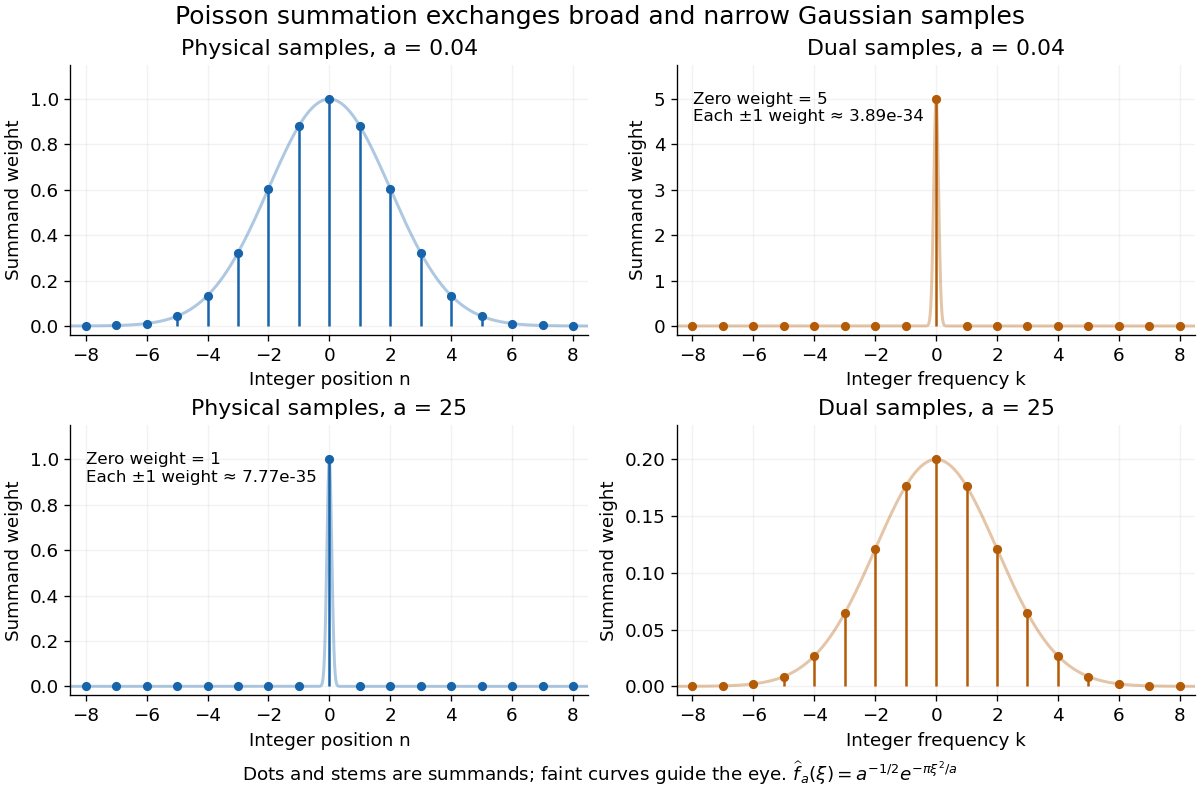


For , the physical Gaussian function has width parameter , while its Fourier transform has width parameter . Many physical samples matter, but the dual zero sample already givesFor , use the physical side instead:These are bounds on the full positive tails, obtained below, rather than estimates based only on the first omitted term. Ordinary floating-point arithmetic rounds these sums to and ; the exact real numbers are slightly larger. A Gaussian sum truncation bound lets us choose the cheaper side and certify its truncation error before evaluating it.
Encircled energy 2026-10-14
Encircled energy is the fraction of total image radiant flux within a circle of radius around the centre of a point spread function.
Work by Phillip L. Lowrey 2026-10-14
There are unlisted articles, also show them or only show them.