
Work by Irene Schulz-Hofer 2026-10-14
Finite calcium-store release model 2026-10-14
For an original mathematical model, imagine a sustained, imposed release pathway, with no store refill during the plotted interval. Let be releasable store amount of substance, excess freely dissolved cytosolic calcium amount of substance, and the cumulative amount removed from into a separate sink. Choose , , cytosolic volume , release rate constant and clearance rate constant . These are stipulated values, not physiological measurements or a model of IP3 receptor gating.
Assume fixed volume, uniform mixing, no binding, no reverse transfer, no outside entry and first-order loss from each donating compartment. ThenThe last equality is conservation of mass for the tracked calcium across the store, mobile excess and sink together; it does not assert conservation inside a biological cell if the sink represents export. A constant background is held separate from this excess bookkeeping. Since , the response is .
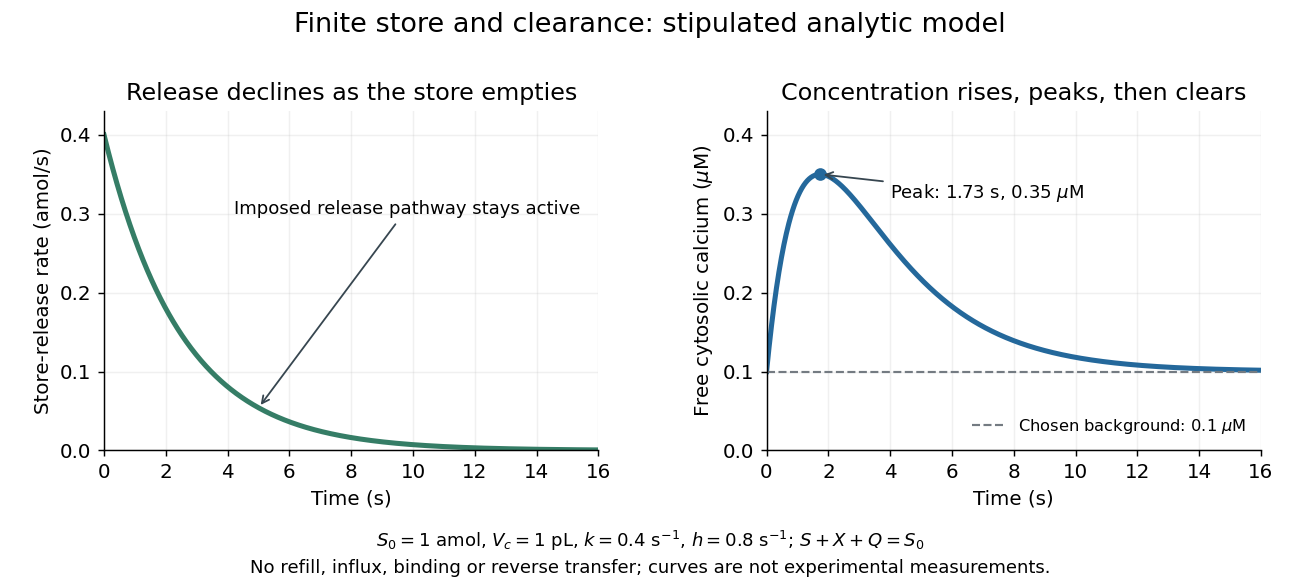

Solving these ordinary differential equations givesRelease declines from the start, yet initially rises because delivery exceeds clearance. Its peak occurs when , at . There and . Ultimately and tend to zero, tends to and returns to . The delayed peak is a consequence of material balance, even though this model has no delayed channel activation.
This distinction guides interpretation: a large released amount need not mean a large simultaneous free cytosolic concentration. Clearance and volume intervene. Real biological cells add binding, store refilling, IP3 turnover and IP3 receptor regulation; the two plotted curves isolate one finite-store effect rather than explaining every calcium response.
A 1984 primary experiment localized IP3-evoked release using pancreatic acinar cells isolated from rat pancreas with collagenase. A homogenized preparation was separated by differential centrifugation, then by a sucrose step density gradient or precipitation with magnesium chloride. The readout was IP3-induced calcium release per mass of protein across fractions. Release tracked two endoplasmic reticulum markers, RNA content and an enzyme activity, across several separation methods. Marker activities for mitochondria and the cell membrane supplied contrasting comparisons: release correlated negatively with them.[ref]
Effect of inositol-1,4,5-trisphosphate on isolated subcellular fractions of rat pancreas by H. Streb and others. Streb, Bayerdörffer, Haase, Irvine and Schulz, Effect of inositol-1,4,5-trisphosphate on isolated subcellular fractions of rat pancreas (1984), abstract: preparation, separation methods, protein-normalized release and marker correlations
Agreement across distinct fractionations supports an endoplasmic reticulum-associated source in this preparation. “Nonmitochondrial” alone only excludes a candidate; positive compartment markers add localization evidence. Marker comparisons control the localization inference, rather than replacing a no-IP3 release comparison. Fractionation may mix or damage compartments, and correlation does not itself identify the IP3 receptor protein. This calcium release readout also does not directly measure secretion or establish identical responses in every biological cell.
Extrapolation Created 2026-10-14 Updated 2026-10-25
Estimating values beyond the range of the supplied sample points. For two distinct points , the affine combination lies beyond an endpoint of their line segment when or . The construction specifies an extension of the chosen model; it does not show that an unknown underlying function follows that extension.
Intensive quantity 2026-10-14
An intensive quantity is unchanged under replication at the same thermodynamic equilibrium. Temperature, pressure, chemical potential and the mass density of a uniform substance are examples. Independence from sample size does not mean independence from state: a material's mass density can change with temperature or pressure.
The relation to extensive quantities is particularly elegant for a differentiable bulk fundamental relation. Put and writeTaking a partial derivative with respect to and cancelling givesThe equilibrium differential identifies these derivatives with temperature, minus pressure and molar chemical potential. They are degree-zero homogeneous functions. The same degree-one assumption yields the Euler relation in thermodynamics, but a surface energy contribution requires extra care.
An intensive quantity generally has no meaningful sum across samples: two equal temperatures do not add to a doubled temperature. Neither is the final temperature after thermal contact generally an unweighted average; heat capacities and the first law of thermodynamics determine the balance. Ratios of additive inventories lead to the useful weighted rules in normalizing extensive quantities.
Hereditary nonmatroid greedy obstruction 2026-10-14
On the ground set , permit exactlyThis lists every admissible subset; the excluded subsets are , , and . It is an independence system: deleting elements from produces its listed singletons or the empty set, and deleting from a singleton produces the empty set. But and violate exchange: neither nor can be added to . Thus it is not a matroid.
The descending-weight greedy algorithm admits first, then rejects both and , returning with weight . Exchanging the tied order of changes nothing. The admissible pair weighs , exceeding every singleton and the empty set, so it is the true optimum. Both and are maximal elements under inclusion of subsets, but only the pair has maximum cardinality. This identifies exactly where the matroid greedy algorithm loses its guarantee: heredity preserves admissibility under deletions, while exchange prevents a locally maximal selection from being too small.
Ground set 2026-10-14
The ground set is the set of labelled elements available for selection. An independence system specifies which subsets of this ground set are admissible; in a linear matroid the labels index vectors, whereas in a graphic matroid they index edges.
Hardy's integral inequality 2026-10-14
Let and let be a real or complex measurable function in Lp space , with Lebesgue measure . The Hardy operator, denoted here by , takes the running averageHölder's inequality ensures , so every such average exists. Hardy's integral inequality statesThe real signed and complex extensions of the nonnegative statement follow from the triangle inequality . Changing on a null set changes neither average nor Lp norm.[ref]
Inequalities by Godfrey Harold Hardy and others. Inequalities, second edition, §9.8, Theorem 327, equation (9.8.2), printed p. 240
Averaging over an expanding interval spreads a localized input across the whole positive half-line. Hardy's integral inequality bounds the total Lp norm of that spread. The Hardy operator is consequently a bounded linear operator on this Lp space. The factor bounds its operator norm; its th power is the constant in the displayed integral bound. These are different constants: at , the L2 norm bound is two and the squared L2 norm bound is four.
Work by H. Streb 2026-10-14
Work by Gregory F. Strouse 2026-10-14
Sparse graph Created 2026-10-14 Updated 2026-10-25
A family of graphs is sparse when its edge count grows substantially more slowly than the square of its vertex count; a common convention is that , where and count vertices and edges. State the intended asymptotic convention explicitly. An adjacency list then uses fewer storage entries than an adjacency matrix.
Work by Giuseppina Lopardo 2026-10-14
Adrenergic receptor Created 2026-10-14 Updated 2026-11-05
An adrenergic receptor is a G protein-coupled receptor responsive to catecholamine signals such as adrenaline and noradrenaline. The alpha and beta receptor families differ in coupling and physiological effects. Response depends on receptor subtype, tissue expression and downstream machinery, so the same hormone can produce different effects in different organs. Receptor activation and ligand binding remain distinct measurable events. [ref]
Quotient of functions 2026-10-14
For functions and taking values in the same field, their quotient of functions is defined by on the common domain of a function restricted to points where . Thus and on the real line give a quotient of functions defined only for .
Function output 2026-10-14
A function output is the value assigned by a function to a function input . It belongs to the codomain ; all such function outputs together form the image of a function .
Function input 2026-10-14
A function input to a function is an element of its domain of a function , also called its argument. The corresponding function output is .
Function evaluation Created 2026-10-14 Updated 2026-10-18
Function evaluation determines the function output for a specified function input in the domain of a function. Numerical integration uses these values at selected quadrature nodes.
Work by Fred W. Turek 2026-10-14
Work by Frank C. Maring 2026-10-14
Work by Francis Galton 2026-10-14
There are unlisted articles, also show them or only show them.