
Differential entropy under affine rescaling 2026-10-14
For real and , the change of variables formula gives . ThereforeThe absolute value also covers a decreasing transformation. If a numerical length changes from metres to centimetres, and the differential entropy changes by nats, although the physical uncertainty is the same. The reference coordinate scale must therefore accompany an absolute differential entropy value.
Let have a probability density function on an open interval, and let be continuously differentiable, strictly increasing there, with . The change of variables formula givesIf the differential entropy and the expected absolute logarithm of are finite, taking the expectation of the negative logarithm proves the displayed formula, for a fixed base . Local stretching reduces probability density; its contribution to differential entropy is the expected logarithmic stretch. The map is invertible, so this change does not mean that the transformation destroyed information about .
Differential entropy of a Gaussian law 2026-10-14
For a normal distribution with mean and positive variance , expand the logarithm of its probability density function:The second term has expected value , hence . Translation of the mean has no effect, while shrinking the standard deviation lowers differential entropy. A standard normal distribution has approximately nats. This connects the continuous spread calculation with entropy power, whose normalization matches a Gaussian distribution's variance.
Differential entropy of a uniform law 2026-10-14
For a continuous uniform distribution on an interval of length , the probability density is . Direct integration givesThus a uniform law on an interval of length has differential entropy , while length two gives . Both laws have total probability one. The shorter interval has larger probability density, making negative; this is neither a negative probability nor a negative discrete information entropy.
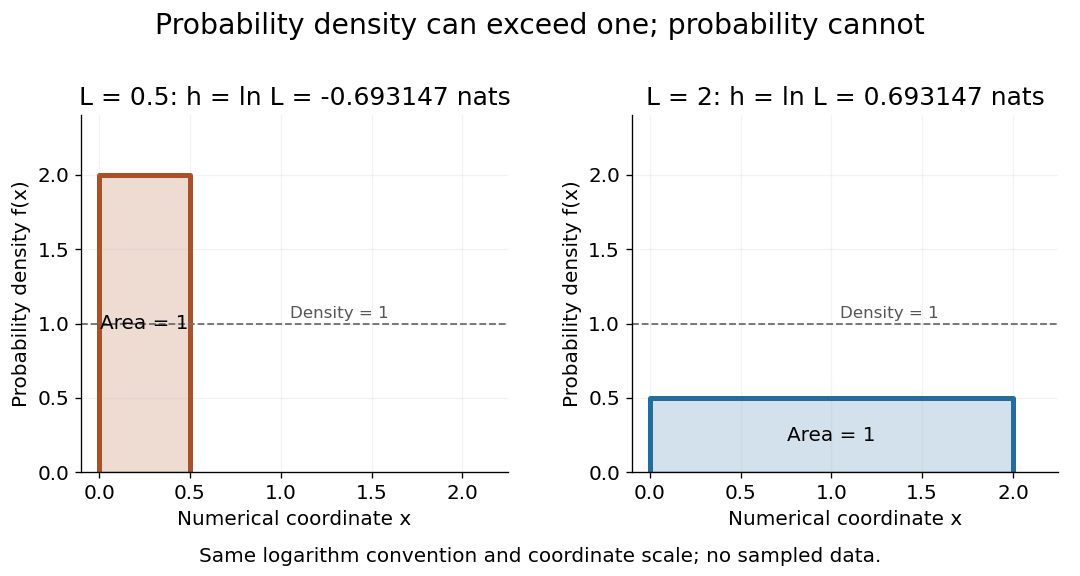
Uniform densities can have negative or positive differential entropy
. The two stipulated continuous uniform distributions have density two on an interval of length and density on an interval of length two. Each rectangle has area one. The reported differential entropy is in nats, using the displayed numerical coordinates. Details.
Order-twelve dicyclic character table Created 2026-10-14 Updated 2026-11-05
This dicyclic group has classes , , , and the two parity classes of , of sizes . Its quotient by is cyclic of order four, supplying four linear characters with , . Its two remaining irreducible representations have and for , where . The traces are on and zero on . Distinct diagonal eigenlines are exchanged by , proving irreducibility; the degree-square sum proves completeness.
One-qubit reduction of Dicke-state superpositions Created 2026-10-14 Updated 2026-11-05
For , and , the reduced density matrix of any one qubit isUse the Dicke state recursion. The rest-of-system vectors of different Hamming weights are orthogonal. For the diagonal terms this leaves the probabilities of the distinguished bit being zero and one. In the cross term, only the rest vector occurs in both states, with coefficients multiplying and multiplying . Thus , proving the matrix. A single Dicke state alone gives the diagonal matrix .
W state 2026-10-14
The -qubit W state is the Dicke state with one excitation:For three qubits it is . Its reduced density matrix on any one qubit is , from the Dicke state recursion. For both diagonal entries are nonzero, so that qubit is entangled with the rest: a pure product state would have a pure marginal. A symmetric-arm reduction of an exchange Hamiltonian supplies a dynamical preparation from one initial excitation.
PSPACE 2026-10-14
PSPACE consists of decision problems solvable using a polynomial amount of work space. Running time may be exponential. Enumerating all polynomial-length relation encodings and reusing working storage preserves this bound, as does complementation. In particular fixed-sentence second-order logic model checking lies in PSPACE.
DFA minimization 2026-10-14
DFA minimization merges states with identical acceptance behavior for every suffix and removes unreachable states. It produces a minimal deterministic finite automaton, unique up to renaming states.
Pfaffian Created 2026-10-14 Updated 2026-11-05
Over a field of characteristic zero, for an antisymmetric matrix, the Pfaffian is . Equivalently, it is the coefficient of the top exterior power of the associated alternating form, with the usual factorial normalization. Its square is the determinant. In size four it is , so its vanishing characterizes the simple nonzero bivectors of the Klein quadric.
Hadamard determinant inequality 2026-10-14
For a square matrix with row vectors , the absolute determinant is at most the product of the Euclidean norms of its rows. If the rows are dependent the determinant is zero. Otherwise Gram-Schmidt process leaves the determinant unchanged and replaces each row by its component orthogonal to its predecessors. The resulting orthogonal rows have lengths no greater than the original rows, and their volume is their product. This proves the inequality; equality holds for mutually orthogonal rows.
Cramer's rule Created 2026-10-14 Updated 2026-11-05
For an invertible square matrix and , replace column by to form . Multilinearity of the determinant and give : all other summands have repeated columns and vanish. Division gives the formula. With integer coefficients this supplies explicit rational solutions and, together with the Hadamard determinant inequality, bounds their numerators and denominators.
Cauchy–Binet formula 2026-10-14
For matrices and with ,where the indices of are taken in increasing order. To prove it, write the th column of as and expand its determinant by multilinearity. Terms with a repeated vanish by alternation. For each remaining index set , collect all permutations . The factor from is ; the sum of the products is . This proves the formula. Applying it to selected rows and columns proves that a product of compatible totally nonnegative matrices is totally nonnegative.
Determinant of the minimum-index matrix 2026-10-14
Let be the triangular matrix with for and zero otherwise. Then and , so the determinant of is one. More generally, for , the matrix with entries factors as and has determinant . This is the finite-dimensional structure behind the Brownian covariance kernel.
Nonintersecting lattice-path determinant Created 2026-10-14 Updated 2026-10-18
For a weighted acyclic directed graph, let be the sum of path weights from to . Expanding gives a signed sum of path families. At the first intersection in a fixed topological order, swap the two path tails. The operation preserves weight and reverses the endpoint permutation's sign, so intersecting families cancel. Only vertex-disjoint families remain. If planarity forces these families to join identically indexed endpoints, their sum has positive sign. Applied to northeast paths with horizontal weight at height , this gives the skew Jacobi–Trudi identity.
Response surface methodology Created 2026-10-14 Updated 2026-11-05
Response surface methodology fits local regression approximations to a quantitative response as experimental settings change. A first-order model estimates a local gradient; augmenting the design permits quadratic regression, curvature assessment and local optimization. Extrapolating a fitted surface outside the experimentally supported region requires caution.
Contrast (statistics) Created 2026-10-14 Updated 2026-11-05
A contrast is a linear combination of group means with . It compares responses without depending on a common additive level. Treatment contrasts and factorial contrasts specify comparisons in a design of experiments.
Latin square Created 2026-10-14 Updated 2026-11-05
A Latin square of order is a array of symbols, each occurring once in each row and column. Used as a row-column design, its symbols label treatments. Centered treatment indicators are orthogonal to both row and column indicators, because every row-treatment and column-treatment pair occurs once. This balance separates additive effects from two nuisance directions.
Optimal experimental design Created 2026-10-14 Updated 2026-11-05
Optimal experimental design chooses observation locations and allocations to optimize a specified criterion for a specified statistical model. Criteria can control the determinant of an estimator's covariance matrix or its worst prediction variance. Optimality depends on the model and the permitted design class, including whether allocations are integer or approximate.
Derrick scaling of Yang-Mills-Higgs energy 2026-10-14
In three space dimensions, rescale to and to . The gauge curvature then scales with two derivatives, and the adjoint covariant derivative of the Higgs field with one. Magnetic, Higgs-gradient and potential energies give the displayed formula. Stationarity requires , which permits nonzero energies. In the Bogomolny-Prasad-Sommerfield monopole limit , the Bogomolny equations give .
There are unlisted articles, also show them or only show them.