
Skew polynomial ring of an automorphism Created 2026-10-14 Updated 2026-10-20
For an automorphism of a unital ring , this ring consists of finite sums , with multiplication determined by . Both left and right coefficient normal forms are available because is invertible. The noncommutative Hilbert basis theorem implies that it is a right Noetherian ring when is, and a left Noetherian ring when is. Invertibility of matters in this two-sided formulation.
Polynomial hull in one complex variable 2026-10-14
For a compact set , its polynomial hull is . In one complex variable this is together with all bounded components of its complement. The maximum modulus principle proves inclusion of each filled hole. Conversely, polynomial approximation of an exterior pole by the Runge approximation theorem separates an exterior point from the filled compact set. The filled set has connected complement, which makes it the natural set for polynomial approximation of functions whose poles lie in the unbounded complementary component.
Polynomial long division Created 2026-10-14 Updated 2026-10-18
Start with a provisional polynomial quotient and remainder . If has polynomial degree at least the divisor's polynomial degree , with leading coefficients and , subtract , whereThe identity survives each step, while the leading term cancels and the polynomial degree of nonzero strictly decreases. Stop when or .
For uniqueness over a field, subtract two proposed decompositions:If , the left side has polynomial degree at least , while the right side is zero or has smaller polynomial degree. Hence and then .[ref]
Chapter 3 Ring theory. Abstract Algebra, Chapter 3 Ring theory, §3.9, Theorem 3.9.1 and proof: cancellation, termination and degree comparison for uniqueness
Remainder of polynomial division Created 2026-10-14 Updated 2026-10-18
The polynomial remainder is the polynomial in polynomial division . Division by has a constant polynomial remainder , as expressed by the factor theorem.
For any identity , polynomial evaluation at a root of a polynomial of givesThis substitution requires no division by . In the worked example, polynomial factorization gives , so its two roots of a polynomial are and . The cubic polynomial and its linear polynomial remainder agree there:A cubic expression has been compressed into a straight line carrying exactly these two values.
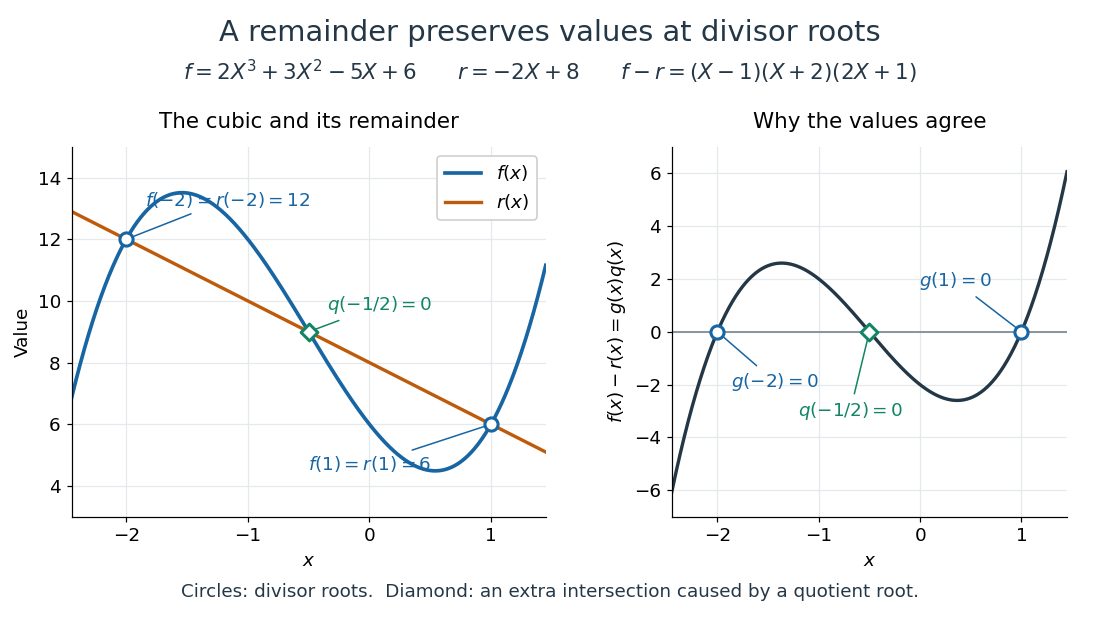
The original polynomial and its polynomial remainder agree at both polynomial roots of because vanishes there
. Details. 
Conversely, those two values determine the linear polynomial remainder by polynomial interpolation. Write ; then and , giving and . The polynomial degree bound is essential: adding any multiple of preserves the two values, but generally raises the polynomial degree. The plot also shows agreement at , where rather than . Agreement of and at a point therefore does not imply that the point is a root of a polynomial of the divisor.
Quotient of polynomial division Created 2026-10-14 Updated 2026-10-18
In polynomial division over a field, the polynomial quotient is the polynomial . The polynomial remainder has smaller polynomial degree than the nonzero divisor unless it is zero.
In the notation , the polynomial quotient is instead named . It is a polynomial determined by the divisor and the polynomial degree bound. The pointwise ratio of the associated polynomial functions satisfiesFor the worked example, , while ; the correction is . Thus a polynomial quotient need not equal the rational function . At and , the pointwise ratio is undefined, but the polynomial quotient still has perfectly well-defined values. When , the divisor is a polynomial factor of and the ratio agrees with wherever .
Squarefree polynomial discriminant does not imply irreducibility Created 2026-10-14 Updated 2026-10-25
A squarefree polynomial discriminant does not ensure that the polynomial defines a field of its stated degree. For example, has discriminant five. Its roots have degrees one or two, so no root generates a cubic number field. In particular cannot be a field basis for any of its roots. The squarefree discriminant certifies an integral basis argument assumes that the polynomial is the minimal polynomial: then the discriminant of its power basis is the field discriminant times the square of the order index. For a reducible squarefree polynomial the analogous rank belongs instead to its quotient algebra, which is a product of fields, not to one root field.
Let be a boundary point of a compact convex set and choose exterior points . Approximate uniformly on the compact set by a polynomial with error at most . At each fixed , the reciprocal converges and so does the approximating polynomial. On a boundary accumulating at , uniform convergence to the singular reciprocal is impossible because each polynomial is bounded there. This distinguishes pointwise convergence from uniform convergence without confusing the two norms.
Strict polynomial error decrease from nonvanishing derivatives Created 2026-10-14 Updated 2026-10-31
If , is real and on an interval, and is nowhere zero there, the displayed inequality holds. If the errors were equal, a best degree-at-most- polynomial would also be best at degree . The Chebyshev alternation theorem and intermediate value theorem would give zeros of the error. Applying Rolle's theorem times would force a zero of , a contradiction. The zero-error case already contradicts . In particular this proves strict improvement for the exponential function at every positive degree step.
In the instantaneous-addition, negligible-removal ratchet, the gap reflects at zero and a first passage to triggers addition and resets the gap to zero. With load diffusion coefficient and opposing drift , the mean passage time solves , , . It is , giving the displayed speed and zero-load limit . The finite-load slowdown is not simply in this diffusion-limited regime.
Reaction-limited polymerization Brownian ratchet Created 2026-10-14 Updated 2026-11-05
When load-gap equilibration is fast compared with chemical events, an opposing force gives an exponential gap distribution. The probability of room for an addition is . With unloaded addition rate and removal rate , assumed force-independent except for this steric gating, the velocity is the displayed expression. For , stall occurs at . Concentration is included in if the on-rate constant is bimolecular.
Pentagonal prism Created 2026-10-14 Updated 2026-10-14
A pentagonal prism has two pentagonal bases and five quadrilateral side faces, with three edges meeting at every vertex. Radial projection from an interior point gives a spherical polygon decomposition with five quadrilaterals and two pentagons.
Quadrilateral Created 2026-10-14 Updated 2026-11-05
A quadrilateral is a polygon with four sides and four vertices of a polygon. For a simple quadrilateral, its interior angles sum to by dividing it along an interior diagonal of a polygon into two triangles. Rectangles, squares and parallelograms are special cases. The qualifier convex quadrilateral excludes a reflex interior angle; a self-crossing four-segment chain requires a different interior convention. Four side lengths alone generally leave freedom to vary the angles and area.
Diagonal of a polygon Created 2026-10-14 Updated 2026-10-20
A diagonal of a polygon joins two vertices of a polygon that are not endpoints of the same side of a polygon. A square has two diagonals of a polygon, forming a two-element group orbit under its dihedral group of symmetries.
Side of a polygon Created 2026-10-14 Updated 2026-10-20
A side of a polygon is a line segment joining two consecutive vertices of a polygon in its boundary.
Vertex of a polygon Created 2026-10-14 Updated 2026-10-20
String sigma model in a spacetime metric 2026-10-14
Replacing the flat target metric in the Polyakov action by a spacetime metric gives the displayed string sigma model. The embedding fields map the worldsheet into target spacetime, while is an independent worldsheet metric. Classical worldsheet diffeomorphisms and Weyl transformations permit conformal gauge; quantum consistency additionally requires vanishing sigma-model beta functions.
An experimental comparison joined a two-ended diol chain, HOPCLOH, with a bifunctional isocyanate, at reported isocyanate-to-diol ratio . The researchers used oven-dried round-bottom flasks and an IKA RET magnetic hotplate with a metal carrier. They varied solvent, concentration, reaction temperature ( or ), and duration ( or ).[ref]
Experimental Design (2⁴) to Improve the Reaction Conditions of Non-Segmented Poly(ester-urethanes) (PEUs) Derived from α,ω-Hydroxy Telechelic Poly(ε-caprolactone) (HOPCLOH) by Jaime Maldonado-Estudillo and others. sections 2.1 and 2.3: flask, heating apparatus and varied conditions
A Bruker NMR spectroscopy instrument measured residual hydroxy group-adjacent signal relative to an ester signal. Independently, size-exclusion chromatography used ResiPore columns at , a refractive-index detector, and polystyrene calibration. Figure 8 reports sharply increasing apparent number-average molar mass beyond the reported conversion . A deliberately water-exposed isocyanate comparison reproduced a infrared spectroscopy band assigned to urea-containing products. The authors warn that tiny residual NMR spectroscopy signals reduce integration precision.[ref]
Experimental Design (2⁴) to Improve the Reaction Conditions of Non-Segmented Poly(ester-urethanes) (PEUs) Derived from α,ω-Hydroxy Telechelic Poly(ε-caprolactone) (HOPCLOH) by Jaime Maldonado-Estudillo and others. sections 3.2–3.3; Figure 3 discussion of the water comparison; section 5.1 and Figure 8: independent conversion and GPC readouts and low-signal limitation
The inference is increasing chain size alongside depletion of reactive groups, consistent with step-growth polymerization. It is not an exact measurement of in the toy model. The feed contains already extended diol chains: counting their constituent repeat units differs from counting each feed molecule as one unit. Their varying molar masses, calibration against a different polymer, residual starting material, and competing chemical reactions further obstruct a direct conversion-to- substitution. Report which functional groups the conversion readout measures before comparing it with stoichiometric imbalance in step growth.
Useful proposed controls, distinct from the reported water comparison, are pre-reaction spectra and matched mixtures omitting each joining partner in turn. Keep solvent, heating, and signal normalization matched. Disappearance of an isocyanate signal in the omitted-diol control would reveal competing consumption rather than establish chain joining. Agreement between residual-group and independently calibrated chain-size readouts is stronger evidence than calculating both quantities from the same Carothers equation.
Hydrogen fluoride Created 2026-10-14 Updated 2026-11-05
Hydrogen fluoride is , a strongly polar diatomic molecule. Hydrogen bonding gives its condensed phases and molecular aggregates behavior different from that of an isolated gas-phase molecule.
In water it is a weak acid by the equilibrium extent of proton transfer, despite having a very polar bond. Bond strength, solvation, and interactions among dissolved species must be considered together; electronegativity alone does not determine aqueous acid strength.
Hydrogen chloride Created 2026-10-14 Updated 2026-11-05
Hydrogen chloride is the polar diatomic molecule . Its bond has unequal electron sharing because chlorine attracts electron density more strongly than hydrogen.
The gas and an aqueous solution are different descriptions: dissolved hydrogen chloride transfers protons strongly to water and is called hydrochloric acid. Its rotational-vibrational spectrum also provides a simple molecular probe of bond length, force constant, and isotopic mass effects.
Periodization of an integrable function Created 2026-10-14 Updated 2026-10-14
For the periodization is absolutely convergent almost everywhere in a period by integrating the sum of absolute values. Its Fourier series coefficient is , where . Absolute integrability permits integrating term by term and changing variables across the disjoint period intervals. This coefficient identity does not by itself assert pointwise convergence of the ordinary Fourier series. Even uniform convergence of the original periodization cannot repair arbitrary point values: has zero transform and a nonzero periodization at multiples of . Additional regularity, such as a continuous piecewise continuously differentiable periodization, validates the pointwise Poisson summation formula in this setting.
// Target: fluid-mechanics.bigb
There are unlisted articles, also show them or only show them.