
Covariate-dependent missing at random Created 2026-10-14 Updated 2026-11-05
For each fixed observation pattern, the probability of that pattern may depend on observed response components and fully observed covariates, but not on the response components missing under that pattern. Conditional missing completely at random is the special case with no dependence on observed response components either.
Minkowski interval Created 2026-10-14 Updated 2026-10-31
The squared interval between two events in Minkowski spacetime is the quadratic form of their coordinate difference under the Minkowski metric. In signature it is . Lorentz transformations preserve this quadratic form; timelike, spacelike and null separation correspond to negative, positive and zero values.
The opposite metric signature reverses the sign of the Minkowski interval, giving ; the physical classification and proper time stay the same. State the convention before using a sign to identify a separation. With the mostly-plus convention here, a straight clock segment has , while a light signal has . [ref].
Brunn-Minkowski theorem 2026-10-14
Let and let be nonempty Lebesgue measurable sets with finite Lebesgue measures. Assume that is also a Lebesgue measurable set; its measure may be infinite. ThenHere denotes -dimensional Lebesgue measure in Euclidean space. Nonempty compact sets and nonempty open sets of finite measure satisfy the measurability assumptions. Measurability of arbitrary summands alone does not guarantee measurability of their Minkowski sum. The theorem does not require convexity. See R. J. Gardner, The Brunn-Minkowski Inequality (2002), Theorem 4.1 and the following remarks.
The th root converts a volume into a quantity that scales like a length: uniform dilation gives for . In the Euclidean plane the theorem compares square roots of areas, not the areas themselves. For the two rectangles above it reads . Equivalently their sum has area . For the two disks, it reads , an equality. These are exact geometric examples, not measured data.
Applying the theorem to the scaled sets gives, whenever that sum is a Lebesgue measurable set,For convex bodies, this means the root-volume of the interpolated shape lies above the straight line between the input root-volumes. In fact is a concave function on : convexity gives for , so interpolating two intermediate shapes gives another intermediate shape and the same inequality applies. The beauty is that no particular boundary shape appears in the bound: possible pointwise displacements force a minimum amount of space.
For convex bodies , equality holds exactly when they are homothetic convex bodies, meaning for some vector and . This equality qualification is part of the Brunn-Minkowski theorem for convex bodies. [ref]
https://sites.stat.washington.edu/jaw/COURSES/520s/523/HO.523.20/Gardner.BullAMS.02.pdf. Gardner (2002), introduction, equation 2 and its equality condition
For positive-sided axis-aligned rectangles, the comparison can be checked directly:Equality requires : the rectangles must have the same aspect ratio. Our and rectangles do not. All positive-radius disks are homothetic convex bodies, explaining their equality.Do not apply that equality criterion without its hypotheses. If , its Lebesgue measure is zero and is a translation of , so equality holds even for nonconvex . Also, changing a summand on a null set can change the measure of its Minkowski sum: in one dimension, and both have measure , but has measure . Removing the single extra point restores equality with sum measure . Thus merely being equal almost everywhere to homothetic convex bodies is not a sufficient equality test for arbitrary sets.
The Brunn-Minkowski theorem also bounds the collision-region volume: for positive-volume compact sets , reflection preserves Lebesgue measure, so . In the toy collision example this gives area at least , compared with the exact area . A lower bound alone does not identify safe reference positions; the actual Minkowski sum supplies those.
Minkowski addition for collision detection 2026-10-14
Suppose a robot occupies a closed set relative to its chosen reference point, and a closed obstacle occupies . Keep the robot's orientation fixed and allow only translations. At reference position , its occupied set is . If touching counts as collision, the forbidden positions in this configuration space are exactlyThe minus sign reflects the robot through its reference origin: solving gives . Thus collision checking for a moving shape becomes checking whether one point lies in a fixed Minkowski sum. Steven M. LaValle derives this translational configuration space construction in Planning Algorithms, section 4.3.2, equation 4.37 and Example 4.13.
For a concrete toy example, take the robot rectangle with its reference point at the lower-left corner, and obstacle rectangle . Their collision region is the rectangleFor example, is forbidden: meets in , of area . At there is just corner contact, which our convention also forbids. Using instead would wrongly miss both reference positions. Only when , as for an origin-centred disk, does the reflection leave the robot set unchanged.
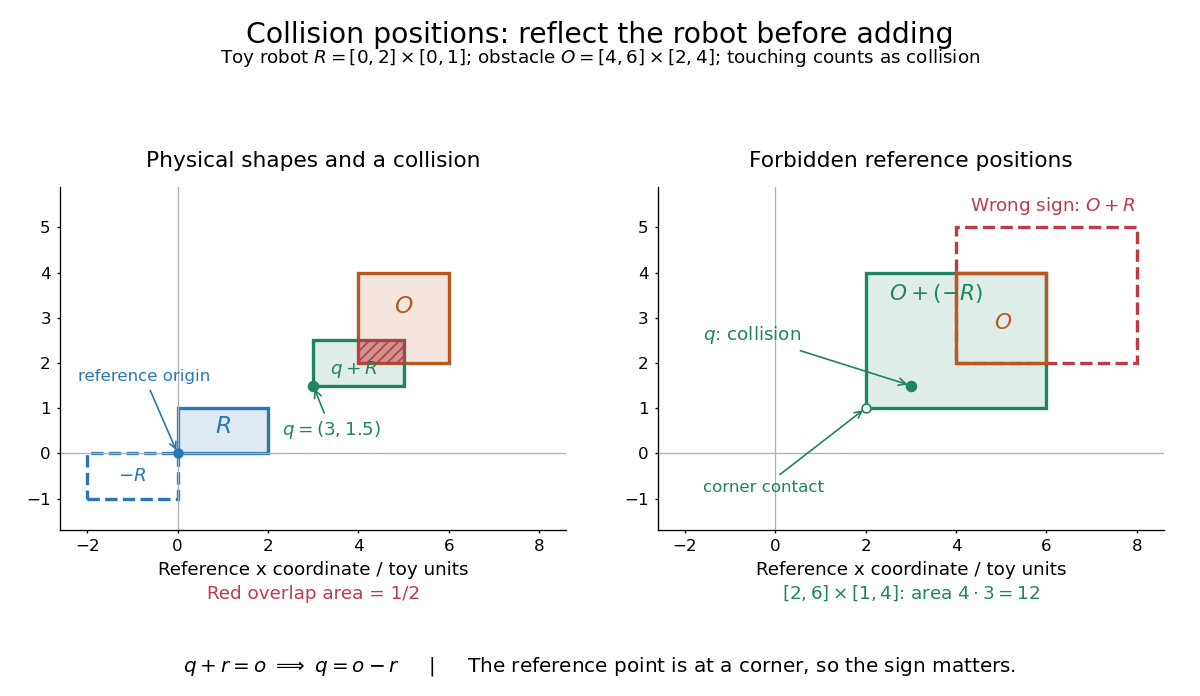
Toy translational collision geometry: a corner-referenced robot requires , of area , and its positive Minkowski sum puts forbidden positions on the wrong side
. Details. 
The same calculation handles bounded additive uncertainty. If the actual reference position is for any , the union of possible occupied sets is . There exists an allowed error causing contact exactly whenConsequently avoiding this set guarantees avoidance for every in this model. For , the example's forbidden region becomes , with area . Here because the error bounds are symmetric; a one-sided error set must still be negated. This is a worst-case geometric bound, not a probability of collision. Rotating the robot requires an orientation-dependent Minkowski sum for each orientation.
Bounded-distance decoding 2026-10-14
For a code of minimum Hamming distance and radius with , bounded-distance decoding returns the unique codeword within Hamming distance of the received word, or reports failure if none exists. The disjointness of radius- Hamming balls gives uniqueness. It guarantees recovery when at most errors occurred, but a word produced by more errors can be nearer to a different codeword and be miscorrected.
Feasible flow 2026-10-14
A feasible flow satisfies every flow balance and every capacity interval of a network problem. Feasibility is distinct from optimality: capacitated flow optimality conditions additionally certify that no allowed balanced flow displacement reduces the cost. With only one independent graph cycle, every balanced flow is determined by a single cycle parameter, and its feasible set is the intersection of the induced parameter intervals.
Two-resource path packing as minimum-cost circulation Created 2026-10-14 Updated 2026-10-20
Consider nonnegative route variables with constraints , , , , and a linear reward . It is a minimum-cost flow problem: use arcs of capacity and cost , of capacity and cost zero, of capacity and cost , of unlimited capacity and cost , of unlimited capacity and cost , and of capacity and cost zero. Close the network by an unlimited zero-cost arc . The four forward path flows are exactly , so conservation gives the resource constraints. This reduction does not assert that general multi-commodity flow is ordinary minimum-cost flow.
A real cosmological deformation adds and changes the gravitino variation to . The modified commutator identity is . It fixes the negative cosmological constant in terms of the gravitino mass parameter. A positive cosmological constant is not obtained by this real unbroken minimal deformation.
Supergravity coupling of an Abelian vector multiplet Created 2026-10-14 Updated 2026-11-05
An Abelian vector multiplet contains a Maxwell field and a Majorana gaugino. With the doubled gravitino normalization, add . The leading transformations are and . Promoting the rigid parameter to a function produces the current multiplying ; the gravitino-current term cancels it. The Clifford identity cancels the Maxwell stress variation. Supercovariant field strengths and quartic fermions complete the transformations beyond this order.
Gravitino-induced torsion Created 2026-10-14 Updated 2026-11-05
With canonical Rarita-Schwinger field normalization, one convention gives the displayed torsion tensor. Its contorsion tensor is . The algebraic spin connection equation determines ; substituting it in the action produces four-fermion terms. This is an instance of Einstein-Cartan theory and is efficiently varied using the 1.5-order formalism. A rescaled gravitino changes the displayed coefficient.
A four-dimensional Majorana spinor gravitino has real components, minus four local supersymmetry gauge functions, leaving twelve before using any Euler-Lagrange field equation. A vierbein has sixteen real components, minus six local Lorentz transformation and four diffeomorphism gauge functions, leaving six. Equivalently, a symmetric metric tensor has . The propagating graviton and massless gravitino each have two states on shell. Six bosonic auxiliary field components complete an off-shell supergravity multiplet.
Old-minimal supergravity Created 2026-10-14 Updated 2026-11-05
Old-minimal four-dimensional supergravity adds a complex scalar and a real vector to the vierbein and gravitino. These six real bosonic auxiliary field components have no propagating kinetic terms. They balance the off-shell component count of minimal supergravity and permit the local supersymmetry algebra to close without imposing the propagating Euler-Lagrange field equations.
Milnor patching of projective modules 2026-10-14
A compatible triple patches to . It is finitely generated projective and recovers after extension of scalars. For free modules glued by , the block identity lifts through the surjective side and makes the direct sum with inverse gluing free. Complements reduce general projective triples to that free case. Conversely an idempotent over is exactly a compatible pair of idempotents over its two factors.
The diagonal maps are extension of scalars; the maps to are differences. The connecting map sends to the difference of its patched free module and the corresponding free -module. Elementary lifting and common free stabilization prove exactness at every internal term. The displayed fragment does not assert injectivity at its first term or surjectivity at its last.
Cyclotomic Milnor square Created 2026-10-14 Updated 2026-11-05
Evaluation of the cyclic generator at and at a primitive th root gives the displayed pullback. The maps to the common field reduce integers modulo and set . If a representative polynomial for the second component has value at one, adding an integer multiple of adjusts that value by a multiple of without changing the second component. This proves surjectivity onto compatible pairs.
Composite midpoint quadrature rule 2026-10-14
Apply the midpoint quadrature rule on each of equal panels of a partition of an interval, with :Each quadrature node is a panel midpoint and each quadrature weight is . For , put . Summing the panel quadrature errors givesfor some . Each panel contributes at most ; there are panels, explaining the composite midpoint rule error of order in big O notation. On a nonuniform partition of an interval with panel widths and largest width , the corresponding bound is .
For on , summing the sampled polynomial exactly yieldsDoubling divides the absolute error by exactly four. For a general function, halving divides the displayed error bound by four, but the actual absolute error need not follow that ratio: cancellation can make it smaller or zero. Continuous functions still give convergence as the largest panel width tends to zero, by uniform continuity; without the bounded second derivative, the second-order rate is not guaranteed. Noise sensitivity of a quadrature rule explains a separate limitation when samples are inexact.
For a free complex scalar field, independent particle annihilators and antiparticle creators giveThe invariant mass shell integral vanishes at spacelike separation: transform to equal time, then reverse the spatial momentum in one term. Retaining only the particle-annihilation term would leave a Wightman function, which is generally nonzero even at spacelike separation. Thus both frequency branches are needed for a local relativistic field. For a real scalar field, the creation term supplies the same cancellation but creates the same self-conjugate particle species.
Double-tree approximation for metric TSP 2026-10-14
Double every edge of a minimum spanning tree to obtain a connected even-degree multigraph, traverse an Euler circuit, and shortcut repeated vertices. The triangle inequality prevents any shortcut from increasing cost. Deleting an edge of an optimal tour gives a spanning tree, so the minimum spanning tree has cost at most the optimal tour. The returned tour therefore costs at most twice optimum and is computable in polynomial time. In the relative-error convention this is an error-one approximation.
Equivalence of metrics 2026-10-14
Diameter 2026-10-14
There are unlisted articles, also show them or only show them.