
Pressure Poisson equation for incompressible flow Created 2026-10-14 Updated 2026-11-05
Taking the divergence of the constant-density Navier-Stokes equation and using incompressibility gives the displayed elliptic Poisson equation for pressure. Its Green function is nonlocal. For an isolated eddy, the far pressure has a quadrupolar contribution proportional to , obtained by differentiating the kernel twice. Boundary conditions can contribute additional pressure fields.
Moon 2026-10-14
The Moon is Earth's natural satellite. Its synchronous rotation keeps approximately the same near side of the Moon facing Earth, while both the near side of the Moon and the far side of the Moon experience sunlight and darkness. See illumination of a synchronously rotating moon for the geometry. [ref].
Joint dominance of payoff vectors 2026-10-14
A feasible payoff vector jointly dominates if every coordinate is at least as large and at least one is strictly larger. A Pareto optimal vector has no feasible joint dominator. Strict increase of every coordinate is not required. This compares each player's own utilities, not the numerical size of utilities across different players.
Negotiation set in two-person bargaining 2026-10-14
For a compact convex set of feasible payoff vectors and a specified disagreement point , the negotiation set is its individually rational Pareto frontier. It is the set of efficient agreements each player prefers at least weakly to disagreement. In a maximin bargaining solution, is the vector of the two security level payoffs. This usage is distinct from objection-and-counterobjection bargaining sets in coalitional-game theory.
Mutual repression stability criterion Created 2026-10-14 Updated 2026-11-05
At an equilibrium , , the Jacobian matrix has eigenvalues . Its product of repression gains is also . Product below one gives a stable node, above one a saddle, and equality the threshold for a zero eigenvalue. Robust multiple stable equilibria require an intervening unstable equilibrium; a gain exceeding one alone is not a sufficient global criterion for a particular pair of repression functions.
// Target: mathematical-biology.bigb
Equal-strength power-law mutual repression 2026-10-14
For positive , this mutual repression system can display bistability for some exactly when both and . If either exponent is at most one, it has a unique stable equilibrium for every . To prove the less obvious case , put and at equilibrium. Equality of the two expressions for gives . The loop gain is then bounded by , whose maximum is . Swap the two components for the other case. If both exponents exceed one, sufficiently large yields two stable equilibria with and . The weaker condition is sufficient to exclude multistability, but does not exhaust all exclusions when the same production prefactor is imposed.
// Target: mathematical-biology.bigb
Common-strength Hill repression criterion Created 2026-10-14 Updated 2026-10-25
For , , the equilibrium slope product is . A value gives a saddle separating attracting alternatives. Both exponents greater than one allow this at sufficiently large common . If both are at most one it is impossible. If , define as the unique positive solution of and set . All equilibria are parameterized by , whose derivative is . Thus multistability for some common strength occurs exactly when . For the maximum is . Consequently alone is not sufficient when the two synthesis strengths are required to coincide.
Data processing inequality 2026-10-14
For finite discrete random variables, suppose is a Markov chain: the final channel uses only , so and have conditional independence given . In terms of the joint probability mass function,and hence . Then the two data processing inequalities areAll mutual informations here use base-two logarithms. Thus deterministic or randomized processing cannot increase the information shared with an unprocessed variable.[ref]
https://web.stanford.edu/class/cs229t/scribe_notes/12_05_final.pdf. Stanford CS229T/STATS231, Theorem 2.1 and its chain-rule proof
For a concrete cascade, take a fair bit and Bernoulli random variables with probabilities , of being one. Assume are jointly independent random variables, and pass through two binary symmetric channels:The second noise is independent of both and , so this is a Markov chain. Both and are fair bits. The net exclusive or error is one exactly when one noise flips the bit and the other does not:Using the binary entropy , the three mutual informations are fully determined:All numbers are in bits. The two losses are and . Thus the cascade retains less information about the original source than either individual channel shares between its own input and output.
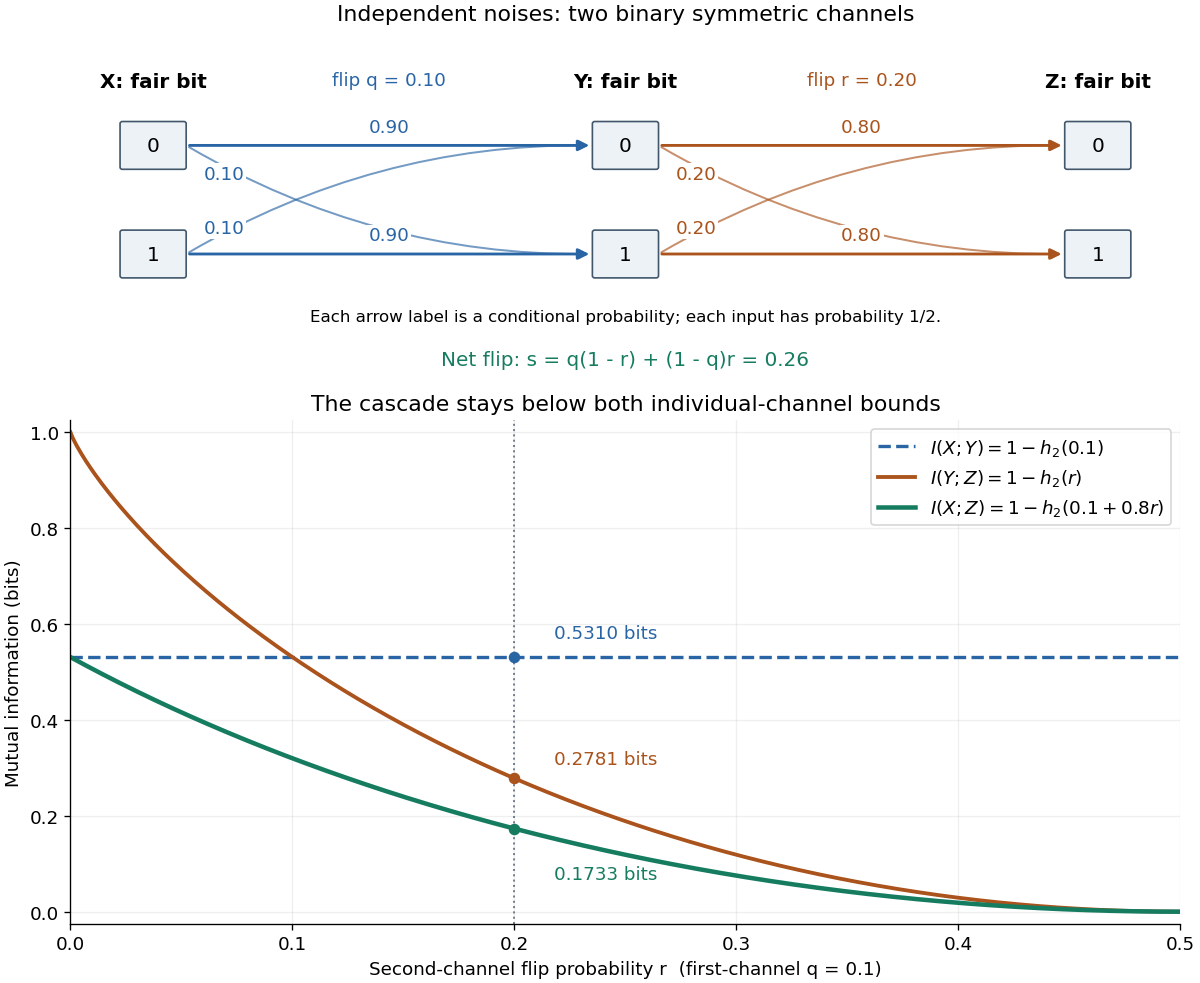

With fixed and , the effective error is . At , and ; at , is independent of the previous variables and . The diagram plots these endpoints and the computed example.
The data processing inequality is useful for testing what a proposed decoder or data summary could possibly reveal: if its only input is , even randomized processing cannot provide more mutual information about than already contains. The Markov chain hypothesis matters. In the exclusive or example from conditional mutual information, allowing a processor to use both and reveals exactly; that processor has additional input, so the conclusion for processing alone does not apply.
The chain rule for mutual information proves both inequalities and identifies their exact gaps. First expand the information about in the two observation orders:Therefore . Next use as the variable being learned:Symmetry of mutual information gives . Both signs follow from the nonnegativity of conditional mutual information; the first gap also gives equality in data processing inequality.
Diagonal monomial action of a second-order Euler operator Created 2026-10-14 Updated 2026-11-05
The monomial is an eigenvector of the differential linear operator , with eigenvalue . Over the real or complex numbers this vanishes exactly for . On polynomials of bounded total degree, the kernel is therefore spanned by the permitted members of , while the image of a linear map is spanned by all remaining monomials. The trace is the sum of those diagonal eigenvalues.
In characteristic different from two, a field generated by finitely many nonzero square roots is the splitting field of a collection of separable quadratic polynomials. Its Galois group embeds into the sign-vector group . Every index-two subgroup is the kernel of a nontrivial sign character. Coordinate sign characters span the dual of this subgroup of , by extending a linear functional to the ambient vector space. A product of the corresponding roots transforms by that character and generates precisely the quadratic fixed field.
Primitive element of a finite field 2026-10-14
A primitive element of generates its multiplicative group. This implies , but an element generating the field extension need not generate the multiplicative group. For instance generates the quadratic extension but has order four, whereas has order eight and is multiplicatively primitive.
Full-weighting restriction 2026-10-14
Full-weighting restriction transfers a fine-grid residual to a coarser grid by local averaging. In one dimension its weights are ; in two dimensions they are the tensor-product stencil . For linear or bilinear interpolation and coarsening by two in every direction, it equals in unweighted coordinates. This scaling makes restriction the adjoint of interpolation for mesh-weighted inner products.
Geometric multigrid V-cycle 2026-10-14
A geometric multigrid V-cycle pre-smooths an approximate solution, restricts its residual, recursively solves the coarse error equation once from zero, prolongs and adds that error correction, and post-smooths. The recursion ends in a direct solve on a small coarsest grid. With fixed sweep counts and bounded stencil work, coarsening in dimensions gives total work per cycle. A mesh-independent convergence factor also requires compatible coarse approximation and effective smoothing; linear work alone does not prove convergence.
Two-grid Poisson factor with weighted Jacobi 2026-10-14
For the one-dimensional Poisson equation, use linear interpolation, full-weighting restriction, an exact coarse solve, and one pre- and one post-sweep of weighted Jacobi with weight . On a pair of harmonics , put and . The coarse correction is , and the smoother is . The rank-one error operator has nonzero eigenvalue . This exact harmonic calculation illustrates mesh-independent two-grid contraction for the constant-coefficient model; it is not an unconditional result for arbitrary operators or transfer choices.
Full multigrid Created 2026-10-14 Updated 2026-10-31
Full multigrid solves first on a coarse mesh, interpolates that approximation to the next finer mesh, and applies a fixed number of geometric multigrid V-cycles before proceeding to the next level. If interpolation introduces only the expected discretization-scale error and the cycle count reduces the inherited error sufficiently at every level, the final algebraic error matches the fine-grid discretization error. The geometric sum of level costs is then , unlike reducing an arbitrary fine-grid initial error by an arbitrarily small tolerance.
Supersymmetric mu problem Created 2026-10-14 Updated 2026-11-05
The MSSM permits a supersymmetric Higgs mass , whose natural size is not fixed by soft supersymmetry breaking. Weak-scale symmetry breaking requires it to be comparable to the soft scale rather than a much larger fundamental scale. Superpotential non-renormalization protects a chosen small value radiatively but does not explain that choice; relating its generation to the breaking mechanism addresses the mu problem.
// Target: supersymmetry.bigb
For the MSSM superfield representations augmented by singlet right-handed neutrino chiral superfields , the homogeneous cubic gauge-invariant superpotential contains the four Yukawa structures , , , and the additional structures , , , , . Weak-doublet pairs contract with the antisymmetric two-index tensor; contracts with the color three-index tensor. Consequently the coefficient is antisymmetric in its two indices, the coefficient in its two indices, and the coefficient symmetric. With , the last five structures violate baryon number or lepton number, whereas the first four conserve both. Singlet fields must not be omitted when classifying a general cubic superpotential.
Morse handle-attachment theorem 2026-10-14
Crossing one nondegenerate critical point of Morse index in a compact sublevel interval attaches a handle . Between critical levels a suitably normalized gradient flow identifies the sublevels. The Morse lemma supplies the local quadratic model for the attachment. Retracting each handle to its core disk gives a CW complex model with one -cell per critical point. Closed manifolds have finite such decompositions; a noncompact manifold requires a proper bounded-below exhaustion for the corresponding statement.
Morse chain complex 2026-10-14
The free chain group in degree has one oriented generator for each index- critical point. A cellular chain complex obtained from the Morse handle-attachment theorem computes the integral homology. Under the Morse-Smale gradient flow condition its differential can instead be obtained by signed counts of connecting trajectories. Over a field, if is the rank of , then . This identity implies both weak and strong Morse inequalities.
Perfect Morse function 2026-10-14
A Morse function is perfect over a specified field when its numbers of critical points equal the Betti numbers over that field. Over the rationals this forces every integer matrix in its Morse chain complex to have rank zero, hence to vanish. Consequently its integral homology is free of rank in every degree; a manifold with integral homology torsion cannot admit such an integral-critical-count perfect function.
There are unlisted articles, also show them or only show them.