
Parity action on canonical massive spin states Created 2026-10-14 Updated 2026-11-05
Choose canonical spin states by applying the rotationless Lorentz boost to rest-frame spin states. Spatial inversion commutes with rest-frame rotations, so Schur lemma makes its action on one irreducible rest spin multiplet a phase . Since , the formula follows. Canonical spin labels are unchanged; helicity reverses. With , the intrinsic parity is .
// Target: lie-theory.bigb
Opposite intrinsic parities of a Dirac particle and antiparticle Created 2026-10-14 Updated 2026-11-05
In the Dirac representation of the gamma matrices, the parity symmetry in quantum field theory action and the charge conjugation action obey , since is real and anticommutes with . At rest, positive-frequency Dirac spinors have nonzero upper components and negative-frequency Dirac spinors have nonzero lower components; they are respectively and eigenvectors of . With the common conventional real intrinsic-parity phase, particle and antiparticle therefore have opposite intrinsic parity. The overall sign is conventional, whereas their relative sign is fixed.
Unimodal interval map Created 2026-10-14 Updated 2026-10-31
A unimodal interval map is a interval map that is increasing to one turning point and decreasing afterwards. For a differentiable map with a maximum at zero, a critical point of even order means with . The critical order distinguishes universality classes of period-doubling cascades.
// Target: dynamical-systems.bigb
Interval root exclusion 2026-10-14
Interval root exclusion certifies that a function has no zero of a function on when a valid interval enclosure excludes zero. For on , the interval square range yields , which excludes zero. Direct interval arithmetic yields and is inconclusive, even though the function has no zero of a function there.
Knowing only that a calculated interval enclosure contains zero does not certify a zero of a function: it may contain unattainable values. Even the positive constant function has a valid, loose interval enclosure . A separate existence argument, such as reliable opposite endpoint signs together with continuity in the intermediate value theorem, is required; see root bracket and bisection method. Interval subdivision can resolve some inconclusive pieces, but remaining pieces must be reported as unresolved unless an existence argument succeeds. This makes interval root exclusion useful for systematically discarding regions in a search.
// Target: analysis.bigb
Outward rounding 2026-10-14
Outward rounding replaces an exact lower endpoint by a representable value no larger than it, and an exact upper endpoint by a representable value no smaller than it. This preserves an interval enclosure under floating-point arithmetic. In the binary numeral system, most rational numbers cannot be represented exactly with finitely many digits, so the rounding direction is essential even for elementary calculations. Rump explains directed rounding and its use in interval bounds in §§4 and 5.3 of his survey.[ref]
https://www.tuhh.de/ti3/paper/rump/Ru10.pdf. Siegfried M. Rump, Verification methods: rigorous results using floating-point arithmetic, Acta Numerica 19, 287–449, 2010, §§4 and 5.3
To see the issue without long binary digit strings, use an illustrative decimal grid with step . Exact interval division gives . Rounding both endpoints to the nearest grid value gives , which excludes the true answer because . Outward rounding instead givesThis decimal toy illustrates the rule; its displayed endpoints are not the results of binary directed rounding. Real implementations need valid outward rounding throughout the calculation, including input conversion and intermediate interval arithmetic operations; rounding only the final output cannot repair an earlier lost bound. INTLAB's tutorial demonstrates why decimal input strings and previously rounded intermediate values need care.[ref]
https://www.tuhh.de/ti3/rump/intlab/demos/html/dintval.html. Rump, Interval computations in INTLAB, How to define an interval II and Invoking interval operations
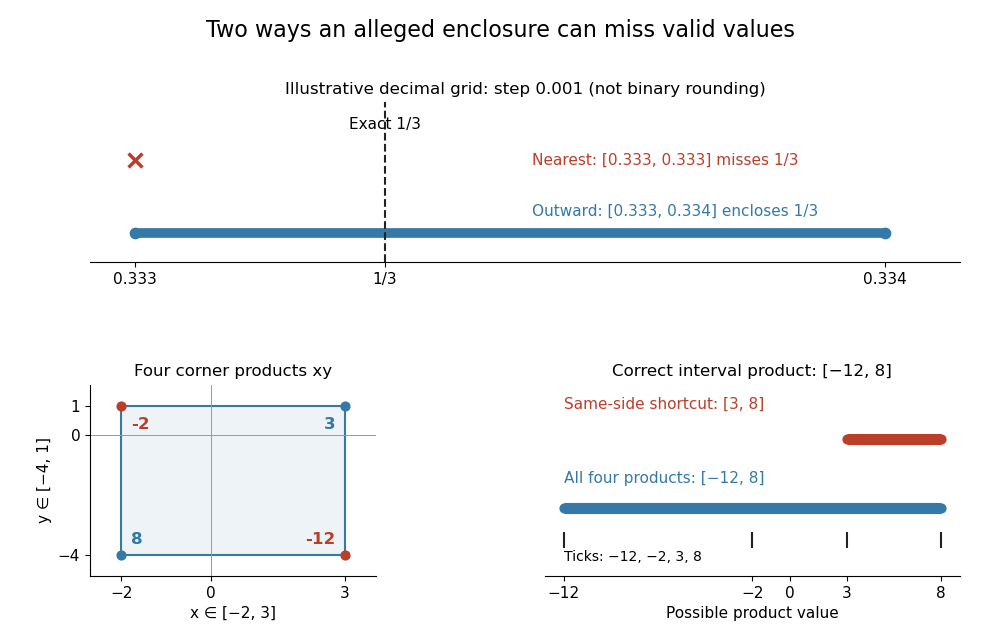
Outward rounding encloses one third on a decimal toy grid; sign-changing interval products require all four endpoint combinations
. Above: rounding to the nearest decimal grid point misses , while down to and up to enclose it. Below: the Cartesian product of and has endpoint products , giving . The two same-side endpoint products alone give the invalid enclosure . Details.
Interval arithmetic operations 2026-10-14
For closed intervals and , exact addition, subtraction and multiplication giveThese interval arithmetic operations describe all results for in the Cartesian product : the two inputs are allowed to vary independently. Independence here means freedom to choose either input anywhere in its closed interval; it does not assert anything about probability. For example, and .
All four endpoint products matter when signs change. For and , the endpoint products are , so . Taking just and , even after sorting them, would give and lose valid negative products.
For division, if , the multiplicative inverse gives and . Thus . This ordinary finite-closed interval rule requires a denominator that excludes zero. When the denominator contains zero, division is undefined for some pairs and can become unbounded near zero; these formulas cannot supply a finite interval enclosure of all quotients. The operations above use exact endpoints; a computer implementation must also apply outward rounding.
Interval enclosure 2026-10-14
An interval enclosure for a real-valued function on a closed interval satisfiesHere means the actual image of a function, also called its pointwise range on ; denotes a calculated interval enclosure. They need not agree. Sampling a few inputs can suggest a bound, but does not establish an interval enclosure between those inputs. Kearfott and coauthors explicitly distinguish the image of a function from evaluating an expression with interval arithmetic, because different expressions for the same function can give different bounds.[ref]
https://www.tuhh.de/ti3/paper/rump/KeNaNeRuShHe10.pdf. Kearfott, Nakao, Neumaier, Rump, Shary and Van Hentenryck, Standardized notation in interval analysis, 2010, Arithmetic expressions and Intervals and boxes
Reduced matrix element Created 2026-10-14 Updated 2026-11-05
A tensor operator transforming in an irreducible representation between states in defines an intertwining operator . In a basis of these intertwining maps, its scalar coefficients are reduced matrix elements, independent of the component indices. Schur lemma makes the number of independent coefficients the multiplicity of in . The component dependence is fixed by the associated Clebsch-Gordan coefficients.
Intersection cohomology 2026-10-14
In the Deligne-sheaf convention, , with normalized in degree zero on the regular stratum. For a compact oriented -dimensional pseudomanifold over a field, and it is dual to , where . Thus the dual of lower-middle singular chains uses the upper-middle Deligne sheaf. The two middle conventions agree on Witt spaces.
Intersection homology cone formula 2026-10-14
For a compact -dimensional link and traditional perversity , finite-chain intersection homology of its open cone is for and zero for . Below the cutoff both chains and possible filling chains avoid the vertex. At and above the cutoff the cone on any allowable cycle is an allowable filling: its new vertex is allowed precisely when .
Perversity 2026-10-14
Interpolant Created 2026-10-14 Updated 2026-10-14
An interpolant is a function satisfying the prescribed sample conditions . It agrees with the data exactly, but need not agree with an unknown underlying function between samples. The polynomial interpolation example shows that a family or a polynomial degree restriction can supply uniqueness; the McShane extension theorem shows a useful nonunique alternative.
Internal-wave momentum deposition 2026-10-14
A slowly established upward plane internal gravity wave has . The mean horizontal conservation of momentum equation gives . Using envelope transport and an initially vanishing mean gives . Its energy density per unit mass is , so . This is the mean flow left behind the advancing wave envelope, rather than a claim that an established uniform wavetrain has nonzero local stress divergence.
In a nonrotating ideal Boussinesq layer with uniform current , constant buoyancy frequency and rigid walls, any stationary superposition of channel wave modes with obeys the displayed relations. With , the total streamfunction is and total buoyancy is . Its material derivative vanishes. The perturbation vorticity is proportional to , so its nonlinear self-advection vanishes as well. The modes are therefore exact finite-amplitude solutions, although large amplitudes may violate physical approximation assumptions or become unstable.
Incompressibility makes pressure adjust throughout the surrounding fluid. Projecting the linear Boussinesq equations perpendicular to a Fourier wavevector gives and . A localized spherical disturbance contains many wavevector directions and therefore many internal gravity wave frequencies, rather than one oscillator at . Its shape evolves and energy radiates into the surroundings; a rigid-sphere added mass analogy illustrates extra inertia but does not give an exact coherent frequency for a free material blob.
Internal-wave response of a sharp buoyancy interface Created 2026-10-14 Updated 2026-10-25
For a lower uniformly stratified half-space and an upper well-mixed half-space, the vertical velocity amplitude is continuous and its derivative jumps by . A wave incident upwards with vertical phase factor therefore has upper evanescent amplitude , where and . Its magnitude peaks at , with amplitude twice the incident amplitude. Lossless reflection carries all incident energy back down; the evanescent upper field carries no mean outgoing vertical energy flux.
Thermodynamic force conjugate to an internal variable Created 2026-10-14 Updated 2026-11-05
A thermodynamic force conjugate to an internal variable is the energetic driving quantity paired with that variable's rate in the dissipation. Its sign and density normalization must be specified. With specific internal energy , reference mass density and the convention used here,Equivalently, if the specific Helmholtz free energy is , then . The negative sign makes positive force-rate product correspond to free-energy decrease at fixed external variables.
For an isothermal free energy per reference volume , the driving force is . Choosing with yields . The internal variable relaxes toward the imposed strain, reducing stored elastic energy. Such a law supplies the mechanical part of a Clausius-Duhem inequality check; the thermal contributions still need their own consistent description.
Dissipation potential Created 2026-10-14 Updated 2026-11-05
A dissipation potential is a function used to generate dissipative rates or their conjugate driving forces. In a force-based convention, a potential specifies an internal variable rate through . For example, with gives and dissipation .
If is differentiable and convex with a minimum at , the convexity inequality gives . This supplies a direct route to nonnegative dissipation. A rate-based convention instead generates forces from rates, so its variables must be stated explicitly. The potential is useful for organizing constitutive equations, but the complete model must still satisfy the Clausius-Duhem inequality, including thermal terms and the chosen energetic sign convention.
Integral-scale intermittency 2026-10-14
Integral-scale intermittency is modulation of the energy-containing motions and the energy supply on large lengths or long turnover times. Averaging velocity statistics over regions or realizations with differing viscous dissipation rates can invalidate universal coefficients based only on the global mean viscous dissipation.
Coarse-grained energy dissipation 2026-10-14
Coarse-grained energy dissipation is a spatial average of the local rate over a region of size . Its random value has mean in homogeneous turbulence. Refined similarity uses this local averaged viscous dissipation to scale velocity increments.
There are unlisted articles, also show them or only show them.