
Superintegrable Hamiltonian system 2026-10-14
A superintegrable Hamiltonian system with degrees of freedom has more than functionally independent integrals of motion, including an integrable set of in involution. At a regular nonzero Hamiltonian vector field, at most independent integral differentials can annihilate the flow. A maximally superintegrable system attains that bound. The three-dimensional Kepler orbit has five independent integrals through energy, angular momentum and the Laplace-Runge-Lenz vector. A closed orbit on one isolated resonance is weaker than maximal superintegrability on an open phase-space region.
Ferrers diagram Created 2026-10-14 Updated 2026-10-20
A Ferrers diagram of an integer partition is a left-aligned array of dots with dots in row , using the longest row at the top here. Replacing each dot by a square cell gives a Young diagram. Reading the column lengths gives the conjugate partition.[ref]
Enumerative Combinatorics, Volume 1 (second-edition draft) by Richard Stanley. section 1.7, Ferrers and Young diagrams
Partition in a rectangle Created 2026-10-14 Updated 2026-10-20
An integer partition whose Young diagram has at most rows and at most cells per row. Zeros may pad the list of row lengths. The partition interpretation of Gaussian binomial coefficients counts these diagrams by their number of cells.
Glucose clamp technique 2026-10-14
Glucose clamp technique: a method for quantifying insulin secretion and resistance. by R. A. DeFronzo and others separates two questions. In a hyperglycemic clamp, variable glucose infusion holds blood glucose above baseline while sampled insulin reports the response. The 1979 article's abstract reports an early release burst followed by a slower rise. In a euglycemic insulin clamp, infused insulin is held elevated and variable glucose infusion holds blood glucose at baseline. Frequent blood sampling, a glucose analyzer, and controlled infusion apparatus make the imposed concentration a maintained condition rather than an uncontrolled consequence. [ref][ref]
The maintained glucose level controls an important confounder: a change in blood glucose would itself change uptake and hormone release. At a steady state, conservation of mass gives uptake equal to infused supply plus endogenous production, after accounting for losses. Consequently, infusion alone estimates uptake only if endogenous production is negligible and the other balance assumptions hold. Labelled glucose measurements can estimate residual endogenous production; matching infused insulin across comparisons matters. Whole-body uptake cannot by itself identify the responding tissue, and plasma insulin reflects both release and removal. This interpretation uses the accessible 1979 abstract and the later authored methods chapter; the original article's full methods were not available for inspection.[ref]
Proinsulin Created 2026-10-14 Updated 2026-10-31
Drosophila pseudoobscura Created 2026-10-14 Updated 2026-10-20
Drosophila pseudoobscura is the species of insect used in the dietary divergence and mating isolation in Drosophila pseudoobscura experiment. The independently maintained experimental biological populations were not already different species.
Binary Brownian drift filter 2026-10-14
For with an independent equiprobable drift , the likelihood ratio between the two drifts is . Multiplying the normal distribution densities of successive increments proves this ratio for every observation partition; continuity then gives the full observed-path posterior. The Bayes' theorem gives . Thus the observed drift is . The process is an observed-filtration martingale with quadratic variation , so the Lévy characterization of Brownian motion makes it a Brownian motion. The observed state is a scaled diffusion with hyperbolic tangent drift.
Gaussian Brownian drift filter 2026-10-14
Observe , with an independent Gaussian random vector of mean and covariance matrix . Its posterior is Gaussian with mean and covariance matrix . These formulas also hold for a singular positive semidefinite matrix . When is invertible, completing the square in the Bayes' theorem gives and . The observed innovation process is a Brownian motion in the observation filtration, and .
Every inner model of ZF contains the ambient constructible universe . By induction, : at successor stages, satisfaction in the same set structure and definability with parameters are absolute; at limits both constructions take the same union. Thus, if the ambient universe satisfies , its only inner model of ZF is itself, and it satisfies the axiom of choice. A procedure that must produce a choice-failing inner model from every model of ZF is therefore impossible. This does not assert that arbitrary inner models of arbitrary choice universes satisfy choice; the obstruction concerns a uniform construction.
Injective cogenerator of abelian groups 2026-10-14
The divisible group is injective: every homomorphism extends to by choosing an th division of its value at , and the Baer criterion applies. It is a cogenerator because any nonzero element generates a cyclic subgroup admitting a character nonzero on that element, and injectivity extends that character to the whole group. Consequently a map of abelian groups is injective exactly when restriction is surjective: injectivity gives extension of characters, while a nonzero kernel element is detected by a character that cannot extend along .
Source term in a partial differential equation Created 2026-10-14 Updated 2026-10-25
A prescribed PDE source term changes the heat equation to , or the transport equation to . If is a temperature, has units of temperature per time. The formulas below assume ; a nonzero PDE source term can change the spatial average even with periodic boundary conditions.
Exponential forcing in a linear recurrence Created 2026-10-14 Updated 2026-11-05
Let be the forward shift on sequences and the polynomial defining a constant-coefficient linear recurrence relation. For a nonzero base , , so is a particular solution when . At a simple root of the characteristic equation of a linear recurrence, the correct trial acquires a factor :The identity follows by substituting into each shift term. A root of multiplicity analogously requires a degree- polynomial factor; the lower-degree homogeneous terms are supplied by the repeated characteristic root of a linear recurrence.
Discrete Green convolution for the period-six recurrence Created 2026-10-14 Updated 2026-11-05
The unit-response sequence , is six-periodic. In the displayed convolution, all older terms cancel under by this recurrence; the two new boundary terms reduce to . Thus it gives a particular solution of the inhomogeneous linear recurrence with forcing . Add the two-dimensional homogeneous span of and for the general solution. This is a discrete Green function construction.
Collinear divergence Created 2026-10-14 Updated 2026-11-05
A singularity of a massless scattering or radiation integral when momenta of two particles become parallel. In quantum chromodynamics, unresolved quark-gluon splittings cause such divergences. A mass regulator or dimensional regularization exposes them; they cancel between suitable inclusive real and virtual contributions or are absorbed into factorized distributions where appropriate.
Infrared-safe observable Created 2026-10-14 Updated 2026-11-05
An observable unchanged by adding a particle with vanishing energy or replacing one massless particle by exactly collinear particles with the same total momentum. This property permits cancellation of real and virtual infrared divergences and collinear divergences in its perturbative cross-section. Fully inclusive electron-positron hadronic rates and suitably defined jet observables are examples.
Graph entropy 2026-10-14
For a vertex law on a graph, choose and an independent set valued random variable containing almost surely. Minimize their mutual information over all such joint laws. This defines graph entropy. It differs from the entropy of a proper coloring, because the random independent set need not be a deterministic color class.
Information content 2026-10-14
The self-information of a positive-probability outcome is the negative logarithm of its probability. Independent outcomes have additive self-information. Its expectation is Shannon entropy.
// Target: probability-and-statistics.bigb
Entropy function for a q-ary alphabet 2026-10-14
This is the entropy in base of the distribution with one symbol of probability and each of the other symbols of probability . It increases on from zero to one, and governs the exponential volume of a Hamming ball. For it is the binary entropy function.
// Target: algebra.bigb
If are independent random variables taking values in a countable additive group, conditioning on makes a translate of . Consequently , and conditional entropy gives . If the two information entropies are finite, equality holds exactly when and are independent.
// Target: probability-and-statistics.bigb
Cross-entropy 2026-10-14
Cross-entropy measures the average logarithmic loss incurred when outcomes follow one probability distribution , but a model assigns probabilities using another probability distribution . For a finite alphabet, write their probability mass functions as and . With base-two logarithms,The expectation is under the true or stipulated source law , rather than the model . Terms with contribute nothing. If but for any outcome, the cross-entropy is : the model rules out an event that can occur. The result is measured in bits; natural logarithms give nats.
The useful identity is cross-entropy equals entropy plus relative entropy:The source's information entropy is the baseline uncertainty. The Kullback-Leibler divergence is the extra average cost of a mismatched model, with the true law first and model second. Thus optimizing for a fixed reduces the mismatch, rather than changing the source's own uncertainty. For finite alphabets, the minimum is , attained exactly at .
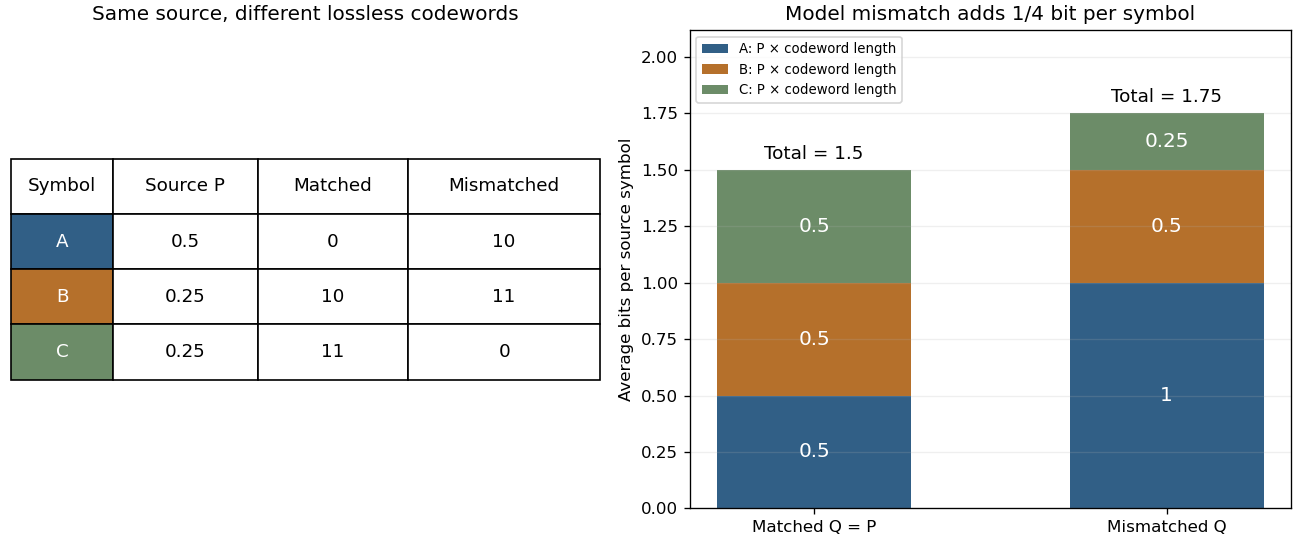
Take a three-symbol source with . A matched binary prefix code assigns , , , with lengths . A mismatched prefix code instead assigns , , , with lengths , corresponding to . Both prefix codes decode exactly, but the most common symbol is shorter in the matched code. Under the same source ,The mismatched code costs an extra (1/4) bit per source symbol on average. No information is lost; the penalty is inefficient representation of this source. The mismatch penalty in lossless coding explains when this coding interpretation is exact.

Cross-entropy is also useful when evaluating a predictive distribution. A report that places tiny probability on the realized outcome receives a large logarithmic loss, even when it usually predicts the most common outcome correctly. The loss convention is the negative of the reward convention in the logarithmic scoring rule. Its expected loss is uniquely minimized by the correct probability distribution, making it a strictly proper scoring rule. Strictly Proper Scoring Rules, Prediction, and Estimation by Tilmann Gneiting and others treats this connection in §3.1, Example 3; its discussion uses rewards, so the signs are reversed for the losses here.[ref]
I. J. Good's Rational Decisions by I. J. Good appeared in 1952. Its published summary describes a method for encouraging accurate probability estimates and a connection with information theory. Strictly Proper Scoring Rules, Prediction, and Estimation by Tilmann Gneiting and others traces the logarithmic scoring rule at least as far back as this 1952 paper.[ref]
There are unlisted articles, also show them or only show them.