
Kolmogorov refined similarity hypothesis 2026-10-14
Refined similarity writes with universal normalized conditional statistics at high local Reynolds number. Then . The distribution of coarse-grained energy dissipation need not be universal. Refined similarity itself does not prescribe that distribution.
In the unprojected polynomial Neveu–Schwarz vertex sector, zero fermion insertions give the usual closed-string tachyon and the massless graviton, two-form and dilaton. Two insertions split into a left-right pair of internal weights and a same-chirality current pair of weight one. The first has and 44-squared scalar components. The second requires a bosonic derivative on the opposite side for level matching and gives the two sets of 946 massless gauge vectors. Four-fermion scalar-current products belong to a different insertion count. A chosen global projection may retain a subset, so these operators do not by themselves specify a projected string spectrum.
Joule's paddle-wheel experiment 2026-10-14
Joule's paper On the Mechanical Equivalent of Heat (1850) describes a copper vessel holding water and a brass paddle with stationary vanes. Descending lead weights drove its shaft through strings and pulleys; the vanes opposed simple co-rotation. A boxwood shaft segment reduced thermal conduction. He measured fall distances and initial/final temperatures, repeating twenty descents per run and disconnecting the drive for rewinding. Calibrated thermometers read the water and room.[ref]
On the Mechanical Equivalent of Heat by James Prescott Joule. pp. 64–66 and Plate VII: thermometer calibration, water apparatus and operating sequence
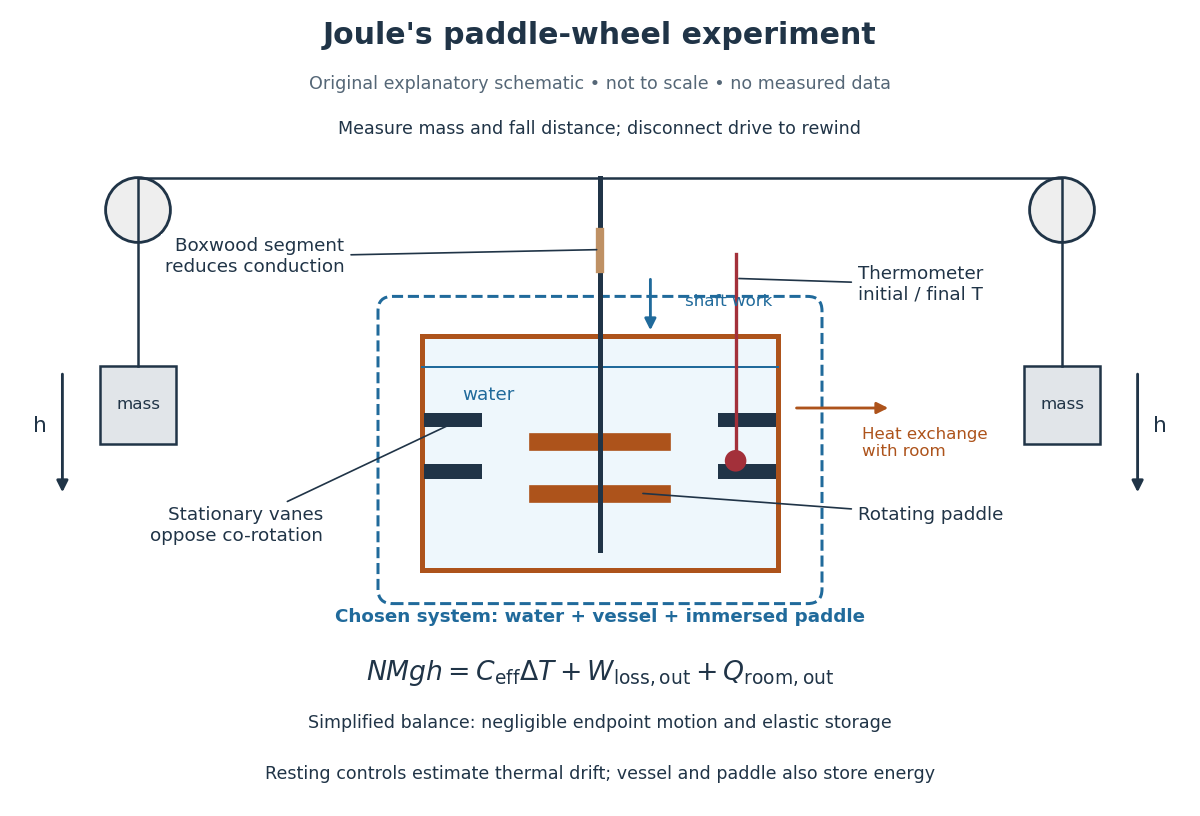
Joule's paddle-wheel experiment: mechanical input and thermal readout
. Original explanatory schematic, not a scale reconstruction or a plot of measurements. The outlined system includes water, vessel and immersed paddle, but excludes the weights and external drive. The symbolic balance separates mechanical losses outside this boundary from heat exchange with the room. Rewinding occurs with the drive disconnected. Details.
His matched resting trials retained the water amount, duration, surroundings and reading procedure, omitting paddle motion to estimate environmental heat exchange. A screen reduced thermal radiation from his body. His calculation included the vessel and paddle heat capacities, external pulley/string losses, descent kinetic energy and string elasticity; it acknowledged residual vibration and sound.[ref]
On the Mechanical Equivalent of Heat by James Prescott Joule. pp. 66, 69–70 and 82: matched controls, apparatus water-equivalent capacity, mechanical corrections and residual losses
The measured observable is a corrected temperature rise, interpreted through the participating heat capacity; it is not a direct view of molecular motion. The experiment tests whether measured mechanical input accounts quantitatively for thermal storage. Frictional warming by itself would establish neither the conversion factor nor the absence of heat exchange. A modern authored demonstration at UCSB instead measures crank turns and a cylinder's temperature with an electrical thermometer: the apparatus differs, but again both mechanical input and thermal response must be measured. [ref]
Internal energy at constant temperature 2026-10-14
Constant temperature does not generally mean constant internal energy. At fixed amount and composition, within one smooth thermodynamic phase of a simple compressible system, an equilibrium identity isThe bracket vanishes for the ideal gas law . It need not vanish for a real gas: changing the volume changes the average interaction potential energy, even when the random-motion contribution stays at the same temperature. The identity follows by writing and using a Maxwell relation; it does not require the actual process to be reversible. [ref]
For a Van der Waals equation model with volume per mole , gives . Thus an isothermal expansion from to , at fixed amount of substance , increases internal energy bySeparating attractive particles makes their interaction potential energy less negative. For stipulated , , , , and , the calculated increase for this one-mole sample is , despite . This dilute stable-branch model example is not a measurement of a named gas. [ref]
A phase transition gives another reason. During equilibrium vaporization of a pure substance at fixed pressure, the temperature can stay at its phase coexistence value while the phase fraction changes. Molecular separation changes interaction potential energy.[ref]
1.5 Phase Changes. §1.5, figure 1.18 and equations 1.7–1.8: molecular attractions and constant-temperature phase conversion
If the closed system does only pressure-volume work, its latent heat input obeysHere is enthalpy. A vaporization latent heat therefore is not automatically the internal energy increment: some input supplies expansion work. A fixed temperature reading alone cannot tell how much internal energy changed. Internal energy and system boundaries Created 2026-10-14 Updated 2026-10-20
For an ordinary stationary laboratory sample, a useful convention isThe bulk kinetic energy includes organized whole-body motion; for pure translation it is , with total mass and center of mass speed . The external potential energy includes elevation in an imposed gravitational field, approximately in a uniform field. Accelerating a sealed bottle or lifting it without otherwise changing its state changes these mechanical terms, rather than its internal energy. Molecular kinetic energy is measured relative to the chosen bulk motion.[ref]
3.2 Work, Heat, and Internal Energy. §3.2, “Internal Energy”: molecular speeds relative to the center of mass; moving-train and roof examples
State the convention rather than applying this separation blindly. If an experiment separately tracks a rotating apparatus or an organized flow, its mechanical kinetic energy must not also be counted in . In Joule's paddle-wheel experiment, waiting for the apparatus and fluid to come to rest removes such an endpoint ambiguity. Including the vessel and paddle changes whose internal energy is measured; including the falling weights additionally puts their changing gravitational potential energy inside the enlarged system's total energy balance.
Interferometric visibility 2026-10-14
Interferometric visibility measures the contrast of a scanned interference fringe. For the mutually coherent, equally polarized two-beam model in wave interference, with fixed individual wave intensities and , the constructive interference intensity and destructive interference intensity giveEqual nonzero wave intensities give ; give . Unequal wave intensities can therefore reduce interferometric visibility even with perfect mutual optical coherence. Random phase differences or distinguishable wave polarizations can reduce it further; zero contrast alone does not identify the cause. Both intensities zero leave the ratio undefined.
For normalized paths with complex amplitudes and identical internal states, the output probability is , so . A photon polarization fringe alone determines transverse quantum coherence but not the sign of the population difference.
// Target: optics.bigb
Which-path information 2026-10-14
If the two arms have internal marker states , an interference cross term is multiplied by . Orthogonal markers remove interference from polarization-insensitive detection even if nobody reads the markers. Coherently making the two markers identical erases that distinguishing information and restores the cross term.
// Target: quantum-measurement.bigb
Interference fringe 2026-10-14
An interference fringe is a spatial band of enhanced or reduced wave intensity caused by a spatially varying phase difference. Uniform crossing plane waves produce straight parallel interference fringes; curved wavefronts can give curved bands. The interference fringes mark the relative wave phase, rather than the individual instantaneous wavefronts.
Destructive interference intensity 2026-10-14
For the same mutually coherent, equally polarized monochromatic waves, the wave interference minimum occurs at phase difference , with integer . The wave amplitudes subtract, giving . Complete cancellation requires equal individual wave intensities; and leave in their common unit. A dark band is a local minimum, and the average across an interference fringe spacing still obeys conservation of energy.
Constructive interference intensity Created 2026-10-14 Updated 2026-10-18
For mutually coherent monochromatic waves with the same polarization of waves in the scalar convention of wave interference, constructive interference reaches its maximum at phase difference , with integer . The wave amplitudes add, giving . Equal individual wave intensities give ; individual wave intensities and give in their common unit. This maximum assumes the optical coherence and detection conditions stated in wave interference.
Isolating integral 2026-10-14
An isolating integral is a regular single-valued integral of motion whose fixed value restricts accessible phase space to a lower-dimensional level set. Functional independence of several such integrals means their differentials are linearly independent on the region considered. A central potential has specific orbital energy and the three components of specific angular momentum as four generically independent integrals. A Kepler orbit has a fifth independent integral supplied by its fixed apsidal direction, encoded by the Laplace-Runge-Lenz vector; its vector components obey two constraints with energy and angular momentum. Circular and radial orbits are degenerate cases of this count.
For with constant pattern angular velocity , ordinary specific energy satisfies and specific axial angular momentum satisfies . Their combination is conserved. This is the rotating-frame integral of motion; in the circular restricted three-body problem, the usual Jacobi constant is an affine rescaling of it. Thus time dependence in an inertial frame does not alone imply the absence of all integrals.
Holding force on a contracting nozzle Created 2026-10-14 Updated 2026-11-05
For steady ideal flow through a horizontal contracting nozzle, Bernoulli equation gives inlet gauge pressure . The integral momentum equation gives the fluid's force on the nozzle as in the outlet direction. Simplification yields the displayed nonnegative magnitude. The external holding force has equal magnitude and the opposite direction.
Field of fractions Created 2026-10-14 Updated 2026-11-05
The fraction field of an integral domain consists of fractions with and , modulo the usual equivalence relation.
In an integral domain, with gives by the distributive property. Since there are no zero divisors, . Conversely, in a nonzero commutative ring, this cancellation property rules out zero divisors by comparing with .
Integral basis of the fourth-root-of-two field Created 2026-10-14 Updated 2026-11-05
Write and an algebraic integer as with rational coefficients. Traces to show are integers. The norm has coefficients and in the integral basis . Set , , , . Integrality gives and . The second forces even and then even; the first forces even; returning to the second forces divisible by four. Thus all original coefficients are integers, proving the integral basis .
Integral basis of a two-prime biquadratic field Created 2026-10-14 Updated 2026-11-05
For an odd prime , traces to the three quadratic subfields show that an integer has coefficients with rational integers . Its norm to forces even and . Hence an integral basis is . The last generator satisfies the monic polynomial , proving integrality as well as spanning. The subfield used for the norm matters: the norm to has different coefficients.
Integral basis of a cubefree pure cubic field Created 2026-10-14 Updated 2026-10-25
Let be coprime positive square-free integers, with . The displayed integral basis has discriminant . Both nonconstant generators are integral, and their products are integral linear combinations of the three basis elements. At a prime dividing , the cubic for is Eisenstein; at a prime dividing , the cubic for is Eisenstein. If , then , and a shift by or gives an Eisenstein polynomial at three. These local uniformizer generators show that the order is maximal at all primes dividing its discriminant; elsewhere the discriminant-index formula for an integral lattice already gives maximality.
Proportional-integral control 2026-10-14
Proportional-integral control is the proportional and integral part of a PID controller, with the derivative term omitted. Proportional-integral control combines proportional control with integral action. For the ideal controlled plant, a constant reference signal, exact measurement and a constant control disturbance, the ordinary differential equations giveThe characteristic polynomial is . Positive and imply asymptotic stability of the equilibrium point: real roots of a polynomial have negative sum and positive product, hence are both negative; a nonreal complex conjugate pair has real part . This is a short stability check for this ideal controlled plant, rather than a rule for every dynamical system.
At the equilibrium point, , , and . For and , the stored value supplies even though the tracking error is zero. This separates the eventual accuracy from the transient response: integral action cancels the lasting offset but can make the plant output pass beyond the goal. The authors discuss practical limits on integral action in Åström and Murray, Feedback Systems, Chapter 11.
For , , and , the characteristic polynomial is . The initial conditions are and , givingThe tracking error changes sign at . Since , the largest plant output occurs at and is , about above the reference signal.
For a separate comparison, start the control disturbance at . For , write . The exact responses areThe proportional control response tends to , while the proportional-integral control response returns to . At , the values are approximately and . The added term in the proportional-integral control response eventually vanishes, exposing how memory removes a constant control disturbance's lasting effect.
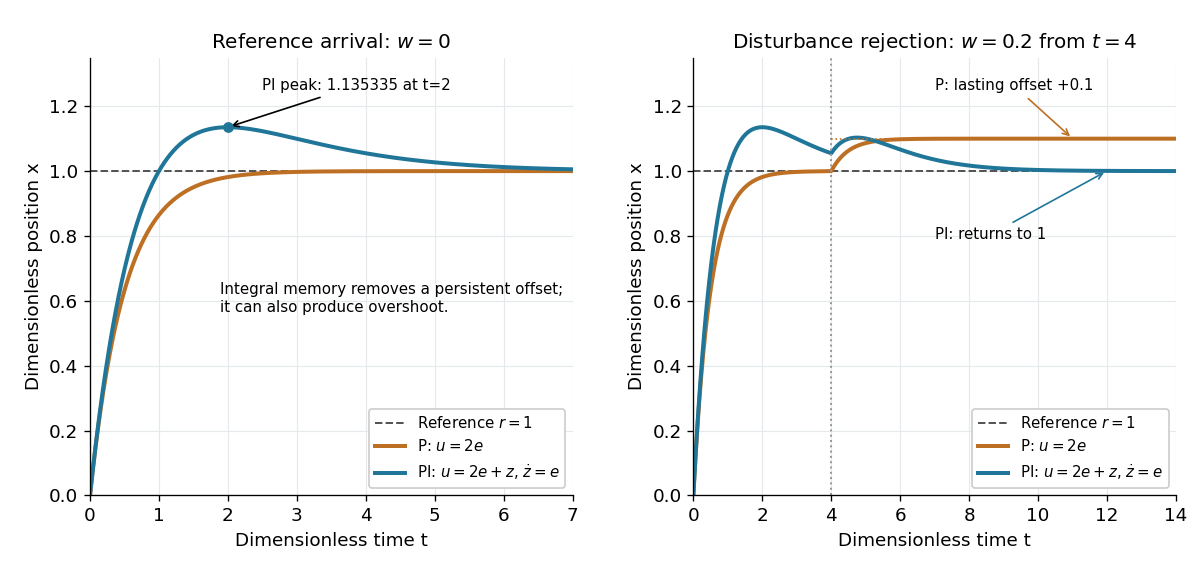
Proportional control and integral action: arrival and disturbance rejection
. Left: the ideal controlled plant has reference signal and no control disturbance; proportional-integral control reaches a peak at . Right: a control disturbance begins at ; proportional control settles at , while proportional-integral control returns to . The generator uses the classical fourth-order Runge-Kutta method with step , splits the computation at , and checks both full responses and the stored memory against their exact formulas. All coordinates are dimensionless quantities. Details.
Liouville–Arnold theorem 2026-10-14
A compact connected regular common level of commuting integrals is an -torus with local action-angle coordinates.
There are unlisted articles, also show them or only show them.