
Heat capacity ratio 2026-10-14
The heat capacity ratio compares heat capacity at constant pressure with heat capacity at constant volume at the same equilibrium state and fixed composition:Here refer to the whole sample, in ; molar heat capacities and are per mole; specific heat capacities and are per unit mass. The amount of substance or mass cancels only when both capacities use the same normalization. Thus heat capacity ratio is dimensionless and independent of sample size. For a fixed-composition ideal gas with positive finite , Mayer's relation giveswhere is the molar gas constant. More ways to store internal energy make a given temperature increase require more heat, bringing heat capacity ratio closer to unity. [ref]
https://web.mit.edu/16.unified/www/FALL/thermodynamics/notes/node18.html. MIT Unified Engineering, Specific heats: definitions and ideal-gas relations
The equipartition theorem predicts when independent quadratic terms in molecular energy are thermally active and their number stays fixed; consequently . A classical monatomic gas with no appreciable electronic excitation has , giving and . For an ideal gas of diatomic molecules with three translational and two rotational terms active, but its vibrational normal mode effectively frozen, gives and . A fully classical harmonic vibration adds both kinetic energy and potential energy, giving and . These are model regimes, not universal constants of every gas: rotational freezing, electronic excitation, and changing composition invalidate the simple count.[ref]
The mechanical significance of heat capacity ratio follows from the first law of thermodynamics. For a fixed amount of ideal gas in a reversible adiabatic process, . Combining this with the ideal gas law gives the local relationThe partial derivative holds at fixed entropy and composition even when heat capacity ratio varies with temperature. The finite-path formulas and require the additional approximation of constant heat capacity ratio. A rapid compression also needs internal equilibration to approximate this path; rapid motion alone does not ensure reversibility. The same local response gives isentropic compressibility and, for small sound disturbances in this ideal gas regime, speed of sound , where is mass density. Thus thermal storage controls mechanical stiffness, sound propagation and the measurements in Rüchardt experiment and Clément-Desormes experiment.
Monatomic gas 2026-10-14
A monatomic gas consists of individual atoms or ions rather than molecules. In the classical dilute ideal-gas regime, its three translational degrees of freedom give by equipartition theorem. Thus , while follows by differentiating the ideal-gas enthalpy . Consequently the adiabatic index is and the specific internal energy is . The same translational result applies to a fully ionized mixture when the particle numbers are fixed. This excludes additional excitation, ionization and radiation contributions to the heat capacity.
Ideal gas law Created 2026-10-14 Updated 2026-10-14
The ideal gas law is the equation of state relating the absolute pressure , volume , particle count , and absolute thermodynamic temperature of a classical ideal gas:Here is the Boltzmann constant, is the Avogadro constant, is the molar gas constant, and is the amount of substance in moles. The distinct symbol avoids confusing amount of substance with the number density , measured in : the same law can be written . Use absolute pressure, relative to a vacuum, rather than an unconverted gauge pressure. [ref]
2.1 Molecular Model of an Ideal Gas. OpenStax University Physics Volume 2, section 2.1: particle-count and molar forms
The exact SI definitions of the Avogadro constant and Boltzmann constant giveThis numerical value is exact; the applicability of the ideal gas model to a real gas is an approximation. [ref] [ref]
https://www.bipm.org/en/si-base-units/kelvin. BIPM, exact Boltzmann constant in the kelvin definition
For , , and , direct substitution givesAt fixed temperature and particle count, doubling the volume to halves the pressure to approximately : this is Boyle's law. At fixed volume and particle count, doubling the temperature from to doubles the pressure to approximately . These ratios use kelvins, not readings in the degree Celsius scale: is , and is .
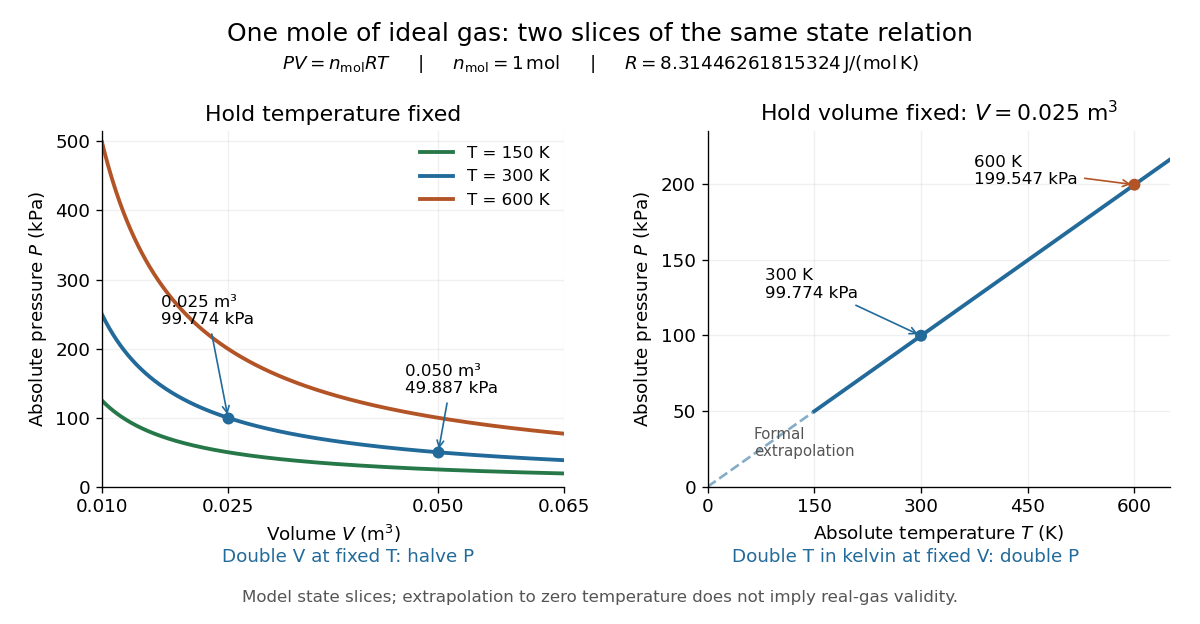
Ideal gas law: pressure versus volume at fixed temperatures, and pressure versus absolute temperature at fixed volume
. Details. 
The curved slices show Boyle's law at three temperatures; the straight slice shows proportionality to absolute temperature at one fixed volume. They are relations among equilibrium states, rather than a prescribed process history. Compression could hold the temperature fixed through heat transfer, or raise it during adiabatic compression. To calculate a process's heat or work, supplement the ideal gas law with the process constraint, the first law of thermodynamics, and the relevant internal energy or heat capacity information. The graph's extrapolation toward is mathematical; it does not assert that a real gas remains classical or gaseous there.
For a stellar mixture with fixed mean molecular weight, the ideal gas law can be written , where is mass density and is the stellar gas constant. It assumes negligible interaction corrections and a nondegenerate gas; excitation or ionization can change the particle count and thermodynamic response.
In his 1834 memoir on the motive power of heat, Émile Clapeyron combined gas laws into a relation between pressure, volume, and temperature while analysing heat engines (printed page 164). The equation above uses modern SI notation and absolute thermodynamic temperature; it is not a transcription of his historical temperature convention. [ref]
https://www3.nd.edu/~powers/ame.20231/clapeyron1834.pdf. Clapeyron, Mémoire sur la puissance motrice de la chaleur (1834), page 164
Molar gas constant 2026-10-14
The molar gas constant is the product of the Avogadro constant and the Boltzmann constant. It converts the particle-number form of the ideal gas law, , into the amount-of-substance form , using with measured in moles.
Partial pressure Created 2026-10-14 Updated 2026-10-20
The partial pressure of a component of a gas mixture is the pressure it would exert alone at the same temperature and total volume. For an ideal mixture, and . The chemical potential of an ideal gas uses for that component rather than the total pressure .
Minkowski's bound Created 2026-10-14 Updated 2026-11-05
If a number field of degree and signature has discriminant , every ideal class contains an integral ideal with
Ideal class group of the imaginary quadratic field of discriminant minus eighty-four Created 2026-10-14 Updated 2026-11-05
For , the integer ring is . The Minkowski bound for ideal classes is less than six. The ramified primes and give independent classes of order two; their product is the class of because factors as the product of these three prime ideals. Element norms cannot equal 2, 3 or 6, so these classes are distinct. Ideals of norm at most five supply no further classes, proving the four-element group.
Ideal class group of Q of square root 229 Created 2026-10-14 Updated 2026-10-25
Put , and . The Minkowski bound for ideal classes is , so the ideal class group is generated by primes above three and five; two and seven are inert. The prime ideal factorizations and reduce it to a cyclic group of order dividing three. It is not trivial: the unit has field norm minus one. If an algebraic integer had norm of absolute value three, multiplying by a power of this unit would make both real absolute values at most . For , this bounds , forcing , which cannot have norm of absolute value three.
Langevin function 2026-10-14
The Langevin function is the mean projection of a freely orientable three-dimensional unit vector weighted by . Integrating over solid angle gives , and differentiation gives . It behaves as at small argument and at large positive argument.
Force-extension of a three-dimensional freely jointed chain Created 2026-10-14 Updated 2026-11-05
Independent link orientations make the canonical partition function , with the one-link integral defining the Langevin function. Differentiating its logarithm with respect to force gives . At high extension, , so the force diverges inversely with remaining length deficit. This requires rigid links and excludes axial bond stretching.
Planar freely jointed chain 2026-10-14
If each link is restricted to a plane, , with . Differentiating gives , where are Modified Bessel functions of the first kind. The high-force angular Gaussian has , so , half the three-dimensional coefficient.
Gaussian limit of the end-to-end distribution of a freely jointed chain Created 2026-10-14 Updated 2026-11-05
For an isotropic fixed-length step , angular integration gives the characteristic function . Independence makes the characteristic function of the sum of steps its th power. Since , the central scaling gives . The inverse Fourier transform isThis is a density with respect to three-dimensional vector volume, not a radial density; the radial density is . It has . The approximation holds on the central coil scale , not near the fully stretched finite-length boundary .
Three-dimensional entropic chain stiffness Created 2026-10-14 Updated 2026-11-05
A three-dimensional ideal chain of independent segments of length has . The isotropic small-force susceptibility gives , so . For a long worm-like chain, the statistical segment is . This stiffness describes entropic end-to-end extension, not axial stretching of the material backbone, whose spring constant is .
An iceberg moving toward the equator carries a thermal deficit into warmer water. Melting extracts heat there, equivalent to transport of heat toward the pole. For an annual number of similar bergs, multiply their individual iceberg melt heat budget by the rate per second. Freshwater effects on density stratification and ocean circulation are separate from this heat accounting.
Iceberg towing drag Created 2026-10-14 Updated 2026-11-05
Iceberg towing drag is the water resistance that a towing force must overcome to move an iceberg relative to the surrounding water. A quadratic model is , where is the relative speed and must be defined using the same reference area as in its calibration.
For a form-drag coefficient, that area is commonly the submerged frontal area. A coefficient describing an equivalent basal resistance may instead use an immersed horizontal area. Interchanging the two conventions changes the force estimate. The dependence makes a modest increase in towing speed expensive, and currents can change resistance without changing the iceberg's speed over the ground.
Damped free drift of an iceberg 2026-10-14
Wet-ice bias in fusion calorimetry 2026-10-14
Surface water counted as ice needs warming but has already undergone melting. Its presence therefore biases a dry-ice estimate of latent heat of fusion downward. This is why drying the added ice is a quantitative control in ice-melting calorimetry, rather than cosmetic preparation. Let be the total added mass at , of which a fraction is already liquid and remains solid. The correct constant-property balance isIf an analysis incorrectly treats all as solid and sets , it obtainsThus gives a low estimate with no heat leak. Unaccounted incoming heat also lowers the estimate; outgoing heat raises it. These signs follow directly from the displayed energy balance. Conversely, dry ice initially below absorbs additional sensible heat; neglecting that term overestimates . These are different biases and may partially cancel, so agreement with a reference value alone does not validate the controls.
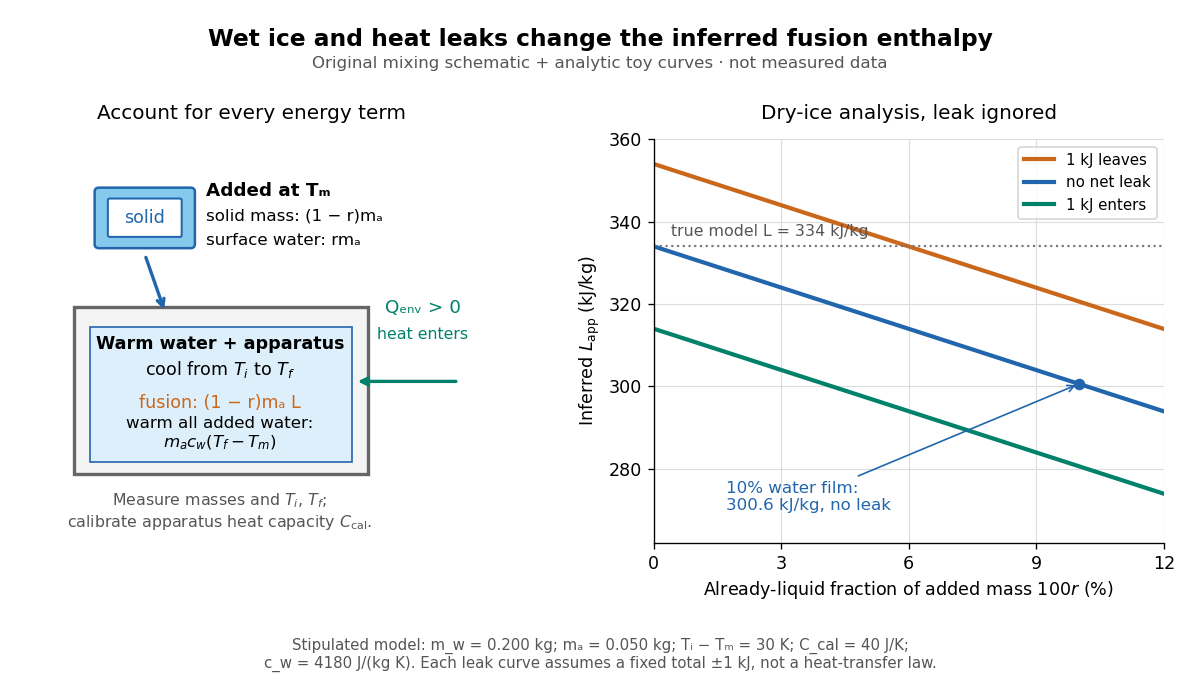

For this model with and , the balance predicts , with consumed by fusion and by warming the melted water. At with the same zero leak, it predicts and . A net incoming shifts downward by a further because . The warmer final water in the wet case is evidence of a smaller fusion budget, not a larger true .
Diffusive glacier-ablation interface law 2026-10-14
In a constant-thickness laminar boundary layer at an ablating glacier, approximate fluxes by and . Neglect solid diffusion and sensible heating relative to latent heat. With ablation speed , solute balance gives , so , . The liquidus and Stefan condition then give the displayed law, where . Its positive root exists when the ocean is above its own freezing point. In the small- regime, interface salinity approaches ocean salinity; in the large- regime it approaches the ice composition.
Ice dissolution in saline water 2026-10-14
Salt lowers the freezing temperature of water. Consequently ice can ablate in saline water below the pure-water melting temperature if the ocean is warmer than its own liquidus. Solute diffusion towards the interface sustains the freezing-point depression. In the diffusive glacier-ablation interface law, small compositional Péclet number makes interfacial salinity close to ocean salinity and gives near the no-ablation threshold. This is diffusion-assisted dissolution rather than a supply of heat above the pure-water melting point; latent heat must still be supplied to complete the phase change.
Hyperedge 2026-10-14
A hyperedge is a member of the edge family of a hypergraph. In an -uniform hypergraph it is an -element subset of the vertex set. For it is an ordinary edge of a graph. A simple hypergraph has no repeated hyperedges; a multihypergraph records multiplicities.
There are unlisted articles, also show them or only show them.